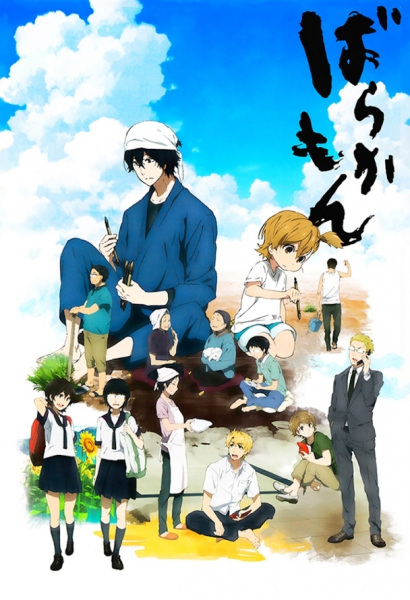

ばらかもん
Seishuu Handa is an up-and-coming calligrapher: young, handsome, talented, and unfortunately, a narcissist to boot. When a veteran labels his award-winning piece as "unoriginal," Seishuu quickly loses his cool with severe repercussions. As punishment, and also in order to aid him in self-reflection, Seishuu's father exiles him to the Goto Islands, far from the comfortable Tokyo lifestyle the temperamental artist is used to. Now thrown into a rural setting, Seishuu must attempt to find new inspiration and develop his own unique art style—that is, if boisterous children (headed by the frisky Naru Kotoishi), fujoshi middle schoolers, and energetic old men stop barging into his house! The newest addition to the intimate and quirky Goto community only wants to get some work done, but the islands are far from the peaceful countryside he signed up for. Thanks to his wacky neighbors who are entirely incapable of minding their own business, the arrogant calligrapher learns so much more than he ever hoped to. [Written by MAL Rewrite]
Main
Main
Supporting
Supporting
Supporting
Supporting
Supporting
Supporting
Supporting
Supporting
Veronin
December 31, 2014
Barakamon shows that you don't need aliens, magical powers and love triangles in order to create an exciting anime. Barakamon is not a tale of good triumphing over evil or a couple finding true love within one another, but rather an example of why our uneventful daily lives is story enough, even if said life involves being assaulted by small children. There isn't a great deal that occurs in Barakamon's regrettably short 12-episode run. There is no overarching, deep story to keep you on the edge of your seat, and by the end of the final episode, not a whole lot has changed from thebeginning. If you were to explain the story of Barakamon to one of your friends, they would likely respond by saying "That's it? Sounds boring." And they would be horribly wrong, as Barakamon is easily one of the best anime of the entire year. The characters in Barakamon are the story. It is about Handa Seishuu, a 23-year-old calligrapher prone to anger and misfortune, and his friendship with the villagers who continually screw him over through a myriad of hilarious accidents. He does not undergo a great transformation by the end of the anime, but simply experiences the joy of human companionship, and no-- this theme is not told through preaching morals. Barakamon is very subtle with its themes, choosing instead to develop characters gradually and believably rather than through melodrama. As immature as Handa and the characters often are, Barakamon is actually a surprisingly mature anime. When Handa finds himself staring in awe at the starry night, the writers do not feel the need to explain what Handa is feeling at that moment. At that point in the story, Handa has been characterised so believably that empathising with his thoughts and feelings becomes natural. He's not a walking gag, an archetype made to appeal to the audience's most basic instincts. He is his own person, highly flawed and vulnerable to mistakes. Whereas most anime protagonists are so dull, so devoid of personality or history that you could throw them into just about any other show, Handa feels at home in his own series. And the same can be said for all the other characters. The kids, especially Naru in particular, are unique in the way that they actually behave like kids. Naru is mouthy, aggressive and intellectually inferior to the adults. She collects bugs, finds poop funny, eats live snails (ugh!) and annoys Handa in just about every way possible. Naru is not cute in the same way that loli characters are. She is an actual child, not a pretend-child created to please the nether regions of lolicons. Just like real, living kids, Naru and her companions are often frustrating and bring ruin to just about everything they encounter, but that energy is precisely what makes them so endearing. The humour of Barakamon is also surprisingly thoughtful, and it hits the mark more than perhaps could ever be expected from an anime. There were no moments where the joke fell completely flat (as was sometimes the case with similar anime like Silver Spoon and Gekkan Shoujo). There are few, if any puns and stereotypical Japanese humour, even if it does still follow the typical manzai format of stupid-thing-happens-and-people-react-to-stupid-thing. The stupid things in Barakamon work because they are actually rooted in reality. It doesn't create its comedy through the characters reacting in some ridiculous, unbelievable way, but through the kinds of accidents that typically follow from playing with children. And from Handa suffering. Unlike most slice-of-life comedies, Barakamon knows how to strike a perfect balance between its humour and the more heart-warming moments. These moments are well-placed and purposely kept rare so that they may carry meaning. What most anime are incapable of grasping is that in the real world, we find beauty in between mountains of hardship; it is not something that can be created artificially and sold and traded at the dollar store. Barakamon understands this, which is precisely why its events feel so natural, even if they do not carry any huge wave of emotion along with them. Barakamon also deserves some praise for its willingness to tell a story with characters of all ages. There are the kids, a few teenagers in the local high school, the adult protagonist and his friends from the city, and the middle-aged and elderly villagers. It does not focus solely on 15-year-olds, and for that Barakamon is all the more special. The calligraphy aspect of the show does have its share of issues, though. Because the focus is almost entirely on the comedy and the slice-of-life, there isn't much detail given to the calligraphy world that Handa is a part of. What makes a good piece of writing? What makes a bad one? Why is Handa's new style so much more meaningful, and what is it even like to be a calligrapher? None of these questions are fully answered. If you don't have any knowledge of calligraphy (and I expect you won't-- I certainly did not), then it's likely these scenes will not do much for you. I found myself much more invested in all the immature shenanigans that occurred between Handa and the villagers. At the very least, I suppose it did show that there's a bit more to calligraphy than simply slapping cool-looking kanji on a piece of paper. Barakamon looks and sounds great. While there's no gorgeous setpieces and scenery to bring heaven to your eyeballs, the artwork is still very attractive and consistent. The opening track is also pure bliss. I would recommend giving it a listen any time you're feeling awful; it's like magic. Will Barakamon shock and bring you to tears? Probably not. But it will almost assuredly change the opinions of anyone who previously found the slice-of-life genre boring, and what it lacks in emotional value it makes up for by being executed nearly to perfection. It is one of the most enjoyable, pleasant experiences I've had with an anime in a very long time, and anyone who simply wants to have a good time and relax would be doing themselves a huge favour by giving Barakamon a try. Its greatest sin is that there just isn't any more of it to watch. As for the best anime of 2014, Barakamon is the winner in my eyes.
just_a_thought
October 16, 2014
Watching Barakamon was like going to a birthday party or a picnic outdoors, chock full of excited children running all over the place, doing what they do best. As an adult (supposedly), you feel slightly out of place but the child in you just wants to jump up and down with them in frantic jubilation without a care in the world. There is a cake too: a black forest with strawberry toppings and as you immerse yourself in the jovial mood, you admit that the feeling of sharing a slice with everyone is sweeter than the cake itself. And what a slice it was! For a slice-of-lifeto succeed, it needs to have a decent premise which sets it up and allows it to deliver a constant flow of quality… well slice-of-lives. For Barakamon, getting the socially inept and awkward “city-boy” Handa to live in a rural island where the residents are both normal and weird at the same time was the perfect set-up. You can already see it in the first episode. In fact, for me the show stepped up a level in the scene where Handa throws out Naru and she is rolling out going “gyaaaah!” in her lovable and unique accent. And then, we follow the life of Seishuu Handa on a place very new and unfamiliar to him: doing some things for the first time, making new friends, enjoying the beauty of nature, picking fights with grade-school kids, catching beetles and going through a plethora of experiences on the island. All the while, he is searching for his own style of calligraphy. I admit that this was the only part of the show that was sort of a miss rather than a hit, for me at least. This stemmed from the fact that I found it impossible to discern the difference of the quality of the works and how Handa’s Calligraphy evolved as the show went on. However, having said that, it is clear that the island life has a profound impact on it: after all, no one can deny the fact that he is inspired by it. One of the impressive aspect of the show is the way in which it integrates doses of comedy here and there. In fact, I would say that it is slightly more hilarious than the norm of the genre. The pacing of the show is wonderful. It is laid-back in general but takes longer strides if need be without rushing itself. The only rushing in the show is the little Naru rushing to Handa’s house both of whom are totally lovable characters. Handa is surprisingly childish and immature even though he doesn’t realize it which makes it easier for him to connect with the kids and the reactions brought on by his impulsive nature are priceless and hilarious. He is the only one who is significantly developed as the series progresses but that is understandable and okay. Little Naru is one of the main allure of the show. She is full of energy and life probably more than a normal 7-year old. You could call her a bit pesky but you would be doing so with a loving smile because her peskiness really helps break down the wall around Handa. Her attachment to Handa is cute indeed and helps their friendship blossom leading to more fun and eventful days for both of them. The only qualm here is that she is not as much developed as a character, even as the show goes on. She, more or less remains the same which is not bad as she is great just the way she is but still one senses a lost potential there. Without going into detail about the other characters, it is suffice to say that they are all sufficiently unique and lovable. From a fujoshi in denial to a lively tomboy to a group of cheerful kids, this show has a slightly large cast. Most importantly though, they are all easily likable even if they do suffer from a lack of development which again is understandable as most of the development is focused on Handa. The best part is their interactions which are top-notch and really help carry the show forward. For instance, seeing a grown man being enlightened by 7 year olds complete with his mortified reactions is quite charming and enjoyable. Charming is the right word for the art as well. A good amount of light and vibrant colors have been used. The backgrounds are decently picturesque and the character designs have also been neatly done and are easily distinguishable. I liked how they made the faces of the children slightly chubbier to sort of contrast them to the more ‘pointed’ ones of the adults. The different facial expressions of the characters especially of the two mains are also impressive and enjoyable. And the animation is also up to par. For the sound, the first tick goes to Naru’s seiyuu who is a kid as well. Actually, kudos to the production team for getting child actors for the roles of those cute kids. Plus, they incorporated a unique dialect for the inhabitants of the island which just adds to the atmosphere and overall feel of the show. The BGM were also decent and as for the opening and ending: although they are not really great, they are slightly better than average. The ending especially managed to stay on my playlist for quite some time and was perfect for the show. Final Thoughts: This show cannot be recommended enough for those seeking a simple slice-of-life full of smiles and laughs and heartwarming moments. After a long hard day, just get yourself a slice of this cake and enjoy the utter bliss that it is.
Stark700
September 28, 2014
Barakamon is a work of art. However, it’s more than just calligraphy as words alone cannot describe the exact nature and discovery of Barakamon. For instance, the show takes place on an island involving a young man named Seishuu Handa. Coming from a more urban based background, his life changes forever as he finds his new life on the natural island of Goto. Of course, this doesn’t happen after he delivers a sucker punch to an elder curator. When someone throws a fit like that, it’s easy to guess that consequences are destined to follow. But can we really call a journey to Goto Islandas a consequence? Perhaps it’s the beginning of a new life for Seishuu Handa. Barakmon explores that new life in this wonderful and charming series that is guaranteed to bring satisfaction through discovery. Adapted from the manga written by Satsuki Yoshino, the series has a simple premise. It adapts a slice of life tone hence depicting it like a narrative style with Seishuu as the main protagonist. It’s simple to realize the show has its charm in the beginning with laughter. Seishuu’s exile to Goto Island makes him the new guy in a brand new world. While the setting still takes play in the modern world, the inhabitants and surroundings contrast of what he is used to. For instance, there are no expensive cars or fancy skyscrapers where businessmen work during their workaholic hours. Rather, everything feels natural with a derivative from civilization. In essence, the show is about learning and discovery for Seishuu because he must adapt in this new environment. Now, that’s not a pushover.’ From the very beginning, the show has the ability to maintain a balanced atmosphere. We see Seishuu and his frustration yet also curiosity on the island. He discovers how simple life yet can be difficult at the same time. It’s a stark contrast to how his former life used to be. And as a master calligrapher, he is all about creation. With that in mind, Barakamon has this mercurial elegance with the style of its characters. Many of its characters live a simple life whether it’s the villagers, neighbors, or kids. They don’t rely solely on advanced technology as evidenced by the old fashioned phones and their way of fishing food. Yet, they also choose to use tools beyond the Amish norm to adapt and survive. For Seishuu, he is like babyface ready to learn everything that needs to be learned. When it comes to characters, there is a noticeable age gap between certain groups. We have kids such as Naru, Miwa, and Tamako. Then, there are others within Seishuu’s age group such as Kazuyuki. It’s certainly an interesting factor to see how Seishuu develop relationships between these characters. Perhaps the most prominent relationship explored throughout the show is Naru and Seishuu. Having over a 15 year age gap doesn’t seem to make the duo compatible to watch at first. However, there’s a certain charm to this relationship as Naru often inspires Seishuu to climb out of his stoic self. Although he is made fun of at first by the kids with nicknames such as “Junon Boy”, there is also a strong attachment between them. In due time, Naru refers him as sensei, as a sign of respect for his brilliant skills in calligraphy. Similarly, Seishuu begins to see the kids in a different light. Despite finding him to be a nuisance, he also learns more from them to adapt with culture. The “new guy in school” tone has a presence when kids greet him with curiosity. It’s like an escapist adventure for Seishuu rather than a punishment for being exiled. To label it as a consequence could actually be the wrong term since the show offers tons of discovery for Seishuu thanks to his new life. One of the strongest aspect of Barakamon is its ability to tell a story without complicated angles such as cliché rom-coms or battle shounens. Each episode itself is a story that cleverly show Seishuu’s life rather than tell. Indeed, they also tie in with Seishuu’s calligraphy skill as it plays as an influence throughout the show. Furthermore, the show has a heartwarming atmosphere and innocence. As much as Seishuu is curious about his new surroundings, the kids too are eager to learn. Through Seishu, they learn more about him and essence of the outside life. Remember, these kids are young and wishes to learn beyond school textbooks. With sensei there as a guidance, the kids get a lot out of his presence. It also creates an incalculable attachment as each episode brings them closer in that intimate way. They become like a family, one that in that Barakamonish to the core. The show is also wise when it comes down to forming friendships. Seishuu makes friends with other characters including high school students and residents of his own age. Seishuu finds friendship in an authentic way through interactions. Surprisingly enough, some of their skills doesn’t differ from his own. Take for example, 14-year old Tamako Arai’s dream is to become a manga artist. Through her interactions with Seishuu, she is even more inspired to make that dream into a reality. Of course, the show also spice up some comedy between the characters as the kids play him as the fool. It’s what friends do after all. You make jokes, laugh at them, and have fun while doing so. It creates connection in that lighthearted way with realism. Speaking of realism, there’s plenty of that. The show takes place on island so the atmosphere feels natural with energy. The cool breeze and surroundings offers a lavish theater for its backgrounds. Furthermore, it brings about a feeling of escapism for the hardships of civilization such as poverty and crime. In essence, it creates a relaxing setting for our characters to enjoy in. And by standards, most of the characters puts on a smile every day. (perhaps in Seishuu’s case though). They greet activities such as calligraphy, fishing, and swimming with pleasure and enjoyment. Comedy is welcoming into the series too without shock values or senseless fan service. Rather, it relies on practical jokes, references, and imaginative tropes to deliver its message. However, the comedy sometimes feels abused when it comes to ideas such as BL; often generated by misunderstandings. It creates a repetitiveness that can be bothering to watch on occasions. Some other gags also quickly becomes old when it’s played over and over. Characterization also isn’t a big strength and feels flat with the younger characters. We only realize their general backgrounds without too much insight on their personalities. Perhaps the show is also a bit too simple as even rivalries (Seishuu and Kanazai) comes off as dull. Indeed, the series doesn’t craft its story thoroughly with plot devices or progression. Instead, it relies on narrative scenarios with the life of Seishuu. Produced by Kinema Citrus, the show has a very natural taste of its backgrounds. Mountains, rivers, and the neighborhood are structured to look as realistic as it can be. Similarly, characters are crafted out of simplistic designs. The girls doesn’t have heavy makeup nor are the guys decorated with bishounen artistry. They all look who they seem to be with their matching personality. It’s like a breath of fresh air with its realistic character designs. There’s also no fan service or awkward camera angles to raise eyebrows. An added bonus is the calligraphy itself for theme and symbolism of art. It’s downright simple, realistic, and portrays slice of life at its best. When it comes to soundtrack, Barakamon can be dry at times. Yet, it is fluid when you examine it with its conventional music. The OST offers a well-balanced tone with its fashionable soundtrack. The coordination of the music also stands out when it comes with comedic scenes and pacing. Similarly, Seishuu’s voice mannerism is portrayed quite well with his emotions ranging from frustration to joy. I also give praise to voice acting to characters such as Naru and Hina. They talk exactly like kids with their goofy remarks and laughter that inspires a curious LOL moment. The OP and ED songs are decent with unique backgrounds. This show is morbidly gratifying especially if you had one of those tiring day. Its simplicity will take your mind off of life. And speaking of life, we get to see exactly how people live on the island of Goto. For Seishu, it’s entertaining with a handful of new discoveries he finds in his new life. But as a gift for the viewers, you will discover a whole lot more than just an island and its people. You’ll discover an honest show about a colorful cast of characters for their worth. And to be honest, it’s worth it.
jawnmewn
September 28, 2014
One of the hallmarks of a quality slice of life show is its ability to make you forget about the real world and immerse you in their world, if only for a few minutes. You laugh alongside the characters as they do silly things, get anxious as they struggle through trials and tribulations, and then feel relieved when those problems are resolved. Barakamon does an excellent job of accentuating this aspect of the slice of life genre. Through a cast of quirky and unique characters along with simple yet powerful storytelling, Barakamon portrays the life of a man who strives to discover his true identityand style. Handa Seishuu, a young but promising calligraphy professional, after reacting in an extreme manner to criticism, finds himself whisked away from modern Tokyo to a rural island for a period of reevaluation and reflection. Barakamon tells the story of Handa's time on the island, his interactions with the village folk, and the search for a calligraphy style that he can call his own. With this simple premise, Barakamon delivers a show that is light hearted, comedical, and downright enjoyable to watch. It was nigh impossible to go through a single episode without a big, silly grin all over my face. From feeling worried for Handa's latest calligraphy contest results to laughing as he attempts to hide his embarrassment due to not knowing how to use a rotary phone, while Barakamon might be a bit slow paced, there is rarely a dull moment. Moreover, although events such as painting the name of a boat onto its hull, or participating in a mochi catching contest may seem to have no deeper meaning other than to define Barakamon as a slice of life, the beautiful aspect of this show is that everything seems to have an underlying meaning or message that helps Handa grow as a person and realize what's important in life. It is amazing how much adults can learn from children, despite once being children themselves. Their naive and simple way of thinking and positive outlook can do wonders for an adult struggling with the more mature problems of the world. A change in perspective or a shift in thought process; sometimes that's all you need to overcome the more complex issues in life. In Barakamon, this is very apparent as you watch Naru and the other village children completely change Handa through simple actions and conversations. It was a pleasure to watch Handa transform from a hot headed, close minded, and unsociable person into someone with broad horizons and an open mindset who takes life a little less seriously while enjoying it so much more. The characters are often what makes or breaks a slice of life show, and Barakamon's cast definitely make the show. From the scrappy and unpredictable ball of energy that is Naru, to the calm and reserved Akki, the wide variety of personalities Handa encounters on the island made the show very spirited and refreshing to watch. We have the troublemaking middle school girl duo of Miwa and Tama who are a riot to watch; Tama with her aspirations of being a mangaka and Miwa, the lovable tomboy who just wants life to be a bit more eventful. Although they tease Handa a whole bunch, at the end of the day they genuinely care for him and they, along with the other children, teach him what it means to care about others. In addition to the people of the village, we have Kawafuji, Handa's constant support from behind the scenes and a childhood friend who always looks out for him, and Kanzaki, a fellow calligrapher who idolizes Handa and serves as his rival and motivation to improve his own calligraphy further. It is amazing how Barakamon's supporting cast of characters all affect Handa in some way, and is one of the reasons Barakamon is an excellent slice of life show. The art is lively and the animation is a bit rough, but fits the style of the show quite well. The highlights were Naru's eccentric movements and general facial expressions in depressing/hilarious situations. The music was pretty standard slice of life fare; however, the opening and ending in particular were well done and fit the show like a glove. While there is room for improvement in both aspects, there is nothing major to complain about. Barakamon delivers a slice of life show that we've been missing for quite some time. With the amount of cute girls doing cute things and moe shows, Barakamon was a much needed breath of fresh air. A cute, endearing, and heartwarming story about a calligrapher who seeks for a style he can call his own, Barakamon is a solid pick up for any slice of life fan.
Allen-KT
September 27, 2014
When the last season of animes started, i was looking forward for just three animes: Tokyo Ghoul, Akame ga Kill and SAO2. Nothing more than that. I wasn't a big fan of slice of life anime, even though i had watched some after, i used to think that this genre was boring. Barakamon prove that i was wrong. The show don't let the rhythm down in all of the 12 episodes. All the characters are good, there's no one that i've disliked, and that's pretty difficult in all anime. The comedy on Barakamon it's natural, not something forced with stupid jokes, the characters are just funny. Handastarts to grown like human on the anime what can be seen in the last 3 episodes. The story is pretty good.Handa starts to choose his own way on callygraphy, and to understand what is really important to him. The sounds in general in the anime are truly AMAZING! The opening "Rashisa" is perfect for the anime. The soundtracks perfectly match the moments too. I usually don't like much endings, sometimes i don't even see, but the ending theme "Innoccence" it's pretty good too. I don't think that everyone will like this show like i did. But i think that everyone needs to give it a try, because it's really good!
Rank
#253
Popularity
#331
Members
709,916
Favorites
13,439
Episodes
12