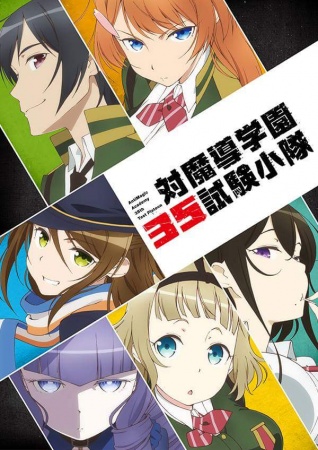

Anti-Magic Academy: The 35th Test Platoon
対魔導学園35試験小隊
In a world plagued by magical dangers and threats, there exist special warriors—known as Inquisitors—who are tasked with non-violently preventing these threats and nefarious actions. The Anti-Magic Academy is a specialized school built to educate and train these Inquisitors, which splits its students into small squads in order to train them to work together. Among these talented squads is the 35th Test Platoon, also known as the "Small Fry Platoon" due to its low ranking and incompetent members. However, everything changes when Ouka Ootori, a powerful yet rebellious former Inquisitor, is forced into joining due to her tendency to break rules and committing a serious violation: the killing of a witch. Tempers flare upon her arrival, as she clashes with their clumsy captain Takeru Kusanagi and argues with the rest of the squad over her views on witches. This eclectic group has a long way to go if they wish to succeed and climb the ranks at the Anti-Magic Academy: they must first set aside their differences and come to work together as a team. [Written by MAL Rewrite]
Main
Main
Main
Main
Main
Main
Supporting
Supporting
Supporting
Supporting
Supporting
Seasonalanime
December 23, 2015
I did enjoy this anime even though I hate harems the characters were all cliché af but I still liked them. It is pretty simplistic but that's not a bad thing. I think it was pretty well paced for a typical harem series. I had no problems with the ending I mean I expected everything I got from an anime like this. I didn't expect anything impactful just something to enjoy with cliché characters and plot. None of the backgrounds in this anime were breathtaking beautiful just normal. :/ I wish the antagonist got more development in all honesty there was nothing deep abouthim he was just there to be there. 😂 If you go into this anime not expecting anything else but a typical harem anime you'll like it. But it's definitely not worth re watching.
ryanxwonbin
December 27, 2015
Supporting
It seems that all the anime companies and their mothers decided to go for the “harem fantasy magic school” theme for the Fall season of 2015. It's actually ridiculous how similar a lot of the shows have been and I can only hope future seasons won't be like this. Taimadou Gakuen 35 Shiken Shoutai is another branch of the fantasy magic shows, and while it uses the harem genre to drag in viewers, it's clear it wants to be more like A Certain Magical Index where the fantasy world and characters make up a large chunk of interest. Unlike Index however, Taimadou completely fails indeveloping the world, characters, and interactions and what it ends up being is a haphazard mess of gibberish. The anime follows a squad of misfits in a witch-hunting school. The world is terrorized by magic that usually does more harm than good. Takeru Kusanagi is a special snowflake MC and leader of the misfits squad. He uses a katana rather than guns, usually spouting some edgy sword attack (Kusangi Style: Dragon Strike) when he defeats his enemies, which ends ups just being a generic sword swing with name emphasis only there to sound cool. Luckily for the MC his entire squad is filled with cute girls. I have no idea if the source material is crap or Silver Link decided to butcher it in their poor adaptation. Regardless, the anime quickly rushes past character and villain arcs in a 2-episode formula. The formula is as follows: a female character has her troubles with the past in the first episode, the second episode follows with the MC winning the female over by swinging his sword around in his robo-samurai armor and swearing he will carry “half of her burden”. Every few minutes there will be world building attempts where side-characters attempt to act mysterious by spouting random magic mumbo jumbo (Arthur Pendragon resurrected, philosophers stone, the Esper organization, the Alchemists whatever) in the looming background. The result at the end of each arc is a jumbled mess of a show with half-baked details and gibberish. It seems clear the writer wanted this to be something like Nasuverse or Index, but the anime’s poor portrayal doesn’t make up half of the respective latter worlds. It's quite unfortunate because the character themselves have great designs and endearing personalities. They however can’t get beyond general interest in to deep and meaningful characters win because their arcs are horribly rushed. A lot of the side characters too are likeable but they are quickly forgotten and left in the dust once a specific arc starring them ends. There are also some pretty grim moments from children zombies to clone genocides which would have left a pretty dark impression on the world build, but they are censored and delivered so poorly with the harem hijinks that they feel awkward. The production values are lazy and boring. The animation in fights feel incredibly generic where the MC is swinging his sword left and fight and not an ounce of effort was placed in choreography. I found myself dozing off in the moments that should have had my attention glued to the screen. It's hard to think a robotic-samurai destroying monsters and dueling other robot smaurai with a katana could be boring, but Silver Link manages to achieve that with this lazy production. The music is forgettable and dull. In the end Taimadou can be thought of as “what if A Certain Magical Index” failed. Imagine if A Certain Magical Index was cut to 12 episodes and each arc had to be rushed in the short time the developers had. The only positive thing I can say about Taimadou is that it has a great cast of female characters, but even they end up being disappointing with their improperly developed character arcs. Taimadou is a show that will be forgotten once Fall 2015 is over and it is a clear example that trying to jump in on what the current popular bandwagon is does not work.
Zaku88
February 6, 2016
Though it initially looks like a military-based magic-fighting show, Taimadou is actually more like your typical action-based harem in a school. It takes many of the good ideas from other shows and, in my opinion, follows many of the themes in Trinity Seven. Our protagonist, Takeru, is the rather level-headed leader of squad 35, the worst-performing team at the anti-magic academy, which is a school that fights against magic using guns and Shana-like contractors. However, soon, their squad is joined by Ouka, an uptight tsundere who happened to be a star inquisitor but demoted due to her revengeful nature. How will she bond with Takeru andhis other companions? Though there are certainly flaws with this show, especially in the latter episodes, the overall execution is well done and the characters are surprisingly interesting and well developed. If you like a mix of action and harem, this is a pretty good choice. Animation: The animation is mostly good though there are a few qualms. The drawing style is pretty mainstream with nice coloring and average shading. Backgrounds are often plain and occasionally blurred out. The setting is actually rather undeveloped relative to the characters and takes place mostly in an urban setting. Despite the school-based theme, there actually aren't very many scenes in what you'd normally consider a school. My main criticism is the blatant usage of low-quality CGI; this is especially painful during many of the latter battles. Characters are well drawn and, compared to Trinity Seven, more appealing over all. Usagi does carry a striking resemblance to Dekomori from Chuunibyou, all the way down to the short eyebrows. Battles are fair overall with average choreography and a fair amount of special effects. Our protagonist uses swords in an age where most sensible people use bullets, which makes for some fun scenes. Speaking of fun scenes, there is definitely a fair amount of ecchi in this show as well. Takeru has his fair share of accidental run ins with naked girls and is often teased by the team's mad scientist Ikaruga. Oh, you even get an entire filler episode dedicated to ecchi with two separate portions involving a love potion and a tentacle-wielding beach monster. Sound: The sound package here is definitely a pleasant surprise. The show opens with a lyric-heavy but catchy and melodic piece; it's the type that grows the more you listen to it. The show often fades into the unique ED by Kanako Itou; though her voice is very familiar, the instrumentation is a lot more electronic (fittingly) than many of her other songs. This is fitting given the show's unique and electronic-infused BGM; expect a lot of drums. There are some nice melodies in the BGM, and it sets the tonality well during both battles and peaceful/playful moments. The voice cast is actually pretty junior and though Rumi Ookubo does a great job as Usagi, Kanae Itou's experience shines as Mari. There's a lot of character development and dialogue here and the main cast does a great job in general. Story: Though Taimadou reuses a lot of concepts that we've seen in other shows, it does it well for the most part. The general progression is a bit of a mix of your traditional action-based harem and the beginnings of an underdog group working to surpass expectations. As mentioned, one of the weaker aspects of the show is the weak setting explication. Why are witches at war against our protagonist's school? Why are there Shana-like weapons contracting with humans? What is the school in the first place? It feels more like the office in Plastic Memories than an actual place of learning (of which we see none of). This doesn't get any better as the show progresses as antagonists hide their true purpose and, like in Trinity Seven, there are hints of larger forces at work that aren't really explained. Fortunately, the rest of the elements nicely conceal this shortcoming unless you really focus on it (sorry- my bad). In particular, the neatly packed integration of fluid plot progression and character development was superb. The show can be broken into character arcs, with each of the harem gals taking their turn explaining their past and otherwise getting center stage. However, the central plot moves throughout these arcs as well, which allows this show to avoid the all-too-often overly-crammed second half of the season. The show also has a good deal of cliffhangers and plot twists, though the latter isn't always positive; the main antagonist for one pops out randomly and is in general overused as a plot device. Though I thought the story was above average overall, too much of the screen time was spent on developing subplots that go nowhere; of course this is unless they are planning a sequel. Character: Maybe it's just me, but I think the characters in this show were surprisingly good. Their interactions were fun and they didn't feel like flat stereotypes. Yes, almost all of the girls are slightly tsundere, but in peculiarly different ways. Mari and Usagi are both exceptionally strong as characters with depth and dynamic progressions. Though the show tries to sell orange-haired Ouka as the primary heroine, she doesn't come across as strong as the others. Ikaruga is a bit of a mystery until her arc but adds a good mature balance to the otherwise overly tsun-tsun group. Even the emotion-lacking Lapis has her comedic moments. In addition to a strong character presence, the show actually takes advantage of the fact that they are a team. No, I don't mean the "leave this to me go on" type of "team" as seen in virtually every other show, but an actual combined effort to overcome odds using everyone's expertise. Therefore, in addition to good character development, you get actual group development as well (their first attempt as a team is quite comical). If there is a sore element here, and it is rather small, it's the antagonists. You don't really care about them, and no effort is made to explain their purpose or rationale. Value: Taimadou is not going to be the next SAO but is definitely an above average watch in its category. It easily trounces other recent contenders in the genre such as Trinity Seven, Seirei, and Fafnir. If you're looking for a decent action-based harem with a bit of comedy and ecchi, and don't mind a thin setting, look no further than this show.
kokorosplatter
January 18, 2016
If you're expecting the average swordsman harem, this isn't quite it, and yet it, exactly, is. Taimadou Gakuen 35 Shiken Shoutai is a satire of the swordsman harem genre that has become the rage in recent seasons. It is enjoyable to watch and follow as it develops, while it points out the glaring, annoying holes that many dislike in the genre. The story is divided into arcs, which is commonplace for this genre. Each arc tends to be devoted to focusing on a girl of the cast while showing how badass the main character is. The common pitfall is that,while they do get focus during their arcs, the girls in other anime are instantly thrown to the side when the next arc comes around. Anti-Magic Academy does not follow the common failures. The great thing about 35th is that all the characters remain relevant with each arc. The events that help develop a character does not just happen inside that character's arc: EVERY ( main ) character develops from events that have passed, and they continue to grow as the series progresses. For the main character's arc, it was enjoyable watching them deconstruct the flashback episode. The purpose of the flashback episode is to explain the angst, brooding, and woe that torments our main characters. When done poorly, it presents in an insufficiently short arc ambiguous reasons, like "I should have told them the truth", "I should have saved them all", or "I should have stopped them from going". Takeru's arc pokes fun by throwing you tons of info and yet you walk out with the SINGULAR reason for his lament. You understand him better as a character and you will understand the place from where he must grow. You will, however, notice that the arcs themselves are very loosely tied together, if at all. If you are a stickler for just the perfect story, you can appreciate each arc and how it is constructed, but not the overarching story, because there isn't one. There is, however, an overarching development in terms of the characters. You will be able to enjoy the evolution of the platoon as a team, supporting one another, and covering each other's backs. Anti-Magic Academy's 35th Test Platoon's true strength is in its use of characters. If you like Kirito but wished he had some emotions, Takeru is your man. If you like Ayato but wished he had a few quirks, flaws, and humanizing characteristics, Takeru is the guy for you. I thoroughly enjoyed watching him grow as a character, and be a badass while being human. He interacts well with the side characters, while shining the spotlight on them. That's right! He actually steps off camera to let the other characters be awesome! The other main characters, the harem, continuously develop as the anime progresses. Their attraction towards Takeru may seem only barely deep at first, but because the platoon develops with each episode, AND it gives events that support the supposed increase in attraction, none of the affection seems out of place. The affection from the artists of the anime is... excessive. While the writing for the anime is golden, the drawings are fanservice-friendly. The ecchi moments can be over the top, especially in terms of Usagi. Luckily, Usagi is a well written character, if questionably drawn; but nothing beats Ikaruga's, Mari's, and Ouka's fanservice moments. Having said that, the art is pretty good, and the action scenes are pretty nice too. Not much frame by frame fight choreography, but enough to accentuate the use of magic, guns, and swords. The sound is amazing, especially that thrilling light techno action theme that plays, akin to Danganronpa's investigation theme. The OP is just the best and the ED was enjoyable too. The series was enjoyable for me in that I was expecting to be turned off, it being the swordsman harem genre, but when it gave me a little too much of that, it clicked that this wasn't like the others. It presents to you the common annoyances of the genre, while showing you it can be done well. Instead of "it's so bad, it's good", Anti-Magic Academy's 35th Test Platoon tells us, "this genre can be bad, but I'll show you it can be good".
Stark700
December 23, 2015
It’s easy to describe what Taimadou Gakuen 35 Shiken Shoutai really is. Just like the reputation of the “Small Fry Platoon”, being described as a group of failures at a school known as the 35th Test Platoon of Antimagic Academy, this show is also a failure of itself. Before getting to the what, how, and why, there’s a few things new viewers should understand about the show. Taimadou Gakuen 35 Shiken Shoutai (also known as Anti-Magic Academy 35th Test Platoon) is a light novel adaptation that has over 10 volumes and currently publishing. Common logic dictates that such an adaptation could only be tolerable ifadapted into at least a 2-cour show. What do we get instead? A chunk of mess and missed potentials that gets buried by Silver Link and the director’s incompetence. Don’t get me wrong though, the show has an interesting premise. Unlike many normal schools, the 35th Test Platoon of Anti-magic Academy is part of a group that is designed to hunt down witches, beings branded with dangerous magical abilities. It’s easy to theorize what they learn is more than the usual textbook stuff like math or literature. While this stands out as somewhat unique, the show is unable to carry itself with its oddball set of characters and messy storytelling. The series follows the bizarre adventures of the “Small Fry Platoon”. Like some light novel adaptations, its story structure is formatted in arcs although it interconnects and has direct relations with the overall premise. In hopes for a faithful adaptation, director Kawamura Tomoyuki instead delivers a disappointing story that fails to capture the magic, emotions, and powers with its characters. It’s pretty much a washed out action flick and nothing more as each episode dashes hopes for what fans will have expectations for this series. And it all begins from the very first few episodes. There’s no official written rule but I think it’s common that most people judge if they drop or keep a show of interest with a span of three episodes. This show will likely take just one. The pilot episode establishes the main premise while also introducing some of the main characters. Because the main cast is composed of female characters, expect some generic impressions like the ‘main guy walking in on girl half-naked’ type of situation. It actually crosses that line not once but sort of twice too when Takeru Kusanagi, the leader of the 35th Test Platoon sees two of his teammates in a lewd fashion. The rest of his squad members are also all girls and throughout the show, their relationship with him ventures into the harem-esque territory. We got Ouka Ootori, a girl with a hate for witches and cold personality. As time goes on, she develops unrecognized feelings for Takeru that is acted out in a slightly tsundere fashion. Her rivalry with Mari Nikadou, a witch formerly affiliated with Valhalla, also gets personal and irritating to watch as time drags on. Then, there’s Usagi Saionji, a shy yet emotional girl with some lack of common sense and desire to marry Takeru. Her background story isn’t pretty despite her high class family status. Ikaruga Suginami, the genius and professional hacker of the group is also well known for making suggestive and often sexual jokes towards her teammates. Oh and finally, the show has to include a girl with a “lack of emotions” so Lapis, a relic eater is added to fill in the void. As the storytelling is handled by arcs, each of these arcs consists of a set of episodes that focuses on a problem and specifically about a girl. Takeru and the rest of his squad always somehow gets involved in these affairs. It’s as predictable as any generic writing when Takeru attempts to save them from whatever problem they have. While it initially handles the buildup and emotional appeals well, it quickly dies out as an arc is wrapped up with the rushing. As a 1-cour adaptation, it fails with minimal plot development and feels more like just a group of ideas thrown altogether in one piece to entertain the audience. I will admit that the action flows pretty well on par with acceptable production values but everything in the end seems to lack charisma. The comical jokes gets old fast and the fan service seems to be forced into the viewers’ minds every time it tries something funny. There’s even some major filler content for this adaptation despite being already rushed. And that’s really tragic considering how much the series dropped the ball with its ridiculous directing. Don’t expect strong characterization but do be prepared for a lack of originality. There may be times that a few of the characters can be quite fun to watch though as their personalities adds some excitement to the messy story. But in retrospect, it’s still not far from disappointment. Silver Links adapts this series and given the production quality, they seem to have taken their sweet time with it. It’s tolerable in terms of action packed choreography especially in the more intense fighting angles. But when it comes to characters, it’s lacking in their expressions. Most of the characters seems to have the same face most of the time. While the character designs holds uniqueness to some degree, it’s hard to make it up when over-saturated fan service is mixed in with it. On the other hand, I am impressed by some of the combat gear the show produces. These include a wide range of guns, vehicles, and magical spells. The technological aspect of the setting also looks solid despite the shallow backgrounds. If there’s one thing to write home about, it would be the music and soundtrack. For a sci-fi military flick with its production values, the soundtrack is surprisingly well crafted. With the stereo beat and fast paced cinematics, it correlates effectively with the action. Character theme songs are also designed with a decent amount of effort as well. While the OP and ED theme songs aren’t stellar, the overall coordination of the soundtrack deserves some praise. Character voice mannerism is another story though. While they have credibility with their personalities, there’s nothing impressive about them. It’s like the group of producers for this show gathered together and thought, “let’s make this show with some pretty action and everyone will have something to talk about!” But really, besides the action and soundtrack, this show is more like an advertisement for the light novel. If you are interested more in the story, then do feel free to give it a read although by this point, it might feel like a waste of time. And time really is something they messed up for this adaptation. With its heavy rushing and lack of characterization, there’s hardly any time to craft a consistent story. In the end, it’s a waste potential.
Rank
#5781
Popularity
#846
Members
327,620
Favorites
491
Episodes
12