Spice and Wolf
狼と香辛料
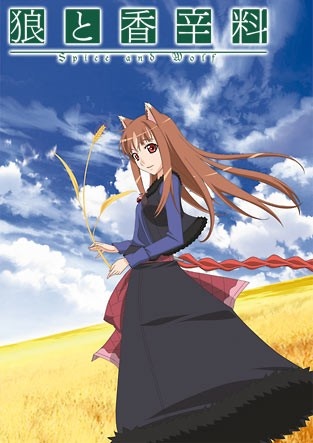
Holo is a powerful wolf deity who is revered in the small town of Pasloe for blessing the annual harvest. Yet as years go by and the villagers become more self-sufficient, Holo has been reduced to a mere folktale. When a traveling merchant named Kraft Lawrence stops at the settlement, Holo offers to become his business partner if he takes her to her northern home of Yoitsu. The savvy trader recognizes Holo's unusual ability to evaluate a person's character and accepts her proposition. Now in the possession of both sharp bargaining skills and a charismatic negotiator, Lawrence inches closer to his goal of opening his own shop. However, as Lawrence travels the countryside with Holo in search of economic opportunities, he begins to realize that his aspirations are slowly morphing into something unexpected. [Written by MAL Rewrite]
Ranivus
April 22, 2008
Wolf and spice can be summed up fairly easily. Be prepared for ALOT of dialog. In essence, its about a story about merchant trading during medieval times. A time when the word of the catholic church was more important than anything else and anyone else was deemed a witch or heretic. Since it is set in such archaic times it would be a perfect fit to have an anime about merchant trading. Ever since i was in middle school I used to play video games with trading and how prices rise and fall from location to location and how supply and demand and even risk marginsfor investing in certain things to turn a profit. That was the main goal, to make money. And that is the main goal of our main character Lawrence Kraft. Through his travels he entrusted a small heretic town that believed in a wolf god named Horo that watched over their crops. And it just happens that Lawrence Kraft befriends this god and he soon finds out that she just wants to go home. And so the adventure begins.... Being a story about trading goods there is bound to be alot of dialog between bartering, negotiating, trading information and the chemistry between Horo and Lawrence. If theres going to be alot of dialog an my anime it better at least intelligent and make sense. Luckily this show does it very well, almost perfect. And its safe to say this is because how Horo and Lawrence feed off each others energies so well that you almost feel like you're right there arguing with Horo. Theres no "voice in the head" in this anime, all their thoughts and ideas go between each other and nothing is never left out. Although little background details are left out for time constraints, viewers with an open mind can understand most of the unmentioned side stories. Those who cant figure out the small things, the subbers (ayako) were nice to place side notes for every episode. Its very refreshing to see an anime that actually takes time to explain things to the point that you are convinced enough to believe the situation at hand. Lawrence and Horo are the only main characters of the show so having a good chemistry between them was key but also having a strong seiyu cast for those two is another reason why this show is addicting. Their voices emit their emotions perfectly and the background music just makes this show so much more elegant and beautiful. Its basically consists of a string quartet. Who ever composed all of the background music must be one of the best composers I've ever heard. I never knew so many emotions can come out of just a group of strings. Environmental sound effects are just as what you would expect after hearing the beautiful strings and artwork. Crickets chirp at night, flames flicker and click, they're all of high quality. But they never interfere with the dialog at all which I enjoy the most. The last component that brings this whole show to masterpiece status is the artwork. This show is best shown on HD resolution definitely. You can see all the painstaking detail it took for all the artists to draw all the settings of the medieval towns, each cobble stone looks different from each other, the stained glass is painted with perfect care. Even all the guild halls and churches have a massive feel to them. Everything about the artwork screams perfection and is easily one of the best artwork I've laid my eyes on. The character animations aren't as greatly skilled as the background and static animations but it does hold a medium-high quality at best. But Horo and Lawrence are still quite memorable throughout the whole show. Overall this show crams so much information and dialog to the viewers its easy to say that its not for everyone. But this is indeed a very intelligent, beautiful, and intriguing show. Its a show that you will either understand or not. As for me I love shows like this that leaves JUST enough out for the viewer to make them think and analyze about the episode they just saw. And I am a total sucker for beautiful artwork and music, but character chemistry is what drives me (and all my other 10's on my list) to score this a 10. ...mind you this show still isn't for everyone.

aereldor
December 5, 2014
This review is for both seasons. TL;DR - Great show. Refreshing medieval drama without corny magic (stunning historically accurate and fun depiction of medieval economics and commerce), immensely likeable main characters, awesome period-appropriate soundtrack, amazing dub, good art. Watch this show, despite the unfortunate cliffhanger ending of Season 2. This is a great lesson on 'Never judge a book by the cover'. That said, I wish they had a better cover... Spice and Wolf was marketed with a half-naked furry wolf girl. Like most people, I was repulsed by it at first sight. Little did I know this seemingly shallow fanservice poster girl is one ofthe deepest characters in any anime ever, and the show is far better than the light novels it's based on. Spice and Wolf doesn't have a grand story - but follows the motivations of its two main characters - Lawrence, a traveling merchant, and Holo, an outcast diety traveling with him. This gives the show freedom to deeply invest into its arcs, and use them as an excellent form of character-building. It also does something great - leaves a lot unsaid, but does it so tastefully that it creates mystery and intrigue rather than frustration. Besides one of the characters being an outcast god, this is an incredibly low-fantasy, low-magic medieval drama, and I haven't seen anything quite like it in Anime - that I enjoyed. The main characters are incredible. They're fun, intelligent, and never compromised to move the plot along. When something happens, it almost always makes sense given the characters' motivations and flaws. The character flaws are so well written, which lets the characters be defined by their shortcomings as much as their strengths. It's great to see them experience joy, fear, exhileration, jealousy, rage... All in complex, unique, believable ways. The side characters aren't as great, but their screen time is so limited that I don't care, they serve their purpose and don't overstay their welcome. Bonus points because the English Dub is far better than the Japanese and brings out the characters way more. The animation isn't groundbreaking or extravagant, but is thoughtful and gorgeous. It captures the setting of a medieval world before the advent of mass industry, blending undisturbed nature with primitive settlements and medieval cities, all without obnoxious fantasy outfits and outlandish weapons. They changed the studio in the second season, but honestly the different style works pretty well too. The soundtrack is great - Yuuji Yoshino seems to have gone to great lengths to specifically use historically accurate instrumentation and techniques, and it shows. Everything hits home, from the festival music (there's a LOT of festival music) to the darker, suspenful tracks. I can't talk about the sound without bringing this up. WATCH. THE. DUB. The Japanese voices can't hold a candle to the English. J. Michael Tatum is a genius, and Brina Palencia is the definitive Holo. The Japanese voices are full of Anime cliches - and once removed, this show has almost none, making it a truly refreshing watch. Don't miss it.
TeslaFreak
May 9, 2015
I saw this anime because of a few recommendations online and several glowing reviews, however upon watching Spice and Wolf I have to wonder how old the writers of these reviews are that they can find this enjoyable. If you've read any other review on this show, you'll know it is praised for its "character depth" and its use of economics. Let me warn you ahead of time, I have seen puddles with more depth than these characters. They are extremely 2 dimensional, the dialogue might as well have been written by a junior high student, and the monotonous tone of the voice acting isappalling. As to the economics so heavily praised by viewers, it is hardly a fair trade for a good story. When the subject is brought up, it sounds more like the characters are reading from a textbook rather than furthering the story. It basically consists of an economic buzzword being said, followed by the definition, in other words the show is extremely full of parrot expositions. The sound of the show also leaves something to be desired, as there is little to no music, almost exclusively dialogue and ambient noise, which I understand was the intent, and could be quite powerful if done correctly. Unfortunately, it was not. Instead of using this tactic to emphasize important and deep scenes, the entirety of the show is treated the same and the viewer is quickly desensitized to the effect and no emphasis is ever placed on anything. When music is actually used, it tends to be poor quality and rather obnoxious, typically played over conversation which was clearly intended to make the conversation seem fun and uplifting but ends up causing the opposite. The art style of the show is average quality and I really have no comment on it. Right off the bat, we are greeted by both Lawrence's friend provocatively discussing a business transaction and Holo explaining nonverabally how comfortable she is nude, and how frequently you can expect to see her that way. At this point you would expect that fanservicing will be the downfall of this show but overall what ruined the show for me was the abysmal dialogue and utter lack of real character depth. As I continued to watch I noticed that the closest thing I could compare this show to, both in character and in dialogue would be Twilight. The obnoxious amount of exposition tropes is also reminiscent of your typical shonen. I expect the crowd who actually do care for this show are coming from a background in Naruto or One Piece, which were also not my cup of tea. TL;DR: If you are below the age of 16 and have never seen anything with a more dynamic story than Naruto, you may enjoy Spice and Wolf, you may even praise it for the greatest characters ever written. But for the adults reading this article who are looking for a show with legitimate character development and an enthralling story, look elsewhere.
santetjan
June 30, 2010
A sensory description accompanied by fields of gold swaying as the west wind moves. A reference to a European legend so obscure most people living where the legend was current will have never heard of it, and well-used to boot. A depiction of change, of progress and of its accompanying alteration of people's perception. All in a preamble spoken in a soft voice. How could this not turn out to be brilliant? When discussing Spice and Wolf, the very title of the series is of interest. More particularly, the sequence of the words of that title. Whereas the Japanese original should have produced the sequence 'Wolf andSpice', the reverse is used in the English title; both sequences are used when people talk about the series. The very preference of one sequence of the title's elements over the other might very well show which such element is more important to the viewer. Equally, it will probably betray appreciation of the show as a whole, as one of the two elements is clearly inferior to the other. -= Wolf =- One way of looking at this series is to see it as a traveller's tale, perhaps even one of a budding romance: a story of two companions trekking from place to place to reach their goal and becoming more firm friends with each bump in the road - bumps that are present, partly as that's how roads are, but mostly as a method of giving the travellers something to struggle with and to overcome. Such a view can easily enough be taken, since both protagonists, travelling merchant Kraft Lorenz and his companion Holo, have a penchant of running into trouble at each way stop, either of their own making or by coincidence and plot-convenience, and especially since theirs is an age-old adventure tale, a tale of crossing a continent while finding one's way home. The particular angle from which Spice and Wolf looks at this story is noteworthy, though. Kraft Lorenz is one of the more unusual characters concepted within the entirety of anime and manga. A travelling trader owning little but his own horse and carriage and dreaming of making enough money to open a shop, he is hardly an archetypal hero. Nor is he concepted to become one. The focus of his character and his actions lie squarely on his business. A generally upright and decent, if competitive, man, his is a less than overly adventurous life of trying to strike a good deal and staving off bankruptcy, trading in commodities and making the best of opportunities encountered by favourable exchange rates or the novelty of trading on credit. At first glance it may not be the most exciting of lives to watch, but it is made up for by the detail poured in each individual transaction and the worries they bring to someone whose very survival hinges on the successful deal. There is also the little fact that he has made a promise to a spirit of an age past, letting this spirit travel with him and helping her search for her far-off home for as long as their routes overlap. His motivation is partly one of expedience, partly one of awe, and partly one of wishing for a companion on the road. While Lorenz is simply a character who is able to assess and laugh about himself and who never strays too far from the path of weighing all his options and usually acting from his thoughts instead of his emotions (somewhat rare in itself), only being overcome at times by the greed his profession might by necessity entail, Holo is what, to many, makes the show memorable. First of all, there's her concept. She's a 'Roggenwolf', a wolf-spirit from folk legend who was a protector of the rye fields and the harvest; the legend depicted in the anime, including the idea that the wolf hides in the last sheaf of rye, comes directly from the actual legend (although the anime most likely speaks about barley, not rye - it's hard to tell, with 'mugi' meaning barley as well as rye and wheat). But Spice and Wolf adds to this simple notion, mentioning how she agreed to be present in the fields in days when the success of the harvest depended on the whims of nature and the supernatural, only to be forgotten when progress and developing technology made her antiquated, until she roused herself from her placidity, longing to return to her old home, a semi-mythical place where everything was bathed in a brilliant silver. A being who is not human, Holo is shown to enjoy the marvels of the human world with all the lack of solicitude of a child. Seeing herself as better than humans, she is a trickster, toying with whatever interests her, shown to like mind-games, wittiness and swiftness in conversation, all the while seemingly thoroughly enjoying being pampered, being treated to large amounts of alcoholic beverages and socialising. While this might make her likable, perhaps even charming, it doesn't make her stand out as a character. What does manage to do so is the fact that, every now and again, without too much attention being piled on it, she, and the audience with her, is reminded of the fact that she is, in truth and not only in word, different, a spirit. At such times realisation creeps through that she is, in fact, hundreds of years old and wise in the ways of the world - but in the ways of the world that was and now is gone. She is a stranger in a strange land, having awoken from slumber only to find that what she once knew is lost. It infuses her with a sense of loneliness that might not always be the most convincing, but at least appears to be sincere. Viewed as a traveller's tale, their story is one of visiting new places and getting involved with the goings-on there, either by becoming embroiled in the affairs of that locale or by interacting with the local markets and traders in a professional capacity. The different tales, more or less one per locale, depicting the ideological problem of Holo being a wolf-spirit and the fiasco of investing in something the market is flooded with, among others, focusing on the interaction of the two travelling companions in their persons and professions with the wider world, generally lead to a calm pacing that give the two ample space to converse with each other and their surroundings and developing the bond between such unlikely bedfellows. As it should be, that bond is slow to develop. Their travelling together at first being nothing but a marriage of convenience, slowly the practical agreement gains an emotional aspect as trust starts to build up. Equally slowly, their conversations change from the purely economical (in all meanings of that word) to the moral and the emotional, yet both keep their distance, befitting two persons who have only known each other for a short time: though banter is exchanged, sometimes infused with quite a bit of wit and mocking of self, once it starts getting personal both have a tendency to back off unless it is truly important for their travels together. If there is no progress in their relationship, this is because there should not be any: Lorenz and Holo are companions, perhaps friends. By knowing each other, they can work together; by caring, they can travel together. But more would be out of place: they are fundamentally different persons in outlook and goals and their focus on the practical side of things only makes them all the more realistic and mature. -= Spice =- Looking at Spice and Wolf as the story of its two protagonists, travelling companions and unlikely friends slowly growing into a stronger relationship is, however, missing the trees for the forest. The super-story isn't but a method to link the little tales together. What makes this series one that stands out from the crowd is the staggering amount of detail poured into the fictional world, a world brought to life in many of its facets by the highly unconventional method of making one of the protagonists a merchant. As a trader, Lorenz is bound to explore the cities he travels through and while he does so the audience is treated to a setting that is as evocative as it is true to actual history. Though Spice and Wolf is ostensibly set in a fictional world, it becomes clear very soon that this world is the Central Europe of the late 14th, early 15th centuries in all but name. In particular, the cities appear as the market towns of the late Middle Ages, and the trading guilds mentioned are a clear reference to the rising Italian companies and the Hanseatic League. The actual content of the show has little to do with the relationship between Holo and Lorenz, but is squarely focused on immersing the audience in the particulars of the small-scale trade of a time when pepper was worth more than gold. It is this what makes Spice and Wolf different from almost anything else out there, and the series makes the most of it, being sure to place enough emphasis on minute details to bring both the practice of the trade and its mentality to life. Through Lorenz and his dealings, the audience is shown the workings of the guilds and bourses of that age, including the modus operandi of the early international trading companies and the limited use (and understanding) of trading on credit, as well as the developing sense of difference between nominal and real value of coinage. While watching Lorenz and Holo exchanging banter, the audience is also shown the more mundane aspects of city life, being taken to watch folk festivals, inns and hostels and a variety of stalls and shops. The faithful rendition of historical detail of the setting - utensils, architecture, accoutrements all, and even, for once, the ships - surpasses anything I've seen to date in anime, putting your average (and better-than-average) Renaissance fair to shame. From the exact construction of buildings to the fact that trenchers were usually made of bread, it seems as if every single detail of the daily life of people has been carefully checked and incorporated. It does so well that I was honestly miffed when noticing that one letter shown was written in modern, not mediaeval, German. Equally striking is the general optimism of the general worldview, a sense that people can understand the world and leave their footprint on it. This, too, is an important part of the portrayed setting and true to historical fact. The time was, and is explained to be in the setting, one of technological progress, one wherein more and more tools were developed to aid agriculture and industry and less and less was dependent on chance. Belief systems focus on the human and their mastery of the world, with nothing standing between man and his God but his own mind, resulting in a general outlook of opportunity, contrasting sharply to most fantasy and historical shows and befitting the more grounded story marvellously. -= And everything nice =- And then, there is myth. Vague, half-forgotten, impossible but in the dark places of the world. Hidden in plain view, in tales from the countryside and quaint mannerisms of people who should know better, shadows of a system of belief of a world past still remain. Only very seldom made explicit, Spice and Wolf employs one of the more subtle and low-key depictions of magic, neatly integrating it into the overall setting. Spirits being real, they only survive where the remaining tales say they ought to be. Reminding the audience every now and then that there is more to the fictional world than market towns, Holo is made less of a unique phenomenon and her desire to return to a home the continued existence of which she can't even be certain of, is thereby enhanced. The supporting cast, as well, complements the setting very well, living wholly in the world of man's endeavours or still faintly recalling what's outside the walls, considering alchemy to be a science yet still a bit fearful of getting involved in it because of its storied connection to the supernatural. Being a series with a slow-moving plot and a lot of dialogue, it was a good choice to try and have each conversation be infused with at least an attempt at wit, and it's nice to see how the failing attempts are often recognised as such by the characters themselves. Always remaining on the safe side of the rational-emotional spectrum, the conversations have a lightness and lack of unnecessary outbursts that keeps the overall tone of the series intact. Mention should further be made of the music. Granted, it's about as standard folk fair as it comes, but it fits the setting, accompanying especially the more festive moments perfectly and has the good graces to sometimes simply not be very good. As far as I can tell, there has been made something of an effort to only use traditional folk instruments and what's left of the musical scores of the time (little of which is certain to be actually old, by the way), and some of these instruments just aren't capable of producing the purer sounds their modern varieties can produce. The opening tune's lyrics also do a very good job of introducing and accompanying the type of story told. -= Icing and Cake =- Looking at Spice and Wolf as the tale of Holo and Lorenz is mistaking the icing for the cake. What comes first in this show is the spice, that is, the setting. In many ways, the travels of the protagonists are but a means to show the audience a small piece of a living and breathing world. Original, if not unique, in focus and angle, superbly detailed in setting and at least decent in adding a glue to fit the separate stories together, Spice and Wolf was, to me, 2008's biggest surprise and an instant favourite. I'll admit that my particular interest in the era alluded to makes me biased, but even without it the originality of the concept, the integration of actual and made-up legend in a detailed world and the soothing charm of the low-key telling of the tales would have me recommend it as one of the very few shows that shirk away from the incessant need to bombard audiences with action and suspense, romance and relationship or like topics. Charming, enjoyable by all age groups, calm and beautiful in its manifold details, Spice and Wolf is a delight to sit down by after a long day and simply enjoy.
Master10K
March 5, 2008
Spice and Wolf is a Supernatural, Romance, Adventure anime set in a sort of fantasy, European, Medieval world. The story itself revolves around a young travelling merchant (Craft Lawrence), who encounters a legendary wolf god, in the appearance of a cute girl (Holo/Horo) and they end up travelling together. However for those expecting plenty of wolf action or full-on romance may be disappointed. Instead it basically follows their journey from town to town, helping each other on complex business deals, whilst coming across major developments and dilemmas. Of course there are pockets of action & minor romantic developments but those don’t play much part untillater on in the short series. Due to the nature of the story; the main characters don’t really stay at one place, so the series lacks recurring characters. But the Craft and Holo duo helps make up for the lack of characters, with their thought provoking and witty comments. Craft is a guy who’s usually so full of himself that it’s hilarious and Holo is the cute, arrogant, wolf-girl that’s there to put Craft in his place. The conversations the 2 have are what make the series worth watching however if you turn off that factory in your head called a brain you are bound to miss something important or amusing. The quality of the animation is sheer amazing. The environments are aesthetically well designed that you’ll notice straight away it is strongly influenced by Medieval Europe. The characters and objects move somewhat fluidly and have a general slender design but this series doesn’t have many opportunities to show what it’s fully capable of. The music is a mix of piano melodies complemented by a variety of string and wind instruments, to go well with the medieval theme. Though I must say, the music is extremely catchy that you may start humming the OP or ED themes without even knowing it. Overall Spice and Wolf is definitely something to watch if you want to try something a little unique, or if you’re just into girls with a pair of cute ears & a tail; because either way you won’t be disappointed. The story may not be all that interesting and neither is the very educational economics and trade involved, nonetheless the well developed, main characters are what make it interesting. With such captivating and hilarious, high-brow conversations between the main characters; it is quite easy to forget about the story that doesn’t feel like it’s going anywhere, half the time. At least the story does nothing to ruin the clever plot but the ending is pretty unsatisfying and in need of a continuation. ^_^
Rank
#415
Popularity
#244
Members
867,176
Favorites
18,278
Episodes
13