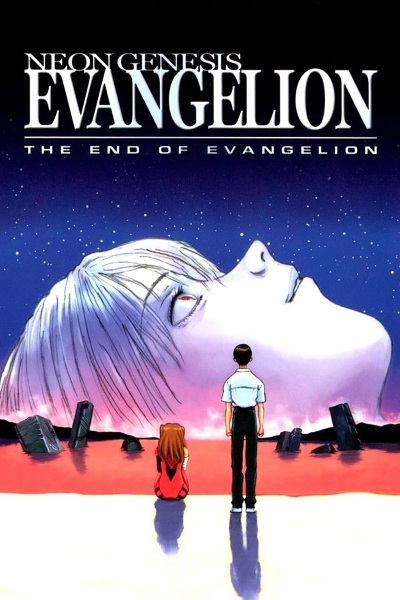
Neon Genesis Evangelion: The End of Evangelion
新世紀エヴァンゲリオン劇場版 Air / まごころを, 君に
Shinji Ikari is left emotionally comatose after the death of a dear friend. With his son mentally unable to pilot the humanoid robot Evangelion Unit-01, Gendou Ikari's NERV races against the shadow organization SEELE to see who can enact their ultimate plan first. SEELE desires to create a godlike being by fusing their own souls into an Evangelion unit, while Gendou wishes to revert all of humanity into one primordial being so that he can be reunited with Yui, his deceased wife. SEELE unleashes its military forces in a lethal invasion of NERV headquarters. As SEELE's forces cut down NERV's scientists and security personnel, Asuka Langley Souryuu pilots Evangelion Unit-02 in a desperate last stand against SEELE's heaviest weaponry. The battle rages on, and a depressed Shinji hides deep within NERV's headquarters. With the fate of the world resting in Shinji's hands, Captain Misato Katsuragi hunts for the teenage boy as society crumbles around them. [Written by MAL Rewrite]
TheLlama
April 26, 2008
[Spoiler Warning] After watching the final episodes of the original Evangelion series, I was really baffled. What happened? I understood that it all took place in Shinji's mind, but that's about it. Where was the ending? What really happened? Those answers are provided by End of Evangelion. We get an alternate retelling of the two last episodes, outside Shinji's mind. From the awakening of Lilith to the result of the Instrumentality, we get to see it all. Of course, there's a lot of moments which are confusing (this is Evangelion, after all), but you kinda get a better understanding of everything that happened. Oh, and for thesake of your well-being, remember that the age rating *is* 17+. There are some really gross scenes in this movie (but that's all I can tell you without spoiling too much). Also, kudos to the animation in this one. I've always enjoyed Evangelion's animation, everything's just really neat, and incredibly flawless, and it stands off as good even today. The same goes for End of Evangelion. Nice animation, and I really like the effects appearing when the Eva series are invoking the Third Impact. I was a bit surprised that they suddenly decided put in real-life clips. For what reason they did it, I don't know, but for me, it certainly had its positive effects. One thing I've also always enjoyed about Evangelion (it's a lot), is the music. Music often portrays the mood very well, so much that you can often only by listening to the song get a picture of the current mood. However, the music they use in Evangelion often goes the opposite way and make a great contrast to the events unfolding. This, however, only strengthens the mood more than any song portraying the mood in a normal way would do. Not to mention that the songs they used in End of Evangelion are great as stand-alone music as well. Evangelion is a psychological anime, and the characters are and behave thusly. They're all traumatized, or have some kind of emotional problems going on. The original series portrayed the characters and their problems very well, and the movie did that as well. I feel that they are real human beings, and I end up sympathizing with them. They have deep emotional struggles, and you're nearly dragged into them. Shortly summarized, the movie was very much like the original series, at the same time also explaining many things the original series didn't. If you've watched the original series, you should definitely watch this, because it's *at least* equally good.
Japanese

Suzumiya Haruhi no Shoushitsu
vivafruit1
February 21, 2014
Story The story starts in a fairly disorienting manner and then moves quickly from there. After about 20 minutes of confusion, however, the anime soon finds its feet and I began to be able to follow what was going on. At around 40 minutes in I was actually somewhat interested... and then, the anime falls apart under its own philosophical weight. Apparently, the creators of this anime thought that they could substitute all semblences of plot with random scenes that supposedly have symbolic meaning. A quote from Roger Ebert's movie glossary comes to mind: "If you have to ask what it symbolizes, it didnt." I have seenthis movie several times, and still cannot enjoy the film one iota. I do not believe that it is because I didn't "get" the film; I believe that there is quite simply nothing to get. Certain Neon Genesis Evangelion fanboys have gotten a huge kick out of analyzing the show and attempting to fabricate some sort of interpretation of the events that transpire, but in my opinion this is a futile endeavor. The shows plot was deliberately made incomprehensible for incomprehensibilitys sake; there is no meaning to the show other than to have no meaning whatsoever. The difference between this film and other virtually indecipherable anime (see: Cat Soup, Paprika) is that End of Evangelion pretentiously demands interpretation.There is nothing to entertain the viewer beyond the movie's pompous symbolism, and this is the film's downfall. Animation Generally, the animation is pretty damn good. Because of the film's obviously larger budget, End of Evangelion improves on the excellent original character designs with greatly improved fluidity and backgrounds. A sequence near the end, where iridescent crosses spring from Earth, is one of the nicer pieces of eye candy that I have seen. Another highlight is Asuka's central fight midway through the show, which oozes with perfectly stylized violence. The awesome animation is marred, however, by two dreadfully awful sequences. In one scene, the "anime" is not animated at all. Instead, a person with a low budget camcorder randomly wanders around town, filming things like empty movie theatres. This comes as quite a shock midway through and manages to come across as exceedingly ugly. Many people I have spoke with have tried to defend the scene by citing its symbolic meaning, but all of them have given me different answers. Ultimately, the sequence is a jarring break from the continuity of the animation, and definitely hurts both the show's pacing and overall video quality. In another scene, there is a horrendously long sequence in which thousands of still frames are flashed across the screen at a mind-numbing rate. Never before have I had to sit through such an obviously expensive, thoroughly pointless, and horrifically painful section in anime. Sound In general, I found the sound to be pretty much flawless. The music does a pretty good job of setting the mood even as the story is falling apart, and voice acting is still excellent. Sound effects, particularly in Asukas battle, are nicely done. Characters Some may disagree, but I thought the original characters of Evangelion were excellent. All of them were almost perfectly imperfect, and as a result managed to capture some of the darkest parts of the human soul. While none of the characters were particularly likeable, every single one was captivating in their infinite flaws.These promising characters, however, are pretty much destroyed in the treadmill of an awful story. By the end of the show, just about every single individual has lost his or her humanity; their actions no longer reflect any semblence of logic or compassion. Forget character development - this is an anime about action figures.Because of this, what was arguably Neon Genesis Evangelions greatest strength becomes End of Evangelions biggest fault. Overall I went into this anime genuinely hoping that at last I would find a little closure to Evangelion. Instead, I got this. Deliberately plotless, the creators apparantly assumed that they could pass off mindless and pointless scenes under the pretense of "art." A huge budget is wasted, a good storyline is desecrated, and one of the most promising animes of 1997 is put to shame. Pretentious and disappointing, End of Evangelion is certainly down there among some of the worst anime that I have seen.
freyakoala
April 16, 2013
End of Evangelion is truly a masterpiece of an anime movie. For me, like many other fans, the last two episodes of the anime series of NGE left me feeling a little frustrated and confused. They are fantastic and innovative as stand alone works but do not serve as a satisfying conclusion to what was an amazing anime. EoE, however, allows Anno to give his magnum opus the ending it truly deserves: beautifully animated, packed with action and philosophical to the core, this film does not disappoint. Taking place in the same universe as the anime, EoE serves as a re-telling of events outside of Shinji'smind or as an entirely alternative ending. The beauty if this movie for me is that it does not spoon feed you the premise, instead it is up to you to decide what exactly is real, what is symbolic and what is psychological. The first half of the movie acts like standard NGE fare...there is plenty of action, and an interesting threat falls upon the nerv headquarters. We are treated to a fantastic Asuka based fight scene, which breaks up nicely the scenes of drama involving Shinji. The interactions between side characters are stellar as always, and one never feels as though a character is being neglected...even the minor members of cast are three dimensional with their own wants and ideals. The second half of the movie is when Anno's depth of work begins to truly shine. Beautifully animated, with stunning apocalyptic scenes, this part of the movie can be enjoyed as an analogy about the fear of being hurt, and the need for the warmth of others. Shinji's fear of reaching out to others has (or almost has) devastating consequences as the world without barriers he envisioned appears before him. The philosophical narration does not read as psychobabble at all: instead, EoE steadily makes simple points about the nature of life. Despite the scenes of destruction EoE presents, the narrative is largely optimistic: as an example, one quote is "if you are alive, any place can be heaven,". As always, this is a wonderfully animated work. The backgrounds of the movie are stunning, and the larger budget definitely shows through, with complex action sequences and amazing, surreal and cosmic scenery galore. EoE is a feast for the eyes! The music, while somewhat dissonant to the general theme of the movie, is great, and strong enough to be appreciated as stand alone pieces. Like the NGE anime, this movie uses famous classical music, which create a dramatic effect. I watched the original japanese Version, and the voice acting was fantastic. Particularly the voice of Shinji...Megumi Ogata is some woman! From crying to *ahem* ....other things..she performs realistically and with a tone of voice so unusual yet convincing. Rei's seiyuu was also fantastic, voicing her with that hint of emotion that is needed for such a complex girl. Expect to see some character development, especially from Shinji and Rei in this movie! Even the villanious Gendou becomes more sympathetic. The interactions between Rei and Gendou and Shinji and Misato are some of the most heart rending of EoE, however, surprise encounters between the supporting cast (particularly the lovely Maya) also tugged at my heart strings. All in all, EoE is fantastic and an imperative part of the Neon Genesis Evangelion franchise. This wonderful movie offers some of the best animation and characterisation I have scene in any series. If you are dissatisfied by the ending of NGE, this will be the conclusion you have been waiting for!
name93
December 5, 2012
When a film starts with the main character giving himself a wank over an unconscious girl after he reveals her breasts by accident, you know you're in for a treat. "It's the end of the world Ladies and Gentlemen, and I'm feeling fine". After a huge middle finger to the audience that were episodes 25 and 26 of the TV series Neon Genesis Evangelion, and the not-unexpected outrage and protests by the fans, the series' creator Hideaki Anno fell into a whole new level of depression that was so deep it hit the centre of the Earth, bounced back through its own anus, turned into a hysterichatred towards the fans and shot up right back into Anno's big head, traversing his large intestine on the way back and thereby planting some serious shit into his head. The result was a giant wank in the face and the ensuing skull-fucking that was the "End of Evangelion" movie. And what a movie it is! Films like End of Evangelion are a rarity, and only come about every couple of years. This movie is the anime equivalent of "Dungeons and Dragons" or "The Room"; a movie so epically bad it's a joy to watch. Though, there is one precondition to properly enjoying this film if you have the misfortune of owning a brain ( unlike the people who rate this magnificent turd a 10/10 ); you have to give all your fucks beforehand. The opening scene of Shinji wanking over comatose Asuka should assist you in switching off the "caring" mode, in which case, you're in for a roller-coaster ride through some of the most amazing shit that has ever been animated. I'll say it openly: I enjoyed this movie a lot, only not in a way you'd usually associate with the word "enjoy". You may have noticed by now that this review is already different from my usual ones, and that's due to two reasons: 1. End of Evangelion is in a special league of its own regarding the films in general, let alone the anime I usually watch 2. I just don't give two f*cks. This is a rant and I intend to enjoy it. So buckle up and prepare to go! As the opening scene plainly shows, Anno's single most important objective in this film is pissing the fanbase off as much as possible, and he accomplishes this superbly and in numerous ways. First of them; making the already unlikeable and despised Shinji as appalling and disgusting as possible. There isn't a single person with a sane mind that doesn't loathe and hate Shinji and doesn't want to torture him in the most gruesome, most painful ways possible. If you thought he was spineless and whiny in the series, just wait to see how he acts during the film, and in particular during the first half of the series, when instead of fighting off the enemy in his Eva, he sits under the staircase, weeps and cries for the unconscious Asuka to come and help him. After he gave himself a wank over her just two minutes earlier. OUR PROTAGONIST LADIES AND GENTLEMEN! What he does in the face of an impending apocalypse is even more admirable, but I shall discuss that later. Sadly ( well, for me, fortunately! ), other characters aren't spared either. Remember Major Misato Katsuragi ( which reminds me that Masamune Shirow and Mamoru Oshii should sue someone ) and how she was turning into Anno towards the series finale ( along with the rest of the cast )? You know, becoming all depressed and upset and stuff? Well, mr. Anno clearly doesn't, for she's all tough and fiery at the beginning of the movie. Hell, she basically bitch-slaps Shinji for being such a whiny, spineless bitch, and practically embodies the feelings of the audience in doing so. Shame she doesn't put a bullet in his head, not only would she make the viewers happy, she'd save the whole of mankind from turning into a stale orange juice. But I'm getting ahead of myself. Anyways, her character in the movie, while awesome, is inconsistent with the series, and seeing how this movie is supposed to replace episodes 25&26 as the proper ending for Evangelion, that's a minus I can't overlook. Asuka starts off as being unconscious, then wakes up to be catatonic and scared and depressed - just like she was at the end of ep 24. Then, in literally 20 seconds during which she has a vision of her mother, she makes a 180 degrees turn and proceeds to kick some evil-Eva arse. Great writing there, Anno! It doesn't at all negate and spit on what was arguably the best about NGE! Immediately afterwards, though, as soon as she fulfills her role of a plot device, she's cast aside until the very last scene of the movie. Same with Rei, who is barely present for the first half of the movie ( albeit it's understandable why that is so ), only to saturate the screen for the most of the second half. She's also ripped of her previous personality, uncompromisingly sticking it to Gendo and accepting her destiny as Anno's final plot device in the quest to piss the fans so much you can cover the entire Earth in piss. Even though there was hardly anyone really likeable in the NGE's cast of characters, and even though they were all deeply flawed as people, they were believable and good characters ( until the last third of the series at least ) and End of Evangelion stripped them of everything, disregarding continuity and only making Shinji the most hated fictional character of all time after Jar Jar Binks. Well, the first batch of turds, in form of handling character development, is done with. Onwards, to the plot! Plot-wise, End of Evangelion is rather similar to the preceding TV series; it starts off decently enough ( not counting the opening wank scene ), only to collapse spectacularly in the second half, falling so hard it destroyed the world and liquified all living things in the process. But while decent, the first part was still not very good, and in retrospect, it falls apart together with the rest of the movie. It's riddled with the aforementioned character inconsistency, plot holes, contrivances, repetition of ad-hoc resolutions from the original series ( namely, when Ritsuko stops a massive hack of the Magi supercomputers... AGAIN, and in the exact same way, only much, much faster ), and much more. There's also some ridiculous no brainers like this one: the Japanese military are assaulting the NERV HQ. While their forces are still inside the facility, trying to retrieve the Evas, their own forces DETONATE AN N2 MINE OVER THEIR HEADS, blasting the Geofront into pieces. I don't care if it doesn't have any radioactive fallout, a nuke is still a nuke and you don't shoot it at a target when your own men are inside! While entertaining, the first half is convoluted, full of contrived plot points and generally a fine example of lazy writing that's only done in the first place to prepare the setting for the ultimate mind-fucking-wank-fest-epically-pretentious-mind-numbing metaphisical clusterf*ck that is the second half of "End of Evangelion". To put it simply, if the infamous live-pudding-scene from "Akira" and the Eclipse episodes from "Berserk" had an s&m orgy during a black mass and conceived a baby, which in turn were to be raised by David Cronenberg, than the second half of the movie would be that baby. There's just no point in explaining it, you have to see it to believe it. If the episodes 25 and 26 were mindfuck. then this is an all-out gang-bang orgy of Anno randomly throwing around epically grotesque and random scenes filled with pointless and shameless religious symbolism that very unsubtly screams "ASK ME WHAT IT MEANS! ASK ME WHAT IT MEANS!" What does all that symbolism mean? Fuck all, that's what, and it's so painfully obvious, that the endless and futile attempts by the rabid fans to read some deeper meaning into it causes me, and the creator, that big troll, to laugh my arse off because they've taken the bait and allowed Anno to win. Also, if I may quote from Roger Ebert's movie glossary: "If you have to ask what it symbolizes, it didnt." Albeit the quote goes a bit too far, the point still stands. We also get some of the trademark navel-gazing too, because ep 25 and 26 just weren't enough. What a joy! Anyways, all the spectacular mind-fuckery and endless nudity of the second half aside, there's one remaining and pretty major flaw of the story. Guess what it is. If your answer was: it's not conclusive, then CONGRATULATIONS! Yes, despite being promoted as a proper and cohesive conclusion of the series that's supposed to tie up all the loose ends and provide answers to countless questions that were raised over the course of the series, it fails to achieve that. As previously mentioned, many of the "resolutions" were either contrived and unsatisfying, or were drowned in the sea of random grotesqueness and symbolism of the second half of the movie. And to top it all, the ending only raises some more questions, leaving the story without a proper and complete conclusion once more. Well done Anno, there aren't many people with the ( lack of ) skill to do that. I'd take my hat off for you if I had one. Now, the few good things about the movie. I gave it 3/10 not 1/10 after all. The visuals are very good throughout the movie, with the exception of a short period of live-action stock footage near the end of the film. In that one scene, a person with a low budget camcorder randomly wanders around town, filming things like empty movie theatres or city streets. This comes as quite a shock midway through and manages to come across as exceedingly ugly. The point? A pretentious and futile attempt to make the movie relevant to the real world and probably further connect with the audience. Well, it failed. Again towards the end of the movie, there is a horrendously long sequence in which thousands of still frames are flashed across the screen at a mind-numbing rate. People suffering from epileptic seizures are warned. This warning also applies to the people without such medical conditions. It's very tiresome. The music does a pretty good job of setting the mood even as the story is falling apart, and voice acting is still excellent. Sound effects, particularly in Asuka's battle, are nicely done. Obligatory pretentious tracks ( namely J. Sebastian Bach's music ) are obligatory. The climactic scenes of apocalypse are played to the sounds of a pop song "Komm, Susser Tod", a bright and upbeat piece that could be played at parties and weddings if its title weren't "Come, Sweet Death!" and if its lyrics weren't about suicide and the end of the world. I'll give you three guesses as to who wrote the lyrics. Well, that's it! The end of End of Evangelion. And what a steaming pile of dick and cock it was, yet I absolutely loved it! The main reason why I loved is because, unlike NGE, which was an extremely mixed bag with some very good stuff and lots of very bad stuff, End of Evangelion was just plainly horrible and I could just indulge in pure, justified hatred that my rational and objective mind didn't allow me with the original series. This is the film that turns everything it touches into shit, and yet dances around pompously, demanding attention and critical recognition in the most trollish manner possible. Its story fails at just about every level imaginable - truly, a movie of such epic and total badness only comes around once a while. In every aspect; plot, characters, dialogue, style, themes... it was such absolute rubbish it reached a Nirvana of Bad and moved to a higher plane of existence. An incredibly entertaining movie if you watch it with a certain mindset. If not, you're either going to smash your TV/computer, or become even more depressed than Anno after pondering the fact that the humanity has been destroyed and turned into a giant orange soup by a character so spineless an disgusting, he makes Werther and Jar Jar look like appealing characters.
2deep4me
June 20, 2014
“Man is spirit. But what is spirit? Spirit is the self. But what is the self? The self is a relation which relates itself to its own self, or it is that in the relation [which accounts for it] that the relation relates itself to its own self; the self is not the relation but [consists in the fact] that the relation relates itself to its own self. Man is a synthesis of the infinite and the finite, of the temporal and the eternal, of freedom and necessity; in short, it is a synthesis. A synthesis is a relation between two factors. So regarded, manis not yet a self.” If you do not understand the quotation above, it is doubtful you truly understand The End of Evangelion. Does this mean you are an idiot? No. Both Kierkegaard and Anno use flowery, pretentious language. Instead of getting to the point, they use convoluted phrases to give the impression of depth. The End of Evangelion. This film, like the anime series, has its fair share of fans and critics. Although this reviewer liked the film, which does not mean he necessarily enjoyed all of it, he belongs to the latter group. From its incoherent narrative to its plot holes to its implausibility—let us not forget clichés and contrivances—the film is riddled with flaws; this is an undeniable fact. Were it not Evangelion, it is reasonable to assume the film would have been met with a negative reaction upon release. Let us be honest. Several reviewers on here, as well as fans in general, were disappointed with the ending of the series. People were confused on what actually happened and did not like the philosophy and psychological introspection; the finale seemed to be a departure from the already established storytelling format—and it was. The End of Evangelion, the alternate ending, is no different in this regard, so it is puzzling why fans accepted it. The film has the same structure as the series: the first half is typical fare, and the conclusion goes into an overload of philosophy (but with more visuals). As with the original ending, existential themes are explored. Philosophical discussion is welcomed, but only if it serves a purpose. It does not. The ending—no, the film itself—is controversial and for good cause. Many of the scenes, and the ending itself, are ambiguous. Hideaki Anno did not bring closure to his story: people still have no clue what happened or what it all means. (According to MAL reviewer Kajia, even the DVD commentators could not comprehend several scenes.) Anyone who states they understand the true meaning (the intended interpretation) behind the film is a liar. Without input from the director, we cannot know. This is not a flaw, but a positive characteristic. The beauty of The End of Evangelion is you are allowed to take what you want from the film, and your viewing experience depends entirely upon your past and knowledge base. If the film changed your life, if your interpretation of the film differs from others, or if you believe the film is nonsensical, that is fine. No one can say you are wrong. With that said, an interpretation of the message(s) behind the film will be given. (Do not read any further if you have not watched the film.) From the beginning, Neon Genesis Evangelion has provided commentary on humanity and life. Continuing on from the series, Shinji, the protagonist, struggles with determining whether his life is worth living, although it does seem he is quite resolute on ‘no’ for the majority of the film. It is only when circumstances—no, the world—changes Shinji realizes it is better to keep living and within the company of others. He is essentially embracing the absurd: he understands he will keep attempting to find meaning but will never be able to find any. It is better to live a life without meaning rather than not live at all, even if we are miserable. The goal of the Human Instrumentality Project is to merge all souls or individual consciousness into one entity, one consciousness. No individuality—just sameness. No conflict, no pain, no struggle for identity. This seems like a good thing, right? Wrong. Life is a continuous struggle for identity, and conflict & pain are inevitable. Shinji realizes this and rejects Instrumentality. Multiple individual existences can be born once again from the single entity, given that people realize what differentiates themselves from others; in other words, they must find their self. "How disgusting." This final remark is not directed at Shinji but rather humanity. Hideaki Anno does not like that society forces us to be what we are not (inauthentic self) instead of what we actually are (authentic self). We are all pressured to act a certain way, even though these behaviors are not true to ourselves. We act for them (the they-self) rather than for our self. Our personality or mindset is shaped by the collective; our identity is created for us. Anno thinks we should create our own identity, not be easily influenced by society, and remain true to our self, living authentically rather than inauthentically. There is disagreement over character development in the film. Some reviewers claimed the characters did not develop in the series but did in the film. No. This reviewer does not hold to this belief. In the series, their development was directly related to their mental state. We observed how the characters' mental condition deteriorated. The series served as a character study, and the characters were great and realistic. (Those who suffer from depression or emotional problems do not recover easily. Without help, their condition can easily become worse.) In the film, there was character development, but it was limited to Shinji and Rei. Shinji became more disturbed (the infamous scene) and Rei became independent, no longer a puppet to Gendo. Asuka's recovery should not be accepted as character development: it was a contrivance. The philosophy, symbolism, and unclear ending are the reasons why this film is still actively discussed. The aforementioned elements made The End of Evangelion an influential film, but not a masterpiece. Furthermore, the philosophy was incorporated to make the film look cool. It was redundant and often jumped from concept to concept. The original ending, although repetitive as well, is the superior ending. It provided for an interesting meditation on individuality, bad faith, Dasein (authentic self), and das Man (inauthentic self) through psychology.
Popularity
#176
Members
1,032,365
Favorites
32,159
Episodes
1