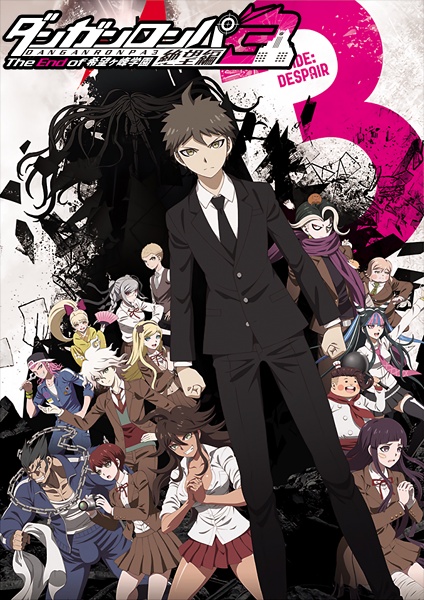
Danganronpa 3: The End of Hope's Peak High School - Despair Arc
ダンガンロンパ3 -The End of 希望ヶ峰学園- 絶望編
Hope's Peak Academy's unconventional class 77-B is about to have an even more eccentric addition: Chisa Yukizome, an alumna with the title of Super High School-Level Housekeeper—and their new homeroom teacher. Cheerful, passionate, and capable, Chisa immediately sets about correcting the students' problematic behavior and strengthening their relationships. It may not be easy dealing with diverse pupils ranging from princesses and nurses to yakuza and impossibly lucky students, but anything is possible with the power of hope. Meanwhile, Hajime Hinata, an unremarkable boy from the school's Reserve Course, longs for a talent. One day, he has an unexpected meeting with class 77-B's Super High School-Level Gamer Chiaki Nanami, who presents to him a new, hope-filled outlook on life. However, unbeknownst to him, the school's upper echelon is about to execute a sinister project centered around Hajime that will bring Hope's Peak—and the rest of the world—to its knees. Zetsubou-hen chronicles the daily lives carried out at the talent-cultivating academy, and the darkness that lurks beneath. As despair slowly infects hope, plans are put into motion to start the Biggest, Most Awful, Most Tragic Event in Human History, and the end begins. [Written by MAL Rewrite]
Main
Main
Main
Main
Main
Main
Main
Supporting
Supporting
Supporting
Supporting
Keirik
September 22, 2016
(Spoilers for the Danganronpa games) As half of the Danganronpa 3 anime experience, Side Despair's purpose is to provide backstory for Side Future as well as fill in Super Danganronpa 2's blanks. Neither should should be watched without playing the first two games in the series, but with Despair's final episode over with I can in good conscience say that they shouldn't be watched at all. Side Despair's problem is that it's boring, safe, predictable, and pointless. As a companion piece to Side Future it does its job fairly well, but in every other regard it's an absolute failure. Danganronpa and Super Danganronpa 2 left severalquestions unanswered, mysteries left up to one's interpretation. DR3 Side Despair aims to solve these riddles and provide answers to what exactly happened to Class 77 before SDR2's events. This was a terrible idea. Class 77's backstory is largely shoved to the background in favour of crossovers with Side Future and an insider's view of series antagonist Junko Enoshima's infernal machinations. When the time finally comes for their big defining moment, none of them have had the development to warrant it. Instead, aside from outliers Nagito Komaeda, Chiaki Nanami, Ryota Mitarai and the Ultimate Impostor, all of them are mushed into one entity. Class 77 is no longer a cast of different characters, but one singular plot device the series has been chained to. Most of the Class 77 segments is spent building up to the demise of the one student missing in SDR2, and when it finally hits it's neither impactful nor entertaining. Junko Enoshima herself has also lost all of her charm. In the games, she appeared only at the very end of DR1 and SDR2. Now she's a main character in Side Despair, and it really hammers home the point that she's best used sparingly. In short, she's just not a very interesting character when you get down to it. She's evil because she's evil, and every single one of her evil plans always goes off without a hitch. What she ends up doing to plunge the world into despair is also incredibly stupid and hokey. The charismatic supervillain who capped off both games on their victory laps is now an omnipresent, transparently evil mwahahaer with little to do or say except ensure that all of SDR2's major backstory beats are hit. The one shining beacon of hope is one of the new anime-original guys, Juzo Sakakura, an excellently written character with a compelling and tragic arc. However, most of his big moments happen in Side Future, though vital setup occurs in Side Despair. Juzo is one of the best additions to the series yet, and his presence alone saves the show from being scored even lower. In the end, I liked SDR2 better when I didn't actually know what happened before it. Every answer we get in Side Despair is far lamer than what I'd envisioned, and just about every character is cheapened by the Persona 4-esque herd treatment. Just about the only character who escaped mostly unscathed was Komaeda, and even he, who was THE defining driving force of SDR2, ended up underutilised and mostly there to provide context for Side Future's events. This show not only fails on its own, but it serves to also make SDR2 a much weaker story once you know just how uninteresting its backstory is. Side Despair is woefully written and dreadfully directed. The animation is also clearly low budget, with the excellent music and voice work, as usual for the franchise, being its only saving graces. You probably already watched this if you're a hardcore fan of the series, but I recommend everyone else give this a skip. Side Future is undoubtedly the stronger show of the two, though even then it'd hard to recommend that one either.
Hope's Peak Academy's unconventional class 77-B is about to have an even more eccentric addition: Chisa Yukizome, an alumna with the title of Super High School-Level Housekeeper—and their new homeroom teacher. Cheerful, passionate, and capable, Chisa immediately sets about correcting the students' problematic behavior and strengthening their relationships. It may not be easy dealing with diverse pupils ranging from princesses and nurses to yakuza and impossibly lucky students, but anything is possible with the power of hope. Meanwhile, Hajime Hinata, an unremarkable boy from the school's Reserve Course, longs for a talent. One day, he has an unexpected meeting with class 77-B's Super High School-Level Gamer Chiaki Nanami, who presents to him a new, hope-filled outlook on life. However, unbeknownst to him, the school's upper echelon is about to execute a sinister project centered around Hajime that will bring Hope's Peak—and the rest of the world—to its knees. Zetsubou-hen chronicles the daily lives carried out at the talent-cultivating academy, and the darkness that lurks beneath. As despair slowly infects hope, plans are put into motion to start the Biggest, Most Awful, Most Tragic Event in Human History, and the end begins. [Written by MAL Rewrite]
Supporting

Supporting

Supporting

Supporting
relenita
September 29, 2016
As a major fan of this series, I was expecting this anime to conclude the story for the three games and this arc was a surprise to many as we got a prequel of the second game to explain many mysteries involving the characters and the entire plot for the rest of the games. Sadly, there's a huge problem when, instead of giving you answers or even more questions, this anime leaves you with contradictions about what you already experienced in the games. Danganronpa 3: The end of Hope's Peak Academy - Despair Side falls into this situation repeatedly. The selling point of this workis, as shown in their PV, the evolution of the 77th class into despair. They're barely present in the series. Barely. And they were the selling point. The development about the characters we all knew and love is null, there's nothing to add into what the games already showed us and at points it contradicts what you have done in the games. The pace of the writing is wonky at best, with jumps in time that aren't explained of make sense in the huge timeline of the franchise, there's fanservice just to cover up the huge plotholes this anime leaves and it doesn't feel like it's a gift for the fans who have played this game for more than 4 years. Just as an example: The final scene from this anime in the credits contradicts the very five minutes you play into SDR2. And that isn't supposed to happen if you're going for a ground-breaking project like this and expect to make people who are already more than familiar with the story be angry or nitpicky because of the poor attention to detail. The few things that save this anime is the music, which is very nice in both Op/End and their OST, the voice acting which is top notch and the appearance of the Despair Twins and their dynamics and also the dynamics between the Future Foundation main Trio. The protagonist and focus of this arc is weak, the introduction of a fan favourite to turn her into the mere shadow she was in the games for a plot device is simply insulting and her classmates are barely in there. Other than Impostor and Health Committee member, no one else gets development in a refreshing way or have any weight in the plot. As an advice I recommend to not be hype about this anime if you're a die hard fan of the series or do it as me: Play the three games in a row, then sit to watch this; because you'll notice all the plotholes and contradictions and you'll be more focused into that than the entire story they poorly presented.
Dream95
September 30, 2016
First things first. You need the play the two DR games (DR 1, SDR2) to fully understand and enjoy the two DR3 anime. If you were a fan of the first installment of the Danganronpa anime, you'll love the games, so please, if you haven't so already, turn around and play those two games (or watch a walkthrough) for the best viewing possible. DR: Another Episode is also mandatory especially for Future arc. Also be sure to watch both Future and Despair arc in broadcast order (i.e. watch future arc ep 1 then watch despair arc ep 1, and so on). There are parts wherethe story and characters might overlap, so be sure to watch it like that for better understanding. DR3: Despair arc is essentially a prologue to the DR story. It centers around the 77th class of the Hope's Peak acadmey, who btw are the main cast of the 2nd game: SDR2. The setting, once so happy and carefree, turns into one of the darkest points in their history: a prologue to the Biggest, Most Awful, Most Tragic event in human history. As the title and premise says, don't expect a happy ending to this. Although it starts off like your typical slice of life school anime, there is a brooding tone that constantly evolves as the episodes contiunously progress, awaiting to become a monster that destroys the students daily lives with despair. This tone starts as lighthearted then transitions into a darker mood, eventually becoming something outright disturbing. Suddenly, the happy, slice of life school setting is no more, instead it becomes violent, bloody and despair-inducing. One thing I liked is that they didn't linger or focus too much into the events the game already touched to an extent, like the Twilight Syndrome case. Just showing things in Hajime's point of view, and that was the better thing to do for the series. One thing I would've liked was to see the 78th class just a bit more than a cameo, like their original interactions with Junko, but with the anime being just 1 cour, it's understandable that they had to leave that out. A disappointing isssue was that he pacing is a noticeably off. I feel like 11 episodes for the 77th class wasn't enough in the end. If it could have gotten a little bit more time, and cut a little bit more of the fanservice, I think the whole tragedy and the aftermaths could have been done better. (SPOILERS: For example, the scene of "her" death and the 77 class turning into despair could have used an in-between scene. Maybe one that goes more in-depth of how the class fully submitted to Junko. The skip between the death scene and the finale was too sudden, considering the two were a couple months apart.) The animation of the characters are really fun to watch as a fan. Just seeing all those characters I loved so much from the 2nd game animated is just so exciting. I felt that one good touch was that as episodes progress and tends to get darker, the art itself progresses to a more darker mood along with the story. Even the opening changes during the middle, to a much more darker color. It was a very nice touch to have, considering what was coming. The OP/ED is pretty good, and the soundtracks were decent, although it could've been better. One thing I did like is how they used some game soundtracks for good nostalgia. The voice acting is fantastic as usual though, just like the games. The voices fit so well with the characters, which always helps the experience. The most important part of the despair arc (and the rest of the danganronpa series in general) are without a doubt the characters. If I didn't care for the characters, I would never have felt anything for them and thus I probably wouldn't have cared what happened to them. Now, since the most of the cast were fleshed out pretty well in SDR2, it wasn't that hard to make me like them from the get go. However, one thing I would've liked to see is just making the cast even stronger. I know that Chiaki, Hinata, and Nagito are indeed the important characters, but I also would've liked those without too much game time from SDR2 to get a bit more exposure and development, like Teruteru and Mahiru to an extent. What I'm glad though, is the screen time the Ultimate Imposter got. Anyways, even if some characters are not getting the desirable screen time, they are still enjoyable to watch. This is also an important reason to play the games before watching this. You just get to know the characters better and smile as they are finally interacting cheerfully without being forced to kill each other. And of course, feel a lot more sadness when they are forced to go through "that process". However, one thing that I am really glad Despair arc managed was Mukuro and Junko getting a bit more depth, as well as Mitarai. One thing I didn't really like though, was how it put focus on the future arc characters for a couple of episodes, halting potential DR0 scenes and even halting the depth of the characters and their downfall. It's a shame that the despair process did not go as I imagined thanks to this, as I would've preferred the "despairification" process to be on a more personal level. Having more than 11 episodes would have helped. As a huge fan of the danganronpa series, I feel both love and disappointment with the DR 3. On one hand, I loved seeing the characters I loved so much animated, interacting with each other. Even the first two episodes which were basically fan service was enjoyable to watch. Although honestly, they could have made the slice-of-life moments shorter just so we could've had more plot development earlier on. And on the other hand there were pacing issues, like I've mentioned. Also, the despair arc is also a big 'what could have been'. What if they would have personalized the despairification process? I think that would have been a better way to showcase and further the depth of both the characters and how they became "despair". Nonetheless, I had this huge smile while watching the first couple of episodes, only for it to turn to sadness and eventually into complete anxiousness as I knew what would eventually happen to the cast. It could have been much better, in fact, after rewatchign the series a couple of times, I just feel disappointed in how the revelation of how the 77th class turned into despair. It's still a fine watch. Give the entire series (games + anime) a try! It's definitely worth your time.
GoldenDevilGamer
September 22, 2016
As Danganronpa fans, we only get to hear stories about the high-school life of the characters and how “The Tragedy” happened, but we never actually get to see that. But with Danganronpa 3 – Zetsubou-hen, we get just that. Zetsubou-hen takes place prior to the events of the first Danganronpa game, primarily focusing on 77th class of the main course and their story about how they became the “Remnants of Despair”. Labeled as a story that begins with hope but ends in despair, it definitely won’t have a happy end. But this is a treat for Danganronpa fans as they get the happy moments oftheir favorite character, until all hell breaks loose. ~{Story}~ Despite being titled as Danganronpa 3, it is actually a prequel to the first game. However, it is meant to be watched after playing the second game as it spoils the plot twists of Danganronpa 2. Being a prequel however, you will already what will happen and how it’ll end. But the sole purpose of this anime is to show you how it happened. The story focuses on the 77th class (the main cast of Danganronpa 2) and their life at Hope's Peak Academy. But the story focuses on our Danganronpa 2 protagonist, Hinata Hajime, and how he tries to find himself a talent. The story also focuses on the new characters that were introduced in Mirai-hen and give more background for them. And as you’ve probably predicted, it doesn’t take too long for Despair to appear with Enoshima creating the “Remnant of Despair” and “Kamukura Izuru Project” taking place. Overall, the story is handle very well and it remain “almost” consistent with what we’ve heard before about “The Tragedy”. The reason why I say “almost” is because there are some things Monokuma/Enoshima told us before that don’t quite happen in Zetsubou-hen. But then again, they were Enoshima’s words… you can’t really trust that, can you? Story: 9/10 ~{Presentation}~ Zetsubou-hen is the Danganronpa you know and love. It starts off in a happy tone, similar to the fun moments for the second game. But then despair kicks in, which is to be expected from anything Danganronpa related. One thing that is well-done in Zetsubou-hen is how the writers manage to remember so many tiny details mentioned in the second game and apply them to this anime. Remember Tanaka saying something about defeating a giant Pomeranian in his. If you don’t remember, don’t worry… the writers haven’t forgotten. And they also applied Saionji’s height change later in the series too. The first couple of episodes of the series is basically fanservice for the fan base. We get to see the Danganronpa 2 characters we know with their unique personalities being shown. We get to see the happy moments of the 77th class before “things” happened. But the rest of the series is what fans expect from this prequel story; despair. The series has the same wacky and zany, yet dark and disturbing tone of its predecessors. The pacing can be a bit too fast as times, but that was to be expected with the amount of plot points that needed to be covered. Presentation: 9.5/10 ~{Character}~ Zetsubou-hen primarily focuses on the 77th Class and Hinata Hajime prior to becoming the “Remnant of Despair”. The characterization for these characters are very similar to their characterization in the second game. Hinata’s still kind of cynical, Nanami’s still adorable, Komaeda’s still kibou-sexual, Tanaka’s still a chuunibyou, Souda’s still pathetic, Mioda’s still loud, Nidai still needs to take a dump, Saionji’s still a b*tch, and so on. Zetsubou-hen is very loyal with its characters and keeps them as how they’re supposed to be. But out of these characters, Hinata, Nanami and Komaeda are the ones that play a bigger role, while the rest are mostly there as comic relief or just for the sake of the plot. Hinata’s inferiority complex kicks in right when we get introduced to him and his accepting the Kamukura Project plays a big role in the series. His complexity is well handled when he’s Hinata. When he’s Kamukura, his more of a flat character, but that’s how his character ends up being. Nanami, who’s appearance was quite surprising since she was known to be simply an A.I. in the second game, plays a big role in this series too. And she ends up being the most unpredictable character since you actually don’t know how things will end up for her. Komaeda is here quite a lot, though it may not always be for the sake of moving the plot, but because we get to see more of his ultimate ability, Ultimate Asspuller… I mean Ultimate Lucky Student. But Enoshima Junko’s also a major character in the series, but that is too be expected since she is the conflict of the series. Zetsubou-hen also builds up on its Mirai-hen characters, like Yukizome and Munakata, and it’s done pretty effectively. For that sole reason, it is meant to watch together with Mirai-hen. Character: 9.5/10 ~{Art}~, The art in Zetsubou-hen is pretty good, but it’s the art style that succeeds more. The art is fairly well detailed and the backgrounds are fairly well done. But the character designs are the most impressive. The characters in Danganronpa 2 all had quite unique character desings, and that same uniqueness can be found here. Some characters look slightly different, like how Tanaka’s hair style is different. But the most notable thing is that the art style is very vivid, especially when compared to the franchise. This creates a contrast to Mirai-hen’s darker-than-normal art style. This vivid art style might have been used to represent the hopefulness the series initially started with and this art style might’ve been used as a contrast for the darker despair moments that comes later in the series. Overall, it was a pretty smart choice to go with an art style that contrast with Mirai-hen Art: 9/10 ~{Animation}~ The animations are fairly good in the series, but it isn’t anything extraordinary. However, that is to say that the animation quality is fairly consistent throughout. Generally speaking, the animation is fluid enough and there aren’t any noticeable animation quality drops. Backgrounds feel a little static though. However, the lighting helps in adding more volume to the visuals. Though if we compare the animation quality to Mirai-hen’s it is a little weaker. But unlike Mirai-hen (which is more action-heavy), Zetsubou-hen doesn’t have any demanding moments that needs high-quality animations. Lerche did a good job in animating two seasons during the same time, which they aren’t used too. Animation: 7.5/10 ~{Voice Acting}~ The seiyuu cast is the same as the games and Mirai-hen. All the well-known seiyuu are back to represent their character. Takayama Minami does the Danganronpa 2 protagonist, Hinata Hajime, and does him and his alternate personality, Kamukura Izuru, perfectly well. Ogata Megumi (the same seiyuu as Naegi Makoto), does Komaeda Nagito again, and she does his voice amazingly well. Just like Danganronpa 2, Ogata has time to shine and show her talent as a character like Komaeda. Hanazawa Kana reprises her role as Nanami Chiaki and does her character very well. Unlike her A.I. personality in Danganronpa 2, Nanami sounds a little less listless, but it matches her character more. Toyoguchi Megumi does both the Despair sisters, Enoshima Junko and Ikusaba Mukuro, and she does a great job with both, but her talent shines with Junko more. Nakahara Mai does a very good job as Yukizome Chisa. Her character didn’t play a big role in Mirai-hen, but in Zetsubou-hen, she’s one of the main characters. And other seiyuu such as Sugita Tomokazu, Kayano Ai, and Fukuyama Jun all do a great job with their characters. Voice Acting: 9.5/10 ~{Music}~ One of Danganronpa’s strong point is its music and Zetsubou-hen is no different. The OP, “Kami-iro Awase”, didn’t take too long to become one of my favorite anime openings. The music, the vocals, and the lyrics are amazing for the song. And there’s a lot of symbolism in the song too. The ED, “Zettai Kibou Birthday”, is sung by Komaeda’s seiyuu and it’s very good. The vocals and music are nice and it matches the tone of the hope in the series. The lyrics is quite weird… but so is Komaeda! Most of the background music consists of music used in the first two games, which is a good thing since the two games had some amazing music. The background music creates a sense of nostalgia due to its familiarity. Till this day, the closing argument theme is my favorite OST and every time I hear it, I always get a sense of joy from it! Music: 9.5/10 ~{Enjoyment}~ As a Danganronpa fan, this is exactly what I wanted out of Zetsubou-hen. It felt really nice to see the Danganronpa 2 characters again and see how their past was. As someone who always wanted to see how everything turned out the way it ended up to be, I was really satisfied that we were able to see that with this anime adaptation. This anime covers “The Kamukura Izuru Project”, “Twilight Syndrome Murder Case” (albeit a little rushed), “Student Council Massacre”, how the “Remnant of Despair” were created, and “The Tragedy”. Though my rating for enjoyment is high, it’s really hard to enjoy a series like this. You’ll mostly just get despair from this series and a whole lot of tragedies. But Zetsubou-hen manages to keep my attention all of the time. Zetsubou-hen and Mirai-hen are easily one of the most enjoyable things I have watched this year. Enjoyment: 9.5/10 In the end, Zetsubou-hen is definitely worth watching if you’re a Danganronpa fan (though you probably already have). Due remember though that Zetsubou-hen, despite it being a prequel chronologically wise, is meant to be watched after playing the first two game. Due note that you must play the second game in order to fully appreciate both Zetsubou-hen and Mirai-hen. Danganronpa’s first game or its lackluster adaptation isn’t enough. But with great handling of its characters, and satisfying adaptations of stories we were only told about in the previous games, Zetsubou-hen manages to be the perfect treat for fans. It may not be an easy watch due to depressing moments, but it manages to keep your attention. But that is to be expected since the it’s a story that begins in hope and ends in despair. + Great prequel anime for the Danganronpa series, that adapts many key plot-points that were mentioned in the games. + Danganronpa 2 characters are handled well and loyal to the second game. + Great OPs and EDs and the background music is the same as the games. + Not only develops its Danganronpa 2 characters, but also the characters from Mirai-hen too. + Lots of fun and satisfying moments for fans of the franchise. - Pacing can get a tad bit too fast at times. Overall: 9.0/10
mkzxwing
September 24, 2016
*Spoilers ahead* Now this.. How should i put it... This is by far one of the worst anime i've ever watched. certainly in my top 10 worst list. The only things it has going for it is how it reveals a few very minor details, how well it worked along with the other arc, and that the visuals aren't too bad (They aren't even close to being good though). Now let's go through what makes this (and every other anime), and then sum up what we have. 1-The plot. It is horrendous. I understand that it was set and there wasn't much room to work withit, but it still doesn't change the fact its bad. The internal logic falls apart quite often. Plot holes are absolutely everywhere. Plot convenience tools are used left and right. There was a story to tell somewhere in there, and it could have been interesting, but instead, it was just a rush job with only the final outcome in mind, and it ended up developing in the most boring, predictable and cliche way as possible. First, we've got an introduction to our class of gifted individuals, yet it was extremely rushed and thus completely redundant - the fans of the game already know the characters well, and a new audience wouldn't have gotten much from such a tiny introduction. Another reason it was redundant is because... Well, its nothing new is it? I mean every second school anime has that in abundance, and that's not the point of the anime as well, so why waste time on it? Now for the character and their interaction with the story. The story IS the interaction of the characters with it. Yet, in this story, most of the characters where completely isolated from the story (You could say only Junko had a role in the whole anime), and everyone who did have a chance to do something or interact in any other way, was either a bystander, or had such a level of incompetence, that even a sock puppet would seem like a rich character next to him. You could pretty much replace every line of dialogue in the anime except Junko's with "it can't be helped" and not much would change. The saddest thing about it, is how the anime is trying to keep the story seem important, dark, and meaningful, by constantly jamming in death, and rubbing it in the viewer's face. The art. Its ok, BUT, the level of detalization of characters was greatly diminished compared to the game, in some cases leaving characters almost unrecognizable. The sound is ok too, bot bad but nothing special as well. So, what do we have left? Well, nothing really. While i don't really believe in spoilers in the first place, the end of this one was spoiled to begin with, so while nothing else, i expected that to lower the score this anime gets further. I was rather surprised to see it got such a high rating instead. Well, now that you know my analysis of this.. Thing... And my opinion on it, feel free to agree or disagree, but please, don't give me baseless arguments and claims such as "you're wrong cuz that's your opinion only", or "You're just hating". I always analyze anime objectively by comparing it to others as well as consulting my knowledge of movie making and story writing that i got from filming school. Such accusations will simply be ignored due to their illogical nature - i found the other arc ok, and the adaptation of DR1 pretty decent after all.
Rank
#2797
Popularity
#783
Members
348,226
Favorites
2,320
Episodes
11