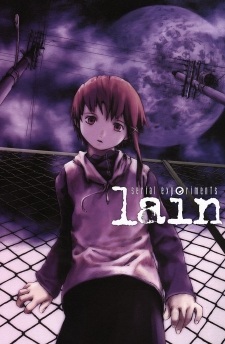

シリアルエクスペリメンツレイン
Lain Iwakura, an awkward and introverted fourteen-year-old, is one of the many girls from her school to receive a disturbing email from her classmate Chisa Yomoda—the very same Chisa who recently committed suicide. Lain has neither the desire nor the experience to handle even basic technology; yet, when the technophobe opens the email, it leads her straight into the Wired, a virtual world of communication networks similar to what we know as the internet. Lain's life is turned upside down as she begins to encounter cryptic mysteries one after another. Strange men called the Men in Black begin to appear wherever she goes, asking her questions and somehow knowing more about her than even she herself knows. With the boundaries between reality and cyberspace rapidly blurring, Lain is plunged into more surreal and bizarre events where identity, consciousness, and perception are concepts that take on new meanings. Written by Chiaki J. Konaka, whose other works include Texhnolyze, Serial Experiments Lain is a psychological avant-garde mystery series that follows Lain as she makes crucial choices that will affect both the real world and the Wired. In closing one world and opening another, only Lain will realize the significance of their presence. [Written by MAL Rewrite]
seraphjei
March 11, 2008
Review for Serial Experiments Lain by John Kim Introduction: I find myself typing this review thinking more about the conceptualization of existence, than the anime itself. Above all, there are two standards I hold true for anime. There are anime that simply entertain for the sake of enjoyment, and there are anime that stretches the boundary of human imagination. Serial Experiments Lain falls in the latter category and for this reason Serial Experiments Lain stands out as a true classic. Serial Experiments Lain pushes the envelope of what the perceived notion of what can be done with television as a medium. The show doesn’t just provideentertainment; it provides insight, and profound views and beliefs about technology and the role it plays in society. With that said it's time to get on with the review. Story: Given that Lain’s story progression is very disjointed, if the execution were to be even off by the slightest, the show would have been ridden with plot holes. Lain however doesn’t need worry about plot and story in the same sense as other anime, but instead relies on the atmosphere and the characters to tell the story. What little plot Lain does have, the show works with it fabulously. Now some may argue that Lain is completely plot driven, but to each his own. Personally I believe that Lain strays as far as it can from bland episodic story telling, and in essence is similar to Citizen Kane in the aspect that the story has little to do with the show. Lain above all is a character study, and the plot only moves forward under the characters. Art: Despite the art being off center in terms of traditional anime, it hardly deters from the overall enjoyment of the series. It is important to note that the series actually benefits from the unique art style presented in Lain. Art is not a big pulling factor for Lain, so if you are a fan of high quality art, you may be in for a rough ride. Sound: The series relies on a minimalist approach to sound and music. Dialogue is sparse, but very profound. Sound effects are seldom used but with brevity, and has a lasting impact on the viewer. Once again, this lack of a quality that would normally be detrimental to an anime’s enjoyment, but becomes one of Lain’s strengths. The sound of the electricity running through power lines, the empty sound of Lain typing on her keyboard, and the scarce use of music. These are all memorable pieces of sound effects that adds to the overall impact of the show. Character: Now this is where Lain shines brightest. In a vast wasteland of mundane same-old, Lain sticks out as an anime that takes its characters to a level that most anime can only dream of achieving. The character of Lain is perhaps the most deep and relevant characters in anime today. To explain upon this point, one would have to watch the series and comprehend the various themes and motif’s on one’s own. But in order to be brief, Lain’s character can be summarized as ascending from human status, to near God like power through the prowess of the internet. Ahem, I mean, “The Wired.” It’s a simple concept and seems like it has been done before, giving credit to the argument, and it probably has. But the beauty here is the cast of side characters that surround Lain. Her sister, her father, mother, and friends, are all extremely deep characters, that although don’t appear to be, are actually extremely poignant in their own right. Enjoyment & Closing: If watched with an open mind, Lain will do more than simply entertain. It is truly revolutionary anime for its time, and the amount of depth in the show is utterly staggering. Never in my years of watching anime have I seen a show as thought provoking as Lain. If one were so inclined to contact me, we could talk for hours upon hours of the religious symbols, and religious references that run about the shows course. We could then change the subject to comparing Lain’s character to that of philosophy of the Jungian Shadow. We could converse and discover deeper and more universal meanings as time progressed. Lain is such a show that the viewer doesn’t just watch it. The viewer must be pushed to think, and who doesn’t want to do a bit a of thinking once in a while?
AestheticOnion
May 1, 2017
What really scares us? Death or the oblivion? Of course, the oblivion. It is not dying itself that frightens us the most, but rather knowing that we will lose everything we loved and cared for. All of the memories we've treasured, the choices we've made and the people we've touched; everything will cease from existence. So why do we treasure our past so much? Is that just a collection of memories the nostalgia bounds us to, or is it the part of who we are? Serial Experiments Lain is not your average show, and definitely not something you run into every day. It is a uniquepiece of entertainment that completely transcends its genre, and presents itself as a work of art. An avant-garde show, not restraining itself to the boundaries of traditional storytelling and plot building, creating a completely unique and revolutionary piece of media. This anime series is NOT for everyone. One of the reasons this show is popular even now, two decades after its initial release, is because its plot is still not completely figured out. The story is told in a rather convoluted fashion, which makes the already complex plot even harder to interpret. Lain is one of those shows that require the viewer to pay full attention to every detail, and challenging them to put all the pieces together to grasp the content of the story. The theme portrayal in this series only becomes more relevant even now, that the use of technology and internet is becoming larger. A nearly prophetic story of what will happen if the lines of reality and virtual world start to blur. Not only does the show do an excellent job at connecting its elements with its heavy commentary on psychology, sociology and technology, but it also has a very striking approach to the themes of human connection and loneliness, and overall an exploration the existential self in relation to the world. it raises a series of very thought provoking and intellectual questions about identity, existentialism, and religion. The show is also very famous for its mind-bending thoughts about reality, evolution and the existence of God. Lain's narrative is rather cryptic, meaning that nothing is told to the viewer directly, but rather gives them the undertone hints and pieces that, combined, make the story. The story is devoided of any dialogue or character's inner monologue, not allowing the viewer to know more than they should, giving them a strange sensation of being lost, and forcing them to search for answers. Due to the absence of dialogues, the show relies heavily on its visual presentation. It tells its story through massive, yet subtle use of symbolism and visual keys. The series is rich of surreal and expressive imagery, with commonly metaphorical content. In terms of characters, there are just the two worth mentioning, with one being far more relevant than the other: Lain and her best friend, Alice. They represent the two sides of the same coin, or, in this particular show, a physical world, and the virtual one. Lain is a lonely, shy, and seemingly depressed middle-school girl, who also suffers from a split personality disorder. She is used to portray most of the show's themes, one of them being a demonstration of the internet's ability to split ones personality, creating a whole different person online. Alice, on the other hand, is much more down-to-Earth, realistic and communicative. Her character is used to resemble reality, and common sense in general, but she is also the key trigger in Lain's development. Also, even though other characters have an important role in the story, and are used as a symbolical representation of a certain element the show portrays, they aren't as significant as the two aforementioned are. What i think is the strongest point of SEL's characters is the manner in which their characterization is done. As a fairly good compensation to show's lack of dialogue, Lain's characters aren't defined through cheesy lines or forced exposition conversations, but rather through their very actions. The show can clearly depict the character with little to no dialogue, only through visual presentation of characters reactions, movement and behavior. In an essence, 'show' is of a far greater value than 'tell' in visual media, and SEL follows that rule in a nearly flawless manner. From the technical sides, even tho the show lacks budget and doesn't have as much production value as most of the shows nowadays do, it still managed to use this in its advantage. The character designs are much more realistic and humanoid than most of the series. They are devoided of any abstract, but very commonly seen elements, such as weird and unique hair styles, unnatural hair colors, huge eyes and so on. This is due to the fact that the show wanted to make itself closer to the viewer and make them project themselves to the characters easier, but also to set a certain border of reality. In a show where so many surrealistic things happen there must be a certain sense of realism so the viewer can actually see what the paranormal happening is. Also, due to the lack of budget, the backgrounds in the scene have minimal amounts of details, and a somewhat inconsistent animation. This allows the author to literally point out elements the viewer should pay attention to. The show also uses lots of repetitive sequences, like the cityscape scene from the beginning of each episode. This is also used quite well, combined with new monologue each episode that really help a lot in the theme exploration. The show uses a very murky color pallet, with two different sets of colors: the deep blue tone, and a thick yellow and nearly sepia tone. This is not only used to locate the time of the happening, which is usually at night or twilight, but also used to switch tones and suggest a certain mood change in a scene. It is very noticeable that the show lacks music, probably due to the lack of budget. In this certain show, this is by no means a flaw. For a such a cryptic and mysterious show such as SEL, the absence of music creates a very unique atmosphere. The over-present silence and sometimes a quiet, but sharp techno sound absorbs the viewer in a world shrouded in absolute mystery, creating an atmosphere that perfectly complements the viewer's feel of being lost. But also, surprisingly enough, such lack of music and creating an absorbing ambient can be use very well when invoking drama. For example, a sudden hard techno bass after a long period of silence can help in creating a sense of tension, and also signifying to the viewer that he should pay attention to the plot point. This can also work the other way around, when the omnipresent background musing is rashly interrupted by silence, creating a very clear tone contrast. Serial Experiments Lain is one of the greatest anime shows ever made, and a personal favorite of mine. It takes an absolute focus on singularity, developing its themes beyond the limits, and pulls the maximum out of its platform for storytelling. It has some of the most aggressive and infinitely deep theme explorations ever put in any sort of media. Its story is complex, intriguing, and somewhat immersive, with thousands of plot-twist, fascinating narrative style, and unparalleled and grounded thematic side. A thoughtful and unique 13-episode experience that can only be described as an onslaught of brutal mindfucks, digging deep into the core of your brain. A perspective-changing brain-basher introducing a completely new look onto this so called "reality". Close the world Open the next
SNKFanboy
June 1, 2015
"Pretentious", according to google dictionary is: "attempting to impress by affecting greater importance, talent, culture, etc., than is actually possessed." honestly that definition very simply describes the anime serial experiments lain. serial experiments lain's story can honestlty be described as a random collection of 'deep' ideas like human concsiousness and existentialistism and its relation to the web, full of forced 2deep4u moments and random exposition supposed to be 'clues' to figure out the needlessly confusing storyline, wich is only made worse with long periods with no dialog and only the sound of a computer humming, which makes for a very boring and uninteresting watch. the characters aren'tgood. lain has no emotion and we never know what she is thinking, and can't relate to her at all, she's basically an alien. there are few side-characters that come up, and they are all not looked at at all, very uninteresting. overall serial experiments lain is a good anime to watch if you want to look smart, but not much else.
AnimeViewerJ
February 7, 2012
Now let me start of by saying THIS IS NOT AN ANIME FOR EVERYONE! *minor spoilers included* The story of Serial Experiments Lain is an interesting complex one to say the least. It starts of by a student commiting suicide saying she does not need to exist in this world anymore. The following day the students receive an email from the dead student and at first they think it is spam mail but that turns out not to be the case. Pretty much the whole show revolves around The Wired (or their version of a more advanced Internet) and how humans use it as a formof communication. The main colour pallete for Serial Experiments Lain uses a lot of blacks, purples, reds and yellows. The shadows pretty much consist of most of the colours listed above. For its time, the art style overall was great. Serial Experiments Lain doesn't rely heavily on orchestral elements and it doesn't have to. The atmosphere already sets the mood for you. There are subtle ominous sounds every now and then. Lain is an interesting character to say the least and as much as I want to give away spoilers I won't. Lain starts of as an anti-social girl if you will, she is a very shy and doesn't really show any emotion. If you do watch episode 3, that's when things start to really pick up. I was left like :O and you will see why. There are more characters, like Lain's so called friends....well really she only has 1 friend out of that 3 girl group, Lain's family, the Men in Black and a secret organization called 'Knights of The Eastern Calculus'. This anime is influenced by philosophical subjects such as reality, identity and communication. Those things are key to what make Serial Experiments Lain such an excellent anime. With Serial Experiments Lain being such an in-depth, confusing anime, sometimes you do feel lost and have to try and regain composure, regain your thoughts if you prefer to look at it like that. Some things may not make sense at the beginning, but then an episode or so later things will start to make sense or you will pick up something from a previous episode and slowly put together the pieces. As a whole I really enjoyed Serial Experiments Lain. So overall just to reiterate, Serial Experiments Lain is not an anime for everyone, you feel lost most of the time, this anime is a thinker (meaning you have to be using your brain to comprehend all of it), many adult themes (not including any of that naughty stuff ;), interesting characters....and in some ways very mysterious, has an odd aura surrounding them. I'll end with this: Close the world. txen eht nepO
ktulu007
July 2, 2014
Serial Experiments Lain is a psychological horror, sci-fi, cyberpunk drama anime written by Konaka Chiaki and developed by Triangle Staff. On one hand, I've seen enough things claim to be psychological with virtually no psychological content that I'm a bit skeptical. However, I've also seen plenty of anime with legitimate psychological horror elements foremost among them being the absolutely stellar Perfect Blue. This will be the only anime produced by Triangle Staff that I've seen so I can't provide an educated hypothesis based on that. I will say that I've seen some other anime that Konaka Chiaki was involved with, though not the head writerfor most of them, and he does have a promising track record. Story: Our tale opens with a young girl jumping off of a tall building. Naturally, she does not survive. Things get strange when other students at her school start receiving e-mail from her. Our protagonist, Lain receives such an e-mail. That's when she starts noticing other strange things around her and starts becoming obsessed with technology. Even though she barely knew how to work a computer before. Now, I will give the series credit on several counts. First off, it's very good at keeping the viewer's attention. It continually gives you hints about what exactly is going on but it keeps them really vague. When it outright reveals the answer, you'll probably have a good idea of what some elements of that are going to be and be surprised by others. The series is also good at mixing its surreal elements with the more realistic elements, giving the narrative a feel that's unique in a way that works. Now, let's look at where the series falls short. The ending is the big one. I don't want to give any details away, but it's a deus ex ending. There are also some elements that are introduced, but never handled in a meaningful or sensical way. The biggest example is that there's a teacher, having an affair with an 8th grade student. In spite of the student body knowing what he's up to and rumours running rampant, he is allowed to keep his job and, somehow, doesn't get arrested or even investigated as far as you see. Yeah, I'm almost certain that would never happen. The worst part is that this nasty little sub-plot, along with being very poorly handled, ultimately has very little impact on the actual narrative. It could have been easily cut and another story device could have served the same purpose without any problems. You might wonder why I'm talking about it so much if it's pretty meaningless. Well, when I see a “psychological” series set in the “present day, present time” I expect to have that psychology grounded in reality, even if the series itself does feature surreal and sci-fi elements. A story element like this just brings you out of the story and makes you notice that this does not happen. The horror elements are another issue. They're largely just kind of weird, but not frightening or scary in any way. Characters: The characters in this do have complexity and depth, for the most part. There are exceptions like the teachers, both their classroom teacher and the one fooling around with a student, who are basically non-entities. They, mostly, react realistically to the strange things happening around them. Except for a few notable cases where they react in reality-defiant ways that make no sense. They also have some interesting interactions and their relationships change in ways that make sense. That being said, there is one very significant issue with the characters. There are conversations where a character will make a statement and contradict it in the very next sentence. The person they're talking to will not respond to this sudden shift at all or will respond by contradicting the last thing they said in order to still be disagreeing with the person they were talking to. Which makes no sense. Art: The background art in this is really good. It's got a lot of nice details and the surreal elements do look very nice. There are a couple issues with it, however. The first is that some of the surreal elements, though impressive looking, don't actually tie into the narrative. To give an example, there's a scene where they show a faceless androgynous figure dancing in fishnets. It's a strange image, but you could replace it with anything else and the scene would work just as well and the imagery really should be reflective of the narrative in some way. The second issue is the way they draw the actual characters. They're kind of generic and the default facial expression for them is dull surprise. Regardless of what emotion the actor is actually conveying. Sound: The actors are decent in this. You get some strong performances, but also some weaker ones. Shimizu Kaori delivers a very strong performance as our young heroine. Asada Yoko also gives a good performance. Igarashi Rei plays one of those characters without much complexity or depth and it does show in a rather mediocre performance. Hayami Show plays an antagonist who is really too over the top for a series that's trying to employ subtle psychological elements. The music is good. It doesn't really stand out much, but it's primarily used as a part of the atmosphere and it works in that capacity. Ho-yay: The ho-yay factor is a 3/10. There are some moments between Lain and Arisu that strongly indicate that Lain has feelings for her. Final Thoughts: Serial Experiments Lain definitely has some things to recommend it. The setup is good. The narrative is compelling. The major characters are complex. The backgrounds look great. Unfortunately, it's held back by several significant problems. The deus ex ending. The story elements where the execution just renders them nonsensical. The scenes where characters contradict themselves and consequently come across as being poorly characterised. The surreal images with no relevance that are just thrown in for the sake of looking surreal. In the end, I would say that the positive factors do outweigh the negative ones, but not by a whole lot. My final rating is going to be a 6/10. It's a decent series, but not quite good. Next week, Rainbow: Nisha Rokubo no Shichinin.
Rank
#573
Popularity
#234
Members
890,060
Favorites
32,691
Episodes
13