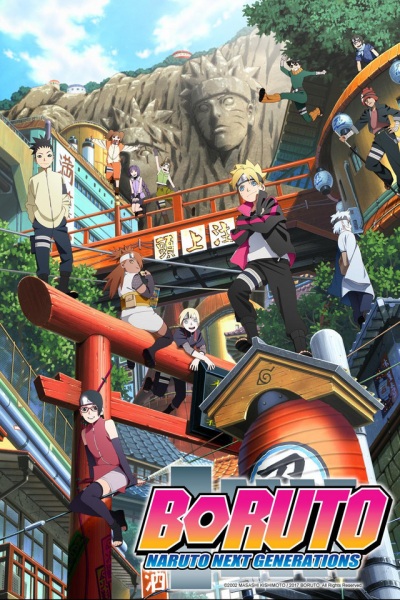

BORUTO -NARUTO NEXT GENERATIONS-
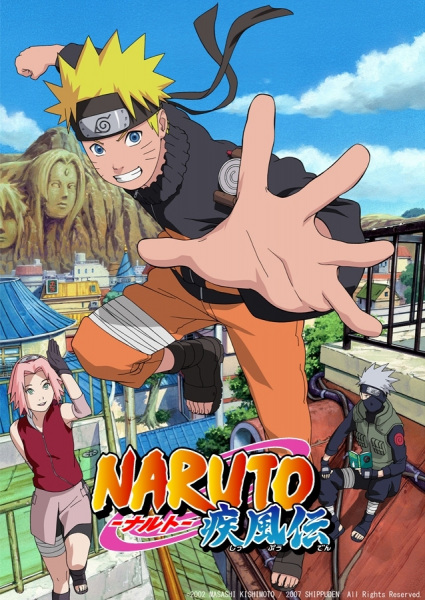
Following the successful end of the Fourth Shinobi World War, Konohagakure has been enjoying a period of peace, prosperity, and extraordinary technological advancement. This is all due to the efforts of the Allied Shinobi Forces and the village's Seventh Hokage, Naruto Uzumaki. Now resembling a modern metropolis, Konohagakure has changed, particularly the life of a shinobi. Under the watchful eye of Naruto and his old comrades, a new generation of shinobi has stepped up to learn the ways of the ninja. Boruto Uzumaki is often the center of attention as the son of the Seventh Hokage. Despite having inherited Naruto's boisterous and stubborn demeanor, Boruto is considered a prodigy and is able to unleash his potential with the help of supportive friends and family. Unfortunately, this has only worsened his arrogance and his desire to surpass Naruto which, along with his father's busy lifestyle, has strained their relationship. However, a sinister force brewing within the village may threaten Boruto's carefree life. New friends and familiar faces join Boruto as a new story begins. [Written by MAL Rewrite]
Main
Main
Main
Main
Supporting
Supporting
Supporting
Supporting
Supporting
Supporting
Supporting
rasterman7
March 26, 2023
After almost 6 years of mostly weekly new episodes, Boruto has come to a close... to its first part. It started airing very shortly after Naruto's story came to a conclusion and it had a tie in movie that it had to live up to. Did it manage to do it? No, not by a long shot. See, one of the main problems of having a weekly shonen that never seems to end is that once you run out of material to adapt you either choose to go the filler route or the anime canon route. The original Naruto went with the former and led toan infamous proportion of non relevant episodes, some quite badly scheduled might I add, to the point where you could spend an entire year watching and come out of it with nothing to gain from it. In this case, Boruto decided to go with the latter and the result was somehow even worse. Not only were some of those arcs dreadful to watch, their lack of quality showed in its poor animation and the same 4 tracks playing over and over again: the chill track, the conflict track, the battle track and the resolution track. It might be an exaggerated number that's the way it was perceived, more so considering that almost 90% of the show isn't adapted from the manga. One would say that this isn't necessarily a bad thing if the anime canon episodes tried to develop some of the other supporting characters in a meaningful way, and very few of them do. But alas, Boruto's classmates are mostly not as remarkable as the previous generation. I'm emphasizing on this aspect since the set of episodes that do adapt the manga well not only feature the best moments in the show with genuine emotion but also well choreographed battle sequences and a more engaging premise. Yes, not everything in this show is terrible, it does have some merits to it. As a result, it is my belief that if they had adapted only those sections in a spread out seasonal manner, the rating would have been much higher, maybe even surpassing the original Naruto. That of course didn't happen and I highly doubt the next part is gonna be any different.
Supporting
teodorsmith
March 26, 2023
Should you watch Boruto? If you want to see the continuation of the franchise, but you are reading mixed reviews, looking at the low score and thinking is it worth your time, look no further. First I want to start with the fact that I like the show, the main plot of it is at least on point and I hope, combined with what's coming, it might be a worthy successor of Naruto. However, the fillers are.... simply empty, as if you have just wasted 23 minutes of your life. My personal advice is to use Boruto Filler list and watch only manga canon, whileanime cannon eps are 20 min filler with a chance for 3 min major plot detail. Story: In terms of the episodes I've seen (skipped 221-286) I believe the main story is very good and it is going to get better "hopefully" in part 2. However the filler eps and some anime cannon are really *skippable* and just there to have something every weekend. Here you must understand that Studio Pierrot started animating Boruto so early on, even reached the manga, while having majority of their staff working on other productions such as Black Clover. The first 50 episodes are mediocre. Afterwards, until around 180 episode, the majority of the eps are simply bad in all directions, with a few 2-3 min major plot things happening. While the last 3 have been amazing. Overall, I believe any Naruto fan will enjoy the story without the fillers. Now if you are fan of the Shinobi World, the fillers expand it by a lot. Art: This one is hard. The animation changed a few times in some arcs. There were some quality animated fights as if I was watching the Kakashi vs Obito fight (nothing can be compared to that, I'm sorry), but some of the filler and anime cannon eps were atrocious in this part. As if someone opened Paint in a hurry, just so we don't watch the black screen with subtitles. The final two episodes had consistent and good animation, but I guess we can only hope part 2 to keep it up. Sound: The only consistency of quality in the show. Voice acting on point. Intro & Outro are masterpieces, the fighting and general OSTs are amazing. The only problem is they aren't diverse enough and are overused, but generally on point. Character: Mediocre at best. I mean you already have the characters from Naruto well-known to most of the watchers. New main characters, which evolve with the show and then you have everyone else - generic master race. Antagonists are potraied mainly as evil, with few exceptions. Note from me: Ao was an amazing semi-side character, that you are gonna see around 180s eps, if you decide to watch the show. Enjoyment: The show is "ok-ish" from my perspective. I really enjoyed all the major plot-driven episodes. Everything else is a waste of time, it is not even funny bad. Overall: Should you watch Boruto? - I think I've managed to answer that above. Always skip fillers! It's an alright show as continuation of the franchise, it just really unfortunate that Studio Perriot couldn't have waited a few years on this one. To produce it with more quality in terms of Art,Character and Story in the side chapters. I rate it around 7,5 without fillers (and 6 with them). Binge watchers will find it more appealing, while those who waited for an episode every week could have been easily disappointed and more harsh in their views. Disclaimer: Take this as more of suggestion than a quality review, as my main rating is around the main plot and important episodes.
JoJo523
March 26, 2023
Boruto is a sequel to one of the best animes I have ever watched but for me sadly it is not 10 percent good as naruto if you are hoping for that. Still, if you consider Naruto a completed anime then Boruto won't be that bad. for me, I didn't even watch half of Boruto instead I followed a list of episodes on the internet that have manga content and some other important episodes and it worked for me again despite that still it is not that good but I will say that the only thing that may be better than Naruto is the fights.Boruto has 3 or 4 top-tier fights, especially Naruto and Sasuke fights. I really didn’t think Boruto was necessary. In fact, I’m quite sure that the majority of people still watching this show are mainly doing so just to see what their old favorite characters are up to. I would’ve been perfectly fine with another show about Naruto as an adult, perhaps, but Boruto? Not so much so why Boruto is bad? The author wants you to forget how powerful naruto is and want us to believe that naruto is just some stupid old man. They want our love, affection, and every other feeling for naruto to disappear and want us to find those in Boruto who achieve everything without reason and logic but you can say who is so much smarter than his dad but the level of power he gets before even graduating is unlogical (Possesses three change in chakra natures/Subconsciously” added Wind and Lightning Release chakra natures to his Rasengan/had better taijutsu than all 5 Kage combined defeating Momoshiki) and not to mention his own unique overpowered dojutsu and he achieved all that in a week of training so the good training arcs became a one episode training Boruto’s villains will never match the likes of Madara or the Akatsuki (Shin’s Akatsuki? I’m sorry- are you serious?). In terms of personality, I’ve found that none of the Otsutsuki have been even nearly as enjoyable to watch- and although they’re definitely strong, in a way, they’re not quite as intimidating as those characters either. Do you remember Pain’s Invasion with Kakashi and Jiraiya’s death? The amount of pure emotion and terror those moments held was unexplainable. When we saw Madara running to fight the entire Allied Shinobi Forces, we could see each of them trembling and praying for their lives. And by the point that Boruto is currently at, Naruto also had Orochimaru, who at one point was just about the scariest person in the show. Naruto has some iconic villains with interesting motivations and beliefs — pain, Itachi, Madara, etc. But most of the Boruto villains are pretty one-dimensional, only interesting due to being strong. It makes them more boring and the interactions with them less interesting they are all a bad version of Kaguya The older characters are never shown as strong as they should be, naruto and Sasuke in particular are just pathetic — even before being literally nerfed by losing Kurama and the rinnegan I know it's not fair to directly compare the two series, and I am sure that the original manga of Boruto is really good, but it is currently in development and has not progressed that much yet. So the anime makers are just trying to keep things slow until the manga gets its way forward. But I don't think this is fair, making 80% of the series filled with unimportant stuff. They should have waited for some more years. But they wanted the attention of viewers and to keep them engaged. so I hope they wait at least a year or so before they continue the next season
Langris_123
February 25, 2024
The rating of boruto is just exaggerated. The show is not bad. It has perfect blend of old and new characters. I was hesitant while watching this after seeing the hate on the internet. People follow the trend of hate. This show is just the level of Naruto classic iif you only see the manga eps. The storytelling is also great. You wil feel nostaligic if you are a naruto fan. ik fillers are a headache bc there is nothing seperating canon and fillers. You can only watch these eps and you will not miss anything and you will be saved from the fillersEp 1,19-23,39,53-66,148-151,181-189,193-208,212-220,287-293 and also watch ep 13 and 14 bc there is a backstory of an important character in there
elumizu
July 19, 2025
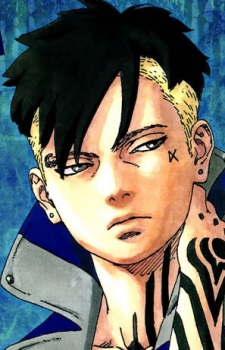
Boruto: Naruto Next Generations carries the difficult responsibility of continuing the legacy of Naruto while telling a story about a completely different generation. Instead of beginning in a world defined by war, tragedy, and survival, the story opens during an era of peace. The shinobi world has already endured its greatest conflicts, and the villages now exist in a time of diplomacy, technology, and modernization. This shift immediately changes the tone of the narrative. The struggle is no longer about surviving constant war, but about discovering purpose in a world that believes the worst battles are already over. At the center of this new erastands Boruto Uzumaki, the son of the Seventh Hokage, Naruto Uzumaki. Unlike the lonely childhood Naruto endured, Boruto grows up surrounded by stability, friends, and recognition. That difference becomes the foundation of his conflict. Boruto does not fight for acknowledgment, but instead struggles under the shadow of an already legendary father whose responsibilities constantly keep him away from home. The story therefore begins as a personal exploration of legacy, expectation, and identity rather than an immediate battle for survival. As the narrative expands, the series explores how the shinobi world adapts to modernization. Scientific ninja tools, advanced communication systems, and new forms of infrastructure begin to reshape the traditional image of what a ninja represents. Missions become less about large-scale warfare and more about maintaining balance in a rapidly evolving society. The story subtly raises an interesting question about whether tradition can survive in a world that is moving toward technological convenience. The scale of the narrative gradually widens with the introduction of the Ōtsutsuki clan. Figures such as Momoshiki Ōtsutsuki reveal that the source of chakra and many of the powers used by shinobi are tied to a far older and more mysterious origin. The story begins to suggest that the world humans believed they fully understood may only be a small part of a much larger cosmic conflict. In this sense, the narrative introduces a form of story complexity where the world does not revolve solely around humanity, but also around hidden forces and ancient beings that have existed long before the shinobi era. Boruto’s own journey becomes even more complicated through the Karma mark connected to Momoshiki. Karma acts both as a source of immense power and as a dangerous reminder that Boruto’s body is slowly becoming linked to a force beyond human control. This conflict pushes the story toward questions about destiny, identity, and whether someone can truly shape a future while carrying a power that was never meant for humanity. Characters such as Kawaki deepen this dimension. Kawaki’s traumatic past and complicated relationship with Naruto introduce themes of belonging, family, and the fear of becoming a weapon created by someone else. The dynamic between Boruto and Kawaki gradually becomes one of the emotional pillars of the series, hinting at the tragic future conflict shown in the opening flashforward. Despite these compelling ideas, the series does face several narrative weaknesses. Pacing remains one of the most noticeable challenges, particularly in the anime adaptation. A significant number of anime-original arcs sometimes slow the progression of the central storyline and can make the overall narrative feel uneven. The focus on the new generation also occasionally struggles with balance. Many young characters are introduced with potential for development, yet the story often narrows its attention primarily toward Boruto and Kawaki, leaving some of the broader cast underexplored compared to earlier parts of the franchise. Power scaling is another area that frequently becomes a point of criticism. The arrival of Ōtsutsuki-level threats pushes the scale of combat far beyond the traditional ninja battles that defined earlier arcs of the franchise. However, this escalation is also a natural consequence of the mythology introduced near the end of Naruto’s story. The world has already encountered god-like beings, so the conflicts in the next generation inevitably move toward that level. Much of the negative reception surrounding the series often stems from comparisons with Naruto itself. Some audiences struggle to accept the transition away from the older characters, while others view the evolution of power levels as a betrayal of the original tone. Yet Boruto is not attempting to retell Naruto’s story. The narrative deliberately moves forward into a new era where the old heroes are no longer the center of the world. Because of this, Boruto can feel surprisingly underrated. Beneath the criticism and expectations left behind by Naruto, the series continues to develop a story about legacy, modernization, and the complicated inheritance of power passed from one generation to the next. The journey may not always move smoothly, but the narrative direction suggests a much larger transformation waiting ahead for the shinobi world. Anyway, keep in mind that no opinion is ever purely objective, and every perspective remains open to discussion. Even so, each viewpoint still holds its own value. If you happen to see things differently, simple mutual respect is more than enough. That same respect is the spirit behind this reflection as well. Wishing everyone a peaceful day ahead, and thank you for taking the time to read.
Rank
#10672
Popularity
#216
Members
926,177
Favorites
7,444
Episodes
293