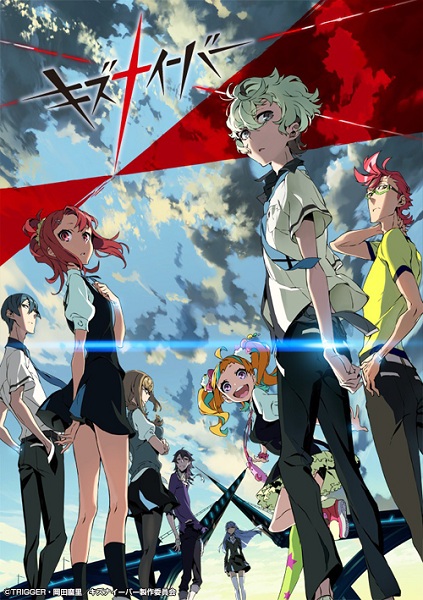
さらざんまい
After the noble Kappa Kingdom falls to the Otter Empire, the Kappa prince Keppi loses much of his power and becomes helpless against the unseen Kapa-zombies. These zombies plague the world, and are the creations of the Otters and manifestations of people's deepest desires. With no other choice, Keppi must rely on three young boys: Kazuki Yasaka, who must carry a box with him wherever he goes; Enta Jinnai, Kazuki's childhood friend; and Tooi Kuji, a delinquent and a school truant. By having the mythical organ called a shirikodama removed from them, the boys are able to become Kappa themselves and fight the Kapa-zombies. However, to defeat them, the boys must connect with each other via their minds, bodies, and—most importantly—secrets. As the Kappa Kingdom relies on these boys, they must reveal themselves as they have never done before, all the while learning that connections are fragile and truly precious things. [Written by MAL Rewrite]
Main
Main
Main
Supporting
Supporting
Supporting
Supporting
Supporting
Supporting
Supporting
Supporting
Harisrox
June 17, 2020
“I want to connect, so Sarazanmai.” As soon as I got to know that Kunihiko Ikuhara is going to direct this, I got excited for it. Kunihiko Ikuhara is a person who made his name in the industry for his uniqueness in series composition and storytelling which can be seen in his previous works such as Mawaru Penguindrum and Yuri Kuma Arashi. Sarazanmai is also one of his bizarre works and it has one of those Japanese folklore creatures called "Kappa", an youkai (妖怪). The first kappa introduced in the series is a Kappa prince named "Keppi" whose noble Kappa Kingdom fell to the OtterEmpire and now the Kappa prince Keppi has lost much of his power and became helpless against the"Kapa-zombies" whom are invisible to humans, these zombies plague the world, and are the creations of the Otters and manifestations of people's deepest desires. One day, second-years in middle school Kazuki Yasaka, Toi Kuji, and Enta Jinnai (The three MCs of the show) get to meet Keppi by coincidence, Keppi steals their shirikodama (It translates to "butt-small-ball" it's a an organ that the kappa can extract from the butt of a person) and transforms them into kappas. "To return to your original forms," Keppi tells them, "you must fight the zombies and take the shirikodama from them." According to the legends, the kappa would drown people in the river and then extract their shirikodama. So, you'd see the MCs using the gush of water to finally get shirikodama from the zombies. And all of this might not make sense to many but it's one of it's standing points. Art and Animation 8/10 The background art was good, character models were somewhat generic but their outfits made them stand out, however the background characters were literally silhouettes which is pretty common in Kunihiko Ikuhara's works. The animation was super fine plus it had all of the characters dancing and singing from here and there. Can't stop myself from mentioning how the ED was literally one of the most aesthetic EDs I've ever seen! It was done by Tao Tajima, a Japanese filmmaker. Sound 9/10 The series had 31 OSTs each character having a unique one for itself, didn't like the opening song (Massara by KANA-BOON) as much as I liked the ending song (Stand by me by the peggies) do check it out, it's pretty cool. Characters 7/10 The series initially introduced 3 MCs: "Kazuki Yasaka", who must carry a box with him wherever he goes; "Enta Jinnai", Kazuki's childhood friend; and "Tooi Kuji", a delinquent and a school truant. Even tho they all have distinct characteristics but they do have something in common such as relations they cherish and want to protect and secrets they want to hide which are revealed throughout the series. Then we have Keppi, the kappa prince who serves as a mascot. Sara, an idol-like person, loved by many does TV-shows. Haruka, Kazuki's younger brother who loves Sara. The gay police officer dou: Reo and Mabo, the only characters I didn't like in this series. Chikai, Tooi's older brother and somewhat his everything. Enjoyment 9/10 I enjoyed every bit of it except the sequence where the gay police officer dou would come and dance, it was cringy and unwatchable for me. There were a lot of Japanese puns which I don't understand how they might've pulled in the dub. And it had many cultural Japanese references and references to other anime as well but none of it could stop me from enjoying it, the show deserves more praise for how much of this stuff Kunihiko Ikuhara stuffed in it. Overall it's a solid 8 from me, only if I could understand all of the the cultural Japanese references and puns, it could've been a masterpiece to me.
altdelkk
October 23, 2024
Sarazanmai it's a unrecognized masterpiece. I accidentally watched this with my father by doing a roulette, and we started watching with low expectations. We laughed so much at the first episode, so we decided to go on. This is with no doubt my favorite anime ever. It looks weird at first, but after watching it, you will get the feeling of crying. I find it surreal how underrated this is. And everything about this anime is perfect, from start to end. It has the trick of making the viewer question everything that is happening, in a funny and weird way, which makes this even moreenjoyable. In each episode, you form a new thought, and newer questions, which in the end are answered in a beautiful story of friendship and connections. I have learned from this anime the importance of connections, and how hard it is in various perspectives. 10/10.
Stark700
June 20, 2019
Sarazanmai is Kunihiko Ikuhara’s first director project since 2015. It’s been four years since we were graced by his body of creativity. This man is no doubt a legend. Whether you enjoy his style of creative content or not, he has been involved with outstanding anime that people still talk about today. These include the iconic Sailor Moon, the infamous Revolutionary Girl Utena, and one of the most bizarre shows of the past decade, Mawaru Penguindrum. Yuri Kuma Arashi may have been one of his lesser known projects but to make a comeback with this show called Sarazanmai is a feat of itself. Be preparedto be graced again by his absurd talent that few can step into the shoes in. To ask the obvious, what is Sarazanmai really about? Looking at the synopsis will probably raise a few eyebrows just judging by its bizarre plot. Within the first episode alone, we are introduced to mysterious creatures based on the amphibious youkai demons known as kappa. Anyone who is familiar with Japanese folklore will recognize their character design. With their green bodies, duck-shaped mouths, and long legs, you can’t help but find this show to be decorated with bizarreness. Of course, this isn’t a big surprise considering Ikuhara’s unorthodox style. What actually make a break for the show is the unusual storytelling. With our main characters connected by the bizarre creature known as Keppi, this evolves into a labyrinth of crazy adventures. Indeed, the opening episode of Sarazanmai is devoted to establish our main characters – Kazuki Yasaka, Tooi Kuji, and Enta Jinrai. Their personalities are what you can easily find in middle school students. However, the show’s story reveals more about their secrets with every episode. This connects to the overall tone of the main plot as the boys are tasked to collect the Dishes of Hope for Keppi. As strange as it sounds, the overall execution of this idea makes a lot of sense. It helps us understand these boys besides what they seem to be on the surface. On the other hand, there are also two policeman – Reo and Mabu who fights against Keppi’s Kappa Kingdom. The show sets a tone for carefully exploiting characters’ motives. With Reo and Mabu’s involvement in the plot, everything gets even more complicated. But truth to be told, Sarazanmai itself is not an overly complicated show. Some longtime fans of Ikuhara may take time to get used to this anime as it’s his first directing project with a main set of male characters. However, don’t let that alarm you. His unorthodox style can still be felt with the overall craziness of the show. As one of the core themes, we have character connections. The show builds on how humans convey their feelings and hidden desires that each of us have. The elephant in the room can also be addressed as well with some noticeable BL tones. It’s hard to pinpoint the exact meaning of this show as a whole but understanding the connections and desires of the characters is ever so important. On a scale of 1 to say…100, Sarazanmai can be judged for a variety of content. Ikuhara delivers his own creativity that does a lot more than just telling or showing. Sometimes, I feel like he can write just about anything he sets his mind on. Even before I watched the first episode, I knew what a ride this would be with the charismatic character trailers. The show seems to communicate through visual dialogues and graphic sequences. What we have here is more than just a straightforward story. In fact, many of the first episodes follows a monster of the week format but always staying connected to its central themes. Asakua (the setting of the show) is also a beautiful place for this show’s motifs. However, don’t be alarmed if you’re not Japanese. The show may take some more time to digest but once you get sucked into this, there may be no turning back. Of course, it’s easy to say Sarazanmai is a niche type of show. You either like it or will reject it as a dumpster fire. Anyone who is unfamiliar with Ikuhara’s creative mind will get lost easily. Hell, it took me a half dozen times to get this show myself. Also, I wouldn’t say the story itself is outstanding. To believe that sounds outlandish considering at least half the show follows like a loop-like format. There’s not much plot developing despite different events happening. To say the least, I’m not too surprised by the overall content of this show’s plot elements. Still, there’s definitely praise to give for this show with how eyecatchy it is. The charismatic dances is one of the prime examples of being able to hook a viewer on in the early stages. While not being an idol show, it’s distinctive of how much energetic aura it contains. Just looking at a group of kappas performing in outrageous dances will get you staring at your TV. Guess what? Kunihiko Ikuhara is back and he brings with him his avant-garde creativity. What Sarazanmai delivers is a show people will talk about for many reasons. The most common one is just how peculiar it is especially in regards with the overall execution. There’s a set of characters that brings you human emotions despite how offbeat the show may get. You may have to watch this more than once to really appreciate what it is. But for now, I just want to say, welcome back Kunihiko Ikuhara. Welcome back, you magnificent Brainaic.
Karhu
June 20, 2019
Sarazanmai is a prime example of a show that falls under style-over-substance, and those who are aware of the industry's state should already know that this field of anime hasn't exactly been very praise-worthy in the recent years. This is.... an addition to the overall selection we have. Not much more since its substance is so lacking that it lessens the impact of its style + those who know the director won't see anything new. Moreover, it recycles animation and entire scenes to such extent that it becomes partially skip-worthy. The repetition level is extreme, especially during the first half of the show. If we lookinto the audiovisuals and directing, Sarazanmai comes with high values. Directed by Ikuhara Kunihiko, Sarazanmai was expected to be a polished work driven by passion, and, if we limit our judgement to production and ignore the repetition, it's easy give a *shrug* and say "yea, whatever". It's hard to agree and almost as hard to actually care. When exclusively looking into technical achievements, practically any term relevant to art, art directing, visual execution and animation techniques could be described with a wide spectrum of praising adjectives. I don't see the point in doing any separate writing work to go into detail with this. In short, if you want to see how good modern anime can look like, this is your must watch series from this anime season.. unless you have any other type of demands in which case watch something else because it still sucks. And now to why this show is not very impressive from other departments. Assholes. I am not entirely sure why this work was so deeply inspired by the action of inanimate objects and living things alike entering and leaving the anus(es) of all sort of weird looking monsters and whateverhteshits, but it happens to unbearable extent. It just feels childish and, well, shit. Something that could have easily been avoided ends up playing significant role in the series. Since this was clearly a driving factor in the director's own vision, it gives an unnecessary bad impression of the entire show already early on, and due to it being one of the scenes that are repeated almost every damn episode, it is hard to overlook. Then we have the characters, who... exist. At least most of the time. I am already done with this criticism , by the way, because there just really is nothing to talk about for the characters are quite literally "nothing". Okay, bit more: It becomes obvious soon after the start that the entire cast is just a part of the animation and story, sometimes nothing but tools that exist in that moment for no other reason than to act out a lame joke. Due to this, the main characters' own, non-existing personas rarely have the opportunity to put weight on any action. To make it clear as possible: this show doesn't have a single character who could be considered an actual self-aware person who has their own will. Finally we have the story. What the series is trying to say I do not know. There are weird creatures, beings that are neither dead or alive, otters/liars (word play that only makes sense in Japanese), bad and good people (note the lack of quotation marks), flying 'everything', police force ran by dudes whose entire beings are build around homosexual undertones, cross-dressing celebrities, at least one furry and kappa + gay frogs, also; truck-kun has his 1 second cameo just to run over someone. This could as well be placed in the character section, but since none of these described.. elements have any actual character value -- rather, their features are limited to what they look like and what type of a role they have in the story -- you see them here. The story events seem to be a rather obscure collection of highly random things that simply occur and not much more. Most things are rather loosely connected to each others because apparently, it's really important to make the whole thing seem mysterious even if it makes the entire story the opposite of coherent. It was hard to find any real importance or significance from the anime itself. Nothing seems to really matter much. Meaningless little tales that all play out the exact same way. After episode 01, you have seen it all, figuratively. The dialogue and Sarazanmai's themes center mainly around being connected, desire, something something meaning of life and also love exists + cats are cool, and desire twice. But at the end of the day, all it has here is its style, the rest is secondary, dragging miles behind the audiovisuals, which also got old immediately after the start. All of these things mentioned above collide and create one hell of a weird combination. Series which core idea seems to be resolving around "desire" and "love" shows no passion, no soul and has personality-lacking characters that are not, at least in my standards, not even passing the requirements of being characters. My main question is this: How can this "desire" and "love" reach anyone under complete absence of resonance? Object don't feel either and self-insert is close to impossible. From viewer's perspective, all I can say is this show didn't even try to make me like it. "Look at me" is all it wanted. Then it asks to look at it again 10 more times, but essentially, you're just rewatching what it did already on the first time. It's not all, 100% bad, but each time when it looked like my opinion could change for something more positive, the series threw in some incredibly generic/filler-ish drama (such as the cameo of truck-kun, like mentioned before, and scene which slaughtered the heroic sacrifice trope) or alternative close up of a g-frog's twitching asshole giving anal-birth to an object the size of their own head. I am not making this up, just to be clear here. Do I recommend this show, then? I watched it for the production and saw just about everything it had to offer by the end of episode 01. I also found it hard to accept the show without complaining about some of the decisions that were made, some of which were just downright cringey, others which just come out bland and left so little impression that they weren't enjoyable even in the given moment. The style wasn't enough to make me overlook all the things that I found to be meaningless or just garbage, which formed a decent pile by the end. After the finale, I can conclude this series is incredibly forgettable and, just like most modern anime; became irrelevant the second it ended. That's a "no" in English.
AndoCommando
June 20, 2019
“I want to connect, but I want to lie.” Sarazanmai presents two sides of the same coin. On one side, we have desires; the sense of longing and hoping for a certain outcome. Often considered an innate part of our humanity, they can also be attributed with the darker aspects of one’s personality. They’re the deep secrets we hold to ourselves, not wanting the world around us to know about, and dreading the thought of if they were found out. But as much as the show focuses on desires, it’s just as focused on connection. The world is comprised of all kinds of connections, whether byblood, through communities or even with similar desires. We are all connected in some way to one another… But connections can be broken just as easily as they were formed. And even with a desire to connect with others, can we truly form the connections we want with the desires we hold still intact? “I want to connect, but I want to take.” Sarazanmai is the latest series of one of anime’s most stylistic and socially-conscious directors in Kunihiko Ikuhara. His ability to tackle thematic topics such as love, adolescence, destiny and power hierarchies through surreal plotlines and symbolism is arguably unmatched in the entire industry. Lauded as a visionary by fans, Ikuhara seems to increasingly escalate the bizarre nature of his works as they’re churned out. Sarazanmai does little to change this notion, taking viewers on a journey that’s honestly hard to describe on first impression. It should come as no surprise that the show can be very difficult to follow at first despite how overtly direct it is in its ideas. There’s such a unique blend of sexual symbols and homoerotic imagery on display that could easily warrant essays analysing just those aspects. But my interest in the show lies more in the characters here, with Ikuhara having crafted in my opinion an oddly compelling character drama in the span of 11 episodes. “I want to connect, but it’s not meant to be.” The main cast of Sarazanmai consists of three middle school students, all vying to protect the desires they hold dearest. The first of the trio to be established, Kazuki Yasaka, also happens to be the most fortunate of the group on the surface. Liked and appreciated by practically everyone around him, it’s not until his more startling hobbies are brought to light that reveals a clearer picture of Kazuki. He’s a child burdened with self-guilt, feeling responsible for crippling his younger brother because of his own selfish wishes, and as a result tries giving him the happiness he felt was taken away. But make no mistake, Kazuki’s actions are made for his own sake, not his brother, and show a fundamental flaw in his character: maturity. Kazuki understands his own mind and wishes, but is unable to recognize the minds of others, and without the latter remains wary of the connections he still has. Until he’s able to appreciate others more, his struggle with connection can only continue. “I want to connect, but you’re so far away.” Toi Kuji is an interesting case in that he acts as a direct opposite to Kazuki initially. The delinquent to Kazuki’s upstanding persona, he ironically counters Kazuki’s self-centredness through being the most empathetic and mature of the three. He understands the feelings and relationships of others best, and despite some troubles with communicating his own thoughts, connections can be formed with others. But in Toi’s case, it’s not so much about forming them, but preserving them. Toi underneath his mysterious nature and dubious actions does have respectable desires – to save the soba shop his parents owned and to get away from the illegal circumstances his brother pushed him towards. From an early age he was taught of the importance of familial bonds, though under the inkling that it ultimately came at the cost of other potential bonds. However now he arrives at a crossroad between preserving the relationship he has with his brother, or valuing the connections made through friendship more. Maybe more importantly, is he worthy of having these new connections? “I want to connect, but I can’t be forgiven.” Enta Jinnai is the last of the three to be enveloped in Sarazanmai’s story, whose desires are probably the most simplistic of the group, but still a core part of his character. Unlike familial love or friendship, the kind of connection Enta yearns for is romantic love, specifically toward his best friend since childhood, Kazuki. But as much as Enta might try to form that connection, his feelings are not reciprocated. Enta can clearly be seen as cheerful, innocent and the one with the least amount of baggage, but overtime it’s readily apparent how frustrated and fearful he is about Kazuki and his situation, at times even hallucinating about what his ideal romantic relationship would be like. A connection already exists between the two, just not the type he honestly wants most. A solution may seem obvious to us as onlookers, but if it were us, what choice would we make? Abandon this desire for unrequited love with someone who has never registered these emotions? Keep these strong feelings bottled up for fear of losing your closest and possibly only friend? Or end up pursuing them, and risk falling in a cycle of heartache as a result. “I want to connect, so I won’t give up.” Three distinct personalities all different from each other are brought together through the strangest of ways – being transformed into kappa and having their shirikodama removed from the anus, before having to fight zombies and remove their shirikodama in order to become human again, assisting the Kappa kingdom in their ongoing war against the Otter Empire. The premise is certainly original, but the themes are what take centre stage here. How connections between people are forged, strained and how that pain can affect each other being the most overt example, but for as much as the series shoves connections at the audience, the relationships between the cast are formed rather organically. The way each character’s darkest secrets are revealed after each fight is what leads to the natural bonding in the show. There’s a trust created as they rely on one another whilst holding their own goals that would put each other at odds, a dynamic rarely explored in anime and is reinforced through the explicit symbolism. But these bonds may also speak to the level of trust required in a world not accepting of their desires, with the backdoors of society being the one place where people can freely express themselves. Or perhaps the world is not as it seems, and in reality is controlled by an industry feeding and profiting off our desires through corporate means. Or maybe it’s just saying that it’s ok to be gay. This is both the beauty and difficulty of Ikuhara’s works; always shrouded in so many visual metaphors that it presents itself as a puzzle, almost devoid from the typical standards of storytelling but still encapsulating a myriad of ideas and messages, to where viewers are inclined to decipher the dense tale themselves. It’s not a style that everyone will enjoy, or even acknowledge, but for those who do, it’s part of the charm, something that is constantly gleaming off of Sarazanmai “I want to connect, but I want to betray.” Now while I am personally a fan of Ikuhara and this series, there are some glaring issues I have with Sarazanmai, most notably due to how this eccentric tale is contained in only 11 episodes. Ikuhara, as beloved as he is by many, is known for his many tropes, from wacky animal hijinks and overly flamboyant poses, to increasingly surreal and almost gratuitous imagery, to the worst of his traits: his re-use of animated scenes. Sarazanmai features all of these quite regularly throughout its broadcast, to a degree where it can be no longer inviting for viewers unfamiliar with Ikuhara’s work. But speaking for myself, watching so many of his trademarks on display leaves very little room for the show to breathe when it needs to. The director’s previous work, Yuri Kuma Arashi, is the worst example of this. To quote a review for the series: “Watching Yuri Kuma Arashi is like trying to memorize the first 100 digits of Pi. Succeeding might technically be considered an accomplishment, but good lord is it meaningless.” Thankfully Sarazanmai does not become this insufferable, staying a joy to follow moment by moment whilst remaining coherent on top. But the quirks do leave their marks on the series. For a show so based around connecting to its characters, the audience is given little incentive to care for the characters in the first place. Factor in the repetitive tropes, a breakneck pace and a script that beats the term “connection” into your skull, and as a result we’re left with inconsistent development and key events not able to fully capitalize on their emotional impact. I truly believe it would have benefited from having more time available to explore the world, the cast, their backstory, etc. in order to tell a more complete story without rushing to the finish line. But alas, we fans get what we are given. “I want to connect, but we’ll never meet again.” Ikuhara’s history as a director is riddled with him having to compromise in some way on most of his projects, whether it be the numerous limitations that faced the production team for Yuri Kuma Arashi, or him completely abandoning his position on the Sailor Moon TV series. But with Sarazanmai, it’s hard to tell if there were any issues the crew faced. Very rarely does an anime emerge with the kind of intensity that Sarazanmai brought in the first episode. At face value, the show is visually stunning, using a multitude of vibrant colours and attractive character designs that immediate distinguish it amongst the crowd. The show has a knowledgeable understanding of colour theory, with red, blue and yellow used to help define the personalities of the main trio. The series also features a surprising amount of action that’s animated very well. I find it extremely praiseworthy that despite MAPPA being credited as the main studio, the first 4 episodes were produced by Ikuhara’s small team at Lapin Track and look no different from MAPPA’s work on the project. The show is like an explosion on the screen, bringing Ikuhara's vivid creativity and imagination to life. “I want to connect, but I can’t express it.” The music for Sarazanmai is fantastic and well-voiced even with how repetitive it can be. Each of the fights feature the same tracks over re-used animated footage of the same dance sequence most episodes. The show takes inspiration from musicals with how it uses a mixture of diegetic and non-diegetic songs that help propel plot and character development, another rarity to be found in the medium. The themes of desires and secrets mesh well with the musical format, utilizing the basic structure and common song format to help give the series a theatrical essence in these moments. The voice acting is also excellent in conveying the appropriate tone, clarity and emotions required from each scene, effectively helping to humanize the characters. The soundtrack was composed by Yukari Hashimoto who also worked on the soundtracks for March Comes in Like a Lion, Toradora, Osomatsu-san and one of Ikuhara’s other works, Mawaru Penguindrum. Yukari has a knack for combining traditional Japanese motifs with modern electronic-style music to create a collection of tracks that’re uplifting in their own distinct way. The opening and ending themes are also bangers if that means anything to you. “I want to connect, but I can’t.” Sarazanmai, as much as I may like it, is an anime I find difficult to recommend, simply due to how hard it is to describe the kind of experience someone is in for. And in a way, that’s how Ikuhara’s works differ from the norm. There’s a story to be found and characters to move it forward, but they rely on interpretation to the point where my experience could end up completely different to that of the average anime watcher. But what I will say is that Sarazanmai sums up a bit of every original work from Ikuhara: The structure of a battle closing each episode with meaning behind each foe faced from Utena, the comparison of love and desire from Yuri Kuma Arashi, and the way society works with a shredder to destroy what the world doesn’t accept from Mawaru Penguindrum, all while maintaining its own identity. Sarazanmai is a weird show, but the weirdness is not complicated, as it constantly bears two sides of the same coin. Connection is an important part of the show, and our lives, but the show is also about hidden desires – the embarrassing parts of ourselves we don’t wish to share. The truth is we all have weird parts about ourselves, and we’re afraid we won’t be accepted if we admit those things. Yet in Sarazanmai, admitting those desires allows for real human connection to foster, and there’s something worth fighting for in that. “I want to connect, so Sarazanmai.”
Rank
#2270
Popularity
#1828
Members
142,614
Favorites
1,411
Episodes
11