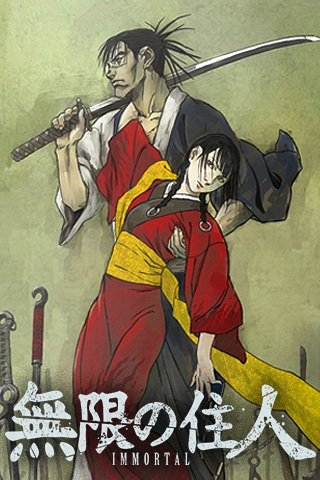

Blade of the Immortal
無限の住人-IMMORTAL-
Manji is an infamous swordsman in feudal Japan who is known as the "Hundred Man Killer," as he has killed one hundred innocent men. However, there is something far more frightening than his ominous reputation: the fact that he is immortal. This is the handiwork of eight-hundred-year-old nun Yaobikuni, who placed bloodworms capable of healing almost any wound in Manji's body. To atone for his crimes, Manji resolves to kill one thousand evil men. Yaobikuni agrees to this proposal, saying that if he succeeds, she will undo his curse of immortality. Soon after this promise, Manji meets Rin Asano, a 16-year-old girl who requests Manji's assistance in killing those who slaughtered her parents. Initially reluctant, Manji refuses Rin's desperate plea. However, owing to her evident lack of strength, Manji changes his mind and agrees to protect Rin for four years. With this partnership set in stone, the two embark on a perilous journey of bloodshed, vengeance, and redemption, each to fulfill their own life's cause. [Written by MAL Rewrite]
Main
Main
Main
Supporting
Supporting
Supporting
Supporting
Supporting
Supporting
Supporting
Supporting
SingleH
March 25, 2020
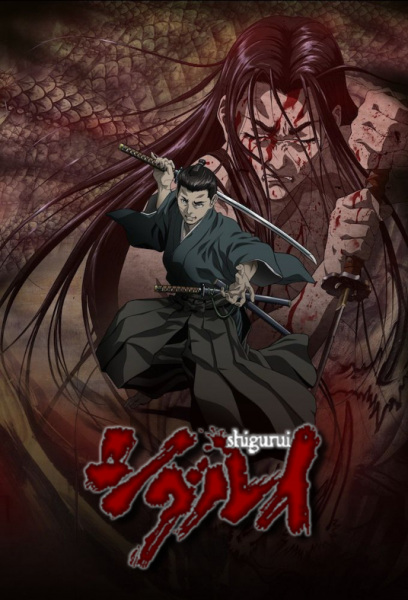
What defines a disappointment isn’t what you got, it’s what you expected. Blade of the Immortal is one of the most illustrious manga titles to date on the back of its artwork alone. No critic worth their salt has ever paraded Blade of the Immortal on the quality of its writing, characterization, storytelling—none of it. It’s all on the art. And rightfully so, so when I see it getting adapted by LIDENFILMS, a studio whose prettiest production to date, Hanebado!, had to rely on the trusty ol’ rotoscope to stay standing for even a single cour, the last thing I expected was an anime whichhad even a whole percentage point of the visual fidelity the source material made itself famous with. What I did expect though—and certainly not from the LIDENFILMS name—was an utterly irresistible tone only director Hiroshi Hamasaki could deliver. Hiroshi Hamasaki is an industry veteran in every sense of the title, and while many of the younger members of the community will’ve probably fallen asleep or scrolled away from this review by now, those aware are sure to be intrigued at worst and excited at best by the mention of his name. Personally, I’m in love with the man, and while I recognize works like Shigurui and especially Texhnolyze were what they were on the profound strength of their writing and conceptualization more so than their visual direction, I can just as easily recognize how said directorial tact of this legend has carried less thematically or emotionally exceptional works all on its own. Be it good shows like Steins;Gate, bad shows like Terra Formars, or even purely artistic pieces like episode seven of Paranoia Agent, all of Hamasaki’s works have been imbued with an alluringly suffocating tonal aesthetic, and Blade of the Immortal boasts the same, but only when it could afford the price of admission. Literally. As my score suggests, I wasn’t all that disappointed. Studio LIDENFILMS is no industry giant, nor are they even a noteworthy player. The studio is under the publication Ultra Super Pictures, which produces a lot of the more—for lack of a better term—eccentric animation studios. Be it Hiroyuki Imaishi’s Studio Trigger, Gonzo’s CG subsidiary Studio SANZIGEN, or Yutaka “Yamakan” Yamamoto’s Studio Ordet, Ultra Super Pictures prides themselves on platforming those who’ll find little success with more corporate minded producers, and LIDENFILMS began as no exception. Whether it be ambitiously attempting to revive a Yoshiki Tanaka classic with their remake of Arslan Senki or making their debut with Senyuu, a short-form gag comedy directed by the aforementioned sensation that is Yamakan, LIDENFILMS began as a home for passion projects, but as time went on and money presumably ran out, the studio began settling for increasingly lifeless projects. Among these cynical jobs taken to keep the lights on, LIDENFILMS has worked hard to continue turning out creative works, and Blade of the Immortal is the latest addition to this roster. Intentions aside, though, Blade of the Immortal is…ugly. The color design is good, because Hamasaki, but the actual coloration in practice is uneven, poorly shaded, and overall, radically inconsistent. The shot composition is good, because Hamasaki, but the utterly insufficient animation direction betrayed nearly all the visual flair available from such cinematography. The sound effects are good, because Hamasaki, but despite the sound designers being more than competent, the choppy key animation makes all but the ambiance seem off kilter and messy. Now, I understand all this may come as a bit of a surprise to those of you well-versed in the genre and the names involved, because Shigurui, an aforementioned work directed by Hamasaki back in 2007 and animated by Studio Madhouse, was heartbreakingly gorgeous despite being fairly conservative with its animation. Shigurui is a samurai drama in much the same vein as Blade of the Immortal, and as its team was miles more talented, it managed to be prepossessingly engaging despite its sparse animation. I’m not denying the fact this adaptation was hard to mess up. I'm just saying they did mess it up. Though, I guess they didn’t mess up the story. As I initially teased in the introduction, Blade of the Immortal is no piece of literature. It’s an artbook, but to say it has nothing on paper would still be something of a disrespect. Blade of the Immortal is a wondering samurai tale about Manji, a cursed samurai hellbent on revenge on those who killed his sister, and Rin, an orphaned girl hellbent on revenge on those who killed her parents. As it happens, these two villainous parties just so happened to have been the exact same people, so having met, our companions unite under their common goal on a quest for vengeance. However, as it also just so happens, Manji is straight-up immortal, so while the story itself amounts to episodic encounters proceeding the exact main conflict which you would expect, the garnish atop such a standard structure which makes it all worthwhile is what little aesthetic style Hamasaki could wring out of the production staff and what sensational amounts of blood and guts the original creator could wring out of Manji. Though I will say, my own opinion having already been stated, I’ve seen no shortage of manga fans complaining about the pacing of the anime. Apparently, the anime adaptation flies through the manga’s narrative at a breakneck pace, and if you’re now wondering why I didn’t complain about the overload of information you’d think would be a side effect of this decision, it’s because the manner in which they sped through the story was by heavily cutting it down, not speeding it up. While more moderate manga fans claim the cut content was unnecessary anyway, I myself can personally guarantee it, because I watched the anime just fine, and to be frank, if events happened at any slower a speed than they did, this show would’ve been one hell of a slog. After all, no story with this little going on under the surface needs to be extended to any greater run time than absolutely necessary. At the end of the day, when it looked good, it was absolutely bewitching, and when it looked bad, it was still a competent if cliché story. The quality of animation was already waning by the end of the first episode—no joke—but at the same time, the fist five minutes of that episode were downright cinematic genius straight from the creative vaults of the priceless mind of its legendary director. If this was an arthouse adaptation by a studio that could handle it, or even if it was made by the same staff only instead into a film or short OVA series with a higher quality of animation and even less attention to an already uninteresting narrative—as long as it was in favor of a pure tone piece—I could easily recommend it to anyone and everyone who’s down with some gore. As it currently stands, though, I’m afraid it’s far too tiring of a time commitment wherein the viewer is forced to indulge a production which proved itself to be able to deliver on some serious aesthetic perfection right off the bat, but which literally hasn’t the means to continue delivering said visual displays on a consistent basis. Ultimately, it seems I can only confidently recommend Blade of the Immortal to those taken with Hamasaki’s style like myself and unfazed by the prospect of wading through the many hours of mediocrity to get to the few minutes of excellence, those who are just samurai otaku and will enjoy anything in the genre which isn’t abjectly awful, or those who are honest-to-goodness bored with anime and just want a gaudy passion project to shake things up, even if said project barely had the production chops to be gaudy about anything. Thank you for reading.
poemofdevil
March 25, 2020
This was a great show. It started out rough. I didn't like the first three episodes that much, but I was drawn to the character and the concept so I stuck with it. I like the more adult/violent stuff... And this has an immortal wisecracking samurai. What's not to love? I couldn't be any happier about my decision to stick with the show more so than how I feel today having watched the finale. That was excellent. From episode 4/5 to the end I had a blast watching this every week alongside Vinland Saga in the fall, and alongside Dorohedoro this season. It was consistentlygreat every week. So, the main problem with this adaptation for most viewers should be the story. I haven't completely read the manga (I've only just begun) but I am aware that they have cut some material out and have rushed through some of the things they adapted. Despite not being aware of what was cut, it definitely did feel disjointed at times. That aside, every other aspect of this show was fantastic. Great voice acting. Great music. Nice animation. Maybe not the quality of Attack on Titan or something fancy like that, but still excellent most of the time. I loved the direction and style I saw in these episodes. The closest anime I could compare this to is Shigurui. I loved the Shigurui manga. I was somewhat disappointed by the anime adaptation. This show is what I wanted the Shigurui anime to be. It has life and style to it that was missing from that other show. I couldn't recommend this show more.
zolla_lucky
July 31, 2024
I saw the cover of this anime, it seems interesting because of the story setting, in ancient times. I found some scenes uncomfortable to watch, too much abuse of cute girls and boys, this anime has no morals, the main character is too selfish and childish. At that time I watched this anime at the beginning of covid, because I had free time and was curious because it seemed like it would be exciting, there would be action or sword fighting, it would definitely make me in a good mood at that time, but it didn't. It took me 3 weeks to finish this anime and 4 monthsto overcome my depression, then I went to a psychologist. thankfully I can still distinguish between reality and anime.
CodeBlazeFate
March 26, 2020
The silver blade cleaves the skin, ripping, tearing through broken flesh. A sea of scarlet spews, transforming into rain dancing amidst the blade that released it. The body broken in two, now covered by a cascade of carmine droplets as numerous as the lives cut short by the sword and its wielder. The loud eruption is followed by silence as the chaos settles into tranquility. It’s a scene characterized by its duality. There’s a strange sense of serenity to Blade of the Immortal 2019. For all of the vile horrors it presents as rape and death are littered across the show’s 24 episode run, there’s astrange sense of tranquility and naturalism to be found in much of it. The world presented by this show is a cold, often quiet one where almost everyone will die or suffer immense pain and bloodshed. Despite this, characters can still have a peaceful dialogue about poetry or engage in several moments of levity and comedic relief that do not feel forced. There’s so much to love about this show, yet all the same, there’s a lot that holds it back. This all stems from the 24 episode runtime the show had, as well as the studio that took on the project. Let’s start with the visuals. An action show is certainly incomplete without its fight scenes. Sadly, Studio LIDENFILMS had significant problems delivering, as most fight scenes resorted to a myriad of quick cuts in place of actual animation and choreography. It often felt like characters were teleporting during these scenes, and there were several admittedly brutal impacts that somehow felt weightless. I doubt anyone is gonna look at the studio and expect brilliant fight animation on the level of what the best Sunrise, Bones, Production IG, or Ufotable productions can put out. However, even with the studio rarely putting out a work anyone has praised for its animation, it’s startling to see moments as jank as some of the running animation in episode 19 and 20. On top of that, there are several moments --especially in the first episode-- where we just see extreme close-ups flashing as background colors flicker white and red. While the intent was likely to show the insane brutality of these violent, bloodthirsty moments while saving on animation costs, these scenes are borderline epileptic. The background just becomes a bunch of strobe lights that cause pain or at the very least, significant discomfort. Lastly, the artwork is relatively fine and consistent for the most part, but it becomes rather difficult to tell characters apart barring those with more distinct designs. There are some significant saving graces to the production, however. Miraculously, the CGI is not only sparse but actually ok. Very few scenes display them and they’re only used for swords that look as metallic as humanly possible. Moreover, there are still several gruesome impact shots that look either beautiful and artsy, or downright devastating. If only the contents of the fights transitioned into those moments better, as there are several gory explosions that look absolutely majestic. While he and his team at LIDENFILMS don’t seem to be too cut out for action, Hiroshi Hamasaki proves to be a wonderful director, presenting dazzling, sometimes imaginative sequences. There are certain nigh-picturesque shots of Edo period cityscapes and nature in general, sometimes transitioning between one beautiful shot to another such as in the finale when we transition from one of our main characters to the sun which her silhouette is placed in the center of. Several quiet moments are captured beautifully through shot composition, conveying the tranquility that parades much of this anime. There are also scenes where certain characters’ mental states or perceptions are warped in the latter half of the show, and they are captured vividly. The fight scene with a crafty old man in episode 21 as well as the sequences in episodes 15 and 16 where Dr. Burando loses his mind out of the sheer grief of his experiments resulting in people’s deaths are prime examples. I cannot begin to describe how vivid and disturbing these scenes are. Did you notice how I was only able to name one of the two characters I mentioned in the previous paragraph? That brings me to another problem with the show. There are so many characters to keep track of, and a lot of them don’t get the time they need to stand out or even be identifiable. The prime example of this is the miniboss squad one of the antagonists, Kagimura Habaki, has, In episode 22, these guys are just introduced with no fanfare. While there are nice glimpses of a character in two out of the three characters here, they are quickly rushed out and even killed offscreen in the next episode. So many side characters just get thrown into the narrative without any real introduction. Combined with how the art style gives several characters the same face, it adds to how indistinguishable, borderline unrecognizable some of the characters are. In fact, I believe that certain characters that were supposed to be hunted down were simply forgotten by the narrative, such as the long-sword guy who is one of the lackeys of the main antagonist. Even the characters we actually care about have several rushed moments, like when we meet someone they care about for the first time, only for them to die in the exact same episode like we’re supposed to be devastated almost as much as they are. It’s genuinely difficult to remember the names of most of the side characters. Makie is the only one I consistently remember, at the time of finishing the show and writing this shortly after. This was one of the many casualties of the 24-episode runtime as it simply was not enough to do justice to a 30 volume, 209 chapter manga. Even after the director asked which parts he could skip given that this was meant to be a complete adaptation, so much about the writing feels rushed. I don’t know if the show needed a few more episodes or an entire cour, but it certainly needed time. Here, episodes often just end abruptly or are paced so poorly that they often just feel like a collection of scenes strung together without any real sense of progression as characters just teleport from location to location with only cuts to black as scene transitions. As such, even some of the more entertaining episodes feel like they go on for double their actual length. The other casualties are the relevant characters themselves. I do enjoy watching most of them, such as the straight-laced yet earnest anti-samurai Taito Magatsu and the tragic, conflicted former prostitute and current Ittou-ryu member Makie. A lot of their stories are filled with emotional moments, and they often feel like believable people. Kagimura Habaki deserves special mention as the second primary antagonist, as they somehow managed to take a character who instigated a heinous research project that involved the kidnapping of prisoners and eventually husbands, and make him genuinely sympathetic with the horrible hand he is dealt and the resolve it leaves him with during the show’s final quarter. Hell, even some of the more depraved characters such as the first episode’s antagonist, Sabato Kuroi, and the rapist/killer madman Shira, have genuine moments. It adds to how believable some of these characters are as people to some extent, sometimes having tender moments like this. Sadly, a lot of them still have rushed conclusions or plot points, and some of them simply meet up through contrivance, particularly with most of Shira’s and Magatsu’s encounters with each other and our main protagonist in the second half. Shira deserves special mention for instigating about half of the show’s 4 or 5 rape scenes, and the show comes off as a little to sleazy in these moments for my liking. I understand that some of these characters are savages, but some of them should have been toned down while others --namely when one of the best female characters, Hyakurin, gets this treatment a second time by a character episode 22 just introduced and then killed off-- should have been removed entirely. Never did I imagine calling a rape scene filler, but this anime works in strange ways. At the very least, a majority of these characters get beautiful sendoffs in the final two episodes, with some of the most powerful and well-directed death scenes I have seen in a long time. It certainly does help that the first 9 minutes of the finale are without any audible dialogue, relying solely on the visuals and sound effects to convey the dizzying, gruesome fates of several of the relevant characters whose paths have intersected at the end. Still, I could see many of these characters being even better and more fleshed-out in the source material, even if this show does still try its damnedest at times to keep them intact. Even after this, there’s still a handful of relatively compelling side characters I haven’t mentioned. At this point, all that’s left is our main trio of sorts. Manji is an immortal hardass with a heart of gold, with some snark and wiseness to him. Not the most groundbreaking or compelling protagonist, but one who does lead to a lot of charming and humorous moments with other characters. There’s a surprising level of chemistry he has with Rin as well as Taito Magatsu as they continually encounter one-another. Speaking of Rin, she’s a case of watching an incredibly desperate crybaby evolve into someone with some semblance of maturity. As much of a pain as it can be to watch her cry almost every episode in the first half and end up doing very little outside of getting captured while bellyaching about her revenge, it does become satisfying when she continues to put revenge aside while managing to come up with useful plans to help her comrades in the third quarter. While she is never the most compelling character, even by episode 9, she starts earning badass moments that make her growing pains worth it. Even in the early episodes, she still comes off better than other whiny “I’m useless and weak” protagonists due to having several amusing moments with Manji, the one she hires to protect her as she continues her quest for revenge. Finally, there’s the man she wants revenge on, Kagehisa Anotsu. He’s an ambitious man, wanting to take the dojo-crushing Ittou-ryu and have it wage war on Edo Japan to showcase the impact of his hateful grandfather’s style. He does this while consciously wanting to spite the spirit of the abusive geezer thanks to the terrible upbringing he had, and how he was forced to leave a peculiar girl he saved in a tree after the man wanted to kill her. It makes the relationship between him and Rin complicated, as she wants him dead but the two still share a past and therefore, she sees some humanity in the stoic man. He is perhaps the least interesting of the trio on his own, though his more vulnerable moments with Rin and Makie as well as his final showdowns in the last two episodes make him somewhat compelling regardless. The only significant aspect of the show I want to touch on that isn’t a mixed bag is the show’s music. While I am not huge on "SURVIVE OF VISION" by Kiyoharu thanks to the extreme engrish on display, the howling vocals and badass guitars make for a decent mood piece perfect for a chaotic bloodbath such as this show. Without an ED to speak of, all that’s left is the soundtrack by Eiko Itsubashi, who had never done an OST for anime before. There are several neat tracks befitting of this time period. However, while they do make for decent pieces that fit the show, rarely do I feel they ever stood out on their own. It works for what it has to be, nothing more, nothing less. It would be easy to call this show a lackluster adaptation of a great manga, elevated by the skills of its director. The narrative is very heavily truncated even from an anime-only standpoint as episodes feel bloated and characters are thrown in without proper introduction. While some episodes did work well enough from the episodic treatment at first, some of them could have made for slightly longer mini-arcs. Once the story gets going around episode 6, the pacing is still too quick for its own good despite the myriad of glorious moments in the latter half of the show. For an action show, the fight scenes are often the worst parts of the anime’s visuals barring some of the brutal finishers. There is a lot to work with, and I can tell that I would have a blast reading the manga whenever I do so. Everything was just held back by this show needing to be 24 episodes when that was not enough to properly capture what was offered. Even a skilled director can only do so much, so it’s a miracle this show remains functional and compelling despite its constraints and issues. Perhaps another cour could have given characters more room to shine and the narrative more room to breathe. The show is sometimes at its best when things are quiet or vivid. At the same time, I dread what that would have done to the show’s already lackluster fight scenes. Alas, greatness is hamstrung. It’s a mix of greatness and mediocrity, much like the duality of the show’s tranquility and brutality. Alas, unless you want to see more of what the Steins;Gate and Texhnolyze director is up to, it’s more difficult to recommend this show than I would like given how enjoyable I found this show to be. Much like the characters themselves, proceed with caution.
Yautja
March 25, 2020
I never thought I'd ever say this. Go watch the live action movie, don't waste your time with the anime. Spoilers ahead. I love anime set in the samurai era, unfortunately this one was a mess. I can't tell if it's because the source material is awful or the adaption was awful because the live action which was extremely trimmed down was pretty enjoyable, but the anime which had far more content (that was still rushed), was far less enjoyable, and frankly sucked. Here's why. The fundamental story of BoTI is solid and very fitting. The arcs and the villains however are pathetically executed. First the arcs.BoTI tries to, and fails, hard, in imitating the iconic atmosphere Monogatari has for one very simple reason. The pacing is shit. BoTI rushes around, drags on, and gets lost each and every arc all simultaneously. It feels like you're watching a show that's being animated as you're watching it. The show is also extremely gratuitous at times. It constantly has excessive cruelty / gore / rape to remind you it's mature and set in a dangerous world. Something completely unnecessary after a certain point. Constantly shoving that sort of thing in your face is a cheap sleight of hand used to avoid actually addressing mature topics in a mature manner. Having the same character get raped or rape when it adds nothing to the story or atmosphere is irritating and makes you think the author has a sick fetish or is relying on such cheap and easy to achieve emotional actions to distract from the failings of the series. The story arcs themselves are often based or start with ridiculous nonstarters, and just drag on. In the beginning, like first 3 episodes, it was fine and you could clearly seen potential, but by the 6th, it was gone. The connection between each arc / episode seemed to be disappearing, and by the end, you felt like someone had dosed you with morphine while watching each episode, and struggle to remember what is happening and why. Simply put, what's bad is not particularly the story or the events themselves, but the way they are portrayed and connected to each other. The characters however, and more particularly the villains are straight awful. Namely Shira, and Ren... (whatever his name was). Shira was a cheap, boring and easy to write villain. One that got plot armored through half the series as well. I don't want to waste too much time on a rant, so to keep things short; his bone arm is impossible BS, even for an immortal (which he wasn't when he got it). He'd be constantly bleeding, infected and in immobilizing pain greater than you can imagine; any human, super, normal or otherwise, would be dead within a week flat with that thing. There was zero, literally zero, chance he survives in any realistic setting during the waterfall episode. He'd lost his hands, and likely had both vertebral arteries cut (as he'd been nearly cut in half at the both shoulders), and feel an excess of 30ft on (not in) water. He'd have died. As a character, he was boring and had no character traits beyond "I'm evil, let me tell you what evil things I'm doing so I can hurt you". He was entirely predictable and bland, he could be written by any person and slotted into any story. He's no different than SAO's Suguo. A lazy, unexceptional, gratuitous chaotic evil character. Renzou was a boring child character, not unlike Gabi from SnK. There's nothing much to say about him that the analogy doesn't already convey. He's unnecessary, poorly done, obviously in the wrong and overall a waste of time and space. The other villains / supporting characters are also kind of just there. Kagehisa has a decent enough backstory and motivation, as does his cousin. Not much to write home about or complain about. Taito however was pretty interesting and well done, a very good conditional enemy / ally. Habaki and Co. is also another "whatever" villain. You just don't remember or care much about them. Manji and Rin. I don't have much of an opinion of Manji, I don't really have any complaints or praises for him. He's just there as far as I'm concerned. Rin is pretty solid most of the time, going through decent enough character arcs, though I find her nativity and naive morality irritating considering that which she endures throughout and prior to the story. (Repeatedly trusting Shira, and the like). She consistently does stupid things which if any genuine character development had happened should have ironed out that issue and prevented those events, which really detracts from this series and her character. A lot of the conflicts involving her would not have happened had the story adequately addressed the development she should have gone through due the events she's endured. I think the characters are poor because they suffer collectively from the absolutely abysmal story rather than being awful or uninteresting character on their own. At least they all have absolutely fantastic designs, though, the animation does them no justice. The animation and art is a fucking mess. It goes from decent to shit and everywhere in between throughout the anime. A lot of the time it looks over-saturated and blurry, like someone left a damp film over saran wrap over the lens of the camera or like you're looking through slightly textured plastic. The characters themselves have solid designs, but the lazy animation and poorly done art ruin a lot of the charm they have when the animation is doing well. The sound is whatever, the OP was unexceptional and something I skipped every time, the OSTs, voice acting, and sound effects were all extremely average and could not salvage this anime in any way. The manga is seemingly highly regarded, but this anime makes me think the manga is probably shit, and not worth exploring or finding out if my assumption is correct or not. That is an astounding failure, I cannot emphasize how poor this anime was in any other words. I again genuinely cannot believe that a live action is better than the anime. If you're considering watching this, go watch the LA first. If you dislike it, don't ever think about touching this anime. If you like it or are ambivalent to it, also don't ever touch this anime because it'll ruin any of your affection towards the series. At least, it did for me.
#2351
Popularity
#2465
Members
93,803
Favorites
529
Episodes
24