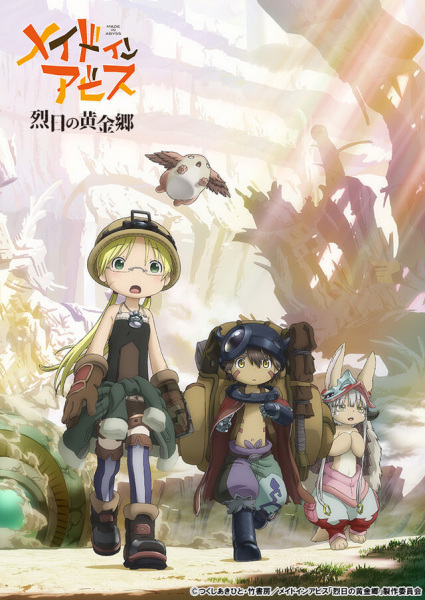

Made in Abyss: The Golden City of the Scorching Sun
メイドインアビス 烈日の黄金郷
After surviving the brutal challenges of Idofront, Riko now possesses a White Whistle, allowing her to descend into the Abyss's sixth layer—The Capital of the Unreturned. Alongside Reg and Nanachi, Riko begins to explore the uncharted domain, where the ruins of the promised Golden City are located. As the trio starts to adapt to the harsh environment, they soon encounter dangerous creatures and treacherous landscapes. Their expedition leads them to a village inhabited by strange beings known as "hollows." Despite the creeping sense of unease that welcomes them, the three venture onward to uncover the mysteries of the settlement and long-lost legacies of the forgotten adventurers who once descended into the horrors of the unexplored Abyss. [Written by MAL Rewrite]
Mcsuper
September 28, 2022
The kid gloves are off. Although some people still do, we can’t pretend this is the happy go lucky journey down the Abyss that we thought this show was going to be back when Season 1 aired all the way back in 2017. One thing that hasn’t changed since then is my undeniable intrigue I have with this series. The adventuring, the stunning scenery, the immaculate OST, the characters, basically everything resonated with me, and with this season of Made In Abyss, that was no different. Since this show is about children, I can relate it to my own childhood to some extent, so I’ll tella quick story. I loved the outdoors a lot as a kid, and still do. I enjoyed hiking and camping a lot, just the wilderness in general, though I didn’t know the necessary worldly survival skills like making a fire, or using a compass. One, scorching summer afternoon, I went on a hike with my friends and parents, into quite a large forest. We walked and walked until “Two roads diverged in a wood”. Being my adventurous and fearless self, “I took the one less traveled by”, albeit with a couple people. It was a maze of trees, and a winding road, far different from the other road, that some of the others from my group travelled on. Knowing that forests were home to such creatures like bears, coyotes, and the creepiest of creatures, I still felt like the happiest little kid in the world, prancing down the forest like nobody’s business. The sun set, and we were set to return from where we came from, back home. However, in our inexperience of the outdoors, we got lost, in the night. We wandered and wandered with seemingly no exit from the vast forest. Hearing the creatures around me, I felt for the first time, a sense of fear, that something might attack my unprepared, vulnerable self. In my fear, I tripped on a branch and injured my leg a little bit. Eventually, my group found the exit, and although those gruelling hours of being lost were some of the toughest in my life, I never stopped being excited about the unknown. And that’s because I started to learn, that there will always be ups and downs in life, and whenever you mess up, it’s always a chance to learn new things, new skills, such as how I could not get lost in a forest next time. The characters in Made In Abyss do much of the same thing, they have encountered their fair share of troubles, but it never gets them down, they learn from the troubles, and have undeniable courage to tackle whatever the Abyss throws at them. At its core, Made In Abyss is a tale of a life’s journey, and one’s slow but sure maturity. My grading criteria: Story: /25 Art: /10 Music: /10 Characters: /20 Enjoyment /15 Thematic Execution /20 STORY: 24/25 This season was a very interesting one to me in that although it’s very self-contained in the Golden City, it tackles the journeys of the past and present, the past being the first adventurers who ventured into the Golden City, the Ganja Squad, and the present being the characters we all know, Riko, Reg, and Nanachi. It further splits into different paths, as each character from the present has their own set of experiences in the Golden City, and each learn vastly different things, and encounter varying things, good and bad. The darkness is instilled in the story from the first moment of the season, and never turns back, yet there are some light moments in the series as well. The Golden City is home to a village, which has their own culture, such as currency, and language, that serves as a very intriguing exploration element that feels as good as the first season, where Riko and Reg explored the wilderness, this time, they explored a city with its own lightness and darkness. For characters from the past and present alike, the Abyss still remains as great metaphor of one’s progression in life. The fact that the sixth layer of the Abyss represents “The Point of No Return”, hammers home the fact that we as humans, only move forward, not back. We can’t go back to being the starry-eyed children we once were, and no matter how hard life gets, we must persevere and find new ways to improve our life and survive. No matter what mistakes we made, we can’t live in the past, because like the Abyss, the real world doesn’t wait for us to get back on our feet and recover. The real world presents us with a barrage of puzzles to solve every single day, so if we get weighed down by our past regrets, we’ll get swallowed up by the curse of the Abyss. ART: 9.6/10 Still very visually appealing with great scenery and I love that they didn’t hold back in the dark moments. The visuals in those moments looked blood-curdling, spine-chilling, and that is what Made In Abyss does so well. MUSIC: 9.7/10 The music by Kevin Penkin instills a great sense of atmosphere, and is very resonant. It’s tempting to listen to it again and again because you can just close your eyes and imagine yourself on an adventure (though maybe don’t imagine what happens in Made In Abyss, or you’ll have trouble sleeping). OP and ED are also very nice, especially the ending by Myth & Roid, which was my favourite this season. CHARACTERS: 19.5/20 The characters continue to be quite the treat to watch. Riko continues to be a character with a ton of heart and a great willingness to persevere no matter how unforgiving the Abyss is. Reg’s backstory is intriguing, and Nanachi has her share of moments, some of which were quite emotional. The characters from the past, the Ganja Squad, had a whole bunch of great characters as well, quite a few that stand out such as Vueko, Irumyuui, Wazukyan, and Belaf. Each have their own struggles, some more than others, and their personalities are quite interesting, ranging from a willingness to do anything to help himself and others survive, to harboring a feeling of guilt that was so great that he couldn’t go on. It’s a very wondrous cast of characters, who each have their backstory told in a very fascinating way, and you feel for every single one of them. There is also no real villain in this story, though I can argue there wasn’t one in Season 1 or the movie. Sure, there are antagonists who oppose the main characters, but they each have their own reasons, whether it is a love for their loved ones, or an appetite for human advancement. There are a lot of morally repugnant themes in this show, but they all have a reason in which to do such unthinkable things, and that’s what makes each and every character special, even if you come to hate them. ENJOYMENT: 14.8/15 Although it’s frustrating that there are so many questions asked, but not enough answers, the show brings about a sort of odd excitement not found in any other show I’ve watched. My immersion was always strong, and every detail in the show is spectacular. Phenomenal. THEMATIC EXECUTION: 19/20 The themes are so well executed because each character is interesting. Another reason is that they never hold back from showing us morally questionable things, whether it is excessive gore, or very grotesque imagery. It really shows us the unforgiving nature of the Abyss, and that is simply amazing. Sure, there are some rather dumb things that happen, such as the toilet humour, but that’s just a minor tonal shift issue for me. OVERALL: 96.6/100 This was an instalment to the Made in Abyss series that felt even better than the first. It’s a great tale of one’s maturity, and it resonated with me a lot. You feel the characters’ fear, you feel their emotions, you cry with them, you smile with them. There is still much to unravel in this adventure, and we probably won’t see another season of Made In Abyss for quite some time, but whenever we get it, I’ll want to be the first in line to witness what comes next in this emotionally damaging journey that I love so much. To everyone who read this to the end, I truly appreciate it.

CryptidSenpai
October 4, 2022
I've never been this astonished and upset with a show I used to love. All the makings of a 10/10 squandered by the biggest sack of shit suffer porn I have ever seen. This is too much. I've been robbed of my empathy. I can't invest myself in the main cast without feeling like I'm participating in one big predictably fetishistic narrative. It wasn't always this way. Made in Abyss' first season set up a story full of hope, grit and unparalleled intrigue. Its setup might just be the best in any anime and the characters were instant favourites for me. Later episodes hit like aton of bricks, I couldn't take my eyes away from it. The ending, after 14 stellar episodes, was equal parts heartwrenching and beautiful. One of the most memorable pieces of media I have ever experienced and probably ever will. Here's where we're at now: The visuals are still great, the soundtrack is still stunning, the world building and character design work never ceases to entertain and every once in a while, there are moments of absolute brilliance. Tragically, the movie prior to this season has taken any tonal surprises out of the plot's sails. We went from shockingly poignant to edgy boarding on fanfiction territory in the span of one arc. Along with this came indefensible moments of cringey character interactions that make me feel wrong for ever having thought the uncomfortable parts of season 1 are additive to the experience. Take everything I just wrote, make the worst aspects of the movie even more unbearable and you have The Golden City of the Scorching Sun arc. Trusting the writing to handle anything with a level of subtlety is a lost cause at this point and fooling anyone a third time will take a whole lot more than another new cast of captivating characters. Ultimately, the further down into the abyss I go, the more obvious it is that this will never be the show I wanted. Through denial, anger and disappointment, I’ve finally arrived at acceptance. No matter how many complaints warrant being thrown at the state of Made in Abyss, you can’t say it doesn’t leave a seriously strong impression. Even if it’s no longer for me, I’m glad more seasons are still being made and that true fans of the manga are getting a masterful adaptation of the adventure they love.
mmm_16
May 9, 2023
Made in Abyss: Retsujitsu no Ougonkyou is an abysmal continuation to what could have been an interesting story. The first season showcased fascinating worldbuildind, captivating the viewer with enchanting atmospheres and the promise of a journey in search of the knowledge at the end of the abyss, all qualities this season completely failed in carry on. The movie foreshadowed the shortcomings of the second season, but there the detachment from the strong points of the plot (dynamism of the journey, discovery of the abyss) was excused by the events that were essential for the continuation of the plot. Here the story becomes static once againand is abruptly interrupted by what feels like a 12-episode long filler episode, which is, by definition useless plot wise. We learn nothing more of the abyss, the real protagonist of the story, or of our old characters, with the exception of Reg; can we truly say, though, to have learnt something new about Reg's past? The objective of the new season is the introduction of a new character who is goint to join the original trio of delvers: this is a major goal, but not at the expense of halting the story for an entire narrative arc. Furthermore, said character's story is complicated and strange in a manner that feels exhibitionist: the gore and the gruesome forms of the beings did not feel organic with the canonic elements. Indeed, the story is quite simple but it seems as if the author's intention was to show off his grisly imagination: it is as if the story was written just to appear strange, as if asking you "Am I not quirky? Am I not incredibly original and different from all the other stories?", just like those people who try to appear eccentric just to set themselves apart from the others. Some character's design was well-thought-out and respected their personality, but it was not sufficient considering this was true only for two out of a dozen characters. I understand the intention behind the introduction of other languages but the constant repetition of some locutions (yes, I am talking about "Sosu") is annoying and migraine-triggering, especially so when we consider the explanation behind it. In conclusion, the creepy,nauseating and perverse scenes, that make this whole work feel like someone's fetish come true, would be excusable, as they were in the first season, if it wasn't for a plot that can only be described as boring and insignificant. The only reason the rate is not 1 is because of Kevin Penkin's Soundtrack, which is, as always, evocative and much more emotional than the plot wanted to be. If you find yourself at the end of this too long review, just know that it is not born out of hatred for the original story but from the disappointment of what it could have been.
Gsarthotegga
September 28, 2022
Season 2 returns with a strong OP/ED combo that complements the Golden City of the Scorching Sun arc very well, and I start by mentioning this because the OP in particular gives a solid impression of how different this season is compared to the original. Unlike the S1 OP that was little more than a summary of the first episode, this one crosscuts frequently between two different sets of characters exploring the Abyss. The closing is rather abstract, bringing to mind the oceanic depths presented at the end of the 5th layer, which we observed in the 3rd movie, and the vastness and mystery itevokes is a great note to close on. S2 manages to finally slow down, and it weaves together an even darker atmosphere with deeper storytelling and world building. Enjoyable as it was, S1 always seemed a bit too brisk, like the author had ants in his pants or ADHD, and sometimes there would be nary an event before Riko and Reg shot through a layer like it was almost nothing, which kind of dampens the impact and undersells the anomalous nature of the abyss. The main characters, Riko, Reg, and Nanachi don't receive nearly as much focus here. They all get separated for most of the series around episode 4. Riko has to fend for herself and doesn't have the luxury of being babysat the whole time and explores a bit on her own. Nanachi revisits the past again, and while I kind of thought this seemed unnecessary on my first exposure to her scenes in the manga, it makes sense; sometimes we expect a character arc to be cleanly resolved and then the character has moved on, but that doesn't tend to be how the mind really works. Reg regains some of his memories and meets the new character Faputa, whose character development is quite strong, because directly and indirectly, much of the 12 episodes actually serve as the backstory and arc for her character, and there are many bittersweet moments due to her complex relationship to the village and its inhabitants. Perhaps the OP oversells the finesse with which the staff weave the Ganja crew's journey through the abyss and our familiar trio of protagonists, but a sizable chunk of this season concerns the Ganja's background and their foundation of the Village of Ilblu, the history of the abyss, and its lore—and while the manga delivered most of this information in one lengthy flashback, the anime wisely chose to mix it up a bit more. Instead of the large scope of season 1, spanning multiple layers, this season opts to instead flesh-out a singular location in the 6th layer, providing plenty of flashbacks as well. Most detractors have complained about this difference between the two seasons, so that is a mental adjustment that will need to be made to fully enjoy this installment. There's always been a layer of scrutiny about this or that element that's questionable or objectionable or whatever throughout MiA's run, but season 2 appears to be a more controversial entry to the franchise than the first season or the 3rd movie. S2 has delved deeper (pun intended?) into territory most are not exposed to often: scatological sojourns and a bit o' butt gut plopping. Get ready to wince with the latter activity! I was eating when they found the "charms." Not fun (this scene and the Meinya scene are more graphic in the anime). I don't feel a need to condemn or justify any specific content. It's true: MiA could have been a very satisfying story without the more macabre, disturbing, or weird elements—the plot wouldn't even have to be reworked all that much, with the main difference being a greater reliance on implying or keeping vague certain "unsavory" aspects rather than showing everything in so much detail. The tone and impact would be a lot different, but either approach would be sufficient with good enough writing and execution. Yet I will say that these "uncomfortable" elements, for better or worse, add a lot of realism, and with realism comes a greater sense of danger for the characters and immersion into their world. This is a dark fantasy involving children embarking on a high-stakes journey through unforgiving terrain that is infested with strange and malevolent creatures and an onslaught of unknown perils. Whether art should conform to this reality of realistic situations and disturbing content in the context of children or not is its own separate question, however, MiA is at least honest compared to other syrupy fantasy anime and series featuring children embarking on their lonesome without adult supervision. Hole in the Ground City from S1 is not quite like the pampered western world; children are pushed to become "adults" sooner, as we can see with Riko (as well as children much younger than her) apprenticing as a cave raider. It could even be argued that modern civilization has an infantilizing effect, as children are brainwashed in public schools when they could be capable of much more. Of course, the adult world can be a dark one, and being pushed to perform as such can lead to harrowing experiences. Think of what horrors might have occurred during the Children's Crusade, where many died or were enslaved during their journey—or even modern migration patterns (the Children's Crusade is a contentious event and not all of them were children). MiA evokes the feeling of an aged fairy tale in its undiluted form before it could be sanitized for children. The colorful child-like atmosphere and the antics of the children clash with dark undercurrents and adult themes, and while I wouldn't go as far as to say this is a deconstruction of any particular genre, it certainly does take what looks to be childish and injects a strand of realism into it, and under the circumstances, there is really nothing else we should expect, unless we want to be lied to. Just as Mahou Shoujo Madoka Magica points out all of the lies and inconsistencies inherent in the magical girl genre, so too MiA tackles the naivety of the coming of age adventure and fantasy stories. There is a palpable sense of vulnerability and dread that always surrounds the characters, further accentuated by how alien and strange the various layers are. Just when the Village of Ilblu starts to seem warm, cozy, colorful, and Ghibli-esque, our characters let their guard down, and all of a sudden there's an "attempted rape" (?) in a back alley that ranks as one of the more disconcerting scenes of that nature because we can't even understand the hollows at all as they tower over the characters, though we can easily assume various intentions—there's even enough ambiguity to suggest more innocent intentions from the denizens. That, of course, brings to mind the distinct language and thought-out culture Ilblu possesses, with a whole host of peculiar customs, and only a few villagers speaking Riko's language. Far too often, the plot armor in a series is tremendous, and while there is technically always a little bit for a story to function, the characters in this have gone through a considerably greater amount of hardship and mental shocks to the point that I'm uncertain of what to expect by the end. Even if they don't die, one wonders what can be expected of their mental state, or if they will even remain "themselves," once we've been introduced to the bizarre narehate forms of the former Ganja crew and various cave raiders who happened upon Ilblu afterwards. There's also no turning back due to the curse mechanism. It's all or nothing. To better underline just how dark the atmosphere is, there is an often fleshy, organic appearance to many of the structures and body horror imagery is used copiously here, some have even reasonably likened MiA to being a much different spin on cosmic horror. I would say MiA also compares very favorably to and acts as a spiritual successor to the Strugatsky brothers' Roadside Picnic novel, which also concerns anomalous environments, with the Zone being similar to the Abyss, artifacts that grant wishes or confer powers, and there is even an equivalent to the curse mechanic. Certainly, MiA is a much greater spiritual successor to the themes of the novel than an on the nose and mediocre spoof like Otherside Picnic, while exploring a much different story and thematic content. Lavishly depicted and benefitting from an art director/background artist known for working with Ghibli, the Village of Ilblu is blessed (cursed?) by intriguing mechanics, where value—of a person and their belongings—is ascertained by an arcane process. It also sports one of the most wildly variegated assortment of critters I've ever seen in a village in any fantasy story ever, as it has an unusual backstory as well; the villagers were not born as they were, their shape, appearance, and abilities are based on their desires, which adds an interesting psychological component, and you might even be able to draw some conclusions about their past and present behaviors to better understand their forms. The body horror is ramped up to the highest levels here, with the village and the villagers having a peculiar symbiotic relationship and a horrible past. On the topic of disturbing elements, the village is doubly so compared to just about anything else in the series, save for Bondrewd's experiments, and there don't appear to be any boundaries that can't be crossed, so long as the value system is respected. One can sell his or her body parts: it's easy to compare the possible outcomes to various forms of slavery and trafficking and even organ harvesting. This system of balancing and value is a large part of what leads to many of the most unsettling and emotional moments of the season. Unlike 2021's Tone-Deaf to Your Eternity, MiA actually does have a sense for emotional beats, and much of this comes from the fact that while the narehate of Ilblu look like they were all aliens gathered from a different planet and don't quite form a coherent community in the way that humans would, they were once human, with common human desires, and most of them were once similar to Riko and had the same undying will to explore deep into the abyss, they just got lost along the way or had no other means of continuing their journey. The time Riko's party spends with the villagers is short, but the scripting and timing make it feel as if they'd been together much longer. Oddly enough, it's somewhat like the sense of kinship one feels on a brief encounter with someone of the same nationality when happening upon one another in a foreign land—this sounds paradoxical when considering the context, but the narehate have two "selves" in some sense, both at odds with one another. Even just small scenes like Majikaja silencing Riko from forming a disastrous contract or the scenes with Meinya and Maaa or Belaf's guilt are surprisingly impactful. Probably the most interesting aspect of the season is the basic relationship between Riko's party and other adventures with the villagers and the three sages. Vueko is an empathetic character with a close mother-daughter-like relationship in lieu of the focus on Lyza-Riko from previous installments and functions as a solid narrator. However, the two shining lights of the Ganja crew are clearly Belaf and Wazukyan. Wazukyan is not a character I would consider an antagonist per se—certainly not a villain—but he could be said to be similar to Bondrewd in a sense, just a much lighter, more positive shade. Both are ambitious and will do whatever it takes to achieve their desires. Without people like them, we'd be unlikely to see advancements, though Bondrewd's quest is of a much more edgy and extreme nature. On the other hand, Wazukyan led a band of people without a homeland into uncharted territory, and he did anything and everything he could to maintain his crew and continue the adventure. I personally think he made all the right choices given the circumstances, and one would be lucky to have such a resolute leader. While they ended up losing their humanity, it's unlikely they would have survived otherwise. Despite the outcome at first appearing to be for the best, any wish granted is always double-edged. Though Ilblu may look festive and wondrous, the inhabitants sequestered there lost sight of their dreams, and their "homeland" becomes little more than a decadent economic hub. I mentioned the psychological aspect before, and by looking at Belaf and Wazukyan, they have quite useful abilities, are seemingly powerful, and even grandiose in form. That's... not the case for quite a few of the villagers, many of whom seem squishy, small, and weak, though a few may appear imposing or strong. The segment with the toilet could easily be dismissed as a gross gag scene, but aside from highlighting the truly alien nature of the abyss, the most disturbing aspect is that this toilet is alive and is clearly a narehate. There's another narehate that has a flat appearance and he likes to have people step on him. Quite a few others seem to be psychosexual in nature. This is a reflection of their desires—especially the base, lower ones. Fetishism, perversion, etc. The rest are concerned with various trinkets and consumerism and just about every character fetishizes the flesh of children and would like to purchase one from the market if they could. As odd and dehumanized as they are, they are also in many ways quite human and imbued with both positive and negative traits. The proceedings were very obviously meant to portray a downtrodden people that lost the same ambition and luster for life as Riko, though there are other plot conceits pertaining to Faputa and the village's past. Wazukyan ceases to lead because there is nothing to lead, though an ambition lingers inside of him. In many ways, MiA is deeply about these competing drives, but we rarely see the other side of the same coin. We spend most of our time with Riko and other delvers, all who possess that spirit of exploration and discovery. Those of Ilblu had consigned themselves to the warm darkness like so many do and lost sight of the elusive light that dwells somewhere deep within the Abyss. Ilblu is the first instance where we see any kind of inertia, and, finally, a reinvigoration.
xmtvzx
July 19, 2025
After watching this and season 1, I really wanted to like this anime. The fantasy art, the character designs, their bonds as they descended further into the abyss to uncover the mystery of their past, I could stomach a scene or two before; However, I can't sit here n act like this isn't straight up fanservice of loli torture porn when it's so obviously portrayed. I hear the manga is even more graphic. It's uncomfortably distasteful and to any good common-sensed person out there, should ruin the anime altogether. Like I just dc what happens, Reg probably finds his people, Riko finds her mom, notwilling to sit thru the weird shit to find out anymore. So with this, I'm dropping it, but I do wanna say.. I watch a LOT of fucked up shit and never gave much care into thinking I'm enabling the content, because I usually see the relevance to the theme in such raw depictions plus its already out there, but this time I truly feel viewing, buying merch, or worse recommending this is enabling and people should speak up about Akihito Tsukushi work because it's unnecessarily disgusting. Hope this Helps! Not Worth The Watch!
Rank
#109
Popularity
#467
Members
532,995
Favorites
6,891
Episodes
12