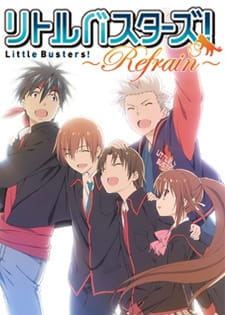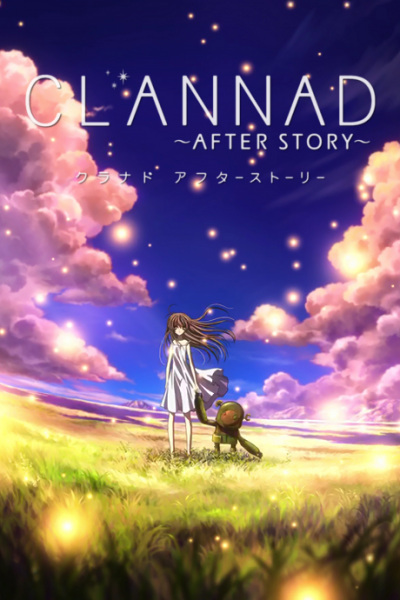

CLANNAD〜AFTER STORY〜 クラナド アフターストーリー
Tomoya Okazaki and Nagisa Furukawa have graduated from high school, and together, they experience the emotional rollercoaster of growing up. Unable to decide on a course for his future, Tomoya learns the value of a strong work ethic and discovers the strength of Nagisa's support. Through the couple's dedication and unity of purpose, they push forward to confront their personal problems, deepen their old relationships, and create new bonds. Time also moves on in the Illusionary World. As the plains grow cold with the approach of winter, the Illusionary Girl and the Garbage Doll are presented with a difficult situation that reveals the World's true purpose. [Written by MAL Rewrite]
LemonLyme
May 6, 2009
I laughed... I cried... I experienced something that changed my life... In a nutshell, Clannad ~After Story~ influenced the way I will live for the rest of my life and not just in some half-assed way like any other show would. It legitimately moved me to make certain decisions, for better or for worse. In that sense, no other anime can compare, as no other anime has provided an equivalent reaction on my part. Before you continue, you should know that Clannad ~After Story~ is a continuation of the story from Clannad and an adaptation from the original Visual Novel by KEY. Although knowledge of the first seasonis not necessary, it is highly recommended if you want to get the most out of ~After Story~ as well as this review. That being said, this review is tailored to all readers, and can be understood without knowledge of the first season. Note that there may be very minor spoilers. Now then, on to the meat and potatoes. I won't spend much time on the individual components of Clannad ~After Story~ (or Clannad ~AS~ as I will call it now) like I have with my other reviews. At first glance, there is nothing notably outstanding about it as a whole. For those who are interested in the individual components, here they are and the reasons behind them are available at the end of the review: Story: 8.7/10 Art/Animation: 8.4/10 Sound: 7.8/10 Character: 9.7/10 Enjoyment (in this case influence): 10+/10 Overall: 9.8/10 | Main Review | It is difficult to convey the emotions that went through my mind as I watched Clannad ~AS~. For those of you who watched the first season and dropped the show, I urge you to pick up ~AS~ and give it a chance. The first few episodes run almost identically to those of the first season, but the true After Story part branches off in a manner that is unique only to ~AS~. What Clannad ~AS~ gives the viewer is a story of life. A story of despair. A story of forgiveness. A story of hope. Through this story, Clannad ~AS~ can powerfully change the way you perceive the world around you. I am well aware that not everyone enjoys Clannad and ~AS~, especially since the magical light orbs are outlandish to some, but for me it was a bit of a godsend among anime. The concept of Clannad ~AS~ is neither truly unique nor breathtakingly wonderful. What the viewer gets when watching it is the story of a man. Nothing less and nothing more. What Clannad ~AS~ really excels at, however, is the way it tells the story of that man. While it may be classified as a romance or even a harem anime by some (at least the first season could be), I really classify Clannad ~AS~ as a slice of life. A slice out of the life of a delinquent who can’t seem to do anything right and struggles to protect what really matters to him as the world comes crashing down. However, “slice of life” can be a deceptive term. As I watched Clannad ~AS~, it was not as much a slice out of Tomoya’s life but a slice out of mine. You see, what Kyoani succeeds in is hitting on the points that make life truly what it is. The continuation of time. The reality of truth. The genuine meaning of “life goes on.” Additionally, by extending over many years, the true significance of every event begins to emerge. Clannad ~AS~ takes the tale of the first season and shapes it around a single person. It is a respectable reflection of life and delves into what many shows do not, and cannot, represent: the story after the story. While many of the situations may be overblown and excessively dramatized (at least in the opinion of some people), it is ultimately true that every facet of Clannad ~AS~ gives the audience some insight into life. Does it matter that there are miracles and magic orbs of light flying around? For me, no. For others, this could be the case. That is to say, not all aspects of Clannad ~AS~ are perfect, but the impact was enough for me. If you are looking for a cheerful anime, turn away now. Kyoto Animation does many things with Clannad ~AS~ including some very effective humor in many places, but Clannad ~AS~ will make you cry and smile, often both in the same episode. I won’t lie, I cried at least 5 times throughout the season. Even when rewatching episodes, I cried again. Don’t get me wrong, Clannad ~AS~ really has some happy moments as well, but Kyoani tends to depress many, many times. Each sad moment is profound and beautiful, but nevertheless it is sad. The ending song, Torch, which is played in every episode, serves to alleviate this, for better or worse. Torch is very upbeat, but many people consider it unnecessary and I agree. Torch can be a real mood breaker at times. The power that Clannad ~AS~ exerts comes from its characters. While the first season portrayed many main characters and their stories, ~AS~ focuses on the life of Tomoya and lightly on the lives of those who surround him. Tomoya is a failure in a cruel world. In a sense, he is a fatal hero. While he may not know it, he is destined to face pain and suffering through his life. There is a bit of controversy over the ending of ~AS~, but those who wish to have a “truer” ending can consider the second to last episode as such (don’t hate me for suggesting it). When seen in that light, Clannad ~AS~ effectively played out a story that neither catered to an audience nor skewed reality (except for the orbs of light, of course). What it presented was something that many people can relate to. The loss of a loved one. The pain of recovery. The neglect of a father. Rediscovering love and friendship. Coping with suffering. *SPOILER* The feeling of holding a daughter in your arms for the first time. The pains and joys of being a father. */SPOLER* What it ended with was a realistic ending and a message for the future. Additionally, if seen that way, the last episode can be portrayed as Kyoani staying true to the visual novel and respecting the source material. *Unfortunately, more talk of the plot would undeniably lead to spoilers, which I am trying to keep free from this review, so please bear with me. Heck, if I’ve convinced you at this point, what are you waiting for? Go see for yourself what all the hype is about. Otherwise, read on!* Ultimately, Clannad ~AS~ molded characters that I thought I was familiar with into something close to human. Their stories produced emotion that made me reconsider the situations of the people that I see every day. Through social commentary and moral struggles, the viewer can genuinely begin to respect Tomoya. I know I wouldn’t be able to withstand half of what he did, but I truly began to respect the fact that he kept going, despite him being a fictional character. Through his struggles, I began to learn about myself. Through the struggles of those around him, I began to respect those whom I had once hated. This may seem extreme, and you may think that I am crazy, but what I write is nothing but the truth. Every episode gripped me, and many episodes evoked tearful reactions, which I am not very prone to. As I continued to watch, I could hardly bear waiting a week for each new episode to come out. At the same time, however, I knew that each episode held a bomb - a flood of emotions that could affect the rest of my day. Clannad ~AS~ went way beyond enjoyment – it went into the realm of what I could call an “epiphany.” Can the story of one man influence the lives of others? Is it still possible if that man is a fictional character? For me, I did not think it was possible for anime to extend its influence at such a level. Clannad ~AS~ proved me wrong time and time again. Look past the first season and the first few episodes, and perhaps you can begin to understand what I mean. For those interested or who can relate after watching the show, this is the ultimate and most powerful result of the show as it applies to me. The following is the reason why I can’t keep my mind off of Clannad ~AS~ and the reason why it will remain as my #1 favorite for what I know will be many, many seasons: *SPOILER* Through Clannad ~AS~, I have basically committed to wanting to have a baby. Ushio love. */SPOILER* | Analysis of components | Story: Clannad ~AS~ is unique in its storytelling, but the story itself is nothing special. The earlier episodes present almost unrelated stories just as the first season did, but Clannad ~AS~ takes a turn for the better with a focus on a single character and his ordeal. At this point, Clannad ~AS~ does nothing but follow the life of a young adult, Tomoya. Sure there is drama (oh, is there drama) and there is romance, in a sense, but in reality, there is no real plot to speak of. What there is, however, is the tale of a life experience that can change the way you live. A real deterrent might come from some of the magic that inexplicably finds its way into Clannad (both seasons), but that never really bothered me. The ending is also less-than-stellar and can be a bit confusing, but as stated before, there’s always the second to last episode to fall back on. Art/Animation: There is nothing blatantly wrong with the animation quality. Kyoto Animation produced Clannad ~AS~, so fans will know that there is nothing to fear. The character design is the same as that of Clannad and other KEY adaptations. The KEY character design is quite distinguishable, with its giant eyes. Personally, I am a fan, but other viewers might dislike the artwork. Other than that, Kyoani did another solid job with the animation, and there are no jerky movements that detract from the gorgeous lessons that unfold. Sound: Kyoani had its ups and downs with the music for Clannad ~AS~. In many aspects, Clannad ~AS~ shoots beyond other KEY adaptations with its unique, unconventional plotline and incredibly well enacted scenes of what could very well be the life of an individual. In fact, many of the ordeals that Tomoya must face strike a particularly strong emotional chord among many people. Who knows, you might not be that certain type of person, but I definitely was. Anyways… back to the music. Clannad ~AS~’s opening sequence is a strong piano melody with deceptively deep lyrics. However, the ending sequence detracts from many of the spectacular moments, especially because Kyoani tends to end episodes on a sad note. As such, many would classify Torch (the ED) as an elaborate troll because it is too lively. Beyond the OP and ED, Clannad ~AS~ features tracks from the Visual Novel, which include very familiar tracks from the first season. Notable among these are the songs with lyrics, ie Ana. Certain parts of the OST mesh very well, and a powerful soundtrack can produce a powerful reaction. However, I don’t remember anything in particular clearly standing out to me, and as previously mentioned, Torch ruined quite a few strong moments. Character: While most of the other aspects of Clannad ~AS~ are very similar to their counterparts in the first season, character development in ~AS~ take a turn for the better. Kyoani successfully made me hate characters that I loved and love characters that I hated. Through a roller coaster complete with dips and turns, Clannad ~AS~ changed the way I perceive all type of people. From Tomoya’s seemingly disinterested, alcoholic father to Nagisa, a character who I actually deemed annoying in the first season, I came to understand what truly makes up a person. Every character really has a story behind their dejected or cheerful façade. Despite the usual “Clannad magic,” every character also turned out to be associable, adding to the personal level of the show. Even the more comical, secondary characters had their share of emotional moments, giving them real depth and giving the viewer a relatively accurate understanding of human nature. About half-way through the show, there is a certain character that changes many, many things. I won’t spoil it now, but her unique appearance is what truly brought Clannad ~AS~ to unmatchable levels. Enjoyment/Overall: Enjoyment is really up to the beholder. My view of enjoyment may be somewhat different from others’. Clannad is not for everybody, but for those who dropped the first season, ~AS~ is truly on a league of its own and worth another shot. Every person has that one anime that leaps up above the rest and leaves a lasting impression. For me, that anime was Clannad ~AS~. No other words can describe the effect it had on me, and I hope that this review has at least made you, the reader, consider picking up this diamond in the rough. | Final Thoughts | Thank you for your time (I know the review was long), and I sincerely wish that you give Clannad ~AS~ a chance. Who knows, it may change your life. As always, comments about how effectively this review worked are welcome. Also, a helpful rating is always appreciated.
Japanese

grungeallaround
August 12, 2011
Recently I had the absolute pleasure of watching Clannad: After Story. I had previously seen the original Clannad and liked it as a light-hearted slice of life anime, good but not amazing. I went into After Story expecting the same thing, but what I got was something fantastically different. Story- 10/10 As I said before, I started After Story expecting it to have the same light-hearted high school drama feel as the first season and, unfortunately, the first eight episodes did nothing to prove me wrong. The first eight episodes are Clannad at its storytelling worst, more specifically the Sunohara arc. Thankfully, Clannadat its storytelling worst is simply "okay". The Sunohara arc makes Youhei's younger sister, Mei, seem like a nosy and irrational little girl in contrast to the mature-beyond-her-years character that the writers seemed to be trying to present her as. The Yukine arc was better, but it pushes the boundaries of Tomoya's "good Samaritan" personality a bit too far. The Misae arc is good by itself, but has very little to do with the story or the characters that we care about. If it weren't for each arc each containing details that are vital to the enjoyment of understanding of the later part of the anime, I would recommend skipping the first eight episodes altogether to get straight to the real good stuff. Thankfully, the latter part of After Story more than makes up for its mediocre first act with the absolute greatest storytelling in anime. After Story quickly gets back on its feet and shows what truly makes it great as we ride the greatest emotional rollercoaster in recent memory. The ending has caused some controversy for being too ambiguous to fully understand without having played the video game, but I feel otherwise. Granted, I had to see the anime twice before I truly understood it, but I was nonetheless able to figure out exactly what happened without any outside help. It's a tough one, but it's very possible. Art- 10/10 While the main setting has its moments of visual awe, the artistic aspect of the anime truly shines in the beautiful and surreal "hidden world". The impact differs greatly from the main world, boasting beautiful lighting, animation, and colors. In the main world, colors do a great job of changing from bright to dull based on the situation and animation is polished to a shine. Sound- 9/10 I've always been a big fan of a musical score acting as a compliment to whats happening on screen rather than a mere accompaniment. Clannad: After Story masterfully pairs its score with each event to further the emotional impact of each scene. It is done so well, in fact, that one cannot hear the music on its own without feeling some kind of emotion attached to that song by a certain event from the anime. The OP is good and very versatile in setting the correct emotional tone for each episode. On the downside, the bouncy, poppy ED is often horribly inappropriate to the emotions that you are left with at the end of each episode and is almost guaranteed to ruin the mood if you aren't quick enough to stop it. I found myself sometimes ending the episode early when the scene seemed like an ending due to my fear of facing the buzzkill of an ED. On the voice acting side, the English performances are top-notch. Each character is paired with a voice that fits their appearance and personality very well and that can easily be recognized among other voices. Luci Christian gives a flawless performance as both English Nagisa and Ushio, and Andrew Love does really great stuff with the situations he is put in as Akio. Character- 10/10 The characters are without a doubt the strongest aspect of After Story. Each one is as incredibly human as they are likable, and their easiness to get attached to is one of the biggest reasons that the anime has such a great emotional impact. When the characters are suffering, it as if one of our friends is suffering, and when they are happy, we are happy for them. I have never felt such an attachment to a set of characters as I did in After Story. Each character plays so well off of each other, including Tomoya and Nagisa, who are without a doubt the greatest couple in anime. In most stories, be it in books, cinema, or television, the romance sub plot is almost always one of two things, the incredibly good-looking and nice alpha-male protagonist gets paired with the incredibly good-looking romantic interest, or the incredibly good-looking and nice but shy protagonist gets paired with the incredibly good-looking romantic interest. In both scenarios, the two characters are always blessed with the perfect personalities and that's why they go so well together. Tomoya and Nagisa are different. Neither of them have perfect personalities, but both of their personalities are able to compliment the other's. Tomoya's hot headedness is able to be cooled by Nagisa's quiet, strong demeanor. It's not perfect gets paired with perfect, it's human finds human. Enjoyment- 10/10 After I finished Clannad: After Story for the first time, there was only one thing I wanted to do: watch the entire series again, so I did. I know that the word "experience" is overused in film and television, but that's exactly what After Story is. I don't cry during movies or anime. I've seen Elfen Lied, Old Yeller, My Dog Skip, Grave of the Fireflies, etc. You name it, I've seen it and didn't shed a tear. Clannad: After Story made me cry like a girl multiple times, and the reason it did is because it's different from anything else I've ever seen before in one way. It is able to appeal to the most human parts of you, whether it's Tomoya's responsibility as a man or Nagisa's inherent ability to remain positive for the sake of the people she loves, the one thing that makes this anime so emotionally powerful is the fact that you could see it happening to you.
Fleure
January 9, 2014
Emotions are a powerful thing; they have the capability to override any modicum of rationality and force even the ficklest of beings to succumb to their emotional disposition. Due to this, often times, those of us who claim ourselves to be critics of various mediums fall short of our own expectations. “Clannad After Story”, a series described as “life-changing” by many is the perfect suspect; a production that captured the hearts of the majority that viewed it while instantly becoming a classic within its genre. Littered with subpar designed moe characters, irrelevant arcs, contradictory elements, forced plot devices, and a plethora of other obvious issues,it truly is baffling how effective an appeal to pathos can be. Although, the series has plenty of redeeming qualities, the title it has so profusely clenched--that of a masterpiece by a large consensus, must indeed be questioned. --Story/Plot :5/10-- “After Story” takes place right after the first season of Clannad and chronicles the lives of certain characters from the first season, primarily focusing on Tomoya, his relationship with Nagisa and more importantly, himself. It attempts to bring a sense of realism to its viewer through the joys and hardships that Tomoya goes through and accomplishes that for a while. It also eliminates the harem aspect of season one and adopts a much more serious tone. The series spans 24-episodes with the first 10-episodes composed of various arcs dealing with other characters and their corresponding dilemmas while the rest of the show focuses on the primary protagonists. This brings up the problem of structure and inconsistency. The initial problem with “After Story” is the characters that are focused on for the first 10 episodes. With the exception of the Misae arc as it LOOSELY connects to the magical component of the show, the other arcs have no direct relevance to the overarching story nor do they serve any function in moving the plot, but are just thrown in there, forcing unnecessary drama. This also causes a huge gap in consistency between the first part of the show and the rest, especially in regards to quality. However, the next few episodes are a pleasure to watch as they highlight Tomoya’s evolution as a character along with his relationship with Nagisa. Structurally, “After Story” fell short, consequently causing a gap in quality and consistency. Substantially, “After Story” has its share of delightful moments, but those are restricted to a very limited amount of episodes. The story is unoriginal, but imbues concepts and themes that are very real and relatable such as: imploring responsibility and growing up, the innateness of hardships, the importance of relationships, moving on, and many others that are close to home. Yet, “After Story” manages to ruin the very thing it tries to achieve. The show spends a great deal of time trying to evoke “realism” through manifesting the aforementioned themes, but subsequently destroys that with its detachment from reality and deus ex machina resolve. For example, one of the arcs in the earlier part of the series shows how two supposedly bitter and rival gangs end up being bros4lyfe via some [extraneous] female side-character. I may not have a proper grasp on gang psychology, but I’m fairly certain that the odds of something like a dudefest and “understanding” blossoming between two rival gangs are astronomical. This notion of “bonds of friendships overcoming everything” is extremely over exaggerated deeming many of the earlier arcs unrealistic, effectively leaving me in a state of overwhelming ennui. For a series that tries to emphasize real life, especially while trying to deal with issues such as loss, acceptance, etc., it negates all validity by embracing a faux idealism grounded in wish fulfillment. The realism juxtaposed with magical idealism/wish fulfillment really disintegrates the show by the end. However, that is probably one of the overarching reasons the show is as popular it is, because instead of staying true to its realistic core, it defaults into fantasy, idealism, and wish fulfillment. It’s successful but at the cost of complete contradiction therefore making After Story somewhat of a Pyrrhic victory. It should be noted that there is nothing wrong with having a plot based on supernatural/metaphysical notions, however, when the show is simultaneously trying to bring a strong sense of realism to the front, it becomes counter-productive and contradictory. I can’t even incorporate this under efficient “magical realism” because of how badly the two are handled when looked at as a pair. Essentially, where “After Story” excels at is deception. It does an excellent job serenading its viewer into a false lull making it seem exponentially better than it actually is by manipulating sympathetic themes and completely over exaggerating them, however, when dissected the story offers nothing unique, let alone life altering. It’s a good effort, but that’s all it is, an effort, that has its comely yet ephemeral moments. Conclusively, "After Story" ends up stumbling within its own narrative and resolution. --Character: 6/10-- “After Story” gets a ridiculous amount of praise for having “human-like” characters, however, the series lacks greatly in terms of balanced characterization. Tomoya is well developed and one can partly empathize with his struggles as he tries to shuffle through the various challenges he encounters. Tomoya’s progression is probably the most realistic part of the show and is fairly well-executed. While the show gives us a dynamic Tomoya, we are left face-palming in deep regret and resentment with the lack of attention given to Nagisa. There is nothing memorable about her; struck with some unknown illness, we often see her washing dishes for like three continuous episodes. I felt no sort of attachment, relation, or even empathy towards Nagisa, rather her lack of progression had the opposite effect. Her static, ingénue personality got unbearable. Oh and she can’t hold her liquor. That just heightened my insouciance even further. The futility of Nagisa truly is a burden on “After Story”. The over-development of one protagonist and under-development of the other did not have a neutralizing effect, but a detrimental one. Their relationship is the foundation of “After Story” but it remains immature, mainly due to Nagisa’s incomplete characterization. Instead of spending the initial 10 episodes on completely useless characters, the series could have utilized the same time to construct Nagisa into a character with dimension, personality, and purpose. The show spent so much time trying to build this false delusion about how “friendship solves everything” that essential aspects got completely disregarded. Tomoya along with an unmentioned character carry the weight of “After Story”. In hopes of keeping this review spoiler free, only the two main protagonists (Tomoya x Nagisa) are discussed. There are plenty of supporting/side characters in the show, some making cameos (from season one), others for reasons I have yet to understand. The only notable side characters are Nagisa’s parents who provide some comedic relief (which is the same recycled humor of the first season) but they still manage to maintain their likability. --Art/Animation: 7/10-- Don’t hold your breath expecting anything aesthetically orgasmic. The girls are molded with “moe” in mind at all times: Unrealistic character designs for a “realistic” anime. In terms of the actual art, “After Story” does a fairly good job. Bright colors are often used to accompany the magical atmosphere and vibrancy of life that the show is grounded upon. There are instances of visually striking scenes scattered here and there, especially with some of the natural backgrounds. There is always light illuminating from somewhere, even in the darker scenes. The one place where the animation did shine is while depicting the “illusionary” world. The background, colors, and overall depiction of that world is nicely done as it provides a very surreal atmosphere to the viewer. However, don’t expect gorgeous animation akin to something like “5 centimeter”. It’s nice, but nothing exceptional. --Sound: 6/10-- “After Story” has a viable soundtrack that fit its purposes. Composed of subtle, soft, and sometimes melancholic piano music, the OST is pleasant, but conventional. It wasn't something that compelled me to go download or re-listen to. The same applies to the OP/ED selections. They are very imminent and “of-the-moment” in the sense that they are enjoyable and appropriate at the time they played. However, I almost always forwarded the OP and rarely listened to ED. The voice actors are fitting in regards to their respective roles. --Overall/Enjoyment: 6/10-- Undoubtedly, “After Story” is at the forefront its genre because of its inherent ability to capitalize on emotions and “feels” to the point where many “manly” tears are shed and lives are changed. However, I could not relate; as the anime defied all levels of logic with convenient plot devices, contradicted its own pursuit of realism, over-dramatized situations, wasted 11 episodes of my time with frankly fatuous arcs, and underestimated the importance of complete characterization--emotions no longer mattered. After all, feels and impact are evanescent, quality is what remains. "After Story” therefore didn’t really leave a strong impact on me nor did I learn some particularly significant lesson about life nor did I put my feels on suicide watch. Nevertheless, the four or five episodes towards the middle/end are truly poignant and laudable—if “After Story” could have maintained that level of quality throughout and refrained from committing some of the aforementioned blunders, the series would have lived up to its hype. Alas, I cannot rate a 24-episode series any higher based on my enjoyment of five episodes. My “After Story” experience is a step away from the norm and that’s the reason I spewed all of this—to offer some solace to those who couldn’t cry those manly tears or indulge in wish fulfillment, while also providing another perspective to those who have yet to watch it that isn’t soaked in sheer “feels”.
KaminaKai
March 22, 2009
*Yet another successful heart warming series produced by Kyoto Animation that surpasses its predecessor.* “… an astounding series with a slightly less astounding conclusion.” Due to the frequent references to Clannad (first season), from here on, the term “Clannad” will be used when referring to season 1 and “After Story” will be used for season 2 and the term “Clannad After Story” will be used when referring to the Clannad series as a whole. A few friendly reminders before we begin. After Story is a direct continuation of Clannad, thus it is not very “new audience-friendly”. Knowledge of certain key events and character relations are expected fromviewers. Again, due to After Story being a direct continuation (in story) from Clannad, and the latter ended with a climax of sort, it is unreasonable for us to expect After Story to start off with the same level of intensity. In layman’s term, don’t expect the show to start with a bang. What exactly is After Story? In short, it is an emotion evoking machine designed in such a way as to suck dry your tears. By combining music, dialogue, and animation (often from the facial expression), After Story has the ability to dominate even the mightiest cold blooded person on this planet. Crappy live drama should learn/adopt some of the plots/techniques used in the anime. They should be ashamed of themselves because some anime by the name of Clannad After Story can present a much better dramatic story as a whole. In addition, After Story can squeeze the deep down juicy emotions inside you that not much live drama (if there is any) can ever accomplish. Those who are familiar with Clannad should have no difficulty identifying various strong points evident in After Story (such as high quality animation), but perhaps one may not be too familiar with the weaknesses of After Story. While some may claim the following “ugly” facts to be minor issues, it is only fair on my part to present both sides of an argument, so to speak. Inappropriate ending theme. The MUSIC makes Clannad what it is (more into that later), but sadly there are occasions when the ending theme just ruins everything the episode worked so hard for. It is important to note that the ED song itself is not bad; it just does not fit in especially with the latter half of After Story. “Clannad Magic”. The magic might work on some viewers, but for the rest of us who are looking for a more realistic story it was somewhat a let down to say the very least. I still recall people used to ask me the difference between Kanon and Clannad, and usually my reply will be the following, “… well Clannad is the more realistic version of Kanon as far as the main story between the protagonists is concerned … nothing too supernatural …” but the magical performance totally destroyed it. As previously stated, the author of this review (ie. me) is simply presenting issues of what seem to be hindrances to After Story from achieving a perfect 10/10 masterpiece for some demanding viewers. In fact, After Story is a show overwhelmed with prettiness. Depending on your definition of prettiness it could mean any or all of the following but let me assure you that there is absolutely no exaggeration involved. Lyrics, Music and BGM! Normally song lyrics are not a big factor in an anime, but After Story’s OP is just too fabulous to ignore. Slowly, I began to learn the meaning behind the song. If you read the lyrics in detail, it is clear that the song is a summary of the story of Clannad After Story. A particularly heart warming chunk of the song lyrics is provided below. “The chilly days continue on, even though it’s already spring. On the mornings I woke earlier than the alarm clock, You, making breakfast for three, Would be standing there.” I would refrain myself from explaining the meanings behind the lyrics, but I hope you can have a rough picture of what kind of story Clannad is getting at just by that one simple verse. You can find the lyrics (in English and Japanese) from the link below. As mentioned earlier, music is one of the key features making Clannad After Story a successful business. Music in Clannad After Story is not simply music. Likewise, BGM is not simply BGM either in the context of After Story. They blend in with the animation, characters, and story. They all compliment each other to bring out the maximum effect to each scene. Animation! The animation quality is slightly better than previous Key adapations by Kyoto Animation. For those who are not familiar with the producer, Kyoto Animation (products include Kanon (2006), AIR, Full Metal Panic series, Lucky Star, The Melancholy of Haruhi Suzumiya, Kiddy Grade, et cetera.) has a pretty good reputation for its high level animation. Simply put, one will be find nothing but beautifully drawn girls, dynamic backgrounds, silky smooth scenes transition, and completely fluid movements in this touching anime. There is, however, not much difference (if at all) in the quality between Clannad and After Story. Characters! One great thing about the characters in Clannad After Story is no matter if they are main or supporting casts, they all seem to be part of a jigsaw puzzle. The show would not be the same without any one of them. What makes After Story superior from its predecessor is its focus on the main protagonists (ie. Nagisa and Tomoya) for the most part of the show. This is evidently lacking in season one because other heroines’ story had to be covered, thus leading to an ambiguous character relationships development between Tomoya and various heroines. Although not a major Nagisa fan myself, one should realize the importance of her character and how it all connect to the story’s main theme. Story! After Story is all about the story! It is by far the prettiest of all the pretty traits that one can think of about Clannad After Story. On the whole, the Clannad series is an astounding series with a slightly less astounding ending. Slightly less astounding partly due to the magic, but could also be due to another reason. Assuming some of us has been paying attention to what Kotomi has been explaining regarding the works of her parents, then perhaps we can take a more scientific analytical approach to the ending via something known as the Omega Point Theory. Due to the lack of spoiler tags, further analysis of the ending will not be possible for this review. However, the following blog will prove to be extremely valuable. Let us just say that the story for Clannad After Story is deep and “pretty”, and leave it at that. Simply put, Clannad is LIFE, period. It lets you experience a wide variety of emotions such as anger, jealousy, joy, love, sorrow, pain, hardship, friendship, and most importantly the care from your family. From the ridiculous comedies presented by Sunohara (or Fuko), to the naivety shown by Nagisa (or Fuko), one can always relate characters and/or events in Clannad to some direct/indirect personal experiences. Additionally, Clannad also teach you the meaning to LIFE. Next time when you are on the verge of starting an argument with your parents, just think about Tomoya and his dad. Think of all the hardships and difficulties your parents went through to feed you and raise you to make you become who you are. You will never know, maybe Clannad can really teach you a thing or two. In an unrelated note, for those who enjoyed watching the Nagisa x Tomoya pairing and at the same time disliked the magical performances throughout the show (particularly the ending), then it is recommended that you give the Clannad movie a try.
kekekeKaj
October 17, 2012
The original series, the highly rated "Clannad", was one painful viewing experience for me - not because it's full of tragic tales, but because of how dire it is. Female characters sugary enough to induce diabetes in a lump of rock, combined with atrociously forced "drama" fast tracked it to a lofty position on my "Overrated Shite" list. And yet its ratings pales in comparison to that of its sequel, "Clannad: After Story". Given my experiences with the first series, I hadn't originally intended to watch "Clannad: After Story", but people kept telling me how much better it was and how different it was compared tothe first season. Intrigued, I decided to give it shot... ...and boy was I disappointed. "Clannad: After Story" was supposedly a different kettle of fish from "Clannad", but it's obvious to me that it's the same kettle, with mostly the same fish inside - it's still very moe; the melodrama is still clumsily manipulative; it's still unmistakably "Clannad". Unlike "Clannad" though, "Clannad: After Story" is somewhat inconsistent. But I mean that as a back hand compliment, in that "Clannad: After Story" had the some good moments amongst the crap, while "Clannad" was just consistently crap. The first part of "Clannad: After Story" is almost indistinguishable from "Clannad". It continues from where the original series left off, taking on a similar format comprising mini-arcs of various happenings around the school. Since Tomoya and Brown Haired Girl are already an item at the start of this series, there is no longer a harem aspect. You would think this would improve things, but in the case of this anime, all it meant was that it concentrated on mass producing contrived melodrama instead. The first arc, starring Sunohara, was one of the worst offenders. It started off as a comedy, and although some parts were a bit tasteless, it was at least tolerable. Half way through though, it tried to turn into a serious drama, and it was all downhill from there on. The problem is that, as with most stories involving Sunohara, the comedy is quite ridiculous, involving an absurd set up that you simply can't take seriously, but the drama directly extends from that set up, and the anime seems to think it's fine to try and deliver emotional punches off this same platform that was used to deliver goofy punchlines shortly before. There are also glaring problems in the plot and inconsistencies in the portrayal of Sunohara's character, but the real crux is this: these problems are not oversights - these are the consequences of the show's willingness to sacrifice everything in order to crank up drama to 11. Not surprising then, that I found it so unconvincing. And so "Clannad: After Story" continues in typical "Clannad" fashion, spinning implausible, almost surreal sob stories about its bizarrely troubled characters ... until around episode 10. This is the point where Tomoya and his ex-harem members graduate and make their way into the big wide world. It marks the beginning of what made many consider "Clannad: After Story" to be one of the greatest anime ever made. So I approached the show renewed hope... ...only to be disappointed once more. However much "Clannad: After Story" changes its settings, it still approaches drama with the subtle touch of a rapist. While I admit that the show does mature somewhat, its maturity is much like the way Brown Haired Girl matures during the show - she became more like a 15 year-old than a 10 year-old. An improvement it may be, but it's debatable whether this 50% increase in maturity is worthy of lavish praise when 1) the initial bar was set so stupidly low, and 2) she's supposed to be in her twenties by the end of the show. But allow me to pause in the middle of my acid spewing in order to acknowledge that there are definitely merits found in this part of the story, and that's enough to make it by far the best part of the whole franchise. As is always the case, these best parts centred around Tomoya himself and not some dipshit moe girl or some other retarded side character. One of the stories dealt with Tomoya trying to settle into a job and striving to overcome, amongst other difficulties, his physical handicap. This I liked, because above all, it was unembellished, believable drama - he actually had plausible real world problems to deal with, which isn't something to take for granted in the world of "Clannad", despite it often being labelled as a real life drama. It's fair to say that the franchise would be a lot worse without Tomoya; he was almost carrying the show single handedly. But there was one other, newly introduced in "Clannad: After Story", who shared his burden of being a rare good character stuck in the cesspit of shit ones. It's not too surprising then, that the stretch of episodes focusing almost solely on the two of them are the best ones that "Clannad: After Story" has to offer. Its emotional apex, a gorgeous scene set in a field of golden flowers tinted red in the setting sun, is hands down the most touching moment in the combined two seasons of the show. Emotional but not forcefully so, it captured the central theme of family with a poignancy and sincerity that's most unusual for the show. But that, I'm afraid, is the last remaining good thing I have to say about "Clannad: After Story". In between the aforementioned high points, and even entwined with them, crappy arcs and sub-plots are found in abundance. Amongst them, there's the incident of an all important decision reached via baseball, and another one that dealt with matters between Tomoya and his dad. The former looks to be an instance of "Clannad: After Story" trying to be subtle by approaching the matter at hand in a round-a-bout manner, in the same way that an elephant might try to do ballet; the latter is another classic case of the show sacrificing its characters to the drama. Time and time again over the course of the two seasons I witnessed Human Plot Device, aka Tomoya's dad, demonstrate his immense capability by taking on whatever personality the plot required, and this unsurprisingly resulted in his character feeling like an unfathonable, contradicting mess. To say the remaining episodes were unsatisfactory would be an understatement. To begin with there was the re-appearance of one of the most fucking annoying characters I've ever had misfortune of encountering, which invoked more sadness within me than all the sad stories in the whole series put together. And then there's the ending. I don't want to give spoilers, so I'll just say that not only was it confusing, but I would have felt cheated if I didn't have so little emotional investment in the show to be cheated out of. That aside, there's also some weird business going on with the ending to the main story not being the last episode of the series. There are two more episodes after the main ending: the first one is an alternative reality side story; the other one, the final episode, is just a recap. It's as if the show was going for the most anti-climatic end to a series ever. The purpose of throwing in that side story eludes me, but the re-cap's summarising did help to make the ending clearer. It doesn't clear up everything though, and there are major plot elements that remain baffling to the end. I did come across an informative time line that made references to the visual novel, and in all honesty, I was quite impressed with the grand scheme of what I saw. Unfortunately, various aspects of the plot failed to translate during the adaptation. Most notably, the visual novel mechanics they tried to port across caused plenty of confusion. The irony is that by trying to be more faithful to the source material, the anime actually ended up being worse off. That said, the ending is just a single nail in a rather large coffin; the show's problems run far deeper, right down to the conceptual level. Other than being filled with moe blobs that barely qualifies as characters, I get the impression that the franchise has been developed from a completely wrong approach. Instead of starting with some good ideas and letting them grow into good stories organically, it feels like the writers started with the intention of making the biggest fucking weepfest ever, then threw in whatever ludicrous ideas that came into their heads in order to achieve their goal. As a result, values like story and character integrity were continuously being compromised to make the show more tragic superficially. This might have been forgivable if it only happened on occasion, but when it's the bread and butter aspects of the story, the end product simply isn't a good drama. It's just emotion pr0n.
Rank
#18
Popularity
#123
Members
1,277,848
Favorites
73,681
Episodes
24