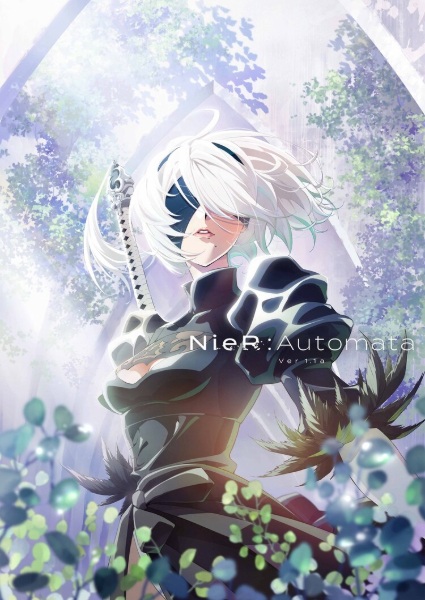

NieR:Automata Ver1.1a
In a post-apocalyptic world overrun by alien-crafted "Machine Lifeforms," humanity is preparing for its last stand. Forced to retreat to the Moon for safety, humans are pinning their hopes on a group of man-made androids known as YoRHa soldiers. Led by the all-purpose battle android YoRHa 2-gou B-gata "2B," the group will fight to take control of the Earth back from its invaders. As war against the machines rages on, the YoRHa slowly begin to see the first shards of truth underlying the brutal conflict. Facing the harsh reality before her, the unwavering warrior 2B starts to question her very existence and just how much she must sacrifice for the sake of humanity. [Written by MAL Rewrite]
Main
Main
Supporting
Supporting
Supporting
Supporting
Supporting
Supporting
Supporting
Supporting
Acausal
July 23, 2023
Anime adaptations that attempt to capture the essence and depth of the story and characters of a video game nearly always end up failing in doing the source material justice, unfortunately. This is because adapting such an intricate and interactive medium like video games–which typically have multiple branching paths and endings based on player choices and actions as well–into a linear narrative and with the need to condense a lengthy gaming experience into a handful of episodes, may as well be likened to the adversity of defying causality itself. It inevitably leads to a rushed storyline, lack of characterization and cast development, the omission ofplot points, and a less immersive experience in general. And so, NieR:Automata Ver1.1a–which sought to adapt one of the most acclaimed video games of all time and one that fully utilizes the mechanisms of the complex medium in which it resides–seemed almost predestined to disappoint as yet another disappointing VG-to-anime adaptation. Of course, no one in their right mind was expecting this to parallel the game itself, but it’s regrettable that at its best it wasn’t something more than merely satisfactory; Ver 1.1a is still remarkably superior to most others like it and as a standalone anime, it isn’t even bad. The anime’s biggest flaw is its inability to create atmosphere, which is conversely one of the game’s biggest strengths complemented by a patient story. This is especially problematic when atmosphere is fundamental to Nier Automata’s compelling, thematically rich and very visual storytelling and how Yoko Taro would funnel a lot of his creative direction through; sometimes powerfully enough to even recontextualize the world he’s concocted. Nier Automata is set in a beautiful post-apocalyptic world where futurism is overrun with greenery, yet the anime never leans into this hauntingly desolate, atmospheric world except for once in episode 2 with the anime-original opening sequence involving the Machines. The pensive sadness of Nier Automata is lost to mere opaqueness because it fails to use silence to tap into the potential of its world for the narrative it wants to tell, which consequently jeopardises the plot and characters as they are not yet interesting enough to stand on their own. This whilst relying on still frames and sometimes exposition dumps leads to the anime underselling otherwise emotional key story beats, and it makes the story feel like it’s preoccupied with moving from plot point A to B despite its commendable efforts to avoid that so it can manage with the handful of episodes it was dealt with in order to condense such expansive content into. In retrospect, the hasty execution of the anime; obviously owing to an atrocious production schedule that was overbearing the staff; was indicative from the quality of the premiere in all its low frame-rate, zero-compositing CGI glory; which was also just a 1:1 adaptation of the prologue devoid of any artistry intent on specializing the content for a 20-minute-length TV format. Let alone the third delay five episodes later which resulted in a four-month hiatus. However, the art direction and series composition cannot be ignored for their merits. And the score is of course palatial, using OSTs directly from the game. Regardless of the immersion-busting CGI and very average animation, the art direction expressly displays an appreciation for aesthetics with its gorgeous character models and beautiful background art, accompanied by a refined color palette harmonious with the overarching mood of the series. This isn’t all too surprising considering the works of art that were the key visuals for this title. Regarding series composition, Ryouji Masuyama the director intended to leave everything from the source material unchanged before Yoko Taro insisted otherwise, and I believe that change was for the better. It justifies the existence of this adaptation, and the mixing of the game’s story with its scattered supplemental content alongside the subtle–occasionally witty–fanservice is very much appreciated. The anime-original content is nothing to write home about, but it is respectful of the pre-established story’s sensibilities. All of this shows the meritorious effort of this adaptation and it confutes the bystanding impression that this is just another soulless cash-grab. I just wish it had properly put these strengths to use. There are amazing background shots which the anime doesn’t allow to linger and enrich its atmospheric narrative with, the elegant music from the game is only used for 10 seconds between scenes, and the pacing is plagued with inconsistencies where less important plot points drag on with uncomfortable lethargy whilst others are quickly transitioned through or skipped altogether with negligence towards thematic exploration. The direction is chiefly monotonous and this makes the story’s presentation lacklustre. There are glimpses of excellence in NieR:Automata Ver1.1a, but its faults ultimately make this a somewhat mediocre and forgettable anime as a standalone title. The 2D visuals and the music must be praised, and the efforts in which it takes to be an inoffensive swerving from becoming a pointless 1:1 adaptation as an inferior product is also worthy of that same praise. But aside from needing to have played the game to sincerely appreciate most of the aforementioned merits; even if you have, the direction remains predominantly monotonous for a source material with such artistry and this results in a debilitated presentation of oftentimes dull executions of the powerful themes and world wielded by Nier Automata. Unfortunately, the haemorrhaging production schedule did no favors for the patient narrative either and this anime deserved so much better than having its reputation tarnished by a huge hiatus. Watch this after you’ve already played the game. The anime being your first exposure to Nier Automata isn’t ideal. But at the same time, this certainly isn’t an offensive disaster of an adaptation enough to leave a bitter aftertaste either. As I said, Ver 1.1a isn’t a bad anime by itself; the story and the art direction are still much better than average. It isn’t a second-rate product to the video game struggling to justify its existence like many VG-to-anime adaptations fall victim to the fate of, and there is evidently charm to it. So you can’t go wrong with picking it up as supplemental content. And seriously, play the video game already if you haven’t… Nier Automata marked a landmark step in video game storytelling because arguably for the first time ever, video games went toe-to-toe with the likes of film and literature in the philosophical arena. It’s a metafictive, nihilistic yet hopeful postmodern masterpiece. Its themes of existentialism, identity, free will and determinism, consciousness and emotion, transcendence and evolution etc are timeless, and they’re explored with sophisticated intricacy. Even if Ver 1.1a was a stellar anime adaptation with industry-setting cinematography, it still wouldn’t completely capture the ethereal beauty of this title because of how extensively it utilizes the complex medium in which it resides.

ZNoteTaku
July 23, 2023
Some shows are virtually inseparable from the narratives surrounding their creation, and for 2023’s *NieR: Automata Ver1.1a*, it had two narratives that it needed to reconcile. The most-obvious of the two was its troubled production life, subjected to delays that finally led to a months-long hiatus before at last returning to remind the anime community that it was, indeed, still a thing. Wondering whether it was actually Covid, or if that was just a convenient excuse to make up for the lack of time, is ultimately not the point. What does matter is that it was plagued with much woe, leaving all involved in theruins of a production to salvage; the long separation equated to something akin to a Game Over, needing to restart from the last save point and do some level grinding before it finally could set itself back on the course to the end. The other was pertaining to its original source material. Leaving the thematic content aside, *NieR: Automata* is an oddity among hack-and-slash, as its elements are more than simply in the service of telling a story. They have a habit of encroaching themselves on the relation between the player and the game; the game’s menu itself becomes susceptible to manipulation and corruption and the UI tinkers with both space and gameplay, leaving things to unfold in ways that defy common video game convention. Since the whole was envisioned as a game first with this form of presentation inherent to the experience, any adaptation would need to wrestle with trying to transfer these qualities into television format, or revoke them altogether and buckle down purely on television presentation principles instead. Honestly, it’s an undertaking as vast as the environment’s scope and as thick as the plot. It has to find its own mettle and forge a justification to argue why it’s a worthwhile addition to the dystopic science-fiction universe. As an entity, *NieR: Automata Ver1.1a* could best be thought of as a story that underwent its own character arc over the span of its twelve episodes, and in juxtaposing where it was to where it finished, I cannot help but be pleasantly surprised at the change that resulted. Watching the first episode felt like an insult, a carbon copy of the game both in image and dialogue. Whether it was directly lifting the iconography of the tutorial or using the original game’s soundtrack, it had no blood. Flying down an empty corridor is far more thrilling as a gamer trying to dodge pipes than as a passive observer watching. At the most cynical, it felt as though *NieR: Automata Ver1.1a* was doomed to be an adaptational zombie, simply executing the pre-programmed motions of the whole via autopilot and not having anything to call its own. This was to say nothing of the end of the episode, which took 2B’s famously existential soliloquy and had to transform it into something romance-adjacent to make it more relatable. Perhaps the series was inadvertently utilizing one of the central concepts of the story – the supposition of human culture to fill the lack of culture for machines. All you’d need to do is replace a couple of words in that last sentence and you’d be all set. Yet little by little, the show found a new foundation to lay itself upon. It seemed that, in the interim between episodes one and two, writer-director Masuyama Ryouji remembered that the world of *NieR: Automata* has too many riches and should not take the shorter approach by casually retelling the story that fans already knew. A new adaptation meant new opportunities, and the anime found them. It comes in the form of both entire plot threads within episodes, or in tiny peppering throughout that add a splash of spice or color to the story the adaptation is naturally obligated to tell. It does not need to be a slave to following 2B and 9S every minute, at times drawing influence from other sources of the *NieR*-verse within the dramaturgy; it affords itself the opportunity to digress away and focus on something else within the narrative that the game simply wasn’t able to do because of the inherent restrictions of its mechanics or otherwise. To perhaps phrase it another way, when *NieR: Automata Ver1.1a* moves past the specter of its “original self,” it manages to cultivate a NEW “original self” synthesized out of its inspirations and into a distinct entity. Even as the adaptation combines the source’s stories [A] and [B] and cannot diverge too far out of necessity, it proves to be as malleable as Pascal’s body, adopting a new form or function. And oftentimes, it is within the quiet, almost-surreal placidness of the world that the series is at its most comfortable, allowing its world to be lived in with its Machines rather than blown up in fiery goodness. Rather than use the word “grower” to refer to it, the series could best be called a “learner.” To be sure, it can only go so far in this respect. In true spirit of its hack-and-slash origin, *NieR: Automata Ver1.1a* has to bring the action at various points, and the staff’s production woes do make their presence known. The movements come across as smooth, though not with the same sense of freedom and poise that tends to define the best of anime action. 2B and 9S can indeed move through space with fluidity, but the storyboarding or choreography cannot quite give them the full release of spectacle that is being sought. It is far from ideal, but it is not garish or ugly, except when the red-purple orbs appear and call all the more attention to its video game origins (they’re easy to dodge with a controller, but not to watch with the eyes). It ultimately makes for a bit of a mixed blessing. Though maybe it doesn’t matter nearly so much this time around the factory; one could argue that we have been spoiled by sakugafests and that this anime’s general sense of action could never quite hit the full stride, but there is an indelible quality to the sequences that does ring as sincere. The fact that the action sequences are as good as they are is a godsend given the circumstances involved. That, perhaps, summarizes *NieR: Automata Ver1.1a* better than anything else. At first flush, the anime seemed poised to be pale a shadow of the original, dwarfed in concept, aesthetic, and story underpinning. Somehow, it managed to patch itself and learn in several capacities and touched upon the inherent wonder that lay within. It’s a rarity that an anime (adaptation or otherwise) manages to pick itself up and dust itself off in the same way that this did, though it could only achieve so much given the restrictions involved both in exploration and in manpower. In that vein, it has created in its wake something that is almost *NieR*, but not quite. You have unlocked ending [A]. _______________ …though, perhaps I’m looking at this the wrong way, so let’s try another angle instead: this is a production that, in more ways than one, should not be what it is. Every sign at the start seemed to hint at an impending implosion, yet through small miracles, it patched itself and learned in an effort to achieve self-actualization. Because it could never understand or explore the totality of it all, it chose instead to be the most “thing” that it could in the time that it had, however imperfectly. In that vein, it might actually be the most-*NieR* thing of all. You have unlocked ending [B].
osricen
July 23, 2023
"NieR:Automata Ver1.1a" is not bad, just DISAPPOINTING. I'm a huge fan of the "NieR" universe and this show made me feel LOST too many times (and not in the good way...) There were some episodes that did GREAT things with the lore (spoiler alert: A2's "origin" and those promising glimpses of Replicant) and THAT IS what this show should've been: a COMPLEMENT to its source material, NOT an intent to tell its story in a WAY shorter and less complex form of media. "Is this for newcomers or veterans?" I wonder, because I can't see myself feeling satisfied as any of them. Art and animationare average at best, with a couple moments of brilliancy, but too many of mediocrity (also, those gratuitous butt-shots of 2B are cringy to say the least). The OP song by Aimer is horrendous (and I love Aimer), but at least Amazarashi's ED one doesn't feel that off. Not a negative word for the rest of the OST, though (and voice acting), as it's taken straight from the video game... but sadly misused more than once. In short: this show could've been REALLY "something" if CHANGES were for the sake of a new experience and not for an "easy way out" (and if its overall quality was WAY better). As it is, I can't honestly recommend "Ver1.1a". Want "NieR"? Play the games. That, you won't ever regret.
regaldemocrat
December 6, 2023
If you live on this planet, you have probably heard of Nier Automata, the legendary video game created by Yoko Taro and released in 2017. I am a big fan of the video game and I really waited for the premiere of this anime with great excitement and expectations. Nier Automata has an extraordinary story, incredible characters, and truly impressive plot twists that made me fantasize to the fullest of what could be achieved by turning this game into an anime series. However, there is an absolute reality that clearly escaped Yoko Taro and that I did not count on: the narrative of a video game iscompletely different from the narrative of an anime. In a video game, you are the protagonist. The player delves into the adventure and discovers, thanks to their own effort, every corner of it. The player forms "bonds" with other characters, and, thanks to the decisions they make, despite being a linear story, there are never two video game adventures alike. Nier Automata is an impressive video game that in a few minutes manages to transport the player to an impressive futuristic world, and little by little you become one with the adventure. The big mistake of the Nier Automata anime is that it seeks to reproduce the same narrative. Especially the first chapters, it really feels like the game. Unfortunately, that is a fatal mistake. In a video game, there are players. In an anime, there are spectators. The way the Nier Automata anime carries its narrative is like inviting the viewer to ask questions, or to delve deeper into what is happening. While this works in a video game, it is a fatal mistake in an anime. The reason is that the viewer simply does not have enough reasons to continue with the narrative. Nier Automata is an anime that does not manage to tell a solid story because it always wants to keep "a mystery of exploration," which is not compatible with an anime. Personally, as the chapters progressed, I wanted to see how they told a story, because I already know how it ends. However, if someone does not have the same motivation, they will find Nier Automata a boring, gray, depressing anime that gives no incentive to continue watching it. If you are a fan of the video game, it is a recommended anime. If you are not, the truth is, I bet you will get bored by the third chapter for having a plot that tries to "make itself interesting" and never succeeds.
gigamale1
May 30, 2024
Everyone has already said it: its weird that NieR: Automata got an anime adaptation; because the game has a complete story that is already loved by fans for how it is and theres no material for sequels, so, what exactly would the anime producers do? Would they make a simple copy of the story in the game? But which parts would be adapted and which wouldnt? The game has multiple endings and simultaneous events. Isnt it just better to do something new instead? Anyway, by the time this review is posted, I have seen all the episodes of the first part and I can say thatthey followed the general structure of the in-game story but they made some changes here and there and also added new stuff. I'll be trying to discuss the anime in a way that interests both groups: the ones that have played the game and the ones who havent. Beforehand, its important to mention the very brief pauses in the release of the episodes. This goes unnoticed by those who watch the anime a year from the release or so but Part 1 had some complications, supposedly caused by COVID-19, which resulted in episode 8 being released in March 19th and episode 9 (along with the rest of Part 1) released in July 23th, more than 4 months apart. That must have caused a rising disinterest in the anime along the way but, we can all agree, it was better than the release of hasty episodes. [S]tory As I already said, the story remains basically the same: it starts with 2B and 9S, the main characters, meeting each other in a abandoned factory, where they are supposed to carry out a mission assigned to them by YoRHa (the group they take part in), which consists of the tutorial of the game. Since then, 2B and 9S become a duo and start doing missions together, as decided by YoRHa, in which they battle against the machines for the glory of mankind. This is the initial structure of the story and the anime goes all the way to ending A of the game, the first main ending. What I believe most NieR: Automata fans adore about the game is the visual storytelling, combined with the beautiful scenery and some philosofical themes, that are gradually presented to the player during their playthrough. Following that thought, I can say that the biggest difference between the anime's story and the game's story is the pace, which may be considered a major flaw. From the p.o.v of someone who played the game, the anime's story may seem a bit fast because the game has a considerably slow exposition to the world, the characters and the plot. But, for a newcomer, I believe there will be no issues; the important pieces of the plot are there and the story isnt rushed at all. Most of the scenes from the game and their contexts suffered minor changes to fit the anime format. There were also new scenes that enhanced the lore a bit and sometimes acted as a little fanservice, like the short references to NieR Replicant in episode 5, which I thought were nice. In particular, the battle between 2B and Adam had a very different conclusion in comparison to the game's. This was interesting to me because it resulted in a pretty clever ending for Part 1. [A]nimation/[A]rt The anime is produced by studio A-1 Pictures, which is known for the overall good quality of their works; they adapted Kaguya-sama, Anohana, Erased, and they even have a past with games, such as the many anime adaptations of the Persona franchise. The art style is very nice, it has an elegant and serious look, which blends with the atmosphere of the anime. The 2D animation is good, I wish I had more to comment about it. And then, the 3D animation/CGI, they usually use it to portray the machines and I believe the models are taken directly from the game. That is to say the CGI isnt bad at all but I do understand the criticism towards it because of the visible contrast between the 2D animation and the 3D animation. [M]usic Honestly, the music couldnt be done by none other than Keiichi Okabe and his team (studio MONACA); hes known for his works in games (like Final Fantasy, NieR and Tekken) and in animes too, such as many arcs from the Monogatari series, which is often praised for its soundtrack. I think its to be expected that the soundtrack for the anime is taken from the game and reused. So, having that in mind, the music ranges from calm and soothing BGMs to intense operas; every piece of the soundtrack is awesome and I personally recommend you, the reader, to listen to it if you are interested. Apart from that, the opening is sung by Aimer; you may know her by other songs like the first Vinland Saga ending, the third Demon Slayer opening and the ninth Chainsaw Man ending. Im completely biased, because Im a huge fan of Aimer, but she has made a beautiful song that matches greatly with the atmosphere of the anime and the themes of the story. Also, the visuals are nice and they get along with the music. The ending is sung by Amazarashi; he also made the first Dororo ending, the Tokyo Ghoul Root A ending and the third Boku no Hero opening. You may notice that the lyrics of both the opening and the ending can be associated with 2B and her perspective in the story. In that regard, they are perfect for NieR: Automata Ver1.1a. [C]haracters As main characters, we have the androids 2B and 9S. Their personalities are simple but end up being very relevant for the plot. 2B is mostly serious and has a soldier-like attitude, while also being considerate to 9S and the others. Whereas 9S is almost like a rebellious teenager, he jokes around and makes spontaneous commentary during the episodes; he is considerably smart too, which is required by his role: a scanner (9S, S = Scanner). Meanwhile, the main antagonists of Part 1 are Adam and Eve, aka the naked men from NieR: Automata. They have a siblings-like relationship, despite not being actual brothers. Adam acts as the older brother; he is smarter and more polite than his brother and has a keen interest in books. On the other hand, Eve is very childish, acts on impulse and looks up to Adam. They may not seen interesting at first for some people but they have a key role in the story, which may be clearer in the second season. Furthermore, some characters from the resistance (a group of androids allied with YoRHa), such as Lily and Jackass, had new interactions and received more attention than in the game; they even got a whole original episode about them, with a special ending. The anime definitely has strong points and I hope I have succeeded in showing them in this review; I think it serves as a good standalone thus far and I'll be sure to watch the second season. But, as an adaptation, I guess it only serves as propaganda for the game; I recommend you to play the game after watching the first season if you get interested and if you havent played it already. So, as a standalone, I give it a 8, and, as an adaptation, I give it a 6. Taking the average, we have a 7, thats my score! And, for the record, I really liked the puppet shows at the end of the episodes, I actually looked forward for them; but I didnt know where to add that comment, so, there you have it.
Rank
#1893
Popularity
#824
Members
334,499
Favorites
2,429
Episodes
12