Grisaia: Phantom Trigger
グリザイア:ファントムトリガー
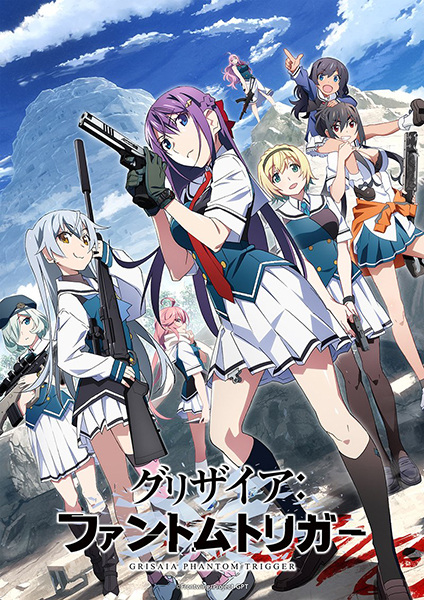
Several years after The Fruit of Grisaia... What was once "Mihama Academy," a sanctuary for young girls, has now been transformed into a SORD (Special Organization for Research & Development) training school dedicated to fostering talent for national defense. Rena and Maki specialize in firearms, Tohka and Gumi excel at sniping, Chris handles explosives and data processing, and Murasaki is a skilled ninja for intelligence operations. Together, they take on cases too complex for the police or Self-Defense Forces, repeatedly facing dangerous missions. This is the story of these young girls, painted in blood and gunpowder. (Source: Crunchyroll)
Synopsis
Several years after The Fruit of Grisaia... What was once "Mihama Academy," a sanctuary for young girls, has now been transformed into a SORD (Special Organization for Research & Development) training school dedicated to fostering talent for national defense. Rena and Maki specialize in firearms, Tohka and Gumi excel at sniping, Chris handles explosives and data processing, and Murasaki is a skilled ninja for intelligence operations. Together, they take on cases too complex for the police or Self-Defense Forces, repeatedly facing dangerous missions. This is the story of these young girls, painted in blood and gunpowder. (Source: Crunchyroll)
Characters
Main
Main
Main
Main
Main
Supporting
Supporting
Supporting
Supporting
Supporting
Supporting
Trailer
Reviews(2)
KANLen09
March 26, 2025
Grisaia: Phantom Trigger — Forever and for eternity, the black sheep of the franchise, without question. It goes without saying that Frontwing's Grisaia franchise has seen better days since its inception in Fall 2014 with the mainline Grisaia series (Fruit, Labyrinth, and Eden). On its episodic VN series of Phantom Trigger, however, it is without a shadow of a doubt that it overshadows the good that is the franchise to turn on its head into something more of a catastrophic showing. You would think that after 3 films and the ousting of the one credible director that has made all of this possible, Frontwing and BiburyAnimation Studios (after taking over from 8-Bit for Phantom Trigger) would learn from their missteps in the adaptation to the small screen. Well, not anymore. After the 3 films (which adapt Volumes 1 to 3 of the game), comes the anime adaptation to adapt the game's remainder of volumes...and it's frankly more of a mess. Even when you thought that you'd finished watching the prequels first before going into the anime, you're already thrown for a loop once again. I thought that seeing the Mihama Academy remnants of Haruto Aoi and the former Phantom Trigger members, plus the SORD girls obviously, would make the memories recognizable since it's been a while since the last showing of the series itself in the late-2020s' Stargazer. But while that is evident and all, the story itself, from evolving enemies to character developments alike, with an all-new staff team, it's clear that you're no longer watching director Motoki "Tensho" Tanaka's adaptation but a re-interpretation of the remainder of the VN according to the unknown director that is Kousuke Murayama, having taken over the reins from him since Stargazer. And I don't know what is truly happening here, because it seems that from his standpoint, the VN content, being too much for anime, got cut down and butchered instead just to make ends meet. Seriously, I think that the removal of Tensho literally cost one franchise's side stories the treatment that they deserve as a full adaptation of competent quality, though this comes with the cost of time and manpower to justify why taking it slow with the VN approach is always a risky business move. No matter if it's 8-Bit or Bibury, the production always is Grisaia's strong point, and it's still great to see the show embracing its cinematic 16:9 movie quality to show that the show hasn't lost its chops. The music, on the other hand, is just not as memorable as past series, even with Mao Uesugi's OP and Yoshino Nanjo's ED songs. In the end, the Phantom Trigger episodic VN series was kind of screwed the moment it turned into adaptations on the small screen. As much content as the VN would have, it's literally impossible to squeeze it into the anime format, so a gamble was taken, and once it looked viable, more can be squeezed out of the series to make a seamless transition. That's the main problem with the films and the anime here, and there's just no way you can come out unscathed trying to understand what the heck is going on. Oh well, let the dust settle, because this is as good a showing for the "sequel" that never got expanded the appropriate way possible.