
ルックバック
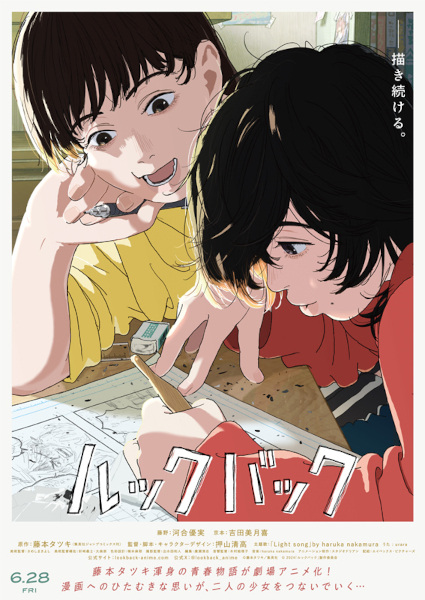
Ayumu Fujino may only be in the fourth grade, but she already basks in high praise for her hand-drawn four-panel comics featured in the school's newspaper. However, when she is asked to share the page with Kyoumoto—a reclusive student she has never met—Fujino feels inadequate for the first time: her free-spirited drawings look embarrassingly amateurish next to Kyoumoto's breathtakingly detailed art. For a year, Fujino shuts out the world, obsessively studying manga creation and drawing tirelessly to catch up to her faceless competition. But Kyoumoto's talent far exceeds hers, and Fujino quits it all. Another year passes, and on the day of their graduation, Fujino finally meets Kyoumoto. This unkempt, shy, and stuttering girl has actually been Fujino's biggest fan all along. Their encounter reignites Fujino's passion for art and sparks the beginning of a years-long friendship built on rivalry, admiration, and their shared love of manga. [Written by MAL Rewrite]
Main
Main
Supporting
Supporting
Supporting
Supporting
Supporting
Supporting
Supporting
Supporting
InfinityDude88
July 1, 2024
With the monumental success of Tatsuki Fujimoto’s Chainsaw Man it is no wonder that studios immediately turned to adapting more of his works. The concern of course then becomes whether there will be a rush to pump something out regardless of the quality. Thankfully, much like Chainsaw Man, Studio Durian was able to uphold and even uplift Fujimoto’s Look Back and, in the process, create a beautiful, heartfelt and devastating movie that will surely leave an impact for years to come. Clocking in at only a little over an hour Look Back is a very short film, however it absolutely makes the most of thatruntime. Beautifully sequenced timelapses emphasise the feeling of constant time passage which establishes a real sense of progression for the film. There is also no time wastage, with every scene playing an important role in either the plot or at tugging on your heartstrings. I also wouldn’t say I was left wanting more by the end, rather that it had an entirely satisfactory and fitting conclusion – perfect for a self-contained movie. Despite being a relatively new studio, Studio Durian took the opportunity to show off their animation skills with some of the most mind-blowingly smooth and fluid animation in the business. For a film about the creation of manga, crazy animation was certainly not necessary, but it does make the overall package that much better. Any scene with movement whether it be running or paper floating about features dynamic action shots with constant flow, employing the common modern technique of 3d environments to stunning effect. This animation style also perfectly reflects Fujimoto’s style of drawing, with realism less important than the impact and emotion behind the scenes. The thinner, sketchier art style of the manga is also reflected in the movie. I think the perfect example of Durian’s desire to go above and beyond is the opening scene, where they fully animate Fujino’s first yon-koma manga in her style creating an exciting opening out of what could otherwise have been a fairly standard scene. The music in Look Back is another aspect executed flawlessly. Nakamura Haruka crafted a fitting soundscape composed primarily of piano and strings. Whilst it swells up at times, particularly during the montages, it also knows when to remain minimalistic in order to let the raw emotion be displayed in full. The ending theme (played at a brilliant moment I might add) remains in much the same style as the soundtrack with the addition of soothing vocals to encourage reminiscence on the short but moving experience that just occurred. I finally want to touch on the theme and story. It is clear from the outset that Look Back is largely a distillation of Tatsuki Fujimoto’s experience as a mangaka (if you couldn’t figure it out from the premise, the appearance of the Chainsaw Man parody Shark Kick later on will surely suffice to demonstrate that fact). Fujino’s feelings of incompetency, her struggle to maintain friendships, the clashes in her partnership, the choice between art university and becoming a mangaka outright, and on and on. All of these elements feel as though they are coming from Fujimoto’s heart directly which makes them all the more impactful and realistic when they occur in the film. Even when things exit the realm of reality towards the end, they do so to emphasise the need to push forward and move on whilst respecting and building on the events of the past that is central to the overall message. Tldr; Look Back is a raw, stunning, beautiful and emotional ride all packed into an hour that left me utterly blown away by the level of craftmanship and heart put into it.
Chiriruu
October 6, 2024
Regret is one of many of human emotions, it’s a painful part of life that everyone at some point will experience. Many wish to live without regret, and that wish is a high one, yet when that feeling comes at a time too late, what do people more often than not do in order to handle it? Look back. Look Back is a sentimental film that depicts themes of regret, how connection forms and holds when we often take it for granted at times, and how art is a medium that can change people regardless of who they are or once were. Despite being a short filmthat runs in at a little over an hour, there is this utterly profound feel of passion that exudes across the length of the film from the people who worked on it. From the vision of Director Kiyotaka Oshiyama that he vividly explains in the after-credit interviews, to the melodic range of the soundtracks of Haruka Nakamura that grasp both the joy and pain of life, to the stunning performance of both Yuumi Kawai and Mizuki Yoshida, Look Back is a defining example of not only a stellar adaptation that improves the source material but a captivating experience on how to deliver a bittersweet message in such little time. Fujino is a character that captures what many of us were like in youth and carries those elements into adulthood. She isn’t the best friend nor is she the most likable person but that’s where Kyomoto comes in, she’s a counter to Fujino. Their relationship is an incredibly touching yet bittersweet one, from the common interest of manga between the two to their years of being a mangaka duo to the events near the end of the film bringing a painful lesson for Fujino. That lesson is one of regret, because even though regret is often painful and revives memories that we may want to forget or wish we could change and do things differently, there is no way to return to that time and the only thing people can do is learn from it. Despite that, Fujino brought Kyomoto out of that room while Kyomoto brought change to Fujino. Fujino however is the main catalyst, with her efforts and pain of creating to her insecurity of her abilities to draw, it’s these feelings and challenges that reach out to many people who have attempted to create but we mustn’t forget about Kyomoto with her problems of connecting to others and her struggles of social activity. In that way of Fujino bringing Kyomoto out of that room, she was the person that Kyomoto needed in order to grow as a person, to get her into the world and to try to go beyond. The soundtracks in this film are a testament to how music truly matters in atmosphere and mood. It’s heavily characterized with piano and chordophones or string instruments, having this lovely sound to it that’s reminiscent of life in motion. In the first half of the movie, it’s bright and lively, feelings that are associated with youth. It’s the kind of music you would listen to in the Summer, invoking a sense of nostalgia and tenderness. In the second half of the film, especially near the end, it’s the complete opposite of the first. It’s melancholic and soulful yet immensely sad, capturing a mood that punches you in the gut and is emotionally rich. It’s like that one specific quote, how the keys on a piano represent sadness and happiness yet you need both to play a song. Across the film, there are two consistent motifs that show the flow of time and the changing relationship between our two leads. Because of how manga is read differently in comparison of Western Literature, being right to left instead of the other way around, the movement of our characters going right to left such as the time when they went out after winning second place in a manga competition, that is one of two said motifs where Fujino and Kyomoto running from the right to the left is a beautiful style of subtlety that shows their relationship changing in tandem with their youth. The second motif and the more obvious one, is how time changes while our leads are in the same position in still frames. This kind of storyboarding was also seen in Tatsuki Fujimoto’s other one-shot, Goodbye Eri or Sayonara Eri. Within Look Back, it’s used to have time essentially move forward quickly and convey how fast their youth is passing by in the span of a few seconds for us while months to years fly by for Fujino and Kyomoto. The room is filling with new material for manga or vice versa, the seasons are changing in the background, and times are changing with them as they age. It’s quiet but poignant, because time often flies by in the blink of an eye. And if we don’t realize the value of that time and the memories that come with it by the time it’s too late, that is where regret is born. Even though regret can’t be avoided as much as one could wish they could, regret can be learned. So instead of dwelling and being stuck with past regrets, move forward and learn from it so you don’t have to experience it again in the future. That’s why we regret, and that’s why we continue. Thank you for reading.
QrXtuV
October 8, 2024
'Then why do you draw, Fujino?' Before entering the theatres to watch this movie, I did not know what to expect, really. I'd read other works by the author Tatsuki Fujimoto — such as Chainsaw Man and Goodbye Eri — but not 'Look Back', and when I saw it was releasing in my city literally tomorrow (at the time) for screening, I impulsively bought a ticket, despite knowing next to nothing about the story. I'm not sure whether this limited or enhanced my experience, but regardless this 1 hour movie would leave me torn. I won't waste your time with a detailed synopsis as it's easy tofind, so I'll just cut to what I wanted to write in this review. To me, 'Look Back' is a masterpiece in human connection; how it portrays the experience of regret and the beauty of seemingly mundane moments we share with those we care about, as well as no matter how much we do care for someone, we cannot choose what's best for them. The relationship between the two main characters Fujino and Kyoumoto felt incredibly refreshing, each being so different yet so similar, making you route for them the whole way through, in spite of and because of the flaws they both held. The movie also showcased a mastery in filmmaking and cinematography, utilized in a way I rarely see in anime. Very often there were prolonged scenes of a character's back (because look back, h a h a), and whenever you believe the scene was to cut away to another, it simply continues to roll, the only differences in the scene being the character making subtle movements and adjustments. A lot of the film felt as if we the audience were just getting a glimpse into someone's life, and I think that's exactly what this movie was. There were many wordless scenes where soft background music (composed by Haruka Nakamura) played over Fujino's and Kyoumoto's conversations or work, but never did these scenes feel dull or uninspired. There was silence because there was no need for anything to be said, and muted conversations because maybe they weren't for us to hear. Fujimoto and the director Oshiyama definitely had a vision for 'Look Back', and I would say it truly came to fruition on the screen because of the immense work and visible creative energy they put into it, along with the talent of the voice actors and everyone else involved. I did not give 'Look Back' a 10/10 when the lights brightened in the theatre and the credits rolled, but as I chatted about it and went home, I don't know why but I kept trying to figure out the meaning of the movie as a whole; the lesson or purpose 'Look Back' had set out for everyone viewing it. The more I tried to attribute symbolism and analogies to it, the more I thought back to each scene and moment, the more I understood that this movie is just life. I say this in the most metaphorically scarce way. Life isn't all metaphors and similes, it's a conglomerate of love, pains, jealousy, happiness, sorrows. Things happen because they happen. We may attribute disasters in our lives to some sort of twisted karma we hold, but in reality it's just how it is, and the world turns in spite of us, and in spite of it all. We can wish to rewind time, escape from reality for a while, but life goes on. And that's okay. I didn't cry in the theatre to 'Look Back', but the next morning in the mirror, I found tears falling down my cheeks. It was then I understood that all this time in the movie I was looking for closure and consolation, but knowing now that it was never needed for the story to be complete.
YusukeU
January 3, 2026
Look Back is a story about choices, the past, and guilt. But Look Back is different from more generic works that deal with the same themes. Here, it builds something uncomfortable: a narrative essay about how choices shape who we are. The work presents a clear parallel between the artistic creation of its two protagonists. Fujino doesn’t draw because she enjoys it; she draws because it’s what others expect from her — someone artistically talented. For her, that’s what defines her. When she realizes that someone else draws better than she does, it isn’t just her talent that feels threatened. It’s her very existence. What defines her. Kyomoto, incontrast, draws as a way to insert herself into the world, almost as a refuge from her reality. While Fujino draws in order to be someone and to be noticed, Kyomoto draws in order to exist. Another important message of the film is that creating is not liberating. The criticism of how mangaka suffer and sometimes sacrifice their lives for a job that maybe shouldn’t — or simply isn’t — that important is striking. And maybe this ties into my personal criticism that Fujimoto writes better one-shots (Goodbye, Eri and Look Back) than long-running works (Chainsaw Man). The frustration of being a mangaka is not romanticized here in any way. There is no guaranteed reward — only insecurity, repetitive effort, and the constant question of whether it’s all really worth it. And this leads directly to the central message of the story: there is no clear mistake in the characters’ lives, only a past that cannot be rewritten. The film’s production and direction greatly intensify these ideas. Look Back manages to communicate emotion, elevates fictional stories that are naturally simple by giving them strong identity and care, and shows a complete understanding of Fujimoto’s work. In the end, the greatest textual strength of Look Back lies in its refusal to offer comfort. The film draws a parallel in which choices are made — often unintentionally — and still build paths with no return. Life, just like the position of a mangaka, and living just like creating stories, means accepting that weight.
Hellother
October 9, 2024
Fujimoto-San wrote a very personal story that seemed to be a tribute to someone and it is very hard to understand the motive behind it without knowing more details. With that being said, I’m very glad that the movie made the theater and Fujimoto achieved his goal, and now the movie itself will be remembered and honored by the community. The story itself is rather simple and plain, without much novelty. It would probably be much more touching to someone that knows the backstory of the characters and their relation to Fujimoto himself. As of now, we do not know much detail behind it andunfortunately, Fujimoto did not show up during the post-screen interview to explain it. I would like to know more about the backstory and I think it would help us understand Fujimoto more, about his history and personal motive as a mangaka. I think it will remain a mystery for the foreseeable future. Regarding the production, the animation is beautiful. The music is great and makes the story so touching. The voice actresses did a great job capturing the personalities of the two characters. Compared to the original manga, the animation did a little more elaboration on the later part of the story and made it less confusing. The movie ended with an open question: ‘why do we draw/create?’ Unfortunately, I couldn’t make an inference about what motivated Fujimoto to draw and create following the movie. I think Fujimoto still owes us an answer.
#97
Popularity
#1210
Members
231,830
Favorites
4,772
Episodes
1