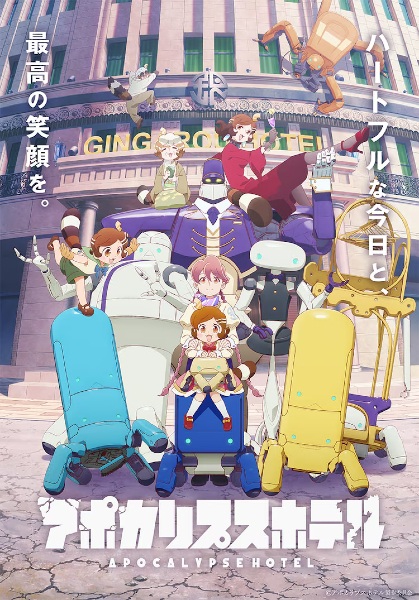

アポカリプスホテル
In the year 2157, Gingarou Hotel, a luxury establishment in Ginza, Tokyo, employs advanced hotelier robots to provide best-in-class hospitality. Unfortunately, no one has visited the hotel in decades, as humanity has long abandoned Earth due to its toxic atmosphere. Yachiyo, the robot "acting acting manager," works tirelessly every day alongside her mechanical crew to keep the hotel running in tip-top shape. Over the years, many employees have ceased functioning, with no hope of repair or replacement. Still, Yachiyo continues to fulfill her duties, just as she promised the hotel's owner before his departure. She remains optimistic that humanity will one day return to Earth—and that she will see the owner again. [Written by MAL Rewrite]
Main
Supporting
Supporting
Supporting
Supporting
Supporting
Supporting
Supporting
Supporting
Mcsuper
June 24, 2025
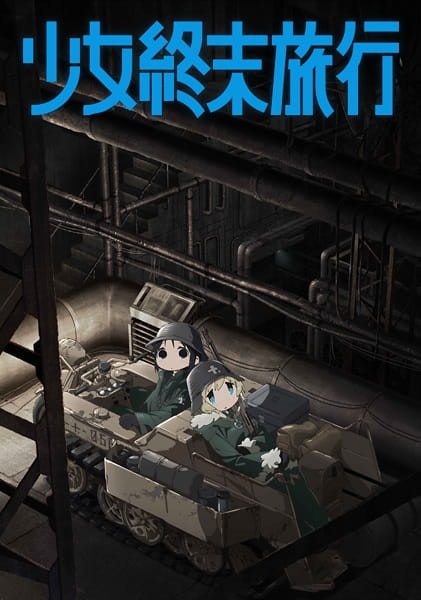
Anime originals are hard to get right. Let’s face it, a lot of anime originals suffer from a variety of things, whether it is a lack of creativity, poor pacing, production woes, you name it. However, when an anime original manages to push through the obstacles that the anime industry faces, it can sweep you off your feet, and that is exactly what Apocalypse Hotel did. From the very first episode, I was thoroughly charmed at the setting, the characters, the music, basically everything, and the rest of the series followed suit. It reminded me of another anime original from last year that put itswacky ideas to good use, which was Train to the End of the World, which thrived on its absurdity. It is another reminder that when creative minds come together, and work on something that they clearly WANT to do, amazing things can happen. It is an irreplaceable experience being able to speculate on what would happen next in a story, without anyone being able to spoil you on how it ends. Human-robot interaction in media is something that has been done plenty of times. With a lot of them revolving around humans getting to know a robot, and the robot becoming more “human” at the end, I thought this “genre” was getting a tad bit old. So what if, there were no humans left in civilization? Humanity has been wiped off the planet seemingly, but they could return at any point. Therefore, one day, people could flood back into the Gingarou Hotel, the main setting of the series. The hope that human civilization would return once more was a hope that Yachiyo, the main character, and a robot no less, was clinging on to, and when there is hope, hard work will ensue. And that is where the charm kicks in. Seeing a group of robots clean up so willingly and happily, proud of their work, even when no customers showed up. The story of Sisyphus comes to mind, as after each day ends, the same work would have to be done with the hotel, over and over, for hundreds, thousands of years, until someone, anyone would visit the hotel once more. The unwavering nature of the robots won me over even in the first episode, because to live a fulfilling life even in a bleak, dying world, I thought it was quite inspirational. Oh, and by the way, these are just robots. Why am I feeling this way? The anime was melancholic but hopeful throughout, and provided the viewer with a wide range of material, whether it was the joy of cleaning and working, dealing with wacky animal customers, insane action scenes, or exploring the areas around the hotel. Even as the characters were as happy as could be, dancing around, partying, or in whatever adventures they were in, reality remained the same, in that the world would not be returning to how it was before. However, the story tells you that is okay. The backgrounds were among the best I have seen in anime, and combined with the soundtrack, the atmosphere was immaculate. I thought some of the best moments were ones that were dialogue-free, where we could just revel in the beauty of the desolate. It is undoubtedly a world that I would not mind being a part of, even as bleak as it looked. In that, it reminded me a little of Girls’ Last Tour, where the main message was how we can still get along with the feeling of hopelessness. Undoubtedly, one of things I always appreciate the most is unrestrained creativity. Just writers and authors letting their ideas flow. It might not be “perfect”, it could be a bit rough around the edges, it might be so wacky that it breaks the confines of what an ordinary person could ever imagine, but in the end, it is what they chose to do. Even if *Apocalypse Hotel* ended up not working out, I would have still appreciated it greatly. There is nothing more powerful than a group of people with crazy ideas about a story, and having it come to life. Truly a beautiful thing. Full props to Kana Shundou on his directorial debut, and everyone else who had a hand in this. I hope they all get many more chances to work on anime in the future. That gacha money from *Uma Musume* was definitely put to good use. I was wondering though, what would end the world faster, mass pollutants, or not having a shampoo hat?
ZNoteTaku
June 24, 2025
Before I review this, let me put on my shower cap! In a world destroyed and depopulated, there would be but a few actually meaningful pillars left standing that somehow provide evidence that it was once teeming with life. In a series that wanted to treat such an apocalyptic scenario with the stone-cold seriousness of what such a situation would demand, it might opt for a museum or library, places designed to preserve and protect the records of humankind. And perhaps then it could provide some kind of grand introspection about how the true meaning of such records was that, though humanity or the planet hasentered its twilight, they were here at one point. It's rather telling therefore that two such “after the end” otaku properties primarily involve robots and places that don’t involve any of that. When Ashinano Hitoshi wrote *Yokohama Shopping Log* back in 1994, he imagined a world that was dying, but it was one I would gladly live in. The people (and Alpha, the café-running robot) have accepted the end and choose to spend the remainder of their time enjoying the peace and tranquility. The sea rises, Misago spends time with the children, and Alpha wonders if her master will return. But until such time, she’ll pour a cup of coffee with a smile on her face, gazing at the sun, and take photographs of a moment in time. And I can think of no higher compliment that I could give *Apocalypse Hotel* than I would give anything to check in to a room there for a time, or perhaps even work there as an employee. To be clear, this anime is not directly a successor to *Yokohama Shopping Log*, but it likewise is informed by its influence even in the midst of all its differences. Standing eternal watch over its microscopic corner of the planet, the Acting Acting Manager robot Yachiyo spends every day at the check-in desk of Gingarou Hotel, waiting for the moment that humanity will return through the doors generously opened by the Doorman Robot (assuming he doesn’t need water splashed on him again). Everything until then will be meticulously maintained, and even as the number of robots on “indefinite leave” increases over time, Yachiyo always stays steady…or seems to, anyway. That kind of steadiness spreads itself into the setting: in a 24 June 2025 interview which involved series writer Murakoshi Shigeru, he mentions the deliberate attempt to make Ginza the location for the series. According to him, Ginza as a real-world setting walks the line between the past and the future, with Edo-period traditions intermixing with Western culture and influence. Fashioning a futuristic fictitious hotel out of a real department store, all while occupying the same general space as an old kabuki theater or small shrine in-universe, certainly seems like the way to do so. With such a backdrop, one might think that a *NieR: Automata* approach of exploring each landscape or location and feeling the ephemerality through the wind and quiet expanses would make the loneliness of Yachiyo, her workers, and the still-shining Gingarou Hotel even more poignant. The series generally chooses not to do so, and there’s something so dismaying and delightful about such a framing. Despite all the literal decay of the surrounding buildings and the “decay” of the overgrow consuming the rubble, *Apocalypse Hotel* hypercondenses the “life of Ginza” into this one single location, an inherent juxtaposition between the traditional manner of Japanese hospitality and caring for guests against a bunch of robots that follow their orders to a silly degree. Like true robots, their rigidity is nigh-absolute. So, imagine the likewise-absolute worry that ensues when a shower cap goes missing, or Doorman Robot cannot fulfill his singular duty of opening a door. Life at Gingarou therefore happens in bursts of things that could be rectified rather simply, but MUST occur with over-the-top abandon because “that is how it is supposed to be.” Similarly, it is because Gingarou is the last vestige of meaningful activity on the planet that its guardians must honor and protect it – under the circumstances, there is no greater dynamic than polishing that floor or taking care of that central tank. Perhaps it is the fate of robocentric fiction that such things cannot remain that way forever. Sometimes by deception and other times by sheer happenstance, guests arrive and Gingarou begins to become a more colorful place, and as such, the comedy itself takes on increasingly colorful dimensions. As fun as the robots are in their eternal quest for perfect maintenance or aggressively checking the environment can be, they discover rather quickly that serving or “living” with others (especially those who are decidedly not humans) is not something that can be so easily written into a rulebook or programming. Their lives get harder, no doubt. But on the sweeter upside, their lives get more enriching as a result…or at least, as far as enriching can be felt by an unfeeling(?) robot. With such a lack of interaction from non-robots for so long, is it any wonder that Yachiyo would temporarily forget herself and just act like a giddy child when it seems like all that waiting will at last pay off? But a melancholic overhang still exists, no matter how funny the show may be at any given moment. Any apocalyptic story, even one as warmly conceived and realized as *Apocalypse Hotel* or *Yokohama Shopping Log*, carries with it the knowledge that “the time before the point of no return” in-universe will not return. The show doesn’t run away from this; the earliest minutes tease the idea of what if indeed nothing happens and Yachiyo and company are trapped within real-life purgatory, perhaps themselves damned to be on “indefinite leave” like all those that came before them. Even as the show progresses and Gingarou becomes more bustling both guest and employee-wise, there’s no complete escape from that question. Acknowledging the overhang however is part of the appeal. It’s precisely because the mortality and “mortality” of the Gingarou employees, their waiting, and its hotel exist that the comedy can itself crackle. There’s an old saying that it’s only when it’s darkest that you can see the light, but that doesn’t mean much unless you look beyond the light and see why it’s even shining in the first place. *Apocalypse Hotel*, in a way similar-but-not-too-similar to *Girls’ Last Tour*, argues with a smile that the darkness itself is the source of that light. As such, the most crazed and bewildering ceremony atop the hotel can take place and not only have it feel completely at-home within the show’s context, but also walk the line and evoke the kind of laughter that only stuff that goes just a bit too far in its oddness or perverse sense of humor can manage to do. In that same interview with Murakoshi, series director Shundou Kana remarked on the difficulty of his first true directorial debut, saying that he caused problems due to his own lack of experience. Perhaps his own work as assistant director for *League of Nations Air Force Aviation Magic Band Luminous Witches* and its production problems lingered in his mind as a potential sign of his own inability. It hardly shows. With great control over everything in sight, every episode works wonderfully in throwing a new obstacle at its cast and its setting, sometimes challenges of their own making or things or from an outside influence. It treats itself seriously enough to give room to breathe and dwell on the inherent ridiculousness of a moment, then doesn’t break any sweat—not that robots can sweat, anyway—as it gives Ponko and Yachiyo a moment to themselves later. With *Apocalypse Hotel’s* completion, CygamesPictures has now made two robot-centric original IPs in the past two years, the first being the wildly bizarre and awesome *Brave Bang Bravern*. If there’s anything to glean from these efforts, it’s that they have an intuitive sense of what it is about robots that people love, find endearing, and cannot help but laugh at. Like Mizushima Tsutomu and most of his output that involves derangedly playing with his toys, whoever is in charge of story development and scouting at CygamesPictures has a keen understanding of trope and convention, seamlessly intermixing it with setting, tone, character, and larger paratextual ambiance. Stories like *Apocalypse Hotel* make anime a better place not necessarily because they “say something” about who we are as people or grappling with larger themes inherent to life. Rather, they recognize the inherent fun to be found in taking an idea and following it to the end of the rainbow. Gingarou happened to be where the rainbow led. Who knows where it’ll lead next?
AeroGunz
August 20, 2025
“Apocalypse Hotel” is what happens when a pretty depressing subject is treated lightheartedly (in a good way, surprisingly). Honestly, after reading the premise I was expecting something more like Disney’s “WALL-E” or maybe something more depressing like Tsukumizu’s “Girls’ Last Tour” with maybe, just maybe a pinch of an anthology like “Four Rooms”. I would say this show leans more towards the former than the latter. Is that good? Depends what you fancy. Personally I would prefer something more depressing, thought provoking (maybe even cathartic) and with better world building but that’s just me. And given how heavy handed and tacky a lot of anime thattackle the vibe can be I can’t be that disappointed. Before we start I would like to explain something. I will be talking about “plot” and “story”. Many people use those terms interchangeably. I’m not one of those people, so to make sure everyone is on the same page… I use the definitions for “plot” and “story” as Lisa Cron describes them: “What happens in the story is the PLOT, the surface events.” “STORY is about how the things that happen affect someone in pursuit of a difficult goal, and how that person changes internally as a result”. I was actually surprised by this show. Despite its many world building flaws and not giving much of a damn about logic, it is a surprisingly competently written sitcom. It balances humor and drama pretty well, although I wish they would make the drama more prevalent. It’s not a big deal overall, just my preference. The humor itself is a mixed bag. We get mostly situational comedy but there is some slapstick, thankfully not much. A lot of the comedy comes from interactions with alien species that have different cultures and preferences. As with almost all shows and movies that revolve around non-human characters, they are all still very much human. Apart from the first alien guest, all others are personifications of different human traits (both good and bad) and I think that helps to sell a lot of the plot that would be sub par or lazy if the characters were human but because they are not, some of the situations were actually enjoyable. Probably because the show contrasts, sometimes goofy, alien design with some serious subjects (that it doesn’t go deep enough and only treats them as an afterthought but that’s another thing entirely). Because of its sitcom format most episodes have their own, contained story and plot. Not much is continued in future episodes. Yes, there are some elements but most are just one time deals, so don’t expect an overarching, grand story. It’s both a strength and a flaw. It’s a flaw because it doesn’t give much in a sense of progression. Most things reset to the status quo at the beginning of the next episode. It’s a strength because it allows the writers to go off the rails with some of the ideas. And trust me, they do go off the rails, bonkers with some of them. A bit of a warning. This show is a slow burn. Not everyone likes that. I do. The problem is that it doesn’t always use its slow pace to its advantage. Probably to compensate it throws in some faster or more slapstick scenes which is a shame because it doesn’t need to. The slow pace is perfect for a show like this. The only thing I would change is to substitute some needless establishing shots for something more dramatic like dutch angle and close ups. It would add some drama and much needed pressure. A few things that rubbed me the wrong way when it comes to world building are all connected to how stupid humans seem to be before leaving earth. It is stated that it was believed that the exodus will last only a few years, so why the hell only the hotel is in good shape? The technology used in the hotel doesn’t seem to be anything unique in that world at that time but no other building seems to be cared for. Why? It’s Ginza ܻ— a luxurious part of Tokyo — it’s hard for me to believe no one else would get the maintenance robots to care for their buildings. Even if some would stop working by the time the series takes place, the hotel’s maintenance robot is proof that others should still work. Even if not all, some parts of town should still be taken care of. I get it, to make its point and be easier to write for the series requires a very specific state of the world, but if that’s the case maybe provide some proof that the hotel has some unique, state of the art or experimental technology used. As it stands it seems that everyone except the hotel owner was an idiot. From where the hotel gets supplies for maintenance and food for the guest is a mystery as well. Despite not having a guest in about 100 years the hotel is able to prepare meals for their first alien guest with little to no problems. I’m gonna give it a pass that an alien is able to eat earth foot, this show has enough logical bullshit that this one seems pretty small in comparison. Anyway, I get they have a small field to grow vegetables and fruit but what about meat? Yes, they have chickens but they serve sea food. You can’t keep it frozen for 100 years and expect it to be edible and we don’t see anyone go fishing anytime soon. Plus, this is Tokyo, I’m pretty sure you can’t catch those types of fish there. Episode 4 actually addresses this issue but it does so in such a disjointed way that it almost feels like a spin off and not part of the main plot. The parts for the robots are also an open question. Those are machines. Machines break when used (and even if not), they need checkups and have parts replaced. I can somewhat believe that the maintenance bot takes care of the checkups but if the state of the door opening robot is any indicator there are no spare parts or liquids. I was thinking that maybe they salvage parts from the robots that broke down but that doesn’t seem to be the case, as all of them are just stored somewhere whole. A thing that shows up in episode 5 and absolutely destroys one of the key struggles for me is the language barrier. In the beginning Yachiyo — the acting manager of the hotel and our POV character — doesn’t understand alien languages and at the start of episode 5 she just does. The show even states that the alien language will be translated for “viewing enjoyment”. Fine. I don’t mind that… much, but that shouldn’t mean that everyone speaks the same language all of a sudden. The language barrier was one of the more interesting conflicts in the beginning of the show and the writers just decided to get rid of it without any sort of build up or setup. They even put a one liner about why she understands the alien language but it’s in a form and place in the script that just screams “Oh fuck, I forgot about it and now have to give an explanation”. Why not just show how Yachiyo learns the language or just have a guest be surprised about her knowing their language and just ask. Then you can give the same one sentence explanation but it would be more organic at least. Another thing with world building is the lack of feeling that any time has passed. Between episode 2 and 3 there is a 50 year time skip and yet, nothing changed. No buildings collapsed, no new robots shut down, everything is exactly the same. If it weren’t for the statement that verbalizes the passage of time You would be forgiven for thinking those two episodes are just a few hours apart and between episode 3 and 5 about 100 years passes and still nothing changes. During the episodes more and more time passes but nothing changes. Not the robots, not the city, not the climate and, what is especially annoying, not the living members of the supporting cast. Everything stays the same for the whole 7 episodes (during which more than 150 years passes). Only in episode 8 we finally get something that suggests the passage of time but it’s still not that much. The same episode also wasted an amazing opportunity. During the previous episode Yachiyo is lost. In the beginning of the episode we see her protege as the new acting manager. I was pleasantly surprised. That was an amazing opportunity for a different type of approach to plot and story. Unfortunately it lasts about 10 minutes before Yachiyo is back. Waste of potential. They could have prolonged her absence for 3-4 episodes to see a different side of the hotel. I do like the crisis she gets after getting back and having to suffer a less than optimal new body because of her injuries. Even despite going totally off the rails with her crisis and comedy, it still had a lot of emotional weight. I call it competent writing. Apart from that I really don’t have much negative to say about this show. The writing is sometimes heavy handed but because of the things that are juxtaposed next to each other it’s not as annoying as it is in other shows. Despite that I find the writing enjoyable. Yachiyo is a pretty good MC, even if her behavior as a robot doesn’t always make sense. The alien tanuki family is… an acquired taste. I really didn’t like them in the beginning but they grew on me. They are not anything great but I guess I’ve seen worse. The best part for me is Yachiyo and her ghost chasing. Even at the beginning of the show it has been more than 100 years since humans left. She must be aware that the owner of the hotel is dead and won’t be coming back. Yet, she still wants to make his dreams a reality. And a lot of them she does. It’s a bitter sweet story where an AI is chasing someone else's dreams and along the way, makes them her own. Episode 11 (probably my favorite) reminded me a bit of “Girls’ last tour” (Probably that’s why it’s my favorite) and that is a good thing. I won't spoil this episode here but I think this is the only episode that drove home that earth was really abandoned. I can’t fully recommend this show because of the flaws in logic and world building but if you don’t mind that, slower pace and bonkers ideas that would fit into a FLCL universe, give this show a shot. I very much doubt you'll be disappointed. Despite everything I am impressed how well this show balances drama and comedy (apart from maybe 2 episodes where comedy reigns supreme and not in a good way).
Chuy_diazz
June 24, 2025
A hidden gem that I was thrilled to find. The story is simple: a hotel run by robots on a planet Earth that was struck by a virus that forced humanity to flee. Now the robots will keep the hotel running until humans return. The premise is simple, but the journey you'll experience with this anime isn't. It's not just an anime with a curious premise; it's an anime that understood its premise and knew how to bring hotel hospitality to animation. The way they understand each of the concepts of hospitality and create an entire chapter around each one is incredible. Even the robots themselveslearn over time. Since they don't have humans to turn to, they are the ones who have to think for themselves, allowing them to develop their own personalities. The anime has two unique features that it dares to play with and be creative with. The first is that it isn't afraid to play with the passage of time. If history needs to jump forward 5, 10, 100, or 500 years to tell a story, they will advance without fear. This helps us see several things, such as how robots leave their status as automatons and become a kind of "new humanity." We see how the hotel goes from being an abandoned building to reaching a second golden age. For this story, time isn't a limitation or a danger, but rather another narrative element. The other unique feature is that each episode features a different genre. We can see entire episodes about a romance, about the characters being detectives, about a drama, a comedy, a silent film, and whatever else you can think of. They even dare to include action sequences that you'd be hard-pressed to see anywhere else this season. Cygames has truly excelled in the artistic department. The set design is done with great care. You can pause frames to appreciate every detail they put into these post-apocalyptic settings, and more than fear for the future, they make you want to live there. The color palette is very pleasing to the eye, which fits with the hotel's main theme because you always feel welcome to watch this story. It makes you feel like a guest who only sees the silly things the two receptionists do to keep this hotel running. I'd like to give an honorable mention and highlight episode 9 of this anime, which could easily be the best episode of the Spring 2025 season. It has such a unique premise and such a precise balance between drama and comedy that it's almost impossible to replicate. Apocalypse Hotel is undoubtedly the biggest surprise I've had this year. It holds a very important place in my heart. Animes that, beyond appealing to your tastes, appeal to your emotions, are the ones that should receive the most love from us. I hope with this review I have returned some of the love that this anime has given me over the last 3 months.
Kumoiro_Shizuki
June 28, 2025
What if Apocalypse Hotel were by far the best anime of this season? (I could have said of the year, but it's still a little early to be sure.) Like Yokohama Kaidashi Kikou, this seemingly discreet little series conceals an unsuspected richness. I could have gone on for hours about what these twelve weeks spent at Yachiyo and Ponko's side have meant to me, but here I'll try to explain, as calmly as possible, why I think Apocalypse Hotel is this season's most accomplished anime - and why it might be worth booking a room there, if only for one night. Animation: 10 Art direction: 10 Visually, it's flawless. Despitebeing set in a post-apocalyptic world, the series sparkles with color and vitality. The unique art direction infuses the series with a warm, melancholy atmosphere. As for the animation, it gracefully follows this luminous energy, offering breathtaking panoramas and scenes full of life. A real feast for the eyes, even for the most skeptical boarders. Music: 10 The soundtrack is the perfect accompaniment to the series' universe: sometimes soft, sometimes cheerful, it envelops the viewer like a soft blanket on a rainy holiday. Special mention must go to episode 9, whose music moved me. This suspended, emotionally-charged moment brought sincere tears to my eyes. A sensory experience that reinforces the feeling of being welcomed in a place apart. Story: 10 Development: 10 Characters: 10 But the beauty of the series lies in its writing. Through its themes - ecology, memory, hospitality, the passage of time, family - Apocalypse Hotel bets on gentleness and depth. With disarming accuracy, it explores the humanity of robots, or rather the hosts of this ruined world, who sometimes seem more human than we are. Time flows differently here. Ellipses of several centuries remind us of the quiet eternity of these characters, frozen in their duty of welcome. So don't be surprised if you briefly lose your temporal bearings: it's a deliberate, almost poetic effect. And then there are the residents of the Gingaro Hotel. Yachiyo, so lively and welcoming, gradually gains in maturity through contact with the galactic travelers. She learns to slow down, to enjoy silences, to savor the present moment - the ultimate luxury in a world in ruins. Ponko, for her part, follows the opposite path: a sunny, air-headed child, she grows up and becomes aware of her role and responsibilities. She becomes, with tenderness, a motherly figure and caring headmistress. Every secondary character - the Tanuki, the alien guests, the other hotel robots - has their own room in our memory. All are served with care, as if each deserved his or her moment by the fireside in the great hall of memories. Of course, I'd need many more paragraphs to do justice to every aspect of this work. But I prefer to stick to the essentials, leaving you to discover for yourselves this strange and touching table d'hôte. I only hope I've succeeded in arousing some curiosity in you, or even a hint of tenderness. For my part, I'd like to extend my warmest thanks to the staff of the Hotel Gingaro for these twelve timeless weeks. It was an unforgettable stay, and I'll treasure the key to my room in a corner of my heart. Yachiyo, Ponko, and all the others: thank you for this wonderful adventure. I'll never forget you...
Rank
#684
Popularity
#2876
Members
73,027
Favorites
426
Episodes
12