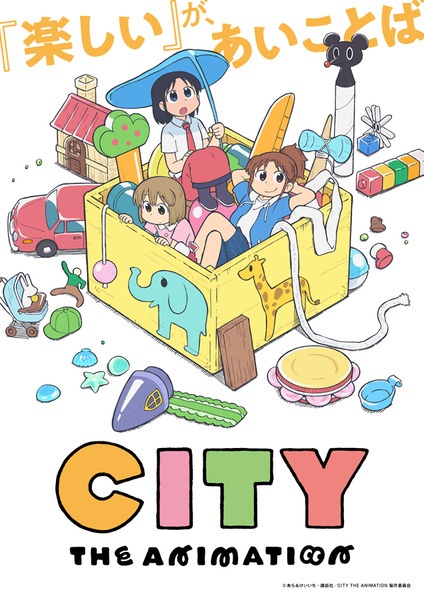

CITY THE ANIMATION
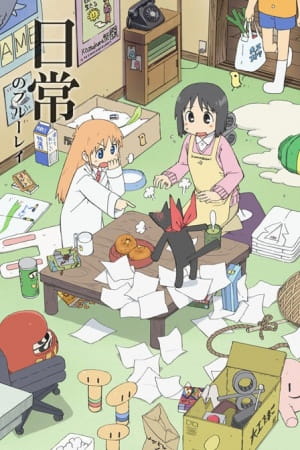
Aimless daydreaming in high school is an ordinary part of growing up. But once graduation comes, suddenly there are bills to pay and a higher education to tackle. Even so, Midori Nagumo never quite stopped dreaming—even after entering college—as she still wants to have fun while ignoring her responsibilities. Contrasting Midori's recklessness is her supposed best friend Niikura, who is the complete opposite of Midori and has a goal of becoming a photographer after college. However, Niikura is often pulled into Midori's schemes, which leads them to meet Wako Izumi, a tenacious, yet airheaded classmate who is always taking pictures of things she finds fun. The trio ends up living together in the same apartment and attempt to navigate their lives in the city of City, where unexpected and out-of-the-ordinary things occur daily. [Written by MAL Rewrite]
ZNoteTaku
September 28, 2025
I had a long conversation with a friend over Discord voicechat two days ago, and I said something during the course of it that seemed to catch him off-guard. When we were talking about our favorite anime of the year up to this point, I made the point of mentioning *CITY THE ANIMATION* and, more specifically, that while it didn’t always make me laugh, I’d readily call it one of the best things that had been released in 2025 thus far. My friend took issue with this stance, saying that it was ridiculous to say that since, for all its aesthetic prowess—and even he admittedthat there was plenty to be had—a comedy’s first and foremost job is to make us laugh. If it doesn’t do that, a comedy isn’t doing its job properly. He didn’t find its humor funny, such to the point that whatever other potential gifts that lay within just weren’t worth calling it a show worth watching. I understand why this mode of thinking exists. The word “comedy” is supposed to carry with it the inherent implication that it should make us laugh, and if it doesn’t, we more-readily say that it’s a bad comedy. But over the years since I started watching anime regularly, I feel as though I’ve undergone a personal reshuffling on two fronts that are relevant for talking about *CITY THE ANIMATION*: one, that my sense of comedy is less about making me laugh and more about having fun overall, however if manifests. And two, that the anime is, like lots of Kyoto Animation work, part of a larger pattern that I’ve become more aware of both by watching and learning more about anime and anime production specifically. I’ll talk about the latter later, but let’s start with the former and a simple question: did *CITY THE ANIMATION* make me laugh? Yes, and no. In its crazy, noisy, bizarre town, there’s no telling what kind of crazy, noisy, bizarre oddity will arise from somewhere within it, making its residents have to deal with that something. And in a place with so many people from so many walks of life, who’s to say what will cause what to transpire? Whether it might involve Naguno being recruited to run like an absolute madwoman and make a soba delivery and chase down a thieving cat, Captain Obina having the football team standing at attention like in the army while remarking that they’re borderline useless without their star player, or Makabe and Ecchan having a conversation about eternally transforming money into counterfeit and then traveling home in-montage while avoiding a giant bear as part of the journey, the underlying philosophy is always the same. Do what you can to be wacky, and if in the process you make someone laugh, then that’s a happy consequence! There is no “plot” in the more all-encompassing sense because the overall sense of mood is the plot and the point. The mood can be glanced by just casually glancing at what’s going on. Essentially any episode at any timestamp will give the impression of a manic energy suffused running throughout the anime. Because each vignette generally speaking is anywhere from about 8-10 total minutes, every small story within the superstructure requires a flow of motion. That doesn’t mean that it’s always screaming itself red or having a magical explosion of animation at every given time (that would be closer to something like *Dead Leaves* or similar), because there are indeed many times where it calmly lets the mood set before flipping the table and letting all hell wonderfully break loose. Everything was so tightly composed that laughing as a reaction to a thing that was happening somehow felt irrelevant. It was always offering something brimming with confidence and abandon that I couldn’t help but love. It’s a circumstance where, both on the technical front and the comedic front, the fuse is always waiting to go off, and when it does, it never feels out of left field even as it pulls a gag or a non-gag moment that could be taken as out of left field. But what is definitely of left field is just what exactly went into this from the production front. According to an interview with Ishidate (special thanks to kViN for providing some details on the matter), he had hoped for an adaptation of *CITY THE ANIMATION* back in the summer of 2022, and was surprised at the near-immediate approval of the work. Kyoto Animation already had experience with Arawi through adapting *Nichijou*, and likewise, Arawi couldn’t contain his own excitement as he eagerly jumped at his editor’s suggestion to adapt *CITY* into Kyoto Animation’s hands. Ishidate and Arawi apparently laughed like idiots at a writing camp as they shared ideas about how to make the anime realized on the small screen, and Arawi directly worked at the studio rather than speak through an editor or proxy. The process was so infused with vitality that showed a kind of communion between creator, creative staff, and creative product. It’s why talented people like Ishidate can direct something like *CITY THE ANIMATION* after having worked previously as director on *Violet Evergarden*, a series on the clear opposite side of the spectrum to *CITY THE ANIMATION*, and why the studio’s staff handle both types of aesthetics and moods. Ideas, and the people who make them come to life, thrive in an environment that can actually accommodate them. And the anime industry needs more stuff like this happening. This may be a bit of a revelation or shock to any relative newcomer to, or more-casual fan of, the medium reading this (hello there! Tell me what you like!), but if I may take a quick second to be rather uncouth, the anime industry is a fucking terrible place. As animators and studios find themselves descending into ever-thicker and more unpleasant webs of production issues, tight deadlines, and now the encroaching reality of AI and how it risks putting out of work all those people in the ED credits who do thankless / seemingly-invisible work that we don’t learn the names of (assuming they get credited at all, which is another problem altogether), anime is a business enterprise concerned about getting content out the door moreso than making any artistic statements. Especially in the current climate of the Reiwa era, seasonal listings are flooded with shows we won’t remember within a couple of months, or shows where the titles are more than enough to make someone think twice about tuning in to the first episode. *CITY THE ANIMATION* may not be the funniest thing under the sun, but its existence is a symbol that sometimes, there are more-significant macro-level concerns and understandings of how an artpiece orients itself into a grander design than whether a bit involving takoyaki in episode three had me laughing my head off (it did, for the record). But isn’t that a navel-gazing philosophy? I don’t think it is. Kyoto Animation is one of the last bastions of giving its ideas the chance to not only develop gradually, but also see their realization while actively trying new boundary-pushing and active training, as has been their longstanding tradition. They, and *CITY THE ANIMATION*, are an odd duck of the best variety, one which helped the studio codify their moe aesthetic through the 2000s, wildly influenced the moe aesthetic of the early 2010s, etc. And here in 2025, they haven’t come close to exhausting their creative juices yet. They didn’t need to make a physical diorama for episode five and have these practical non-animated moments, but they did it anyway – the idea of “Let’s try it just because we can, and let’s see if it works” is beautiful as a thing in and of itself that I can’t help but be thankful that it exists, even if I found it an unfunny husk begging for death (it wasn’t, for the record). When a piece of media vibrates at just the right frequency, it radiates warmth even in its moments that affectively “don’t work.” Why does this matter? One of my university students asked me at the end of an academic year what’s the point of praising something, however “new” or “interesting” or “ingenious / ingenuous” it might be, if it doesn’t move us personally? Why praise that which doesn’t reach all the way? I couldn’t help but remember this in light of the conversation with my friend from a couple of days ago. Years later, and with a lot more media consumption and instruction under my belt, I have a better answer (I hope). To that, I say that it is important to recognize that there are, at times, greater perspectives to consider than one’s own ego for whether “thing funny” or “thing not funny.” It is more about one’s own ability to understand that a different mode of thinking is sometimes required for watching something you realize on some level is truly special, even if it doesn’t completely coincide with what you want or like. It is about making YOUR effort to reach the creative energy on its own terms rather than waiting for it to “reach you.” It is actively broadening your own horizons into territories you didn’t dream of or didn’t think you’d ever chart or learn, and how through that, you will be remade into something newer and more beautiful, even if you still come out the other side not actually liking the thing in question. Is that not worth celebrating? But let’s also not overstate the case – this anime will be, as it is in the here-and-now, endlessly compared to its earlier progeny, *Nichijou*, both stylistically and structurally, and elsewhere with other comedies of similar swagger (and arguably even *Lucky Star* in the Kyoto Animation canon). It also is likely not going to rewrite any book anytime soon, both in terms of how to create comedy-centric anime or industry practice. The anime industry will be as problem-laden as it was before this anime existed, if not moreso as it lumbers into its (un?)certain future as Kadokawa prepares to adapt whatever is going to be its next *Long Light Novel Title with a Highly-Specific Gimmick That Might Involve Reincarnation in Another World While Maxing Out My Vigor Stat*. But for thirteen Sundays over the summer and into the beginning of autumn, a kind of unrestrained vibrancy, happiness, and joviality shined. And it was called *CITY THE ANIMATION*.
Japanese

11equalsFish
October 1, 2025
These are my complete honest impression as a huge fan of the the works by manga artist Keiichi Arawi, but just know that I'll be critiquing parts of the show in detail, so it's a long read. CITY: The Animation has been a distant dream for fans in the past decade, so this has been a long time coming. It's a miracle this comedy spiritual-sequel has finally been made by Kyoto Animation with their top tier craft. CITY should be a grander, more mature story-oriented take on Nichijou, but this adaptation has skipped more than half of the original manga content, making it an unbalanced adaptation.It's a difficult compromise, but they managed to condense the story to 13 episodes, each ~27 minutes. Nichijou in 2011 was the second last 2-cour show made by Kyoto Ani, being 26 episodes. The manga licencing issues with Kadokawa are why another collaboration with Keiichi Arawi didn't happen until more than a decade later. These rights are crucial for Kyoto Ani, which is known for fair practices. This studio also had such a deadly and tragic attack, some of those original artists behind Nichijou are gone. It's hard to develop that series further, so City the Animation is the next best thing. ART AND ANIMATION - 9/10 The level of technique and composition is on a very high level, incredible consistency across every frame, and illustration and directing that feels immediate and silly, perfectly like the manga. Th art style has no gradients, but bold lines and shapes give clarity to every detail and motion. The character animation and 3d camera movements are stunning. The style is cute but transitions easily into more realistic detail during close-ups and multiple layers of composition, grounding the environments with an impressionistic but believable depth. This all gives the world of CITY a tactile, intuitive feeling. Things operate on an heightened emotional level. Moments in the manga are extended, given lots of emphasis, and are surpassed by this anime. The intimate and calm moments balance the loud and bombastic moments. Overall, it's amazing to watch. It's super impressive this is inked in analogue, the finalized thick lines directly on the paper in brush pen, it takes such skill to animate that way. It is heart breaking how the old work influences this new one, and how some of the staff from Nichijou who died can still be felt and represented here by the staff that worked with them. The studio and the author worked closely on this series composition, and this feels like a unique and artistic work. This is nearly the best looking show I've seen, but it sticks to a fun mood and doesn't really have peaceful or serious moments. There is a ton of movement and fun. The simple character designs are animated with great detail, and the effects animation is evocative of the feeling of the scenes. The anime adapts the manga down to the panels, interpreting the art style variations, characters movements and duplicated body parts as they really would be. Subtle small movements, stretchy bounces, smear frames, action lines, onomatopoeia and silly abstractions are all precisely drawn. Every line and color in the background frames the characters with a balance that only great illustrators can achieve. The color design is warm, bright and vibrant, giving a sense of energy and comfort. The backgrounds for comedic moments are creative and colourful. This bold visual style shows the wonderful joy and absurd mood of this comic world, feeling like a summer where everything goes well. Episode 5 is an incredible highlight, I think the flat simple design makes the episode easier to follow, for all panels and multiple POVs. It's a breath taking experience, with the intensity of information. Rewatches are kind of necessary when there's a lot to see and remember at once. The physical model of the mansion is fun mixed media. Other episodes also have incredible sequences and animation showcases like this, but there are some still frames that have no movement in lower energy moments. STORY AND COMPOSITION - 6/10 This comedy is about the intertwined stories of an ensemble cast, many short moments of people in the titular City, their stories contrasting and connecting with each other. Nagumo, Niikura and Izumi are the main characters, but there are many nearby residents living their lives. The sections skip between many topics in the school, a family run restaurant, a newspaper department, a soccer team, a theatre troupe, etc. These contrasting stories are interconnected and woven together, making a varied comedic tone. CITY's best quality is the relatable and loud emotions, and the beautiful detailed spreads depicting those character moments and environments. There is genuine whimsy and fun showing the joy and coincidences of life. The range of jokes and scenarios is wide, but the series composition is odd because the missing foundations are noticeable. The anime cuts crucial sections of the main character's story, removing most of the context from the anime since the beginning. Most of the farcical and bombastic jokes have been cut tell the slice of life parts in this limited time, which is not the strong point when the entire presentation is comedic. They removed the more adult scenes too. Less than half of the story has been adapted, but the series' pace looks to reach the end in this one season. Little in the series has enough build up or context. None of the ensemble cast gets enough scenes. Whole arcs are skipped, leaving things somewhat incomplete. The focus is skewed so badly that that the three main characters don't really have a backstory or connection, so they are quite vague. The evil land lady who adds context to Nagumo's money troubles is almost completely gone, and the main characters have little time to themselves, so a main part of story's conflict, drive and soul is not present. It's built as a series about everyone, with intricate connections that can be appreciated most by attentive viewers. This is lessened as the high school side characters are the only ones given time for a complete character driven emotional arc, which are the most simple and cliché parts. This only works as a palette cleanser to the actual main characters. Kyoto Ani reorganised Nichijou, a gag manga, into a coming of age character story to create solid emotional core, but they removed CITY's story and cut much of the young adult themes of maturing. The vision is not fully realized. This kind of collective story achieves a compounding effect only when it has time to develop, and the CITY manga is an evolution of Keiichi Arawi's style, pushing the bounds for energetic creativity. Part of the comedy's effectiveness is that it seems silly, but it has a surprising sustained level of depth, scale and craft. The irony is Kyoto Ani set the standard here, Nichijou's mundane slice of life direction adds depth to the absurdity, and the intermissions of stunning sakuga and photo realism broadens that comedic range. With the follow-up CITY series they've made a show like a beautiful, authentic gag manga, but the story is reduced to be more superficial. Doing the opposite has broken the effect, the series feels like pieces of great moments that don't have weight or much real meaning to the characters. The entire narrative backbone that develops the main characters is gone. It's telling by episode 5 with the huge crowd scene, we don't know most of these characters yet, and the connections between them are vague. It's awkward that there is so much skipping, and the viewer has to make many assumptions. They've also condensed the entire island arc into one outro sequence, which is novel, but there's not much satisfaction in that. I've only found a handful of funny moments in the entire season because of the rushed pacing, but it is consistently amusing, and the story composition is functional. The song and dance number at the end is beautifully choreographed, and a creative wrap up, but it's not as complete as the missing final Mayor Election arc that addresses all the characters of the entire City and connects them all together in one grand finale. There is limited character progression outside of call-backs, and the larger scope doesn't amount to much. MUSIC AND AUDIO - 6/10 The music is appropriately silly and whimsical, but could have more variety. The tone of the jokes can be delicate with the quiet music, which doesn't always match the intensely surreal jokes. This show does not have enough unique music for the many completely different scenes, and it gets a bit repetitive. There are long stretches of silence without background noise which can kill the mood, but is peaceful. The tone is light but not that comedic, and the music often doesn't have enough energy and texture to match the stunning visuals and slapstick. The timing of the accompaniment matches the jokes well, so it is good when it counts. In comparison, Nichijou had an incredible orchestrated score, with 4 times the number of tracks. There are a few scenes like that which are elevated by beautiful music, such as Niikura punching the big nose creature. The classical orchestral music and Niikura's undignified suffering is hilariously absurd, showing the struggle and beauty of life. Overall, the show's score feels light hearted but sparse. The sound effects are mostly detailed and satisfying, being a bit toy-like and funny. Some parts could be more dramatic and louder for impact in the literal explosive moments. The voice actors all sound like their character archetypes and give great and earnest performances. They say exaggerated and funny lines with good timing, with a large range of contrasting emotions and expressions in the joke structures. The OP has a joyful yet nostalgic sentiment about friendship, and the difficulty of living and growing up. It is a celebration about precious moments of connection. It is well composed and balanced in a pop way, with an easy melody, some slow sensitive parts, and soulful singing. The overall effect is beautiful and inspiring. The ED is beautiful and creative, with pseudo CGI claymation. It looks so colorful and soft, the silly and playful mood fits the show well. The design has beautiful soft shapes and bright colors. FINAL THOUGHTS AND NOTES - 7/10 This show is more balanced than Nichijou, but it's genuinely disappointing if you've read the manga. It should've been more with the stunning art direction, but not much of the show feels meaningful. It's hard to understand why this show has been composed like this, maybe it's from lack of budget and support to make it a longer length. It does work as a counterpoint to Nichijou. In my opinion, Episode 5 is the most satisfying, so I feel the show peaks early. The ending song sequence is also great. Some fans are hoping for a second season or OVA, since Kyoto Ani often makes sequels and movies. This one season is incomplete, but the opportunity has already been used. We will likely never get a complete adaptation. If CITY was adapted to the midpoint, a season 2 would've been great. This adaptation is really accurate towards the scenes and panels, but the material's potential is a bit wasted. This is an good show because it is a bold creative risk and technically in class of its own, with a stunning and incredible production. I would not recommend it to everyone, because absurdity is not everyone's taste, and the heavy Japanese style and references are interesting but may be confusing. I'll watch it again soon to refine this review.
5iv3_
September 28, 2025
CITY: The Animation is a fun bundle of stories that have that classic Nichijou/KyoAni flair, or at least, that's what I thought when I started this. Undoubtedly, it's definitely got that nichijou comedy but for some reason, it didn't hit the same. I understand that between city & nichijou, they're different. They aren't meant to be similar. But with CITY I felt sort of disappointed for some reason. Maybe my humor has changed in the last couple years I've watched nichijou but Idk, something with the humor here wasn't hitting too well. There were some oddball episodes that were absolutely hilarious and that I enjoyeda lot, but the majority of them weren't like that. Animation on this is outta this world. So vibrant, fluid, and you can tell how dedicated KyoAni was with this. So at least in that department, absolutely phenomenal. Overall, I did like it enough to finish it. While it didn't hit all the time for me, for others it seems it was a big hit. And it was still a fun show to watch so overall i'm happy with it.
MisterK
October 5, 2025
In the sea of mediocre cartoons, violence, objectification of teen girls harem and shonen series, with a great impact barges in CITY. Originally written by Keiichi Arawi, author of Nichijō and Helvetica Standard, CITY the animation is a true and precious gem. Art style obviously inspired by the revival of the city pop music and it's pop-art envelope. Score reminiscent of Nichibros and Pat & Mat by Piranhans. And finally, humor that isn't relying on simple slapstick or stretched cringe, but truly absurd and abstract jokes or long buildup with satisfying reward. Titular CITY is a small city placed somewhere in almost rural Japan. Story follows multiple characters, weavingtheir interlacing storylines and interactions into tightly knitted fabric that will wrap around the spectator bringing weirdly cozy and warm emotions. Giving off strong summer vibes, always sunny CITY, is a place where weird hairdresser, slackers, busy families, noodle sellers, impossible animals, rich and common live their own lives. It is hard to even sketch up main story without focusing on explanations how who when and why... But! There are two middle schooler girls having their tight friendship with everything silly people would do in that age. There's group of sophomores and young adults, figuring out what they want. There are two families filled with great cast of characters. Police officer, antique trader, weird snake... snake-like creature. Actually, more weird creatures! Theatre troupe. Pastiche parody of Tezuka's weird scientist professors and comically well written stereotypical anime butler. Great art style and direction. Animation that mixes in clay-like 3D and even crafted scenography. Mentioned soundtrack that completes each scene and story. Everything just works. It is just so rare and refreshing to get series, that is this well balanced at what it wants to do. Might be best anime in many, many years. If you liked Nichijō or even enjoyed some Monthy Python sketches and jokes, want cozy escape from reality, this series might be just the right thing for you. Must watch if you loved The Taste of Tea or Symbol.
FlowMAL
September 28, 2025
When I first started City The Animation, I instantly thought “Wow, this feels just like Nichijou.” Then I discovered it was from the same author and studio, and it all made sense. The DNA is undoubtedly there, but it isn’t a reheated plate of jokes; City takes its own unique direction. City is hands down, one of the most inventive comedy anime that I’ve ever seen. The animation is absolutely incredible, not in the sense of flashy fight scenes or a “look at our budget” spectacle, but in how absurdly creative and expressive it gets. Kyoto Animation really took the “Animation” part of the title seriously;every frame oozes passion, and visual ideas keep detonating faster than you can process them. It’s not trying to look “cool” or trendy, but instead stretches the medium to its fullest purely to elevate the comedy and storytelling. Among all the episodes, two in particular cemented this feeling for me. Episodes 5 and 13 are what made me realise that this was reaching masterpiece status. It is one of the funniest and most creative episodes of anime I’ve ever seen, quite literally pushing the boundary of what anime can do; the kind of thing that makes you stop, rewind, and rewatch the whole thing because you can’t believe how far they took a single bit. But City isn’t just about gags and surface-level laughs. The characters and world are so well fleshed out that when it came time for sincere moments, they hit hard. The show pulls off goodbyes that sting and friendships that feel real. I didn’t expect that kind of depth from a gag comedy, but City delivers it seamlessly. Add in an OP and ED that radiate the anime’s quirky, vibrant spirit, and the whole package clicks into something unforgettable. Despite all this, City never really got its moment in the spotlight. Maybe it was bad timing, airing in such a packed season. But that doesn’t take away from what City achieved. It isn’t just a side-note to Nichijou; it surpasses it in consistency, creativity, and sheer comedic audacity. City doesn't deserve to be remembered as Nichijou’s little sibling, but as one of the most inventive comedies anime has ever pulled off.
Rank
#578
Popularity
#2647
Members
83,562
Favorites
663
Episodes
13