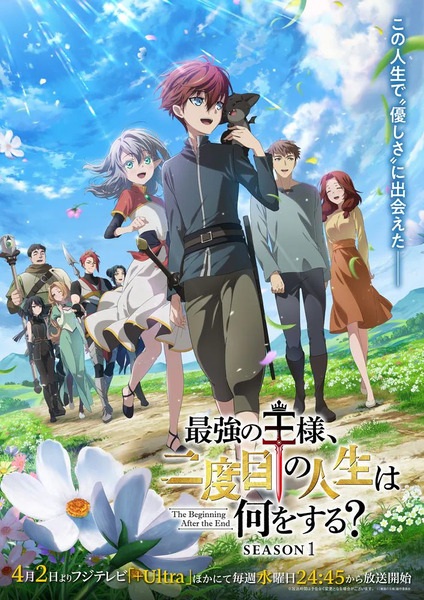
Saikyou no Ousama, Nidome no Jinsei wa Nani wo Suru?
The Beginning After the End
最強の王様、二度目の人生は何をする?
The story follows the strongest king in history, Grey. Although he possesses unparalleled power, wealth, and fame, there is no one who stands by his side…and he trusts no one. One day, Grey suddenly meets his death and is reincarnated as a powerless infant named Arthur in a world of magic. Surrounded by a loving family and companions, Arthur starts to experience joys in this new life that he never knew in his previous one. However, during a journey, his family is attacked by bandits... Thus begins his second life, filled with love and adventure! (Source: Official site)
Synopsis
The story follows the strongest king in history, Grey. Although he possesses unparalleled power, wealth, and fame, there is no one who stands by his side…and he trusts no one. One day, Grey suddenly meets his death and is reincarnated as a powerless infant named Arthur in a world of magic. Surrounded by a loving family and companions, Arthur starts to experience joys in this new life that he never knew in his previous one. However, during a journey, his family is attacked by bandits... Thus begins his second life, filled with love and adventure! (Source: Official site)
Characters
Main
Main
Supporting
Supporting
Supporting
Supporting
Supporting
Supporting
Supporting
Supporting
Trailer
Recommendations
Reviews(20)
Hypokrites
June 18, 2025
The Beginning After the End was one of the most highly anticipated light novel adaptations to come out from outside Japan. Written by Brandon Lee, known by his alias as TurtleMe, this story takes a more careful and genuine approach to Isekai—a genre not typically praised for its strong writing or compelling characters. Boasting one of fantasy’s richest worldbuilding, a meticulously detailed magic system, compelling character-writing, and immersive storytelling, any adaptation—be it manhwa or anime—had some pretty big shoes to fill. After a long wait, the ten-year light novel finally received the anime adaptation the fans have long been waiting for, yet they were nothappy. Given how loved and praised the original light novel and manhwa adaptation was, it begs the question: why did one of Isekai’s most well-loved stories receive such poor treatment in its anime adaptation? The backlash grew so loud that the author had to make a statement acknowledging their complaints. And while he didn’t explicitly address his grievances, his disappointment in the adaptation was unmistakably evident. Quick disclaimer: Despite being a fan of the original light novel myself, this review won’t be a comparison between the adaptation and its source material. The majority of the disappointment The Beginning After the End inspires is mostly due to Studio A-Cat failing to translate the light novel’s writing quality into an anime form, and while these grievances are valid, criticism grounded in comparison fails to provide a fair evaluation of the anime in and of itself. But what remains true with the majority of its criticism is the lack of care, effort, and ambition in adapting this work. While the anime does have its strengths, every good thing you can say will evidently be followed by a “but.” An episode in, a rushed nature of introduction became painfully clear—overloaded with exposition and character setups squeezed into a brief 20-minute runtime that extends throughout the whole series. Instead of taking the time to introduce the characters, magic system, and world coherently, each episode resembled that of a disjointed slideshow. Its fragmented vignettes gave the impression of a disorganized production, each scene feeling like it’s completely separate from the other despite following the correct timeline. The Beginning After the End’s world shows an underlying complex magic system. However, the complexity is ultimately dumbed down by a poor introduction, where the concepts of augmenters and conjurers are undermined by weak lectures and visual aids that rival primary school presentations. The animation and voice acting fall significantly short, even when compared to lower-budget Isekai adaptations. Studio A-Cat’s execution lacks the emotional nuance necessary to convey character traits—Alice’s vulnerability, Reynold’s immaturity yet caring warmth, Sylvia’s selfish yet motherly nature, and Arthur’s curiosity and growth are all diminished. Rather than capturing the awe and vulnerability of someone discovering magic and family for the first time, the production portrays an overly detached tone that undermines the story’s emotional core. While Arthur’s guarded demeanor from his past life justifies some of the restraint, it should have never stripped away his humanity or youthful curiosity. Still, credit must be given where it’s due. The Beginning After the End’s biggest strength is a rare gem we can find in its protagonist. I praise the series for the way it depicts the characters as individually flawed but provides room and appropriate progression for growth and redemption. Among these characters is Arthur—previously King Grey—whose character writing stands out the most. Most reincarnation stories follow an overused blueprint: a shut-in NEET or burned-out salaryman dies, is reincarnated or transported, and suddenly becomes an overpowered genius—no questions asked. They rush emotional and intellectual growth, often redeeming flaws and absolving terrible past behavior for the sake of an empty power fantasy. Only a few titles distinguish themselves to be a cut above the rest—to name a few: Log Horizon, keeping its protagonist grounded in strategy as that’s his biggest strength; The Eminence in Shadow, which embraced the protagonist’s strength pre-reincarnation; Re:Zero, that maintains Subaru’s physical weakness while emphasizing emotional resilience; and Mushoku Tensei, which—albeit has its issues—expertly portrays how someone can grow past their trauma. The Beginning After the End takes a similar approach in its storytelling to that of The Eminence in Shadow, where the protagonist isn’t strong because of reincarnation. Arthur is strong because he was King Grey—someone whose title was earned through brutal one-on-one duels, and social training appropriate for someone assuming the gravitas of a king. What sets Arthur apart is that his strengths and other seemingly perfect traits don't just carry over. Much like a foreign exchange student translating what he already knows to a new language, Arthur had to translate his knowledge and experience into a new context: an entirely new and immature body, a different magic system, new styles of combat, unfamiliar political structures, and a society he had to integrate into from the ground up. This makes his progression not only believable, but earned. His magical proficiency isn’t some divine gift of reincarnation, either. His past world had a system akin to mana called “Ki.” It’s similar in principle to augmentation specifically in this new world. This background provides a believable foundation for his competency as an augmenter. Similarly, the mismatch between his combat knowledge and his immature body is a small yet crucial detail to establish a sense of realism to his development. Unfortunately, my praises end here. As the adaptation currently stands, there is no indication the anime would distinguish itself as anything more than your typical Isekai. Despite having all the ingredients to prepare a thought-provoking and well-written story, the adaptation comes across less like a passion project and more like a marketing investment—a promotional piece to direct new fans to the more delicately crafted manga and light novel. And in all honesty, that is a direction that I wholly encourage everyone to go to—whether you enjoyed the anime or not.