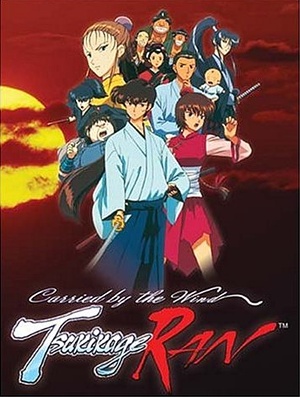

Carried by the Wind: Tsukikage Ran
風まかせ月影蘭
In the Edo or Tokugawa period (1600–1868), Ran, a female wandering samurai whose skill with the katana is only matched by her taste for sake (rice wine), is joined by a chinese martial artist who calls herself Lady Meow of the Iron Cat Fist. Tsukikage Ran has individual episodes that are just short stories of their adventures.
CookieBun
June 8, 2009
As years pass, things change. So do anime. Once, most anime series that people watched were lighthearted series that for the most part concentrated on the fun. Now, many series are trying their hardest to be ambitious and be the next big thing. It is no way a bad thing, and from it spawns many wonderful titles, but sometimes one can get tired of it all. So people look for things that are just plain fun to watch, like those Jackie-Chan movies. Kazemakase Tsukikage Ran delivers just that, in its short glory. --Grade: 7, + 1 extra point for great characters and enjoyment: 8-- The show greets itsviewers with a traditional Japanese styled song, instead of what the viewers usually expect. Even the presentation of the opening is a reminiscence of old Japanese TV series, and it goes together with the series really well, taking the series' setting and mood into consideration. The OST itself isn't anything amazing, but it does its job well without getting in the way. The animation is what you can expect out of a TV series at the time, and it does take a big dip in comedic parts. However, the director, Daichi Akitaro, is pretty skilled in making the most of it until he can bring out his trump card: action scenes. His action scenes are amazingly fast paced and wonderfully choreographed, bringing out the best in the characters. Why can't real sword fights be this cool? The main characters are tastefully designed and are very attractive. They spare Meow the stereotypical Chinese double bun and the verbal tic of aru, which is nice. Ran looks graceful and pretty, but looks formidable enough to be taken seriously. Unfortunately most characters don't get this treatment and look very comical, but it is forgivable. The characters themselves are very likable. Meow actually manages to be funny without going into the annoying area that hyper idiots usually go into. Ran is, in one word: awesome. She is amazing swordswoman worth respect yes, but her antics are just really interesting to watch. She doesn't care about hiding her sex either and prefers to address herself as the beautiful wanderer who happens to pass by. There's just something really cool about someone who doesn't care about what others think. Ran and Meow kick ass, literally. Meow doesn't get as much screen time to show off her martial arts skills but it's understandable as it's Ran's show. The series is episodic and while they are enjoyable none of them are anything amazing. Now that was what I was expecting and I'm fine with that, but I am disappointed that they did not go deeply into the duo's backgrounds and only hint it. Understandable, but I'm sad I cannot learn more about the characters I've come to like. One of the biggest things I search for in anime is enjoyment and Kazemakase Tsukikage Ran delivers just that. Doesn't try to be ambitious, but just does well with what it has and does a great job of it. Newer generation of viewers who watch only the latest shows might not have the patience with the series, but for older viewers it is a series worth watching, just to go back for a while.
ace52387
September 25, 2009
Leaving life to the wind perfectly describes Kazemakase Tsukikage Ran. The series follows the traveling swordswoman, Ran, and her partner Meow (or more likely, Miao) as they move from town to town, stumbling upon troubles and fortunes at the whims of fate and coincidence. Story & Characters: There isn't a semblance of a central plot, it's not particularly dramatic and its episodes are a bit formulaic. Perhaps it is this simple, and gentle approach to story telling which forgoes the dramatic and melodramatic that makes this series so easy to enjoy. It's safe; you know what to expect, and no pretentious philosophy lessons orpainful corny moments pop up to ruin the action-comedy in its simplest form. Of course the trade off is that the episodes become quite predictable, but the characters are amusing enough to make their light-hearted adventures enjoyable despite that fact. Both Ran and Miao are foolish in their own ways. Miao is quite simply dense. She's often flattered by Ran's thinly veiled, backhanded compliments. Ran on the other hand, is blunt to the point of tactlessness. She doesn't give due respect to anyone except inn managers, and only because they bring her sake. Alcohol is her one worldly desire, and it's a fervid desire at that. Her laid back nature and simple wants hide her incredible skill with the sword, but unlike similar characters in Kenshin or Vash, Ran isn't much of a hero. Her laissez faire attitude extends to her morals as well. She'll punish wrongdoings, but only if it takes place in front of her eyes, and the way she passes off desperate pleas demonstrates her "out of sight, out of mind" stance regarding justice. The rather rigid formula of the episodes are all based on these character flaws. Miao will help anyone with a decent sob story while Ran refuses and looks for alcohol instead. They separate; Miao eventually realizes she's bitten off more than she can chew and Ran will come to the rescue, possibly because she can no longer let whatever evil was taking place slide, but more likely because she ran out of sake money and needs a loan from Miao. The humor is similarly repetitive; playing mostly off Miao's idiocy and Ran's social impropriety. With only 13 episodes, it manages to scrape by without getting old. The ills of society Miao and Ran stumble upon, from drug dealing, extortion, swindling, amongst others, create enough variety in both situational humor and plot to keep the series somewhat fresh. I wouldn't recommend marathoning Tsukikage Ran though. Animation & Music: The 70's Asian pop opening and endings along with its 80's, Rumiko Takahashi look hides its age well. I did a double take when I read it was made in 2000. Ran's bouts are fast and concise (at times to the point of being anticlimactic), not particularly well animated, but at the very least, fully animated, with no still screens or cut outs. While most of the characters wield the Katana with two hands, Ran only uses one, hacking with it like a machete. It's a nice fit to her unorthodox nature, and her dislike of Samurai. Miao fights hand to hand, but her martial looks look awkward at best, ridiculous at worst, though still commendable for being fully animated. The music is a complete throw back. Not only the OP and ED, but also the regular BGM's, many of which even sound like they were recorded in old studios. They bear that slight fuzziness in the higher notes that typical of older recordings. To go to that extent for its classic appeal is impressive. -- Watching too much Tsukikage Ran at once will exacerbate its repetitive nature. On a sparing watch schedule, Tsukikage Ran is action comedy distilled to its purest form. There are no fetish characters, no social-political comments, just some nice good-guy vs. bad-guy action dealt by a classic boke tsukommi comedy duo.
scottro11
September 18, 2014
Perhaps it's because I grew up during a time when the formulaic western was popular, but half hour stand alone episodes of our heroines going into a town and (in most episodes) doing something to put things right, appeal to me. When so many anime have an opening pop theme this opens with a more traditional sounding enka. It may be the only anime where I never skipped the opening song. Some of the fight scenes were done quite well, being moderately realistic sword work. (Save for the lack of blood and, as seen in the opening scenes, thecommon trope of bad guys lining up to be killed, rather than attacking two or three at a time.) The characters were likable, though sometimes Ran reminds me of an Eastwood in the Man with No Name films, if he suddenly become like a little boy when offered liquor. Meow is the goofy sidekick. I think I had at least one loud guffaw per episode. It was an underrated show and I wish there were more episodes. As others have said, simple but very enjoyable.
5camp
June 18, 2012
Tsukikage Ran is about a female samurai and her fellow female martial artist travelling companion in pre-industrial era Japan (Edo period? I'm terrible with the exact dates of these period pieces). It's a very goofy take on the genre, with everyone acting all cartoony and pulling exaggerated facial expressions and cartoon dust clouds, and the animation plays it suitably free and loose during those areas. However when a fight is going down, suddenly the animation takes this huge jump in quality and every punch and jump and sword swing is meticulously detailed, which makes these scenes far more exhilarating and exciting than the goofy setups should really allow them to be. I have a sneaking suspicion that they animated the same moves for each fight, but I like the illusion so I never bothered going back to check that. Also the character artwork avoids the issue that plagues other 2000-era anime where they don't do the shading on the face correctly, making it look like they haven't got any chins. It's like the 2000 equivalent of noses disappearing in current day anime. I had Tsukikage Ran described to me as 'fluff', and that's certainly the case. Each episode is a standalone story in which the two lead characters wander into a town in the search of sake and get themselves involved in some sort of local kerfuffle. The stories are usually brain-meltingly black and white. Some kid has gotten themselves involved with the local yakuza in an attempt to earn money for whatever. The head yakuza characters are almost always hilariously slimy evil caricatures. I'm convinced they got the same guy to voice the villain in every single episode, with the same low slimy voice in which he wrung his hands and ate babies using a spork and stuff like that. The reason they're eating babies and not, say, drinking blood from the caved in skulls of their enemies is because they're usually totally incompetent losers who get instantly turned over by the main characters when they stroll in, usually just trying to mind their own business. So it's not a particularly deep anime, but it works because of how well realised the two lead characters are and how well written their dialogue is. The writing is seriously sharp in this regard, and often caught me off guard with little turns of phrase, such as "that's not my baby, I'm so pure I make flowers bloom" and other lines like that. I particularly love the hypocrisy the lead samurai girl Ran has when faced with a potential drink of alcohol. She could have her pride shoved into the dirt, the clothes taken off her back, the yazuka hiring her to kill a family of eleventy billion, and she would try to justify to herself that it's OK and the right thing to do if it was her only method of getting her hands on a bottle of sake. I also love her slightly egotistical side, such as how she refers to herself as 'beautiful' whenever she introduces herself. I've never been a particularly big fan of the all-serious, all-knowing superhuman characters like Captain Harlock or Black Jack, and Ran felt like a subversion of those types of characters. She acted all-knowing and all-serious and usually ended up saving the day, but that hubris she has made her more flawed and therefore more entertaining as a person. Ultimately though, being as shallow as it is, Tsukikage Ran doesn't do a huge amount to ever get me too invested in proceedings. Lets do an obvious comparison to another Edo(?) era anime that plays it pretty fast and loose with historical accuracy: Samurai Champloo. Like Champloo, each episode is fairly standalone as the characters travel from place to place. However there is a much stronger character focus in Champloo that gets you more emotionally attached to them. As we learn about their pasts, we learn more about why they're travelling and who they really are. Tsukikage Ran doesn't really have that. There were a grand total of 2 episodes where we get to learn about the characters pasts somewhat, and even they tell very little about who they are or why they're travelling. Now that may indeed be the point. They're travelling for the sake of travelling. It just doesn't make them particularly interesting. Still, Tsukikage Ran is plenty enjoyable. I would have liked an English dub, because although it wouldn't have gelled with the setting, I would have been able to zone out as I watched it and do other stuff. It's not a show designed to demand your undivided attention. You have it on in the background, picking up the witty lines here and there, and the plot for each episode is either so simple or so trivial that not picking up on the details will barely affect your enjoyment. In a way, I'm criticising Tsukikage Ran for not being something it was never trying to be, as it was only ever meant to be light entertainment, and it achieves that with flying colours. It just means there's a limited amount of enjoyment I can get out of it.
AnimeEnjoyer420
January 16, 2022
Recommendation: A samurai adventure slice of life series. Enjoyable if you like period pieces set in feudal Japan, but otherwise skippable. Positives: + The wandering samurai structure lends itself well to the episodic format. There is no overarching story, and each episode is self contained, so it can even be watched out of order after episode 1 with no loss of comprehension. + Grounded in a way that anime usually isn't. There are no pink haired lolis with magical swords or anything of the sort here, it's relatively realistic and restrained. + Artwork, music, costuming and character design are all very evocative of the setting and time period. Itmakes it feel like you're there. The OP is excellent and fits well thematically too. + Ran is a really fun character and makes for a great co-protagonist. Negatives: - On the other hand, Meow, the show's other co-protagonist, is punishingly annoying and nearly singlehandedly ruins the show. Meow's idiocy is so over the top that I actually started getting mad at her at points. The idea behind the odd couple pairing with her and Ran is good enough on paper, but she should have been dialed back 3 or 4 notches. - Episodes tend to have highly formulaic setups, where Ran and Meow enter a city, get attacked by the townspeople who mistake them for villains, and then beg them for their help when they're defeated. At least half the episodes follow this pattern and it becomes a bit predictable and boring after you've seen a few. - Action is overly sanitized. There is virtually no blood even though people are regularly getting killed with swords. It makes it difficult to tell when characters are dead or have merely been knocked out or disabled and undermines the drama in those scenes. - Action choreography is hit or miss. Meow's martial arts look cool and well animated, but the swordfighting tends to be too "zoomed in" and it's hard to get a sense of what is happening or where people are in relation to other things. - The drama is much weaker than the comedy, and serious scenes suffer for how closely they're juxtaposed with goofiness. In particular, the episode where Meow meets a childhood friend that has broken bad and started selling drugs is a huge swing and a miss for trying to hang a serious storyline on Meow, the goofball comic relief character of the series.
Rank
#4102
Popularity
#5499
Members
19,589
Favorites
88
Episodes
13