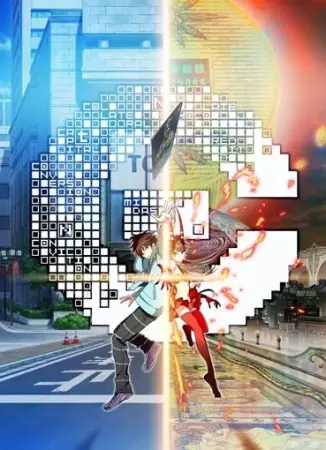
[C] CONTROL - The Money and Soul of Possibility
「C」 THE MONEY OF SOUL AND POSSIBILITY CONTROL
Money is power, and without it, life is meaningless. In a country whose economy is in shambles, second-year economics university student Kimimaro Yoga understands this fact all too well, as he is surrounded by the relatively luxurious lives of his peers and struggling to make ends meet. However, his world is turned on its head when a stranger in a top hat arrives one late night at his door. Going by the name Masakaki, the visitor petitions Yoga to come to the Eastern Financial District, a place where money flows in abundance if one offers their "future" as collateral. Although reluctant, greed triumphs reason and Yoga accepts the offer, thus taking on the mantle of an Entre. But unbeknownst to him, the land of wealth he has entered is an alternate realm built in the likeness of his own, where Entres are forced to participate in weekly duels called Deals, with their collateral at stake. Pitted against his countrymen and fate, Yoga must quickly adapt in this new world if he hopes to protect his fortune and future—and discover just how much money is truly worth. [Written by MAL Rewrite]

Main
Main
Main
Supporting
Supporting
Supporting
Supporting
Supporting
Supporting
Supporting
Supporting
SirHellfire
November 1, 2014
The phrase, “Your entire future is riding on this.” Fits this show too perfectly to ignore. The Short Version: (+)It’s a bit different from the norm. (+)The main dou are fun together. (-)There’s plenty of CGI for you to get angry at. (-)The soundtrack isn’t that great. The Story (7/10): The story of this show is unique is the sense that I can’t think of another show that takes someone’s future, turns it into a battle avatar, so they can then win what is essentially a universal dollar, that ends up affecting the entirety of the real world in terms of economics. That’s pretty much the entire point of the showin a single sentence. The thing that actually makes this concept of fighting interesting, is that when one of the fighters lose, as in utter annihilating defeat, they lose their future as well. Meaning if they were going to have kids or something, they won’t have those kids anymore. That risk alone makes the battles interesting as hell. I don’t really know what else to say other than its unique and the fights are weighted with risk. The Characters (6/10): The characters in this show aren’t anything special, I will say that the character you think is going to be a tsundere isn’t going to be a tsundere, not entirely anyway. Kimimaro Yoga: The protagonist and major in Social Economics. Souichirou Mikuni: The one trying to manipulate the entire global market and owner of a literal cash hungry asset. Msyu: Asset to Yoga and probably my favourite character of the show. The other characters in the show are mostly forgettable, and there’s only two other characters that actually do something in the entire show, everyone else is inconsequential. The Art & Sound (6/10) & (5/10): The art in this show is pretty standard, apart from the MC’s neck looking like it’s about to give with the slightest force. The rest of the art is CGI, and if you absolutely can’t stand CGI, turn back now because you aren’t in for a good time. I didn’t really mind the CGI that much and I actually think it lended itself to some scenes, apart from any scene involving Masakaki, every time he popped up on screen I wanted to skip a bit forward. The sound of the show was entirely forgettable the OP, ED & OST flew right over my head. The voice acting was standard, no single person stood out, and I can’t really say much else about the sound at all. What do you think of this show? It’s a unique show and I think I’ll buy it, but only if I see it in the shop, not going to look for it. Would you recommend this show? Yeah it’d kill a fair bit of time, if that’s what you need, otherwise you won’t miss out on much. Goodbye my brethren, see you in the next one.
Nimious
October 25, 2012
How much is your future worth? That’s a great concept question to start a series off before it proceeds to insult your intelligence. From the outlook C may appear to focus on economics, witty dialogue, and perhaps even action. Well, it’s a trap. C is actually a series that consists of plot holes which builds on plot holes so as to continue with plot holes. There is actually no element in this story that is properly developed enough to truly attain a genre label. For example this series puts on a facade that it is based on economics using words like micro, macro, mezzo, inflation and even phrasessuch as “overheated economy” while it doesn't encompass the actual meaning of these words. Why do that? I’m convinced that the writers opened economic and business textbooks and took out and used every cool sounding bolded term without understanding the definitions. That or they have no idea what they're writing about or how to write. While there is some sort of action, mystery, and what even looked like romance; none of these were suitably developed and expanded on as the series tried to do too much with too little commitment. Coming to this series off a recommendation from Spice and Wolf I could not be any more disappointed or insulted. I tried hard to give this series every chance possible to be liked and as a 19 year old second year university accounting student I thought I could relate to the protagonist Kimimaro, who is a 19 year old second year university economics student. Aside from the studying and lifestyle that every student stereotypically has I couldn’t relate with him. Actually Kimimaro is a character not to be messed with. This isn’t because he wears impenetrable plot armour but because he can’t grasp the opportunities in front of him nor justify any of his actions through a logical thought process; it’s frustrating. He is a character that manages to lose focus of his values early on in the story and fails to establish new values as he lallygags his way through the story. Honestly how did he make it to university? The antagonist Mikuni however is a far more mature character with believable ideals and justifiable actions. As the overlord of the Financial District he does his best to minimize its damage and save Japan. However as the plot was so poorly formulated all his hard work and sacrifice is wasted as the magical rule that the protagonist is always right (even when he isn’t) and always wins was enacted. I won’t spoil the ending for you but the scheme that was implemented would in reality have crippled a country’s economy permanently and ceded its control to another nation; in other words, economic suicide was the solution of choice. Ridiculous right? Now if you have any knowledge of economics and business stay away from this series as you will have headaches from the ignorance of the writers. The story was so disastrous that the rules that it established are changed in a moment’s notice for the sake of continuing the plot. It's as if playing a game without rules. It's just no fun if you don't know how to win. The one saving grace for this series was its animation. It’s beautiful like Bakemonogatari with great landscapes that are plain yet marvelous. Though really if you wanted beautiful animation you could just watch Bakemonogatari right? Ultimately C is a series that forgot the original concept that drew in its viewers and develops in the wrong directions. Had it truly focused on dialogue, economics, and business this would have been a great niche series that would have likely fascinated a mature audience. Sadly this series tried to do too much and ended up being a badly developed battle anime with a hint of mystery and a poor excuse for romance.
_laz_
July 14, 2011
Exactly what it says on the title, the theme of this anime is about Corruption done by “The Money” in modern times for “Soul and Possibility Control” of the ignorant masses to turn them into mindless animalistic puppets to be toyed with by the government and businesses. That is probably a stretch and a bad joke. As interesting as the theme is, it is looked from a foolish naive perspective through the main lead Kimimaro Yoga, a member of the ignorant masses. There are spoilers so read at your own risk. Our main lead is an over-used archetype, present in the majority of anime titles aimedfor youths, which is designed to “relate” his entire life to the majority of the lives of its audience. He is an average student who has a crush on his friend Hanabi Ikuta and works as a part-timer in a convenience store. He has a bad unexplained childhood. He believes in living in the present. He is very OPEN towards anyone that doesn’t challenge his ideology of life. Without it, there would not be any clash of the titans in the last episode that was suggested in the last scene of the opening. Ignorance of opposing forces and the fate of our future is bliss after all. He only starts developing after hearing extreme opposing views from different parties which ends up horribly until a Total Deus Ex Machina came to “save” its audience from the truth behind the ending (Masakaki stated that the future is a collateral). Without other people, he is screwed. Like Ganta Igarashi from Deadman Wonderland, he is given his own avatar for Deus Ex Machina in the form of a younger, cute, powerful, childlike or immature Asset Msyu who eventually falls for her owner. The number of times and the situations when he is saved by Msyu are incredible. Every time he is screwed, Msyu just does some unexplained OHKO that miraculously got them out of ANY hopeless situation. However, please take note that she herself brought up Kimimaro from a useless stick figure to a reasonable fighter with a clear belief system. Her character development is typical and predictable but interesting nonetheless. What about the “antagonist” suggested in the opening before the start of the first episode? He is Souichirou Mikuni, the smart pragmatic businessman counterpart of our protagonist and the saving grace of this show. The emphasis on his characterization, development, and behaviour is a major influence to the entirety of the show. Without this character, there is no [C] and opposing organization to the Financial District. Midas Money is less controlled so its effects are amplified, resulting in grave losses such as loss of loved ones and/or one’s life. There is absolutely no major conflict for the protagonist to resolve. Why he is not the main character is left to your interpretation. The rest of the supporting cast, don’t need much attention because they are written to FORCE the two main male leads to fight in the end. Jennifer Satou and Kou Sennoza represent the core contrasting beliefs of Souichirou. Both have unique lives and better reasons to be the main protagonist than Kimimaro because they have logical justifiable explanation for staying in the alternate world. Still, they are wasted because a puppet that eventually becomes them is more interesting than them gaining the same strength as Souichirou. For the story, only the Financial District is of any value but lacked focus on its psychological and philosophical aspects. Its origins, purpose, effect on the business world, MMORPG setting with weird characters ranging from Eldritch Abominations to cute humanoid tsundere or kuudere loli characters, Midas Money, [C], unique concepts, etc. are the only reasons why anyone is watching this but all is not present in the first half. [C], the destroyer of bankrupted financial districts, is shown in the later portion of the second half. There are also certain questions left unanswered. How does the battle system work? Why are certain characters significantly stronger than others regardless of experience? Why are governments not cooperating together from the very beginning to prevent [C] from removing countries of existence? Who are the people above according to Masakaki? Who is the “God” figure in the last episode? Is the ending another version of Instrumentality (Neon Genesis Evangelion)? Whatever. Let's just focus on the visuals and sound. Production values are medium at the very least. They are not outstanding but unquestionably (YMMV) fitting. The opening and ending themes brought me out of my misery whenever I watch this so I never skipped them and watch the preview of preceding episodes. They both start and end the show well every time. Voice acting is fair as well. The style and quality of the art are normal with certain use of CGI. The resulting presentation though is quite good but aesthetics alone don't make any show good ... unless it's porn. Simply put, this is not recommendable.
DeSwitch
August 1, 2012
Story (3/10) I imagine the executive meeting that inspired this dull, jabbering insult to my intelligence went a bit like this. Director: I’ve been thinking lately we should do something deep and relevant about today’s global financial situation. It’s been all over the news and I think the kids would appreciate someone really bringing it down to their level. Exec: Uhh, really? But finance is like so BOOOOOORING. Director: Well, of course we could spice it up a little, you know, give it a representational hook or gimmick. I have one or two ideas that I think would really - Exec: Oh oh oh! I’ve got it, I’ve got it!MASCOT BATTLES! Director: What? Exec: Write this down! It’s not often I get such inspirational flashes. I can see it now - economic conflicts figuratively enacted through pet monsters! ‘Cause everyone likes Pokemon, right?? The result, ladies and gentlemen, is this show, the worst possible marriage of everything that shouldn’t exist in anime. Dry, abstract exposition about money combined with utterly mindless battles between metaphorical creatures that have no real-life relevance. Burrow deep enough and C: The Money of Soul and Possibility Control appears to contain a human tale about taking huge financial risks for the sake of loved ones. That this is mere veneer becomes clear the moment we ask why the characters don’t just work overtime, get a second job, or aim for promotion, considering any of these require less effort for more guarantee. The financial battles are vehicles for an impending apocalypse caused by some… thing that gets no explanation. All we know is, at some point, a digitised whatsit begins to sweep through Japan and the hero has to do stuff in the ether to make it go away. Not that the fights are any good either. Occurring without reason or logic, they generate about as much friction as a limp dick. Just as one combatant summons giant balls of fire, the opponent blocks with an inexplicable beam of sparkling blackness, all the while an electronic voice yells nonsensical financial jargon not even the Wall Street folk would enjoy piecing together (how to counter sensibly when your enemy has just thrown a hail of MACROFLATION!!?). There are no recognisable dimensions to the battles, no identifiable limitations that tell me ‘this person is highly skilled compared to that person’. Thus we must take for granted that Souichiro Mikuni, the cool, mysterious rich guy, is unbeatable because everyone says so; when he fights, I can’t actually tell. Art (4/10) I’d like to put a message out there for the kids growing up on a diet of C-like atrocities: animated backgrounds full of feeling, atmosphere, and texture do exist. For evidence, look to Mahou Shoujo Madoka Magica or Eden of the East. The polygonal edifices we get in C bring to mind the artistic sensibilities of a McDonalds restaurant - cold, garish, and above all cheap. Effects happen, shapes and colours and patterns zoom past but none of it serves any discernible purpose except to distract us for another five seconds. Sound (8/10) In moments when the plot wholly eluded me, the score managed to restore some of the potency of the situation. Unfortunately, sandwiched between unmemorable opening and closing themes, and voiced over by a crap script, the courageous cinematic soundtrack gets entirely lost. Characters (3/10) If there’s anything anime needs more of, it’s teenage boys trying to get stronger. I’m being sarcastic, of course. What anime needs more of are characters I can tell apart from all the others. C’s cast melts into a giant pot of tokenism and archetype that effectively abandons the audience to apathy. I’m surprised, for instance, that the bland, pineapple-haired protagonist (had to look up his name, Kimimaro Yoga) was thought qualified to be one when his only notable features are being nice and harbouring angst about his long-lost father. The only vivid performance belongs to Masakaki, the guide of the alternate dimension in which the battles take place; he is a nod to Willy Wonka that strips away all the child-friendly veneer and replaces it with a chilling pitilessness. Overall (5/10) Colour me spoiled if you will, but I like to spend my time watching things that I understand. I like characters for which I feel empathy doing things I could imagine myself doing if I were in their situation. Most of the financial jargon the target audience will struggle to relate to and anyone who does will snooze simply at the banal abstractedness of it. Instead of a poignant metaphor on the dangers of economic risk-taking, we get a discombobulated mess that farts a host of vague concepts. The only emotion this show inspires in the process is boredom. By the way would of been a three and was really willing to as well, but seems its an overall and the overall comes to a total of 4.5, I have to round it up to 5, so C got lucky this time. C you round!
Gorbovskiy
September 29, 2013
Well then, what should I begin with? Story – 9 Are you used to stories which are good-for-nothing? [C] is something better than that. Let’s say money rules the world, and there’s a parallel space where all the money flows are controlled and resolved by a Persona-style fighting, ain’t this sounds cool? The plot also is about settling what is more important – the present or the future? The story develops somehow similar to the one in Guilty Crown, bringing up more and more questions… making the viewer think and jump to their own conclusions. But the logic is leaking a bit, and hence 9/10. Art – 7 Thefirst episode is marvelous, with all that great artwork and animations; the battle scenes are fascinating too… the characters lack originality (except for some figures, to be honest), alongside with the backgrounds. I was expecting to get more detailed images, really, but the current level will do too. Sound – 8 The music is just fine, and it does help creating the right mood. The sounds, however, are somewhat lame, as well as the bright and optimistic ending song. Overall, I’m not impressed but relieved. Characters – 10 The protagonist is, surprisingly, a simple university student, thinking about getting by and, but as the time flows, he is really growing up, changing himself and his perception of the world around him… Even though he is a slowpoke when it comes to making a decision, he does everything it takes to choose the best answer, shaping the reality the way he wants it to be. Moreover, each other character has their own detailed background and their own reasons as well, and I can’t help but sympathy them, even if they have completely different ideals. ”I’m a businessman first, then I’m a parent”, as one implies… personally, I know a lot of people thinking this way too, that’s why I can tell the characters are more that realistic and interesting, without lots of clichés (That cabin driver… what are you? Cain from VtM? Igor from Persona? Really cool, you know). Plus there’s no certain villain amongst humans in series, which is rare and great. Enjoyment – 5 After all, it was… plain. I have almost started yawning by the last episodes. Like, the authors couldn’t come up with more breathtaking moments then the beginning had. And if you want to about economics in an entertaining way, you may receive the same joy off a simple textbook. An anime full of adventures must be more… lively. And seriously, the opening is full of spoilers. Overall – 7 This anime has as many interesting ideas as borrowing from other series and stuff like that. Is it bad? Who knows. It resembles me of a bunch of things I like, though, and I can’t help but say this anime is worth seeing once in awhile, if you don’t mind watching something truly unusual. The end is really a something too. It goes without saying that economy is an inseparable and indestructible part of our life. Can one prove this wrong?
Rank
#3928
Popularity
#815
Members
338,292
Favorites
1,372
Episodes
11