
バーテンダー
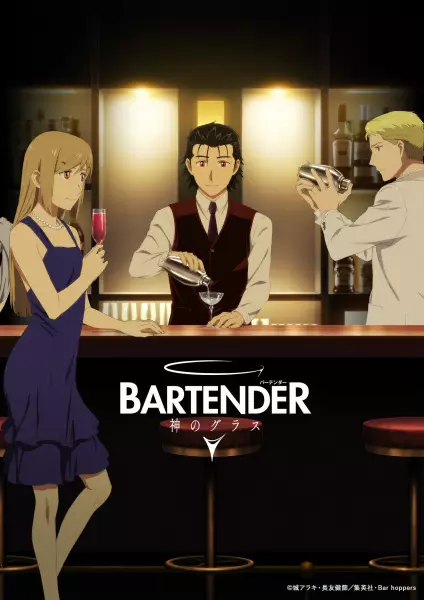
Hidden in the backstreets of the Ginza district is Eden Hall, a lone bar operated by Ryuu Sasakura, the prodigy bartender who is said to mix the most incredible cocktails anyone has ever tasted. However, not just anyone can find Eden Hall; rather, it is Eden Hall that must find those who need it. Customers of varying backgrounds, each plagued with their own troubles, wander into this bar. Nevertheless, Ryuu always knows the ideal cocktail to console and guide each distraught soul. [Written by MAL Rewrite]
Main
Supporting
Supporting
Supporting
Supporting
Supporting
Supporting
Supporting
Supporting
Anomalous
August 31, 2007
“In happy times, one cocktail is enough, because anything you drink will taste good. But if there are a hundred shapes of unhappiness, I want to be a bartender who will make a hundred cocktails to soothe unhappiness.” An anime series about a bartender at work might not sound like anything worth paying attention to, but Bartender is a calm, gentle series that might be just what you need. Each episode covers the stories of customers that go into a bar to soothe their souls. Bartender Ryu Sasakura assists them with their problems by making them a cocktail with a history or taste that relates tothe customer’s situation. By coming to terms with themselves through their drink, each customer can leave the bar satisfied. Each story is expanded upon not only by what the customer reveals but by narration, often by others that have also been healed by the bar. Each individual story is well-developed, detailed, and brought to a satisfying end. However, there is no plot carried across the full show. Much of the animation style is abstract, using many unrealistic background effects, quite a few of which are theatrical. For example, a character may be having a conversation at the bar counter, then the scene will cut to a narrator elaborating on what is happening, perhaps in a spotlight or even simply living their own lives. It may not seem realistic, but it’s pulled off quite well. While it may seem that it would be difficult or boring to follow a show narrated like this, it never is thanks to the animation that makes it clear what is happening in reality and what is abstract. While the background music doesn’t stand out in any particular situation, it also helps to create the atmosphere. The opening song provides a good introduction, and the ending is slow and simple, yet effective. The characters in each story are very believable. Instead of crazy characters made for the viewer’s excitement, they are developed to be believable people. In addition to each episodic character, the bartender himself is presented very well. Although at first he is the idealized “Glass of the Gods,” the man who can always make the perfect cocktail for a customer, his past is also addressed. By the end of the series, he has become a three-dimensional character with his own history and shortcomings. Bartender’s true strengths lie not in the technical aspects, but the atmosphere. It’s an incredibly relaxing show and does a great job doing exactly what the creators felt a bar should do: soothe the customers. Watching an episode is a great way to calm down after a bad day; you can sit back and enjoy without shutting down your brain. A word of warning, it’s not as enjoyable in large quantities, save it for when you need it. Bartender doesn’t try to be big or exciting, but instead appeals to people who want to relax while learning a little bit about alcohol and life. It’s a lovely little series that brings emotion and realism in a way that other, flashier shows can’t achieve.
Maegil
April 6, 2014
Children have no place in a bar, and most youths prefer dancing in nightclubs to loud music and cheap booze... but for those who wish a calmer and more mature place, there is the bar. Even among bars, there is a variety of styles: from seedy dockside dives, to beer halls where there is always a ball game or race being played on a large screen, to the dimly-lit classier cocktail bars... What, then, is a bar? A place where they serve drinks, sure, but that's just an element of the whole. A bar is a social environment safe from the rest of the world where one goesto throw off the worries for a while; the drinks are just aids to relax and let go of tension and inhibitions. If it is a good bar, it's a place one regrets leaving even to go back home. In Bartender, we are welcomed with a warm smile to the Eden Hall, a small but cosy cocktail bar. The bartender himself is a confident and therapist to the regulars, well known for his near-magical ability to serve just the right drink to soothe each customer's soul from their problems. Go talk to him for a while, then ask him to surprise you - he'll deftly squeeze, blend, shake and mix the contents of a few bottles while sharing bits of trivia about the different ingredients. You might eventually realize that he's adding more than spirits into the cocktail, he's also mixing in tales, history, metaphors and emotions... that what he's making isn't simply a drink, but a customized healing potion to which the liquid in the glass is itself only a minor part. --- Essence: Story & direction: 9. Bartender is a niche experimental anime, episodic, and although the introduced characters become regulars and appear or even participate in subsequent episodes, in general each episode is dedicated to a patron and his problems. Instead of following a formal plot, it depends on realistically fleshed-out characters and an excellent direction using advanced techniques such as multilayer superimpositions, juxtapositions, camera angles, flashbacks, using characters as mouthpieces for a omniscient narrative, and seamlessly intermeshing the episode's theme with documentary elements. While the latter are fundamental for understanding the characters' thought processes, they sometimes distract from the main theme, which is why I didn't give a full 10 to this section. Characters: 10 As said before, the characters are realistic and well fleshed out. Sure, we mostly only see what they allow through the metaphorical public masks everybody uses or the tidbits we get from third parties, but isn't this also part of the realism? Even the bartender himself, who keeps his professional face throughout the series, gets a significant bit of his past explored by the regular patrons' chatting and rumoring, bringing him down from the near-deity status his current abilities grant him and back to the human realm. The one time this realism was broken was when a character behaved irrationally in an emergency, for the sake of setting up the stage for an episode - but the outcome was so satisfactory that I'm unwilling to penalize the series for it. Enjoyment: 10 This is a hit-or-miss series that should be avoided by anybody who either dislikes bars or slow, talky shows; it also requires a modicum of maturity to enjoy properly. If this is not your case, avoid it altogether. Even then, as with alcoholic drinks, it should be taken with moderation. The best way to enjoy it is one or two episodes at a time, in a dimmed room, and with your favorite drink at hand. Cheers! --- Existence: Art & animation: 8 The art is very good; the bar was created with loving detail, with shadows, reflections and detailed settings. The characters are competently drawn, with a wealth of adequately used facial expressions. There's not much happening throughout the episodes, most of the time it's just talking heads - the most fluid animation happens during the preparation of the cocktails; still, the characters smile, frown, gesture, grimace - and blink! - while in the background there's the occasional patron going to the toilets, blowing smoke or adjusting his chair. There is the CG that, given its age, is far from photographic; still, it is pretty much limited to the flow of liquids and the sparkle of bubbles in tall glasses, and doesn't interfere in the enjoyment. Sound: 9 The OP is a nice duet between a female patron and the bartender; it is, however, too upbeat for such slow and intimate series. The ED is a delicious jazz song, played while a real barman prepares and serves us the cocktail featured in the episode... Not once did I feel the urge to skip it, instead I wanted to pick up the glass and sip it. The rest of the music is ambient soft jazz, jamming in harmony to the scenes and accompanying the mood without ever overwhelming - which, for such a series, is just perfect. The background sounds are what one should expect from a small bar: glasses and bottles clinking or tapping on the table, chairs dragging, and the such - nothing spectacular, since anything more would actually detract from the experience. --- Essence score [3;8]: 7.8 Existence modifier [-2;+2]: +1.7 Overall: 7.8 +1.7 = 9.5 --> 10
kufreabia
April 8, 2008
At first glance, Bartender appears mundane. It appears to be one of those self indulgent works that could easily turn you off. I mean, are we really going to spend 25 minutes talking about a bartender, and drinking? But you are wrong! This is one anime that is really interesting. We have here a work from someone who loves drinks and presents it to you in a very creative way. The stories to me are real, and relatable. Each episode appeals to the mind and the emotion. There is no cheezy moment that you see in most slice of life anime. The writer of this putseffort into making each episode captivating. Something worth noting is that Bartender is slow paced, but not drawn out. I felt like the timing, conversations and narrations were excellently synchronized. One thing I really enjoyed in the story were the narrations - it was so well placed. The art is crisp. I also enjoyed the visuals in this. In some instances you feel the life of a bar...thanks to the lighting. The shots of the city at night were lovely. Another thing in the art was how the character flashbacks showing the younger years were so realistic, and when the older character is shown it feels like a real aging process had taken place. The art is lovely in this. There is nothing extraordinary about the sound. It is well done, and is of the expected quality. One thing I should point out is how nice the ending soundtrack is, I like it a lot. Usually I skip listening to a soundtrack after hearing it once, but in Bartender's case, I wont mind having a copy of that song! The characters are well rounded. The bartender at first seems one sided in the stories, more like a prop. But as the series continue, you see how human he is. I love it. There are various narrators in this story, but I particularly enjoyed the (few) scenes when the "NeoBartenders" give history or insight into some topics. I loved this series, and would recommend it for anyone. It is well paced, and good to enjoy especially on a weekend, or at night after work. Lovely, Lovely Lovely. Thanks for reading this review.
ZephSilver
February 16, 2015
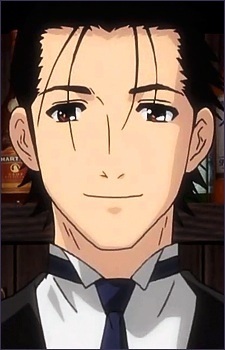
Anime as a medium is very diverse; it covers every topic, premise, and concept under the sun. But for the most part, a majority of the shows that occupy the surface tend to be spastic in portrayal. Often using eccentric personalities and brightly lit set designs to draw the attention of passing observers. Like neon lights hanging outside a store window, each vying for the attention of new customers. This kind of presentation within itself is fine, but every now and then, we as an audience seek out titles with a change of pace, something to help us unwind from the schizoid bubbly madness ofneon lights and confetti that the medium is typically known for. As it would have it, Bartender happens to be such a title; a show that leans more towards a somber, easygoing tone, with it a promise of tranquility and relaxation upon entering its world. Something handled with a sense of class and composed order. And like the drinks themselves that it will come to discuss, so too does this show handle itself with a sense of meditation. A title that ushers the viewer out of the cold and into the warm cavernous embrace of its narrative. But this bar isn't without fault, as it seems the very strength of subtlety it conveys has also worked against its favor. The ethereal spell cast upon those that enter revealed to be the smoke of cheap incense purchased across the street from the very schizoid neon-lit stores we as viewers were trying to avoid. We sought for Mushishi and Kino's Journey — this isn't it. In place of real oak floorboards, we have laminate stick-on tiles. An emulation of highly refined content that's quickly made apparent the further we walk across its wax covered surface and sit by the bar counter to be served up a drink. A drink of idealism too sweet to swallow, but still worth discussing nonetheless. The most durable aspect of this anime comes from the individual stories and how well they are put together. The entirety of its run-time takes place in the bar Eden Hall, and for the most part, they almost always follow the same structure, where our lead bartender Ryuu Sasakura solves our clients' problems over a glass of a particular alcoholic beverage. What's perhaps more interesting than these wandering clients themselves are the segments within each episode dedicated to discussing the history of particular drinks and how they came to be. The tale of their origins usually providing a bit of insight as to why the bartender suggested the drink, as well as a means of newfound appreciation for the alcoholic beverage in question. In Bartender, drinks are given a new meaning, not in their history but in the way they are discussed. Instead of merely existing as a means of getting shit-faced, drinks are treated as an art form, elevating itself above just cheap service. This being demonstrated with the techniques shown in the serving of any individual spirit. A kind of drink engineering of precise measurement and emphasis on care. As you could imagine, It can get a little campy at times since the anime seems to promote a motto of "drinking is the key to life, the key to soothing one's soul," but you never for a second doubt its intentions when making those bold statements. However, what is brought into question is what those bold statements are used to service. Bartender haphazardly attempts to solve every issue over a glass of alcohol. And this is where it all clashes. Where the authoritative position it holds towards itself can't be taken seriously with the dime-store purchased incense burning away, and the artificial sheen of fake wax floorboards glaring from under your feet. This anime's mythical portrayal of spirits as a healing agent for every person's problem robs it of all the down-to-earth qualities it desperately holds onto. A title that treats mundanity as transcendent things capable of toppling the sobering realities of life itself. All attempts to take the show seriously is rendered impossible, as it unintentionally rides the border of parody. It doesn't also help that the entire thing looks like it was made on a shoestring budget. The soft glow of bar lights reduced to splodges of overlayered color. Wood presented with the texture of plastic. Drinks that have the appearance of CGI molasses. When compared to other titles made within the same year, it's average at best. Made all the more glaring when accounting for the fact that shows like Mushishi, 009-1, Black Lagoon, Ergo Proxy, Nana, Higurashi, and Hell Girl, just to name a few, were among those entries in question. By virtue of comparison, it's like juxtaposing high-end marble floors with Walmart linoleum. Everything was just incredibly flat-looking. Characters talking but only the immediacy of mouth-flaps being recognized. Scene framing devoid of dynamics or personality. Panning across stills to avoid animation. Cut-out models to avoid intimacy. The universe of Bartender just rings hollow, making the electric glow of the neon-lit titles behind our backs as we uncomfortably position ourselves on the bar stool that more inviting. If anything, this oasis becomes a way of indirect advertisement for the happy-go-lucky works that surround it. Which leaves us with only one thing left to address, the man of the hour positioned on the other side of the counter. The one that's been serving us drinks all night with a calming smile and a demeanor that speaks for his expertise, Ryuu Sasakura. Characterized as a well-kept, caring man, Ryuu was perhaps Bartender's strongest selling point, as he treats everyone that walks into his bar as welcomed guests. Nothing less is expected from the namesake of the series, but perhaps his talents are entirely too good for the project he's attached to. You see, Ryuu is basically the Houdini of bartenders, seemingly knowing every alcoholic beverage as a matter of principal. Like a walking encyclopedia of everything drink related, as well as a master at reading people's characteristics upon first encounter. These attributes have earned him the nickname "Glass of the Gods" among the city-folk. Very little is known about Ryuu's personal life, with only one episode being dedicated to his humble beginnings as a bartender. What we do know of him has more so to do with his interaction with those he hosts. Instead, he is treated as an aficionado to help teach the viewer about the different types of drinks and the importance they hold in the annals of history. There are recurring characters, but their purpose in the narrative was far too minuscule to worth addressing. In this unpolished world of linoleum and cheap trinkets, Ryuu is the only takeaway aspect worth holding on to. Aside from the moments dedicated towards alcoholic infotainment, there isn't much here worth recommending to others. There are far better "zen" alternatives out there for those seeking an oasis away from anime's usual clutter; some of which aired the exact same year as this show. Ultimately, when it all boils down to it, Bartender with an earnest title that sadly relied on a false sense of authenticity, of which, it wasn't given the proper attention needed to be able to mask that truth. But the fact that drinks were treated as an end-all-be-all solution for the customers that came to Eden Hall was truly the reason I could never suggest this title if wasn't on your radar, to begin with. At the end of the day, tackiness killed this show and there's no other way around it. A title buried by time but sadly one I can't see any value in resurrecting.
Retro8bit
January 18, 2009
Two words: unique experience! Upon first approaching this anime I was expecting this series’s "Bartender" theme to simply be a gimmick, but no it is actual everything you would expect from an anime that deals heavily with life in a bar. (minus the fist fights of course, since this is a small classy bar) Story: 7/10 Bartender revolves around a young man named "Ryu Sasakura" and his many experiences working in a small town bar of his. The main chunk of the story will deal with one of two things the whole way through: Ryu listening to his customer’s problems, and giving a pretty in depth history onmany drinks. So with that in mind I feel that I should warn you now--to be expecting lots and LOTS of dialog in this series. The story itself is quite interesting, as you get a good variety of situations from the customer’s circumstances--from love, misunderstandings, work related problems and so on. It’s remains quite realistic with all of it’s content in the plots. My biggest complaint with it, is that it remains a bit too strait forward with the story, and perhaps sticks a bit too much to its "Bartender" theme. Rarely will you ever see Ryu out of his bar, plus we never get any real development from the story either--just one customer’s problems after another. However it does do some things to help keep the plot from getting tedious, and that is with the drinks themselves. Ryu never simply just serves the drinks to his customers, but also enlightens them on how to make it, and how said drink will help in their problems. This helps tremendously in keeping the theme from becoming a gimmick, and you can really tell that the writers looked into the history and style to each drink the anime talks about. It is also interesting to note that you get some nifty recipes to the main beverage of the episode upon its conclusion. (since each skit highlights a particular drink or two) The atmosphere from the story is fantastic, and makes you want to cozy yourself up in a nice warm blanket on a cold day when watching it. Overall it accomplishes what it sets out to do--it's a "slice of life" anime about a Bartender at work! Bartender doesn’t really contain anything offensive other than the obvious--alcohol! However it doesn’t do it in a harmful or bad way, but more in an educational approach. In fact out of all 11 episodes only once do I recall a costumer ever coming off as even "tipsy." There is some brief language ever now and then, but pretty sparse over all. Art: 8/10 The art style contains mostly dark style backgrounds and nicely detailed characters and environments. What caught my attention most with the art was the bottles in the background behind Ryu. They have been pain-painstakingly detailed to each beverage (different shapes and designs from each bottle). There isn’t a lot of fluidity in the series because there is very little action to speak of, and will only catch your attention with the drinks being poured into the glasses. Since this anime only takes place at night as a whole, get use to seeing the color black a lot. But each character was animated nicely, and they looked like their respected ages. The animation may not be anything really spectacular, but it does fit the anime very well. Soundtrack: 9/10 The sound is the strongest point of the anime, to sum it all up: very relaxing! A lot of jazz style piano tracks surround the background. Even the voice cast they got for all of the characters were very soothing to listen to. (this is especially true with the narrator that begins each episode.) It was intentionally made this way to fit the layed back bar theme, and I feel they pulled it off quite nicely! It will most likely get mixed results with the viewers, because when it comes right down to it--it is jazz music after all, and it is pretty standard for it’s genera too. So if you aren’t a fan of it to begin with then this title certainly wont make you change your mind. But if you can appreciate it’s music content, you will simply love it! Characters: 8/10 All the staple characters to the series are pretty small in numbers. You only really get about three--the Bartender, the Narrator and this young women named Miwa (who pops in during many episodes as either a costumer, or does some narrating of her own) Their not particularly deep characters, and despite the fact that Ryu is indeed the main lead of the show, he is over shadowed by the customers who get way more screen time than him. I also don’t feel that he was used the best either, as he never really showed off much of a personality when compared to the customers, and only seemed to be there to give advice. (almost like he was only part of the scenery at times) But despite that fact the cast is indeed likable, and all act the way most adults would. Nobody ever comes off as exaggerated, and is very down to earth in their personalities. I liked all of the characters as a whole, and really cared for them to get a fix for their problems in the end. Overall: 8/10 Bartender can be considered the "Opera" of the anime world. To some it may be as entertaining as watching the grass grow, yet to others a truly unique experience that is a nice breath of fresh air with it’s content. And hey, you can actually learn some history from it too! Bartender is neither deep nor complex, its strongest asset is the relaxing atmosphere it surrounds you in, it’s a great title to watch when you need to unwind after a hard day at work. The best way I think you can enjoy this anime? Wait for night fall, kick off your shoes, sit back and...relax...
Rank
#2887
Popularity
#2259
Members
106,812
Favorites
545
Episodes
11