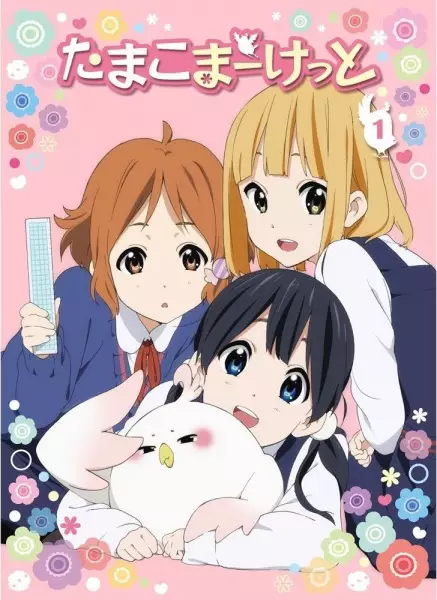

たまこまーけっと
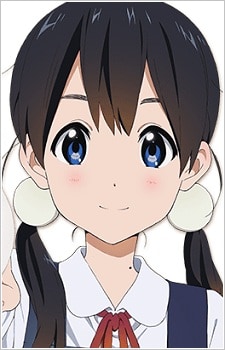
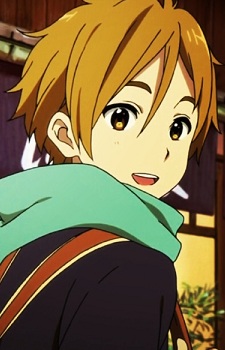
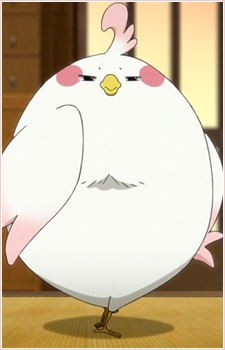
Inside the Usagiyama Shopping District lies an eccentric but close-knit community of business owners. Tamako Kitashirakawa, a clumsy though adorable teenage girl, belongs to a family of mochi bakers who own a quaint shop called Tama-ya. One day, Tamako stumbles upon a talking bird that presents himself as royalty from a distant land. Dera Mochimazzi, as he calls himself, states that he’s seeking a bride for his country’s prince. Intent on his mission, Dera follows Tamako home and develops an addiction to mochi, becoming painfully overweight and subsequently unable to fly back to his homeland; thus, he takes up residence with Tamako's family and becomes the community’s beloved mascot. Meanwhile, Tamako's friend, Mochizou Ooji, continues to hide his true feelings for her. Their fathers are fierce mochi rivals, but will it be enough to drive a wedge between Tamako and Mochizou? And just what will happen to Dera's task of finding his prince’s destined bride? [Written by MAL Rewrite]
Main
Main
Main
Main
Main
Main
Supporting
Supporting
Supporting
Supporting
Supporting
Veronin
April 6, 2013
There's something about anime which allows us to derive entertainment from the mundane events of an ordinary person. Coincidentally, ordinary is the best way to describe Tamako Market. Starring the young lady Tamako and a flamboyant talking bird, Tamako Market is yet another anime that attempts to cash in on the slice of life phenomenon. It is not an anime that prospers through the strength of its plot, setting, or themes, but instead subsists through the cuteness of its characters. Should we criticize an anime for not going beyond that? Maybe not. But there is certainly a problem when such a simple anime still fallsshort of its potential. Tamako Market's biggest weakness is regrettably its characterization. Each characters has about the same depth as wrapping paper, as none of them even once prove to be more than their established archetype. Tamako is merely your ordinary, dense heroine (think Chitanda with pigtails) who is no more memorable than any other generic slice-of-life lead. There is little to make her stand out aside from the fact that she is cute and naive. Even when the story shows small signs of her developing as a character, it will simply fall back on her denseness in order to prevent any growth. The result is not pleasant. You cannot have a character-driven slice-of-life anime told through the perspective of a weak character. It does not work. Though one might think: if not the protagonist, the rest of the cast may be better, right? Not here, it seems. For nearly all of the side characters are a superfluous addition to an already large cast. The biggest offenders are Tamako's school friends: Midori, Kanna, and Shiori. They do not serve any purpose but to quickly provide a sense of friendship in Tamako's daily life. While there are a couple of episodes that focus on these characters and attempt to give them personality, once the next episode starts, the show will treat it as if nothing even happened. This is especially an issue in the case of Shiori, where an entire episode is spent introducing her to Tamako's group of friends— yet afterwards she is not seen for almost the entire story. What was the point? You could remove these characters from the show and nothing would change. Tamako's childhood friend, Mochizou, is yet another victim to the weak characterization. His character design at least carries some degree of promise, but the lack of screen time compounded with his unfortunate role as a plot device do not do him any favors. There are a few heartwarming scenes between him and Tamako, such as when they talk at night through a string telephone, but the overall execution of this romance is invariably poor. It is entirely composed of Mochizou woefully attempting to convey his feelings to no avail, with Tamako conveniently being blind to Mochizou's evident feelings. In many ways, their relationship is reminiscent of the cliches from harem anime. To be fair, this isn't a story that focuses on its romance. But can one forgive what could easily have been so much more? The show's mascot, Dera, will either amuse or infuriate you. Considering that he has more screentime than any other character in the story, this can potentially destroy any entertainment value that the show might otherwise hold for the viewer. There are a few witty moments here and there, but most often he is simply detracting from time that could have been better spent developing the human characters. While you may hate him, the one thing that can be said in his favor is that he creates personality within the show: he is anything but a bland character. Whether you lean towards hatred or endearment, Dera will leave some lasting impression on you by the end of the story. Hopefully a positive one. On a more positive note is Tamako's younger sister, Anko. She does not receive much screentime in comparison to Tamako or Dera, but what little she receives is written considerably well. Her two episodes focus on the innocent crush that she has towards a classmate, and the way in which the anime conveys this is surprisingly subtle. Anko does not outright state her feelings, but through her body language they are made very clear to the viewer. As well as being sickeningly adorable, Anko is surprisingly the most believable character in the show. Too bad she is treated as irrelevant in all but two episodes. Aside from the characters and romance, there are small problems within the story itself. Most notably is during the last few episodes. After an abrupt twist at the end of the 10th episode, the show immediately tries to rush in some semblance of a story at which it fails quite miserably. Not only does this undermine the slice-of-life aspect of the previous episodes, but the writing is marred by contrivances such as when the Prince somehow travels (or is it 'teleports'?) from a distant country to appear at the most convenient time possible. The ending is scarcely better either as it completely disregards these events in order to revert back to the mundane slice of life. I am not sure that KyoAni knew what kind of anime they wanted to make with Tamako Market. While the content of the show feels uninspired, at least there is some charm in the presentation. There's an interesting contrast between the mundane activities of the shopping district and the unique carnival aesthetic they are presented in. The soundtrack compliments the style of the show especially well, while even the shopkeepers and background characters are given distinct (often eccentric) personalities in order to breathe life into the world. Not that you will remember them, though. Artistically the anime shines, but those looking for something of the same level as previous KyoAni works will likely find themselves disappointed. The animation is fluid, the facial expressions and scenery are fairly detailed, and the color scheme is vibrant— though little is actually done to enhance the experience. It is an anime that looks and sounds pleasant, but the lavish budget often feels more excessive than beneficial. In the end, Tamako Market is another disposable slice-of-life anime to be consumed and forgotten. The fundamentals are intact, and while there are still signs of potential waiting to be realized, this is an anime that will probably leave you with a bitter feeling of emptiness once it is over. One would think that after KyoAni's success with K-ON, they would understand what is needed to create a quality slice-of-life anime. Apparently not. Perhaps KyoAni should stick to animating existing material from this point on. Tamako Market may not be a bad anime. But it is certainly a lacking one.
Supporting
Frog-kun
January 30, 2013
(NOTE: This review is written for general anime fans and assumes no familiarity with other series. If you dislike moe, I still think this series is worth watching, for reasons I will discuss below. After episode 5, I decided to bump up the rating to an 8.) Kyoto Animation is very well known for their cute character designs and on the whole, Tamako Market seems like it was a consummate effort on their part. It's not new and it's not original, but it seems like it was created very easily and with great refinement and polish. So what is this series about? Not a lot, ifI'm going to be honest. Tamako is the daughter of a mochi (a kind of Japanese rice cake) maker and the episodes seem to revolve around what kind of new mochi she makes for each different occasion. There's a certain educational appeal in this. Tamako Market also focuses on the bonds Tamako has with her friends and family. It captures the feeling of living in a small yet close-knit community. People from all walks of life populate this town and they all interact with each other in simple yet heartwarming ways. This series is a slice of life in the purest sense of the word. The most praiseworthy aspect of the anime is the cozy atmosphere it manages to create. It's as if nothing bad will ever happen in this town. It's definitely escapist - but in a different way from most anime. The world of Tamako Market is one where you want to escape to and live in because it's so simple and innocent. If the world was just a little bit more like the one in Tamako Market, it would be a much better place. That's the appeal in these sorts of shows. In addition, KyoAni seems to have crafted their ultimate cute girl in our heroine Tamako; she is nice, polite and liked by just about everyone in the series. Though she is not a particularly quirky or memorable character (besides being totally dense when it comes to romance - I pity her love interest), her traits are very balanced and she has an air of genuine sweetness that's impossible to dislike. I do not think Tamako Market is "moe pandering". That is an unfair slight against the anime. Yes, the girls are cute, but so is everyone else in the series, even the old men. One particularly charming episode focused on Tamako's FATHER of all people. If anything, this series is targeted for general audiences and has a family friendly feel. It is not an otaku series and it is not trying to be one. I am neither a moe fan nor a moe hater so I would prefer to look at this series through the merits of its STORYTELLING. The problem I detect with this series isn't so much in the content so far but in people's expectations of it. I believe the first episode was not a strong indicator of what the series is about. The first episode was high on energy and comedy, mostly through the slight supernatural aspect of the show. A talking bird is the main comic relief mascot of the show and this character featured prominently in the opening episode. But Tamako Market isn't really a screwball comedy, even if it does have a quirky sense of humour. It is really a laid-back sort of anime that takes its time to develop the various characters and let the mood sink in. While the premise of the bird character's subplot reappears in the second half of the series, his main role in the series is for a bit of laughs and to support the character development. The few subplots and promises of development lead to nothing in the end, and while it's not necessarily a bad thing to see a story that isn't so focused on a tight storyline, Tamako Market feels particularly light and frothy, all the more so because what plot it manages to build up is deemed irrelevant by the end. Tamako Market sets itself up to be one thing and turns out to be something else. I do consider this to be a flaw in the writing. Even slice of life fans should take note that the dialogue isn't particularly witty and the charm comes across as somewhat calculated. As I said before, it's not moe pandering, but there's a certain "been there, done that" aspect to a few of the more emotional scenes - most likely because seasoned anime fans may have already seen them done in previous KyoAni shows, or just in anime in general. That doesn't stop this series from being good at what it does, but there is a distinct feeling that it could have been stronger. Some episodes do drag in their pacing. Still, it's a nice slice of life show, very clean and perfectly harmless, even though it doesn't do anything new with the genre. Do give it a shot.
Stark700
March 27, 2013
Do you like MOE? Are you a fan of Kyoto Animation's other works? Do you enjoy watching cute girls doing cute things? Do you like a talking bird running his narcissistic mouth 24/7 about his superiority and the world around him? Well, if any of those registers a response of “yes”, then this series might be somewhat of an interest for you. Tamako Market is a new original series from Kyoto Animation. The series is directed by Naoko Yamada with the studio known for their other works such as Clannad, Chuunibyou demo Koi ga Shitai!, Hyouka, and K-On! The series is a standalone title with noother adaptations from any sources of LN/Manga as of known. Now, I admit, this series is a quite something especially in the 'kawaii' department. But beyond that, I'm not sure if Tamako Market lives up to the hype and humor that I originally thought it had. Well, the series lacks a direct story but takes on a more slice of life style of things in more of the fun way. Take for example, we got that bird named Dera “Tori” Mochimazzi (if that even its real name). He claims himself as being “noble” with a sharp tongue and often talks in an aristocratic pattern. He also seems to be dense of the real world and how it functions. For instance, he takes the girls' actions of colliding into his face as a way of “declaring their devotion” towards him. In reality, this is obviously not the case but only a case of allergy. It happens quite often too and Dera being the silly bird that he is takes everything in the way his culture taught him to be. As for most of the other characters, the series presents them in the usual cute way, the Kyoto Animation way. There's Tamako Kitashirakawa who stars as the main protagonist of the series. She is a first year student in high school who is enjoying the time of her life. Despite her denseness especially to those in her life, she is very hardworking and strives to help out her family the best way she can. In fact, she is easily able to make friends at school and even at earned the affections (or maybe I should assume here to be accidental fondness) of Dera. Tamako is the main star of the series and hell, even some girls got the hots for her. Among some of her friends includes her childhood friend Midori, Kanna (a member of the Baton club), as well as the cool girl Shiori. Oh and let's not forget the guy friend, Mochizō Ōji. It is hinted throughout the series that he has a thing for Tamako but who are we kidding here, it's Tamako after all and she gives 'dense' a whole new meaning. In fact, there is even a sort of “love triangle”. Unfortunately, it is quite weak and blend that most viewers will not be able to notice it much. Even so though, the characters all have different personalities as well as what they hope to be in the future. They just seem to be too simple and not enough depth. Given the premise of the show and its genres, it's not too surprising in the case of Tamako Market. On the other hand, the adults of this show (besides Tamako's cool dad) seems to be more in the background. In this show, the kids are the stars and the adults are the ones on the other horizon. As mentioned before, this show is rather plot less and lacks any if at all, strong development. In other words, don't go into this series with some sort of strong story because the way it's being handled. However, there are some little things that are amusing to reference to if a viewer pays more careful attention. Most of Tamako's family members' names are related to mochi as well as having meanings. For example, Dela Mochimazzi hates to eat mochi. His last name reflects on the 'mochi is terrible' taste in which he dislikes the taste of mochi. Tamako is also born on New Years Eve which just happens to be the busiest time of the year so her birthday is often forgotten. Well, at least it's better than February 29. The series' episodes typically spotlights a certain event in Tamako's daily life as well as spotlighting some of the other characters (including that bird Dela). Even Tamako's little moe sister Anko gets her own episode when she demands to be called “An!” Shiori had her moments during her own spotlight as she made an impression for Tamako and her friends. Now, they are the best of friends. I won't get to that bird Dera since he tries to steal the show (like he did with the first episode) every week. I do find him quite annoying though as his mouth never seems to stop talking about his ethnics and culture. At many stances, I find this series to be cute. We have the Tin-to-Phone talk as a little theme to bring back some childhood nostologia. I mean, ask yourself, when was the last time you talked to someone with a tin can? Nowadays, we got cell phones, androids, and whatever else you watch your anime on. But going back to the old school of using old fashioned tin cans is just something so nostologic. Not only that, it is cute. Among other things, there is a sense of innocence especially with Tamako. Those headbands on her hair and the way she displays her postures in the OP song are all part of this. In fact, Tamako is one of those girls that you can't help but want to be friends with. For Anko's case, her seemingly crush on a fellow classmate turned out to be someone else that most of the cast did not see coming. It's one of those instances where innocence kicks in again and we can't help but smile for Anko; or maybe, I should call her 'An' as she wants to be called. Despite all cutesy moments and fun, the series does have some dramatic moments and even a somewhat antagonist of the series. This is reflected in the face of Kanna Makino when she has some plans of her own against Midori. Otherwise, some of the drama involving Anko and her classmates are occasionally a pleasant watch. Unfortunately, this show does not escape the typical beach episode. Although not for fan service reasons (I think?), there is a beach episode where the main characters relax and have fun in the sun. It's been done by Kyoto Animation in the past before and here we are again. Otherwise, the series' blend storyline does not make up for its other attributes. Also, that damn bird named Dela tries to steal the show every single episode. He's almost everywhere whether it's on Tamako's head, at the beach, the mochi shop, or at school. He tries to be the star of the series but more often or not, he stays as the comic relief. This is reflected in his personality and the way he behaves himself where the only attention he gets is seemingly what he least expected. He claims to be some kind of aristocratic prince but let's face reality here folks, he is just a flat bird with not even an ounce of hunting skills considering the place he is freeloading in. Talk about being worthless, just like the 'plot'. In terms of visuals, Kyoto Animation does it again. The series has very rich scenery and displays fantastic features of the characters' expressions. The luscious backgrounds along with its strong balance of artistry sets this series as a top tier in the art department. More so though, Tamako Market gives more of a realistic feeling of what is being like in the show. There's the beach, the mochi shop, the neighborhood, and school. It works out right and along with the character designs, we can clearly see that Kyoto Animation is behind this. I mean, just take a close look at Tamako's face. Aren't you CURIOUS about what mystery series' female protagonist that Kyoto Animation worked on previously from where she resembles from? For soundtrack, I would say that the ED song is quite catchy. It is playable on repeat and seems like an orchestra that is crafted with a fast rhythm and catching pace. Most of the soundtrack is composed of that lighthearted tone with some added fun choirs in between. The voice actors did an okay job to reflect their tone style although there's a certain character in the series that seems to display some gender confusion. More noticeably though, Tamako's dad displays some musical skills of his own and a few of the background music later on seems to be based off of famous works. Overall, I think this series gets a '6'. If I was judging it based on cuteness, I would score it something like a 15/10. However, the weak story and seemingly lack of character development makes it less convincing against some other titles from Kyoto Animation's works. That bird by the name of Dera (again, is this even his real name?) is quite annoying and gets repetitive to watch. I do admit though that the series is quite cute and brings a smile to my face whenever I watch it. This time around, I'm not sure if Tamako Market is really that good. Well, it definitely is kawaii.
2SugoiToActSugoi
June 22, 2014
Before watching Tamako Market, I had to prepare myself. I mean cold showers, a critical state of mind stemmed by delirium, and eating a cup of ramen filled with enough hot sauce to burn my tonsils off. Distraction from the cuteness is key—because the cuteness is paramount. It springs up in all corners, in every moe smile, in every darned bit of music, in every bright color. Beneath a tactful disguise of a thousand hues of pink, a conniving truth festers. If you let your guard down you will never see it. I’m here to tell you the truth. And the truth is that Tamako Marketis any moe-lover’s dream—on the outside, at least. In case I haven’t mentioned this already, everything is cute. In fact, the cuteness is played up to such a level that all you see, all you notice, is cute. The animation is bright and bubbly and perfectly moe; it fits an anime of this caliber and deserves praise for setting the stage. The voice acting and music will not disappoint. On the outside, Tamako Market is glorious and if one is content with this then good enough for them. But for those of us who begin to question the cuteness, for those of us who find that the cuteness isn’t enough to stop critical analysis, a deeper look is in order. For the sake of this review, I will break through Tamako Market’s façade. There are few layers beneath. Actually, it’s painfully simple, even more so than some other slice of life anime out there. Despite the bubbly aura that the animation and music emanates, Tamako Market feels uninspired and, weirdly enough, even bland. This isn’t because it’s a slice of life anime. In fact, anime of this genre often have an inexplicably entertaining quality despite the commonplace happenings. Where other similar anime stand strong, fortified by character chemistry and those signature quirky events, Tamako Market can’t seem to establish itself. Everything is there to create another wonderful edition to the world of moe—right? Actually, no. The deeper parts of moe and slice of life, the parts that leave a good anime fan satisfied, are not merely looks but what’s on the inside. It’s just like the question of best girl. She may have to be cute, but there are a lot of cute girls and when it comes down to it, her heart matters more. For anime, the heart is something known as plot and characterization. Tamako Market starts off pretty well, introducing us to the cool and friendly place where Tamako lives and Dera, a pompous bird that she just happens to encounter. The story basically revolves around Tamako’s daily life with this bird, her friends, and mochi. The one thing that Tamako Market tells us consistently is that mochi is great, mochi is good, and mochi is life. Otherwise, everything is loosely about friendship, family, and some sort of plot revolving around Dera that comes in when it wants to, only to be remembered when convenient and then sloppily handled at the end. For some, the amount of moe cuteness is enough; getting absorbed in it is fine for them. But the reason why all you see is cuteness and the reason why there’s so much of it is because there isn’t anything else. The best thing that Tamako Market could do was play that up, and it definitely did that. However, those of us looking for something deeper will only be content in watching this anime (though that does not mean they won’t enjoy the ride) instead of absorbing all that it has to offer. Tamako and her friends are the only thing that would make this anime remotely interesting—and that fact doesn’t fare well for it. The dialogue is bland, the jokes are bland (and barely noticed), the crushes are bland (and very badly handled), and the characters (especially the ones with the most screen time) are bland. The latter is the reason why the former is bland. The characters that had promise on episode one bore you by episode twelve because they’re exactly the same. The archetypes that you were introduced to don’t have any deeper facts, quirky characteristics, or new emotions to show you that twelve episodes have passed. Where many slice of life anime keep you interested with facts or entertaining life stories or at least a deeper kind of characterization, Tamako Market doesn’t stretch its legs. All of them are insipidly themselves—Tamako is forever cute and naïve, Kanna is forever unusual, Midori is forever bubbly-ish. In fact, perhaps unsurprisingly, but definitely unfortunately, the most interesting and promising characters are the ones with the least amount of screen time. The reason why Tamako Market fails to inspire praise is because it doesn’t handle itself well. Though another (not implausible) reason is that perhaps it thinks it doesn’t need to, so long as there’s cuteness. Many will agree with that and many anime veterans will not. Look in each corner, my friends. In one, we have cuteness, the appealing shell. In the other, we have a gray, murky goop, the unappetizing innards. The question of which one will win can only be answered by you, the viewer.
tommy73
March 31, 2013
“You used to be much more... "muchier". You've lost your muchness.” - Alice in Wonderland. Not that I'm a fan of that series, nor that I even know the story (please don't shoot me), but this perfectly describes studio Kyoto in a ball. They've been famous for making various key adaptions such as Clannad and Kanon, and other series being described as far as controversial like Haruhi. But lately, they've been said that the rising hill is sloping downwards now, and Tamako Market contributes to more evidence for that hill, with less and less 'muchness'. That hill consists of weaker attention for the story, and withmore delicious amount of budget and moe to sprinkle the... fillings, not just the topping. That's right, it's the infamous "style over substance" type, and Tamako Market went exactly in that route. It'd be really nice to have a good balance of substance, but that doesn't mean we should completely ignore the style either, and it's styles like in Tamako Market that are actually pretty rare. Hence why I used Alice in Wonderland for quoting. 'Tamako Market' means a market full of Tamakos. Just kidding, but please stop laughing at my hilarious well-made joke which was carefully crafted in three whole seconds. It does take place in a market though, and a rather lively one at that. There's several mochi shops rivaling each other, and a high school girl named 'Tamako' is part of the shops. She looooves mochi, and makes 'em for the market who has the happiest atmosphere going around. Also talking bird appears and strange love triangles occur, whilst the mochi shops does the most epic contests against one another, rivaling themselves out with their wild mochi-cooking skills to the point of exhaustion and hardships. Okay, I lied, there's no real cooking rivalry. There's talking birds though. As a complete, shocking surprise, it's about nothing, or at least for the majority of the time. However, the way it structures itself gives both an avoid alert and a treat for those for can bear the first few episodes. My initial first response to the first three episodes were that they were "boring as a wall", as well as "stupid as a talking bir- oh wait". Nothing happens, and it seems a little pretentious with a smiley face to try and keep me engaged with a talking bird hitting on girls. It's only after I finally picked up the series again when it was nearing its end on airing, where the episodes after three actually became a little more than entertaining. It's ironic because, for those of you who follow the three episode rule, you'd be only watching the lowest of the TM episodes. The structure follows a episodic layout, and it's not surprising as it's a slice of life. They're purely episodic to the core though, as they each contain stories of both main and side characters, dealing with simple problems and affection towards different people and such. This kind of layout already sets you up with the characters in front of you, and since the story doesn't follow a linear line, not much changes or developments grow much, if it has any at all. With that said, it allows you to familiarize yourself with the happy market, and as you get more into the market's pace, you'd find it gets much more enjoyable and natural with different kinds of stories later on. That said, it can go the opposite effect if you're not fond with the market itself. If you feel the urge to burn those flowers in the shop, that fat talking bird who didn't save the show, those puffy mochi-like cheeks on Tamako and those puffy mochis themselves, then feel free to get up and leave to collect your fire, as you're not going to like the show at all. Don't burn Kanna's hammer though, Kanna's the best in the show. How dare you. But I'd be a little surprise for anyone to hate the atmosphere of the anime, particularly the market. I find the atmosphere to be a little more... magical. Which is a little bit of a surprise myself, since I don't tend to find this sort of lovely, bouncy atmosphere in anime often now. The show presents itself in a more musical-play fashion rather than a relaxing one. Things play out like a fantasy musical, if there's anything else to describe it best; the lovely, light soundtrack fleshes the musical style out quite a bit, as some scenes feel as though it's actually a music video. Things flow like flipping through a happy and merrily written book, sometimes ending in a fashion where a message warps up the episode as if it actually ends a good night sleep. It's a lovely atmosphere, and gives a tingly sensation of joy inside... though, it takes a bit of time until it really gets into you (at least after episode 3 for me). Oh, did I ever tell you there was actually a story in the show? Dera, the bird who I just called 'the bird' for a while now, actually comes to the country for a specific reason. That background of the story stays behind the shadows for the majority of the show though, so the reasoning for him lurking in the market isn't because he tried to make a 'moe slice of life about nothing' show more interesting, but for a future reason to be revealed later on. The storyline of the whole situation with Dera isn't so surprising though, and in fact it's fairly simple to get your head around without the need of developments or plot twists. It's ever so simple writing, with a vague climax that doesn't really make up for the entire series, so if you're expecting your wow meter to be of the chart, don't be. That and the fact the actual story is literally behind the shadows doesn't keep any sort of substance following, since it's pretty much hidden in the entire series. There's not even a sense of mystery either; the market's being too busy smiling so much that a fat bird that can talk is something that should be subjected upon, since even scientists can't find birds in the world who can freaking talk, let alone a noble perverted one. The point though is that it's a super simple story which doesn't get put on subject until the few last episodes of the show, and so the rest of the episodes is just about character stories in the market, as said earlier. There's no linear story to follow; only those in the market. Let's talk about the lovely dovely production values for now, and take a break of the main cake of the show. What do you expect from Kyoto Animation then? In comparison to ChuChu and Hyouka, the budget doesn't go as astounding as those two. It's more comparable to the likes of K-On!! though, as they are done by the same sub-team as each other. The animation is very fluent with its movement, making them extremely fun to watch and building up a good amount of gif files in your folders. The main girls are in the baton club too; what's more fun than looking at cute girls throwing and spinning batons around in the hall? Also, there's quite a blob of moe in the anime, though it's not focused upon as much as people state it is. If you are allergic to moe and get itchy spots down there, you can stay away from this, but I honestly don't see how or why it's a big problem for the show. The OST is ever so musically lovely. I wish the OST is already out, but it seems like it only goes as far as the character songs for download. Anyway, the soundtrack provides the magical atmosphere even further, and fits the entire show almost perfectly, as said earlier. The opening contributes to the magic musical style too, though not so much of the ED as that's more of a J-Pop serious song. It's not much of a problem, since it's musically very well-done, and it's a must-have to get the full version of. Sound effects and directing is consistently good, and the OST is used wonderfully, fitting from a cute AMV to a mini musical narration play thingymajigy, as described earlier. Voice acting is great too, and Dera's voice gives of the royalty feel of his being quite well. Well... mostly royalty. But umm... about Dera.... Some say he's the life saver of the anime, whilst others state he's a big, fat thing wasting precious screen time for the anime. In theory, he's only set in the market because of plot (oh how convenient!), right? But, as said three main paragraphs ago, the actual story is bored behind the shadows, so Dera's not actually needed 9 tenths of the time. His personality is of a king's noble servant, yet he's not aware that all his 'charm' are not actually capturing any of the girls' hearts at all. Even mochi proves him as a clown, turning him bloated and heavy. He's in the show listed as a main character, but it's in fact that he only proves to be a comedic clown character who can in fact be super annoying to some and praise-worthy to others. Whether or not he saves the entire show is an entirely different question. Without him, Tamako Market would be a normal slice of life about mochis, lesbians and magical happy atmosphere floating around. It can only prove Dera as a little bit of a plot device to bring the "plot" to the market, but even without him the effects of being bored as a brick in the first few episodes would be the same. His existence is very polarizing in opinions because of his strange noble personality, with a sense of weird affection birds shouldn't even have towards girls, and sometimes he just kills moments by narrating with a somewhat cheesy voice. That said, if you really hate to see him, he's hardly the center of attention in the majority of the time, so be glad or be sad; either way, this talking bird isn't going to leave his mochi behind you'd still have to deal with him in the show. Aside the case of the talking bird though, there's a whole cast of other characters too. You got the group of girls being Tamako's friends (Tamako being the main character, if you haven't noticed), who are blond Midori, glasses Shiori and the best character in the entire show, Kanna. Her ruler and hammer wins me over, and so she proves best award for Tamako Market person. The market has a ton of people living there; a flowerist whose gender is unknown, other mochi makers and shop keepers plus the families, the friendly elderly people, dancing old man, newly bird couple, little kids and so on. It's quite a colourful bunch, and the entire cast brings the happy and lively atmosphere in the area, so lively that it's a little unnatural to be in, but nevertheless fun. Several of the characters get a decent amount of screen time, but not much can be said about the developments. They're pretty interesting and likable in their own right, especially having the center of attention in some of the episodes (though Kanna doesn't weep weep...). The cast is a fun bunch, in conclusion, but even with some background and attention, development doesn't really grow upon nearly all of them (except Dera, funny enough). Tamako Market can be regarded as another moe creation from Kyoto, and with even more style and less substance than before. Popularity sure got them "muchier", but now their muchness has shrunk over the years to the point where great things wave bye-bye to their opportunities of potential (talking about that one Key VN which got rejected because Kyoto was 'too busy'... forever cry weep weep...). That all said, Tamako Market wasn't as bad of a ride than I thought it'd be, but stating that the story is extremely unique and well-written is worth face-palming. I wonder what Kyoto's going to do in the future then. And should I look forward to it?
Rank
#2505
Popularity
#562
Members
460,219
Favorites
1,706
Episodes
12