

The Vision of Escaflowne
天空のエスカフローネ
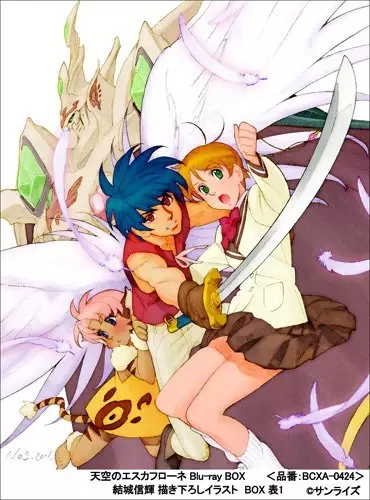
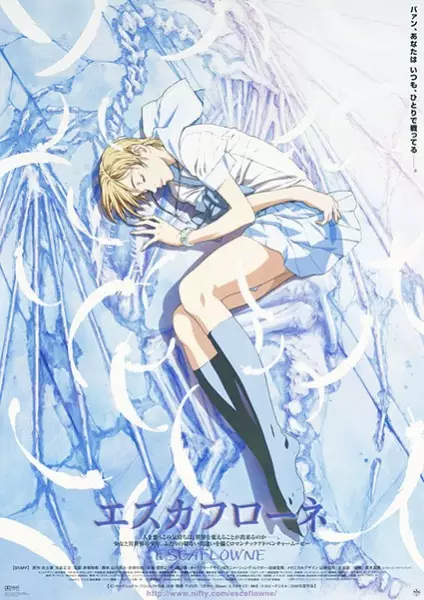
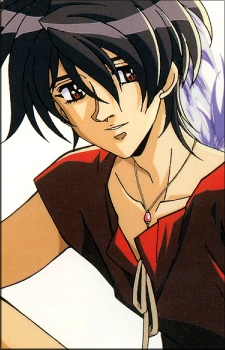
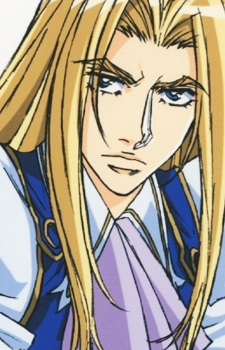
Hitomi Kanzaki is just an ordinary 15-year-old schoolgirl with an interest in tarot cards and fortune telling, but one night, a boy named Van Fanel suddenly appears from the sky along with a vicious dragon. Thanks to a premonition from Hitomi, Van successfully kills the dragon, but a pillar of light appears and envelopes them both. As a result, Hitomi finds herself transported to the world of Gaea, a mysterious land where the Earth hangs in the sky. In this new land, Hitomi soon discovers that Van is a prince of the Kingdom of Fanelia, which soon falls under attack by the evil empire of Zaibach. In an attempt to fight them off, Van boards his family's ancient guymelef Escaflowne—a mechanized battle suit—but fails to defeat them, and Fanelia ends up destroyed. Now on the run, Hitomi and Van encounter a handsome Asturian knight named Allen Schezar, whom Hitomi is shocked to find looks exactly like her crush from Earth. With some new allies on their side, Van and Hitomi fight back against the forces of Zaibach as the empire strives to revive an ancient power. [Written by MAL Rewrite]
Main
Main
Main
Supporting
Supporting
Supporting
Supporting
Supporting
Supporting
Supporting
Supporting
Lindle
April 10, 2011
Vision of Escaflowne has something of a name for itself in anime history for being an an attempt to appeal to both shonen and shoujo demographics at the same time. Featuring mechas, swordfights, explosions, stuff burning etc. alongside bishonen male protagonists in a love triangle with the regular everyday girl from another world seems to be a lot of its selling point, and as a result, it's often fondly remembered as a true anime classic of the 90s. Escaflowne revolves around a teenage girl named Hitomi Kanzaki, an everyday ordinary girl who happens to like reading tarot cards. Or so that was the extent of it,until one day, she ended up being whisked away to the mysterious world of Gaia with a dragon-slaying teenage boy who was returning. As it turns out, Hitomi has ended up in the midst of a world about to break into full-blown war, as a result of the strange actions of the nation of Zaibach. The first, and most obvious problem, as you may have already guessed from the synopsis, is our main character Hitomi. She is basically just what you would expect from what has been said... a bland, overly moral cliché, existing mainly for the female side of the audience to project themselves onto, as she is paired up with both of our handsome bishonen leads. And unfortunately, they aren't anything impressive either. Van Fanel is an angsty prince who sees his kingdom destroyed at the start of the series, and if you just noticed the clichés rack up, you're not the only one. He also happens to be the one that Hitomi will obviously get paired with by the end of the series. He is balanced out by Allen, who happens to be a charming, charismatic ladykiller who excels in basically every field he participates in. He had the most potential of the three, but by the end of it he's honestly not all that interesting. Throw into this a number of annoying supporting characters (along with one who happens to be pretty awesome), and you have a relatively poor set of protagonists. However, this is mostly where the bad in Escaflowne ends. The plot in Escaflowne manages to be very solid, enough so to balance out the poor leading cast. The directing is even better, building some excellent scenes with solid action, mostly revolving around the mechas (referred to as Guymelefs). When talking of Escaflowne, you will probably end up hearing a fair bit about the Guymelefs, and with good reason. The steampunk design that they use makes them an excellent contribution to the mecha genre. In fact, the steampunk vibe in general is probably one of the most solid things about Escaflowne. On top of this, while the protagonists are rather underwhelming, the antagonists certainly fare better. Dornkirk, Folken, and Dillandau are a far better trio than Hitomi, Van and Allen, with the latter being quite firmly the most memorable character in the series due to being batshit insane. Folken is Van's brother, and has more than a handful of similarities to a certain Star Wars character (I won't say who, but you can probably guess) and I mean that as a compliment. And Dornkirk, the Big Bad, does sit back for most of the series, but can be rather menacing when he is directly involved, and provides some very interesting motives. From a production angle of things, Escaflowne was excellent for its time, and in technical terms it's still very solid, but unfortunately the art and animation have aged quite a lot. Most notably in the case of the infamous CG dragons. The character designs are clearly the thing that have aged the worst, though. Saucer-like eyes and misshapen noses are everywhere in them. The soundtrack is by Yoko Kanno, so odds are I don't really need to say anything else because it's freaking Yoko Kanno. The voice acting in the original Japanese is also excellent, with Maaya Sakamoto providing her debut role as Hitomi, and Minami Takayama gives a standout performance as Dilandau. Unfortunately, the dub does not even come close to shaping up. None of the actors involved really seem to grasp the concept of "acting", nor do any of them sound remotely convincing in their given roles. Overall, Escaflowne is definitely an enjoyable run, but I really can't see where it gets its status as a classic from. It's far too flawed to be deserving of a 16-year legacy, nor has it really contributed anything good to anime as a medium. Nonetheless, it's still quite a solid story if you can get past the main characters. Final words: Overrated, but still quite good. Story/Plot: 8/10 Animation/Graphics: 7/10 Music/Background: 9/10 Characters: 6/10 English Dub: 2/10 Overall: 7/10
derpiii
June 30, 2019
Patiently watched all 26 episodes expecting some grand payoff - it never happened. I want my time back. This is a shoujo with a mecha aspect thrown in to appeal to the shonen userbase. It does a poor job executing on each part, nor is the sum of those parts decent. This would've made a decent 2 episode OVA. But for a 26 episode long show? It's a hard skip. You're not missing anything. ================================================= word padding to meet the minimum review word count - word padding to meet the minimum review word count - word padding to meet the minimum review word count
zealot1138
July 16, 2009
-- Please do not read if you have not watched this and/or do not like any spoilers. Thank you -- Ok, maybe all that FMP watchin' made me want to revisit another tortured love story chock-full of action and beautifully drawn characters, so I cracked open the Special Edition box set of "Vision of Escaflowne." I hadn't seen this series since I was going to UCLA (and I only mention the school bit so that when I admit about my blubbering later, it won't seem too pathetic). I wasn't sure I would ever want to see this again since my first impression of the series went fromindifference to impressed to infatuated with a finale of utter disappointment! I had never cried so hard, not from sadness, but because I was that horrified that any story could build up such a fantastic love story only to part the couple by the greatest of distances. (I'll get into this later but I did want to address the good first.) Like all good anime, there is a combination of burgeoning romance, love triangles, surrounded by action, good vs. evil, and surprises. High school track runner Hitomi Kanzaki is mysteriously transported to another world called Gaea where she is torn between her feelings for Allen Schezer and the feelings she didn't realize she has for Van Fanel. Initially, I couldn't get past the character designs based on the overly elongated and pointy noses. Once I got used to it, the rest was easy. As a fan of mecha and medieval knights, Escaflowne does a fantastic job with their Guymelef designs: essentially, they are over-sized suits of armor that have a Da Vinci-esque design of mechanisms ala mechas from Macross, etc. I love the look of blending medieval and organic materials with modern/sci-fi technology and the designs here don't disappoint. Escaflowne transform into a flying dragon which fits in naturally in Gaea where the Samurai are knights of their respective realms, dragons are slain as a rite of passage, and transportation is via horses and ships (but ships that fly, natch). Even if the series was rushed and unfairly edited down into their 26 eps (from an original 39, I'd read), they did a wonderful job of introducing us to these various characters who grow and develop over each episode. And here's the rub, for me: the relationship between Hitomi and Van seems platonic enough upon meeting. They are thrown together by fate and no other reason. She is immediately infatuated with Allen because of his chivalry and his looks (since he reminds her of her upper classmate Amano, who she has a crush on). Van is just this young king who is rash, stubborn, and immature in more ways than one. And because of these differences, it's rewarding to see Van gain experience and maturity over the series and to see how much he and Hitomi are always making sure the other is alright. They realize way after the fact that each is in love with the other - it's tender and sweet. One of my favorite heartbreaking scenes is Van having gone to find Hitomi in the rain, only to see her in Allen's arms (above). This love triangle has some of the best subtle moments of jealousy as evidenced by the characters facial expressions (which says a lot for an animated show), such as when Van extends his hand to Hitomi to jump aboard Escaflowne only to look slightly hurt when Allen picks her up and hops over with her. Hitomi also briefly goes back to Earth only to return to Gaea when she and Van simultaneously realize they want to see each other again. I prattle on about this because all these great moments are completely annihilated by the ending of the series. The conflicts of war and violence on Gaea have been resolved and the kingdom of Fanelia is in a peaceful era of Reconstruction. Hitomi tells Van she would like to stay on Gaea with him. Van says that's just fine with him, but that they could see each other any time anyway. So Hitomi says goodbye to Van and begins to levitate upwards in the magical light column. Everyone on Gaea is also sending Hitomi their farewells too. Now, I could live with this kind of vagueness since the very end shows Hitomi back on Earth where Van visits her (whether it be only a vision or a quick light column visit, I can't quite tell but!) and she tells him she is doing fine. What KILLS me is that as she was leaving Van, she tells him that she will never forget him, even when she becomes old - all of which implies she won't be with him ever again! This still upsets me now because it totally ruins (for me) the idea that maybe they will be together again one day, maybe after she's out of school. But to say that you'll never forget someone is to say that you'll never be or see someone again. So WTF is going on there? I read one post on a message board saying s/he felt they'd be together again once she is done with high school, and I want to believe such a happy ending myself. But if they'd only cut out the "I'll never forget you" crap, I'd feel more optimistic. I can't really explain why this stupid ending upsets me so. I mean, it's a frickin' animated show with a vague enough ending that I really could force myself to believe whatever I want. So why am I still angry? *sigh* I wish I knew. I guess I feel such a beautifully well done story is thrown away when it can't be wrapped up as well as it was unfurled in the beginning. But, there's something about the Japanese (or most Asian) cultures that can't seem to shake the disappointing and unfulfilled love stories.
inarizushi
March 8, 2013
Vision of Escaflowne is a woefully underrated show. It comes from that time in the '90s when anime played hop-scotch over the line between shounen and shoujo. There is plenty of romance, and love triangles abound, but it's set in the middle of a war and there are giant robots, bloodbaths, and dragons. A psychic high school girl named Hitomi gets pulled onto the mysterious planet of Gaia where the earth and moon are visible in the night sky and anthropomorphic animals exist. Gaia seems to be in it's Mideaval period with monarchy still in effect, but has very different technology than Earth. Thereare no computers, phones, or cars, but there are airships and giant mobile suits. The mechs, called Gymelofs, are amazingly designed. They look like a knight's suit of armor and move with gears and steam. They're completely believable in the swords and dragons setting. The "magic" in Escaflowne is really more "mysticism" and has definite rules. Personally, I really like Escaflowne's art work. The style is very different than most anime with the characters having long, prominent noses, and round rather than spiky hair. The series is unique and the art reflects that, though it did take some getting used to. It's drawn very consistently, which usually seems to be a problem in 90's anime. The colors can sometimes feel a little murky, but mostly it works for that "Dark Ages" feel. The animation was above average for it's time. The sound is FANTASTIC. Yoko Kanno did the music, so really, what else do you need to know? She beautifully blends Japanese lyrics and Olde Worlde European ballads that sound like they're played on harp and hammer dolcemer. The more modern sounding poppier songs are never out of place, and there are Gregorian monks chanting "Esca! flow! ne!" The original Japanese voice cast is very, very good, and the dub is surprisingly watchable with the standout roles being the villains. Dub!Hitomi's and Allan's voices may take some warming up to, but over all I recommend the sub and dub equally. Escaflowne has a large cast of richly detailed characters and as more is revealed about their back stories, their actions become more understandable and relate-able. Even the villains are given this same treatment and care. Van, our main male hero, starts out brash and seemingly apathetic, but we learn that he is actually trying desperately and has an inordinate amount to prove. Hitomi is a real asset in battle. She's smart, an athlete, and rarely needs to be saved. She's a tough, interesting girl, and she will tell you what she thinks of things. Like any shoujo heroine, she's prone to the occasional romantic flights of fancy, but they fit the story and are endearing. Millerna is a princess studying to get a medical degree and doesn't mind leaving her castle to travel with our rag tag group of protagonist. The final standout is the utterly psychotic villain Dilandou. Usually, character driven shows are my favorites, but where Escaflowne really shines is the plot. There are more twists than you would ever innitially imagine. The writers managed to weave in mythology like Atlantis and even include Isaac Newton while keeping things completely believable. The pacing is good (no filler!) and the storytelling really makes you think and figure things out. The ending is bittersweet in a really effecting way and all the story elements fit together like puzzle pieces--the proof of good plotting. The world, Gaia, is also a fantastic part of the show. The world building is immense and immersive. Gaia has it's own histories, various races, political structures, belief systems and customs that are unique but logical. Escaflowne is one of my favorite shows for it's sheer brilliance and originality. It really takes you inside the characters' heads and we are asked to deal with their experiences in this war as it brings more of their pasts back to confront them. Watch Escaflowne if you like mechs. Watch Escaflowne if you like your shoujo romance with a healthy dose of action. Watch Escaflowne if you want an epic fantasy. Watch Escaflowne if you want a complex, intelligent plot. Really, you should just watch Escaflowne.
Venneh
October 5, 2008
Title: The Vision of Escaflowne Manga, Anime: There are three different manga for this anime, and the two that were released around the same time as the anime are worlds apart. In order to understand this, you need to know a little something about the production. Escaflowne was in development for about five years. Shoji Kawamori (famous for his work on the Macross series and Eureka Seven) came up with the initial idea for the series after a trip to Nepal, and hashed out the basics of the series with Minoru Takanashi at Bandai, with Hitomi originally as a curvy, long-haired, air-headed girl with glasses,and a decidedly more shonen bent to the series. Sunrise (famous for their work on the Gundam series and Cowboy Bebop) was originally selected to do the series, which was then planned at 39 episodes, and Noboteru Yuki worked with Kawamori, with the director at the time being Yasuhiro Imagawa. The director stuck around long enough to coin the phrase Escaflowne, and then left before production actually started, and the project was shelved. Two years later, Sunrise picked it back up and bought on Kazuki Akane (famous for his work on Noein -To Your Other Self- and the Birdy the Mighty 2008 remake), who then gave the series a complete makeover, bringing in shoujo elements to balance out the shonen, notably, making the men a bit more into bishonen and remaking Hitomi as the girl we know in the series. The first of the manga titles to come out shared the anime's name, and was based on the original production ideas, which gave it far more of a shonen bent. This manga was done by Katsu Aki, and ran in Kadokawa Shoten's Shonen Ace magazine from October 24th, 1994 to November 26th, 1997. It was licensed Stateside by Tokyopop, and the eighth and final volume was released on September 14th, 2004. The second manga title, titled Messaiah Knight - The Vision of Escaflowne, later retitled Hitomi - The Vision of Escaflowne, was released around the same time as the anime, and was a shoujo adaptation based more on the final version of the anime. Yuzuru Yashiro did this adaptation, and it ran in Kadokawa Shoten's Asuka Fantasy DX magazine from April 8th, 1996 to January 18th, 1997, and has yet to be licensed Stateside. The final manga title is called Energist's Memories, which is an anthology of several stories from the Escaflowne universe done by several manga authors. It was released in January of 1997, and also has yet to be licensed Stateside. Escaflowne is a twenty-six episode series (yes, you'll notice it was cut down from the 39 episodes originally planned) that was produced by Sunrise and Bandai Visual, and directed by Kazuki Akane. It ran on Japanese TV from April 2nd, 1996 till September 24th, 1996. It was licensed Stateside by Bandai Entertainment, and the latest full boxset was released on April 11th, 2006 as part of the Anime Legends collection. Story: High school track runner Hitomi Kanzaki has a talent for stunningly accurate tarot readings. One day, she has a vision of a young man slaying a dragon, and, later that night, the same young man is transported to her world in a pillar of light, along with the dragon, and he slays it. As soon as the young man, named Van Fanel, has harvested the energist stone that lies in the dragon, the pillar of light returns him back to his world, Gaea, where both the moon and Earth (known as the Mystic Moon) hang in the sky - only Hitomi is taken back with him. As Hitomi tries to find a way home, her latent psychic powers are awakened, which in turn awakens Farnelia's mech (known as Escaflowne), and she becomes caught up in the politics and conflict between Asturia, Farnelia, and the Zaibach Empires. You can tell that the story was originally meant for a longer series, but the decision to trim it down to twenty-six episodes came through just when the series came in just as production was beginning, and the director didn't want to sacrifice any of the characters or plot lines. So, instead, the already elaborately planned plotlines and character development was made to fit into a twenty-six episode series. And, admittedly, while the story and development is a bit jerky, slow at first but then speeding up in others, it still manages to completely and coherently wrap things up in its length, not to mention give the fairly extensive cast of characters good development. And speaking of characters, I have so much respect for how they developed them. The characters all start out as fairly common shoujo tropes, but are developed into real people and incredibly engaging ones at that. Hitomi especially; she could've been this horrible Mary-Sue, but instead she is developed and even grows up a little as she makes her way through Gaea and reacts pretty realistically to her situation. Relationships between all of them are slowly developed, and you aren't hit over the head with it as they are; when they are finally bought to light or out and out pointed out, you realize, "Oh, that explains it!" For those of you who are mech fans, you'll be happy to hear that the mech fights are paid as much attention to as the the story and character development; there's at least one major fight every other episode. And especially appropriate is how they developed the mechs to match the level of technology that's found in Gaea. Gaea is general is built extremely well as a world; just about every aspect you could think of is given thought and explained in ways that don't make you feel like you're being hit over the head with the exposition hammer all that much. The downside of all this is that you feel like you're getting bombarded with information, and there are a few minor characters that are mostly running gags and who they seem to forget exist for a few episodes here and there and then are bought back into the story to remind the audience, "Hey! They're still here!" So, overall, while there is quite an overload on information, and a few gag characters are forgotten here and there, Escaflowne's story is still pretty good, and all elements of it are given equal loving attention. Art: Compared to other shows that were airing roughly around this time (Ruroni Kenshin, Martian Successor Nadesico, Ghost in the Shell), Escaflowne's art is pretty damn good, if not gorgeous. Character designs are given the perfect amount of detail, not to mention as are all the different races on Gaea, mech designs, backgrounds, just everything is absolutely beautiful in this. There are some very strong lines used in this, like what we saw in Ouran High School Host Club. And overall, the quality of the art has aged quite well. The style of the art has not aged well, though. Facial features are extremely exaggerated, notably with a few noses that could conceivably be used as swords with how pointy they are. Also, CG use in this is fairly obvious, which is a bit understandable, but it's still a bit painful to watch at times. Music: The music for this is absolutely spectacular. Yoko Kanno did the work on this, and it's not the typical jazz soundtrack that I've seen from her in Darker than Black and Cowboy Bebop. Instead, here, we get EPIC orchestral scores, with beautiful string work and special emphasis on the cello (used to be a cellist, so it's always great for me to hear the instrument used so well) and excellent choral arrangements. The OP is sung by Maaya Sakamoto, Hitomi's seiyuu, and is just a lovely ballad (well, waltz, actually, it is in 3/4 time) in general. It's always a good thing when I don't skip through the OP, and it's even better when I sing along to it; I did this every episode. The ED is a more stereotypical upbeat JPop number done by a guy instead of a girl, and was very easily skippable. Seiyuu: This series is chock full of good seiyuu. Hitomi was Maaya Sakamoto's (famous for her work as Haruhi in Ouran High School Host Club and Aeris Gainsborough in Final Fantasy VII: Advent Children) debut role, and her singing of the OP was her first work singing. Besides Ms. Sakamoto, Jouji Nakata (famous for his roles as the Count in Gankutsuou and Alucard in Hellsing) appears as Folken, and Juurouta Kosugi (famous for his roles as Akio in Revolutionary Girl Utena and Fernand d'Morcerf in Gankutsuou) appears as Dryden. As for the other seiyuu, the voices fit well, and were acted well, which is all I ask for. Length: Twenty-six episodes makes the series feel a bit pushed for time. Having the full run of 39 episodes probably would have helped this in the long run, and especially given it some time to breathe. Any shorter, though, and it just wouldn't have worked. Overall: Escaflowne has an excellent story and characters, a well-built and animated world, excellent seiyuu and beautiful music. It has a few flaws, mainly from the compressed schedule it was given to air in, and the occasional forgetting of characters but, nonetheless, is a very solid series. It's not a ZOMG favorite series for me, but I would definitely recommend it for anyone looking for a good series. Story: 9/10 Art: 7/10 Music: 9/10 Seiyuu: 9/10 Length: 7/10 Overall: 41/50; 82% (B)
Rank
#1540
Popularity
#1550
Members
176,028
Favorites
2,285
Episodes
26