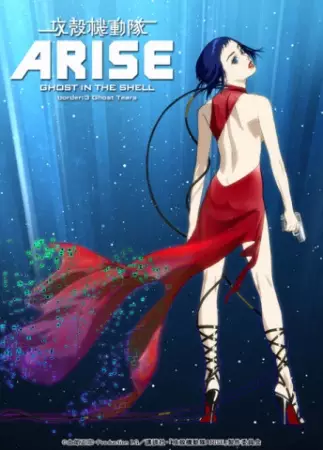


Ghost in the Shell: Arise - Border 3: Ghost Tears
攻殻機動隊ARISE -GHOST IN THE SHELL- border:3 Ghost Tears
Third movie of Ghost in the Shell: Arise. Motoko and Batou work to try to stop a terrorist organization whose symbol is the Scylla. Meanwhile, Togusa investigates a murder of a man who possessed a prosthetic leg manufactured by the Mermaid's Leg corporation. (Source: Wikipedia)
Main
Supporting
Supporting
Supporting
Supporting
Supporting
Supporting
Supporting
Supporting
AXxoN-N
July 28, 2014
TRIVIA: The third episode of Arise is subtitled "Ghost Tears" because the franchise is presently balled in a corner weeping from the garbage juice squirted into its eyes. Preface: I usually don't bother to write reviews unless I find myself auto-forming a review in my head as I watch. This occurred during the third episode of Arise because the flaws are so glaring they jump out at you neatly wrapped; it almost feels like this review has been written for me and I'm merely transcribing. Easy as transcribing is I still wouldn't post, unless what I saw which seemed so obviously godawful to me had yetto be slandered as much as it deserved. So with 2 reviews on here ranging from mediocre to absolute perfection, here I am to commit abortion. Central Flaw: Motoko the pussy. The main draw of GITS, for me, has always been the Major. She's one of the best female characters in the medium, in any medium, and on her own merits. She can't be pigeonholed into any one trope, because she's a complex character dealing with massive global, political, and philosophical issues - but always tempers them with her own individual existential concerns. The diffracted nature of her personality is greatly needed to sell the concepts of the series, ie, how augmentation can change the self-hood we experience in relation to our bodies and consciousness. The Major is subversive in appearance and proclivities (scantily clad, domineering, bisexual in the manga and SAC) to the point of being intimidating in modern contexts, and this quickly sells us on the reality of the universe she inhabits with its changing values, moral codes, and opportunities. She's a fluid character in a fluid environment; in every iteration she's shown to fluctuate between loyalty to external forces and roguish self-actualization at the expense of others. In short, she's a great example of a strong female character precisely because she's so much more than just a strong female: she's unpredictable. And so it's a great pain to see her reduced to a hetero-normative cliche romance where she defers completely to a one-note, flat-out Bishounen who predictably betrays her. It's conceptually flawed, but the script is even worse: imagine if Ripley from Alien(s) was inserted into Bella's place in any given Twilight scene, and you'd essentially have every romance scene in Ghost Tears. I understand that a prequel requires showing us characters when they weren't yet themselves, when they were foolish and idealistic and more vulnerable than we're used to seeing them. But the problem is we've already seen this delicate spin on the Major in 2nd Gig, and the Kuze romance had substance, mostly because the related plot-line developed the Major in a significant way; the Ghost Tears romance develops young Motoko insomuch as she has a teen girl epiphany that love can be specious. The only signs of the old Major come in short bursts whenever someone pushes her over the edge, and in these misjudged scenes the Major is simplified to another extreme and becomes merely histrionic. Hurting the integrity of an iconic character is enough to make Arise a botched effort but its other sins seem almost endless: Flaw #2: The supporting cast becomes the ancillary cast. I understand there's only so much you can do in 60 minutes, but aside from seeing Motoko become Motoko, the novelty of Arise is that you get to see Section 9's recruitment. Or at least that used to be the marketing ploy of the OVAs, now I'm not so sure. Each episode has just been a barrage of things happening which so happen to involve a future member of Section 9, so that after the climax we're treated to: Motoko: Hey, want to be on my team? Future member: Okay. There's no grandeur to them joining, they don't even seem to play major roles in the proceedings deserving of their recruitment. Togusa was the addition to the team this time around but if you asked me what he did that so demanded his involvement I couldn't tell you, because I can't remember anything he did. The characters being put into the periphery is more glaring in Ghost Tears because they're sidelined for the dull romance. But what really sets their writing apart as poor this time around is their reduction: the full extent of their presence in most scenes is the delivery of a signature character trait (e.g., Batou delivers sarcastic one-liners, Togusa mentions his Mateba, Paz talks about his relationship troubles). We've seen all this before, across two different installments of the franchise, and by this point the characters are just self-referents winking at the audience. And the Logikoma got about one line. Why even add a moe-relief device to something with such a short run-time in the first place if you won't let them deliver? Flaw #3: Production integrity. The Oshii GITS films are some of the most beautiful traditional and digital animation, respectively, that you can ever hope to see. And although SAC had its problems (especially in the first season) with characters going off-model at inopportune times, the production integrity on an episode by episode basis was absolutely amazing for a 52-episode series. We don't get nearly the same level of craft in even 60 minutes of Arise, where characters go off-model so severely their heads seem to glide up and down on their necks like moeblob thermostats. And it's not even a budgetary concern because you can tell the budget was enormous, it's the fact the designs aren't sustainable for anything other than static close-ups. Coming off the heels of SAC, which had some of the best character designs in the franchise (and the industry as a whole), this is BS. Flaw #4: Convoluted garbage. It's a testament to what little I have to say about the plot when it's almost the last thing I address. I can't begin to tell you the specifics of anything that happened except for the various lazy twists slinged out toward the end that render your attention up to that point a wasted effort, because none of the specifics really amount to anything. So it's a good thing I barely paid attention. And this is not for lack of trying: the script is at ends with itself. It has no clue how to communicate to an audience visually or textually. The majority of scenes are people sitting around and talking - and this is somewhat of a staple in the franchise. GITS involves heavy exposition that mixes a lot of lingo and jargon together: corporate, philosophical, bureaucratic, political, technological, legal. The structure of SAC is usually a dense briefing followed by the actual meat of the episode, so if you phase out during these expository sequences you're screwed. But SAC and the films isolate these expository sequences between actual plot development, and they employ a lot of visual staging to guide your attention throughout. Ghost Tears is almost entirely exposition. There is no pacing, there are no deftly wrought symbols, there are no beautifully rendered settings, there is little to no actual directing involved. People talk, and they talk a lot, and they talk about things yet to be given a visual referent. Nothing that occurs outside of talking adds emphasis to the plot threads, because anything that isn't talking is mindless and random action sequences so wholly removed from relevance that they don't even feature human characterization. In one scene an innocent worker discovers he has a sort of explosive inside his prosthetic arms, and so to save everyone else from the impact Sec. 9 throws this dude's entire body down an elevator shaft with no remorse, no comment, no beat at all aside from complaining about the smoke. This could be intentional, but I can't imagine what the writers thought they were accomplishing: if the characters aren't involved in their surroundings to the point of having logical thoughts or feelings of accountability, why should I care about what's going on? It becomes a mere series of events. SAC and the films have characters doing what they do because of grounded motivations, and if they ever come to the point of allowing casualties for the greater good they have internal and external conflicts. So there's mindless violence on one end and needlessly dense exposition on the other end with no balance involved. I'm left feeling like no single scene has impact on the other. There's nothing cohesive about the nuts and bolts of the script but there's also nothing cohesive about the themes underneath. Motoko yearns to feel human so she has romantic relations. Cool, but we've seen this before and it's unrealistic to believe that anyone (but especially Motoko) would feel more human when engaging a partner so inhuman and boring. Other themes involve the difference between bodies and objects, losing track of identity when your body is switchable, etc., all cool, all done before in the franchise, all irrelevant to the actual plot of the OVA. I haven't even mentioned what the plot is. So what is the main plot? Something about water corporations. Riveting. Granted, the seedy underbelly of ostensibly benign corporations is an interesting concept, but the script doesn't allow you to consider this because it's handled with no mystery - a character appears on-screen and says I Work for Water. It's a shame the writing team didn't think to utilize this aspect of their script, just as they didn't think to utilize any other aspect of their script. Final flaw: the Kaworu dynamic. And we come full circle with the romantic interest. I can't remember what his name was so I'll refer to him as Kaworu, because that's essentially who he is, and his dynamic makes much less sense when not paired with a weak-willed character like Shinji, and instead with the diametrically hyper-willed Motoko. The chemistry with Kaworu makes no sense, and this is most evident in how Motoko is written as a completely different character in all of their Attack of the Clones-esque gallivanting. The conflict between the Major's sense of duty and sense of self can be easily grafted onto a romantic situation and, as I've said before, already was in 2nd Gig to much greater effects precisely because it involved tragedy and schism. In Ghost Tears there is no conflict: the Major becomes weak willed and seems comfortable staying there until the story pulls her back out. Bonus flaw: the soundtrack. It sounded like Playstation-era shovelware techno BG music and the ending song with Sean Lennon (???) was the aural equivalent of dumping a tanker-truck of sand onto a gaping flesh wound. --- It's ironic that a major visual theme (pretty much just an aesthetic choice with no depth at all) is water and water-related things, because this is essentially a watered down and pointless version of the franchise. Absolutely avoid it at all costs unless you enjoy watching stillbirths.
Stellio
June 30, 2014
Ghost Tears opens with Motoko making passionate love to her then-lover, Akira, later even featuring the two attending another couple’s wedding with Motoko wearing a rather promiscuous, alluring dress. Her colleagues, especially Batou, make fun of how fatuous and short-lasting this relationship is. How does Motoko respond? She hacks Batou’s prosthetic arms, again reminding him of how humiliating it is to be punched by your own fists. Being the third installment to the Ghost in the Shell Arise series, Ghost Tears is quite the bombshell. A sexy and assertive Motoko leads an investigation into a terrorist organization whose symbol is the Scylla, an ancient sea-monster.Meanwhile, given that the original Ghost in the Shell franchise only hinted at casually sexual relationships between Motoko and a few others, a great leap is taken to visually display Mokoto and Akira "passing the time together." And no, cyborg sex is just as crazy as it sounds. As the story progresses, Mokoto and Akira's relationship eventually blossoms into a romance. And while this new development may sound fun and gratifying, the romantic flavor in Ghost Tears bears a double-edged sword. For one, because previous installments of the franchise never mention much about Motoko’s romances, teasing dialogue about Motoko’s former relations with men can feel a bit unnatural. Although Motoko has indeed always had an enigmatic quality about her, seeing her supposedly fall in love with another person simply doesn't blend well with her exceedingly self-reliant personality. However, that is not to say the romance wasn’t fleshed out appropriately. In fact, Ghost Tears is brave in attempting this feat while exploring crucial parts to Motoko’s character: Should a cyborg as robotized as Motoko live as a human or as an object? Should she love another human with ease? These inquiries are hardly new to the franchise, after all. The original Ghost in the Shell (1995) portrays a mysterious and dystopian universe filled with questionings of the self, and Stand Alone Complex 2nd Gig similarly spotlighted Motoko’s character feeling lost, uneasy, and insecure. However, Ghost Tears breaks away from the crowd by sacrificing the always rational, composed Motoko in lieu of a perhaps more humane and emotional depiction of Motoko. As a result, her struggles become a bit more relatable, but can also alienate some viewers due to their inconsistencies to Mokoto's depiction as a character in the rest of the franchise. In addition, the plot is also somewhat of a mixed bag. Similar to the first two parts of the Arise series, the mystery feels underwhelming mostly due to how little information is revealed, the loose pacing, and how quickly everything is pieced together. Akin to other installments of the Arise series, there’s hardly any thrill in its predictable manner of presenting a murder, some suspects, and then the resolve. In particular to Ghost Tears, the slow pacing for most of the movie is a rather different approach than the action-filled climax and beginning. And for some, this blend could come off as distasteful and chaotic. The animation has its highs and lows: for the most part, the action sequences are fluid and invigorating when there are exciting encounters. Moreover, the blue ocean scenery within Mokoto’s mental universe and the city backdrop capture great atmosphere depth. However, there are some fairly flawed and dreadful-looking illustrations of Motoko in certain scenes. Her character design and composure would look off-set, and this made the animation look very shaky at times. But hey, at least Motoko’s exposed body was drawn to be aesthetically pleasing and rather erotic in some scenes; so no complaints there. Complementing the art, the OST was used suitably, and the ED in particular ended on a chill, feel-good vibe that left the movie on a pleasant note. Recapturing the strangely charming aura of the original Ghost in the Shell (1995) while putting its own spin on Motoko's character, Ghost Tears is unique in its content but lackluster in its presentation: All in all a must-see for fans of the Arise series thus far. The third time’s the charm. Almost.
iHitokage
June 30, 2014
So another GITS is here. This time we learn something new about Major's past and also about the legendary Section 9. I think this Arise series is getting better and better with every episode. I really enjoyed this one and I think it was the best on of Arise so far. I loved the thoughts about the cyberbodies, are they real bodies or just a things? This film contains again all the GITS stuff like hacking into other people's minds, problems with some body parts, super cool Motoko Kusanagi and of course all the other characters, logicomas etc. We can see again cyborgs and humans side byside. The ending scene for example, Kusanagi talking to Togusa, A special trained full cyborg and a normal natural human almost like from a history, like he's not really from that age. And not only that scene. Although Motoko is a full cyborg and had a dark past, we can see her also falling in love in this episode, not in a normal way like we probably know from all the romantic films but still... Also one interesting scene about old people with a new lives with a new cyborg bodies, living again, getting married etc. Kinda interesting.
Po_and_Dong
August 12, 2014
Arise has been a little bit up and down so far, and the series has yet to get into the same league as the films and SAC, but the latest Arise episode succeeds at being its own thing while bringing in classic element from both previous iterations. Ghost in the Shell: Arise - Border:3 Ghost Tears is the first Arise episode to show what the other ones lacked, Section 9 back in action, and this certainly works in favor of this new episode. This is what you should expect from this movie: a SAC style plot with the most intricate storyline so far in Arise,SAC style action and operations starring all your favorite characters with their SAC personalities for the most part, for the first time since 2nd Gig the Major's romance, and some themes and references to the original film as well. Before I get into more detail, I have to say this was definitely my favorite of the Arise series so far, and I'm sure you will like this one if you enjoyed the last couple. I can imagine Ghost Tears being a little bit controversial to the long term fans of Ghost in the Shell. The reason is because Ghost Tears features something that has never really been especially prevalent before, which is romance. Ghost Tears has a romance between the redesigned Major and an original character called Akira Hose. This romance is very direct, mature, and at times a little bit cheesy but definitely more prevalent then the extremely subtle romance in GiTS and the little bit in 2nd Gig. I don't think it was a bad romance at all actually, in fact its making Arise stand out in its own way. Sure its cool to see all this SAC stuff again, but if I want SAC I'll go watch SAC. By having some original flair, this anime is able to call itself a true new incarnation of Ghost in the Shell. Akira Hose himself, is a pretty interesting original character. This is the first time Arise has succeeded at doing this. Although he is in a somewhat similar role, Akira Hose is not quite Hideo Kuze, he is much less of an egoist, must less of an idealist, much less imposing, and much more charming. If Hideo Kuze is a rock, Akira Hose is the water. Now, Akira Hose isn't exactly character of the year. He has one motivation and basically makes a misshapen beeline to achieve his objective while getting sidetracked by his Major love interest. A little bit predictable but a good addition to the cast dynamic which had already largely borrowed from a 12 year old anime. A little bit more specific will follow. Ghost Tear's plot revolves around a conspiracy involving an illegal weapons manufactor stationed in Japan sending weapons to a fictional arabic country so it can fight its arab spring and what not. Section 9 is called to investigate how they are smuggling these arms, what the arms are, and what the hell it has to do with the exploding dam across the road. Hell yeah, classic Section 9. So the plot had its own share of detail. It is more intricate than the first Arise, it has more plot twists, it does not sacrifice sense for suspense, and it was definitely better than the rather paper thin plot of Arise 2. I enjoyed it well, but that was just one part of this anime that made it a success. All members of Section 9 had their moments, not just Motoko. Batou wisecracks against the Major and gets hacked which was hilarious, and rips someones head off. Borma is still bald and Borma, he threw some innocent bomber to his grave in a action so swift and deadpan I wasn't sure if I should have cried or chuckled. Togusa's facial detail has somewhat gone down, but his personality has not. He uncovers most of the case in this episode, good going Togusa. Etc etc. So it was a pleasant surprise that characters got their due when they were neglected before. Plot was good, characters were fun, and the action was nice. Arise also has a couple things that are more aligned with the original GiTS (and 2nd GiG to a degree.) For example, Motoko reveals her complex (surprise) about her cyborg body and how she feels alive with it. This is something we see in GiTS obviously, but not in SAC to much of degree. It was interesting, albeit not in the same league of depth GiTS goes to. I give them props for throwing in the Togusa's revolver joke too, that just kind of wrapped the references altogether. Music was underwhelming and unmemorable for the third time consecutively. Intro and ending music aside, theres nothing you will remember from this movie I am sure. If One Minute Warning and Stamina Rose can get stuck in your head theres no reason Arise can't do the same. The verdict is: it's good. I gave this episode a 7 not because there were any problems but just because it wasn't particularly outstanding in it succeeding categories. However, I am most definitely pleased with the anime I just watched, definitely the best Arise episode so far!
morbious37
March 16, 2016
Themes: Evolution of Section 9. Are we our bodies? Are our bodies just a tool? If our bodies are a tool, then what are we, a soul? The power of an idea, the hero as idea/meme (hearkening back to the concept of Stand Alone Complex) How a "full human" fits in a cyborg world.Loss, what happens after a tragedy. We see a much more sensual Major in this, and after seeing this, it makes sense why Major was never one for much romance. Speaking of Major, there are some sweet scenes in the cyber world, with some moderate fanservice, but this reminds me of how much less fanservice there is overall in this series compared to others. The thing that grated me watching this episode was the multiple versions of Major and other characters. Sometimes you would see multiple versions of the same person in a single shot. It's like one animator started the first half of the scene, then someone else with a slightly different style finished it. The fact that black market underground trading is providing so many plot points feels a bit underwhelming to me. I can only say "meh", and hope they end up writing diverse stories.
#2861
Popularity
#3589
Members
48,886
Favorites
33
Episodes
1