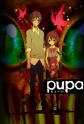

Pupa (ピューパ)
Abandoned by their abusive parents and with only each other to depend on, siblings Utsutsu and Yume Hasegawa find themselves led astray by beautiful red butterflies that have appeared in their world. Unbeknownst to them, these crimson winged heralds trumpet the beginning of a cannibalistic nightmare—a mysterious virus known as Pupa is about to hatch. After succumbing to the full effects of Pupa, Yume undergoes a grotesque metamorphosis into a monstrous creature with an insatiable desire for flesh; Utsutsu, on the other hand, is only partially affected, gaining remarkable regenerative powers instead. Reaffirming the resolve to keep the promise he made to himself years ago, Utsutsu is willing to sacrifice everything in order to always be there for his precious little sister. Pupa tells the story of a loving brother's desperate struggles to save his sister while protecting the world from her uncontrollable hunger. [Written by MAL Rewrite]

Main
Main
Supporting
Supporting
Supporting
Supporting
Supporting
Supporting
Supporting
Supporting
Marow
April 17, 2014
When I first heard of Pupa it seemed rather interesting and worth looking forward to. Based on the horror manga with the same name, Pupa tells the story about two orphaned siblings who only have each other to rely on after severe domestic violence. However, one day they are both infected with the Pupa virus which turns the younger sister Yume into a grotesque man-eating monster while the older brother Utsutsu gains regenerative abilities. This is, to put it bluntly, an exciting premise and Pupa appeared to have all the elements to make a memorable horror anime. While there had been mixed opinions from those whohad read the manga, I figured that at the very least it would make for an experience unlike any other in recent years. What I personally found to be noteworthy was how Pupa appeared to be the complete opposite of the recent brother and sister relationship trend in anime that often danced around incestuous undertones. Here we would instead have an older brother who had to sacrifice his own body to satisfy his little sister’s cannibalistic hunger. Rather than a cheerful outlook it was cynical one full of dread and hopelessness. Ironically, much like a cruel joke, it was the actual anime adaptation itself that became full of hopelessness. You see, Pupa was originally announced in early 2013 yet all buzz around it quickly faded due to a lack of news. Months passed and finally a vague air date was revealed: the fall anime season. Eventually the fall anime season approached, however Pupa was nowhere to be seen. The staff apologized for the delay and announced the series would instead air in the winter anime season 2014. At this point in time there were also some bad rumors floating around, mentioning how Pupa would be a short five-minute anime and not actually full-length. Today, we all know the result. Indeed, Pupa ended up only being a couple of minutes per episode. As you might understand, this is a format that makes the actual horror atmosphere a disservice. It is impossible to create a proper eerie atmosphere with such little time, especially if the story is to move forward in a reasonable manner. Speaking of the story, it is nothing but haphazardly told nonsense. It jumps from one event to the next with little to no explanation and ends in the middle of nowhere. To make the story even more difficult to follow, Pupa suffers from heavy censoring for no obvious reason. It is also incredibly inconsistent – sometimes censoring a mere knife while letting loads of guns pass – and often covers the whole screen with censor beams, effectively destroying what little that was left of the actual horror. Exactly to who is Pupa aimed towards? Fans of the manga will be disappointed with this mess of an adaptation while anime viewers will be utterly confused. I cannot come up with any good explanation myself other than that this is the worst anime I have ever seen.
literaturenerd
January 10, 2015
Overview: Little can be said about Pupa that hasn't been said already. It combines some of the more...icky fetishes together into one cluster fuck, but then censors itself and fails to even entertain those few individuals it was aimed at. Imagine if the Human Centipede or Salo was censored down to a PG-13 rating. What the hell would be the point of watching?! The brilliant plot?! The splendidly written characters and dialogue? There is NOTHING left of value! Marketing skills: -10/10 Let us do a little math. Let us say hypothetically that 1 in 1,000 people have a sibling incest fetish and 1 in 100,000 have acannibalism "vore" fetish. Assuming these unusual fetishes are independent events, the number of people with both a cannibalism and a sibling incest fetish (the target audience of this show) would be a whopping 1 in 100 million people. The global population in 2015 is 7 billion, so the target audience is 70 sick motherfuckers on the entire planet, that would actually enjoy this show. I fucking hope those 70 people are happy, because we other 6 billion 999 milllion 999 thousand 930 people are NOT! Plot: -π/10 "I'm gonna eat you up Oni chaaaan!" "Oh yes little sister, please eat me!" (chomp) (slurp) (moans of pleasure). Rinse and repeat for 12 God Damn episodes! At least each episode is short! Art: 2/10 As mentioned above, the bright lights of censorship prevent this from even having the macabre fun of a Cannibal Holocaust. I'm convinced that everyone involved with this production simply hated Mankind. Overall: 1/10 "What a piece of work is a man! How noble in reason, how infinite in faculty! In form and moving how express and admirable! In action how like an Angel! in apprehension how like a god! The beauty of the world! The paragon of animals! And yet to me, what is this quintessence of dust? Man delights not me" - EVERYONE after watching this series!
eririri
March 27, 2014
Pupa is a symbolic story of an abused maiden, Yume, who upon entering puberty develops an abominable and perilous love for her older brother Utsutsu. Seemingly a series which only caters to those who are gratified by gore and incestuous lust, Pupa actually explores, more than most other “imouto shows”, the complexities of the tabooed love between siblings. Perhaps most importantly, understanding of the series’ themes necessitates recognizing the circumstances surrounding the siblings’ childhood, and the Freudian psychoanalyses which the author may well have been inspired by. Sigmund Freud pioneered the field of psychology during his time, and a significant portion of his revolutionary findingscan be summarized into the notion that powerful childhood experiences, even if the subject does not remember said experiences, can subconsciously and drastically affect the development of libido and bring about what is known in psychology as “sexual aberrations”. Yume and Utsutsu grew up with an abusive and sadistic father, their only solace lying in each other. Utsutsu seeks comfort from his sole purpose of defending his beloved sister, whereas Yume is soothed only by her brother’s protecting arms. Yume is, metaphorically, a pupa containing the unnatural feelings imprinted into her subconscious during her childhood. Fast forward to puberty, and these feelings undergo a metamorphosis into a “monster”, in this case her monstrous lust for her brother. Both Yume herself and her surroundings realize the abominable nature of her love, yet Utsutsu remains in complete denial as Yume’s love has always been a natural and pivotal part of his life. There are several factors which gives rise to this interpretation. Yume morphs into a monster in a set time-cycle, and requires feeding in this cycle. This is comparable to the menstruation cycle which initiates during puberty, and the cyclical inclination to sexual activities which arises from it. While this depiction is blatantly simplified and even sexist, it is not completely unjustified as a symbolic representation of an especially anomalous case. The infamous feeding sessions are, as many suspected, metaphors for sexual intercourse. Both parts are reluctant to this act; Yume is afraid of hurting his brother for her own selfish desires, while Utsutsu is unable to derive sexual enjoyment from intercourse with his sibling, hence his suffering during feeding. Yet, he is unable to leave his sister in misery, and Yume imminently succumbs to her lust. Interestingly, neither characters perceive the act as perverted or sexualized, further proving the psychological derangement of them. As Yume and Utsutsu fall deeper and deeper into the rabbit hole, their conflicting feelings are depicted as outside forces which seek to interfere with their relations. Both are chained and tormented by unknown institutions, which they are eventually forced to confront and demolish. Perhaps they shatter the barrier erected by the morality of society, as symbolized by the slaughtering of the soldiers? Or do they overcome the innate biological repulsion toward incestuous acts, symbolized by the malign scientists? Yume’s and Utsutsu’s struggles with themselves as well as each other are undoubtedly convoluted, and Pupa provides an interesting and unconventional depiction of this strife. Any analysis above is only that of the writing and themes, and it is important to keep in mind that the anime is an adaptation by studio DEEN of the manga original. As is widely established, the animated Pupa’s production values are certainly not top-notch. While the animations are completely inexcusable, I personally do not find the art or sound too terrible considering that most shorts are not visual spectacles. Though this is rather inconsequential in its evaluation. More importantly, the short length of the adaptation has simplified the story to the point that it scarcely contains anything beyond vital plot elements. Add to this the frequent interruption of the narrative and the pacing problems it imposes, it becomes rather difficult to form an emotional attachment to the characters or the story. In conclusion, I do not think Pupa deserves all the ridicule and hatred that is being dished out. It provides a fascinating and unique symbolic illustration of the overused incest trope, complete with a hint of psychoanalysis that it deserves. Yet, when subjected to the magical touch of studio DEEN, it becomes a terrible series from every perspective other than the psychological.
Laora-inn
July 17, 2015
This anime, I think, can't be understood literally. It's a story about complicated and extremely painful relationship between brother and sister who were abused by their father since early childhood. The siblings are alone in whole world, adults are some kind of threat for them; so they begin to build their own world, their... cocoon of maturity. The beginning of anime underlines: it's a story about siblings' love, and, actually, there IS a lot of love. Maybe, too much. But children haven't ever known what "normal" love should be. Their father abused them, their mother ignored them, and such type of relationship was "so itbe" for them. They are used to be beaten and to protect each other; now they are alone, they are closer to adults by age (but aren't adults YET), they can be free of abusing... More than it, their abuser wasn't interested in them during some time. But they love each other so, so much, how should they express it? They were beaten and protecting each other before; now they are not beaten, can't feel pain and take more pain to protect the other. And yeah, there is the virus, "Pupa" (which seems an allegory of being teenager, not child and not adult), and sister must hurt her brother to stay a human, not a monster. Literally she _eats_ him, but he's regenerating from time to time - he is also infected, regenerating is his only possibility. All of us can understand the subtext of biting, eating and drinking blood - a sexual desire. The scenes between brother and sister, when he "helps" her, looks more like sex, than like anything else. They are partially naked, they are moaning, touching, she hurts him, he is bleeding, like a virgin girl - gender roles are vice versa, and this is the dark side of incest, like in manga "Berserk" (Serpico and Farnese), there a girl is absolutely dominant. But in "Berserk" we have other setting, the sexual desire's expressing more literally, and the parents are not so abusive - as a result, Serpico and Farnese are not so crazy for pain. They can express their love with other tools. Brother and sister in "Pupa" can't. Why? Because they are only pupas, cocoons. So their relationships are painful and horrible - they are not used to normal life, normal love, all is complicated and causing pain... now. But their cocoons may become butterflies someday - this is meant to be an adult. You can understand "Pupa" only with allegorical thinking - and tremendous scenes from series are just footprints of reality, fantasies built around feelings grown in sadistic family. Fantasies, in which brother sacrifice his body for sister - not vice versa. He is her victim, her food, her desire, her crucified love; all we know that men can be cruel and love in one time. Women can too - anime shows it. Here we have a system of forbidden motives - incest and awful bloody love as the strongest. But it's definitely LOVE, mixed with desire and need in own sibling to be alive, to be a human; our morality's protesting, because most of us have good parents and don't know how is it to be beaten every day. With the fact that this anime is short (imho it's good; I could understand the main idea and like it, now I'm interested in manga) and that it's thought to be a horror, not a family drama about teenagers who are siblings and love each other in forbidden way... I think it's not strange that it is underrated. Personally I had my pleasure to watch it - story and characters are real for me, I liked music and art... And extremely liked subtext of the story.
Whotfreads
September 15, 2024
Throughout all the hours I spent watching anime, I have never experienced such greatness. This anime transcends your classic anime tropes and brings a whole new light to the horror genre. After finishing this masterpiece, I had to sit down and reconsider all the other things I could have done in those 48 minutes. I was also forced to skip lunch as I couldn't bring myself to consume food after witnessing such greatness. While a lot of people would move on after watching this I certainly can't as it made a very large impact on me as a person and as me as an olderbrother. This anime showed me the importance of family bonds and how I have many things to learn from Utsutsu. Overall, this anime truly was a hidden gem that changed my entire viewpoint on anime and exceeded my known boundaries to establish a new standing as one the greatest shows to be ever created. After all, there is not a single other anime that made me think long and hard on all my life choices and how it led to me watching this. Edit: I stopped watching anime after this
Rank
#14781
Popularity
#1380
Members
200,042
Favorites
268
Episodes
12