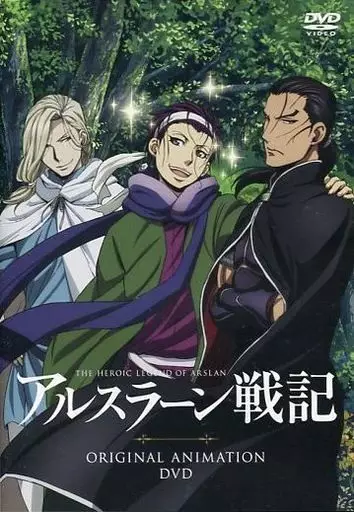
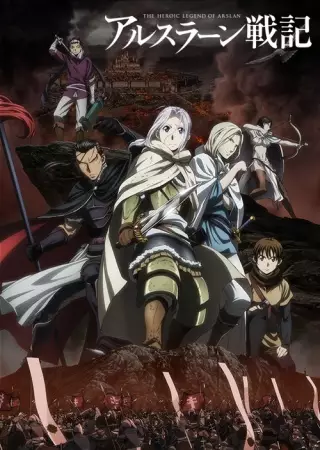

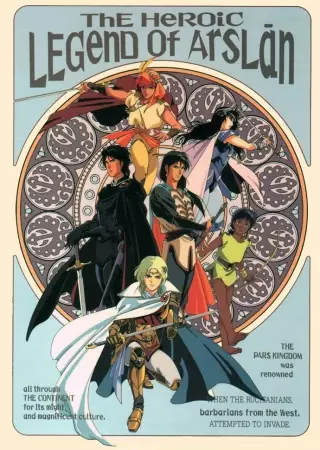
The Heroic Legend of Arslan
アルスラーン戦記
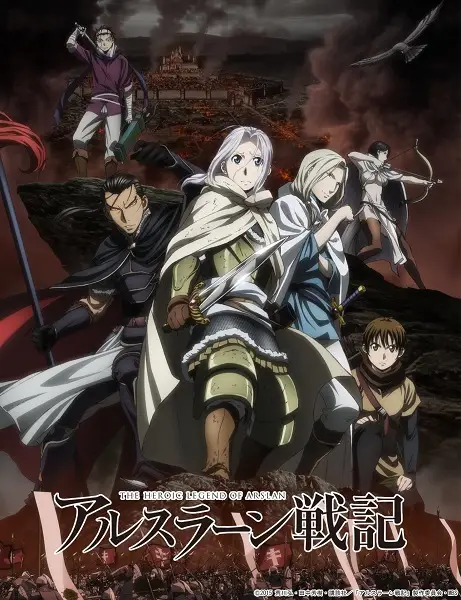
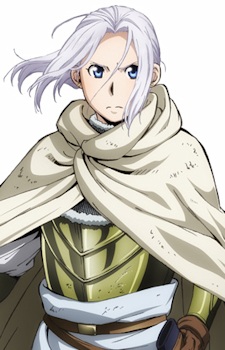
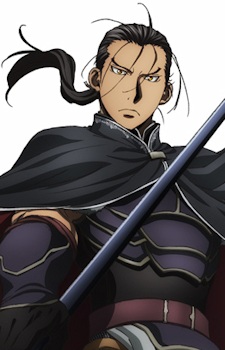
The year is 320. Under the rule of the belligerent King Andragoras III, the Kingdom of Pars is at war with the neighboring empire, Lusitania. Though different from his father in many aspects, Arslan, the young prince, sets out to prove his valor on the battlefield for the very first time. However, when the king is betrayed by one of his most trusted officials, the Parsian army is decimated and the capital city of Ecbatana is sieged. With the army in shambles and the Lusitanians out for his head, Arslan is forced to go on the run. With a respected general by his side, Daryun, Arslan soon sets off on a journey in search of allies that will help him take back his home. However, the enemies that the prince faces are far from limited to just those occupying his kingdom. Armies of other kingdoms stand ready to conquer Ecbatana. Moreover, the mastermind behind Lusitania's victory, an enigmatic man hiding behind a silver mask, poses a dangerous threat to Arslan and his company as he possesses a secret that could jeopardize Arslan's right to succession. With the odds stacked against him, Arslan must find the strength and courage to overcome these obstacles, and allies who will help him fight in the journey that will help prepare him for the day he becomes king. [Written by MAL Rewrite]
Main
Main
Main
Main
Main
Main
Main
Supporting
Supporting
Supporting
Supporting
ZephSilver
September 28, 2015
**this review will contain minor spoilers** Yoshiki Tanaka, you may not recognize his name but you've undoubtedly heard of his highly acclaimed behemoth Legend of the Galactic Heroes; a seminal war epic that influenced many series in its wake, with a legacy that still ripples through the world of anime and manga to this very day. When I heard that another one of his creations were going to get the anime treatment with Arslan Senki, my interest was immediately piqued. I was expecting another grand series with rich themes of political warfare, larger-than-life moments littered throughout and a far-reaching cast of developed personalities to carry itthrough. I was expecting a show that handled its content with a sense of gravitas, leaving no room for shortcuts. I was expecting something with a discipline, where proper writing and coordinated planning wasn't just an afterthought. And as if to solidify the deal even further, I found out that the character design work and manga adaptation of Tanaka's work was done by Arakawa Hiromu of Fullmetal Alchemist fame. The person behind one of the greatest war epics of all time partnered up with the person responsible for what's arguably one of, if not, the best shounen of all time. With such promising creators taking the helm, what could possibly go wrong?... Well, as it turns out, everything can. Arslan Senki was an anime that attempted all of the qualities expected from a Yoshiki Tanaka work but done so with none of the nuance or tact. It's juvenile in presentation but takes things seriously, it relies on implausible scenarios but pretends to be strategic, and it reeks of abused literacy devices in substitution for proper storytelling. Arslan Senki was simply a war epic that wanted to wear big boy pants while still not knowing how to tie its own shoelaces. The primary focus of Arslan Senki was a common tale that has been told many times over. A timid prince turned gallant leader slowly building his support and will to reclaim the throne that was stripped away from him. For all intents and purposes, the story itself was a coming-of-age just seen through the eyes of a more privileged individual. This isn't exactly a bad thing as long as the writing is solid. After being betrayed by factions within his own kingdom, Arslan, the crown prince of Pars, found himself fending for his life with everything around him being thrown into turmoil. This 1st season follows Arslan as he finds himself befriending new allies and growing out of his naivety with each new obstacle he's forced to encounter. The story itself was fine but the way it was handled was anything but. Writers often use characters within a story as plot devices to either move or manipulate the narrative to their liking. In order to make such an underhanded, yet necessary ploy less noticeable, the writers would evenly distribute the abilities or relevance among several characters, as a means to avoid turning any given individual into a Mary Sue/Gary Stu. So you can have a character who excels at X but not Y and vice versa. And while the set abilities and roles of the characters involved in Arslan were indeed separated, they only manage to avoid being Mary Sues/Gary Stus to only become HAX beyond probability instead. Narsus was a HAX tactician to the point where no matter how unfathomable or detrimental the circumstances, he would asspull a strategy just in the nick of time to save everyone's asses. Daryun was a HAX warrior that made mincemeat out of hundreds of men with no visible signs of fatigue or any human tenancies to speak of. Gieve was simply HAX at life, as he seemingly found a way out of death flag territory time after time again with little in the way of proper explanation as to why. Falangies, for no God-given reason, turned into Trinity and walked through a barrage of arrows like she was auditioning for The Matrix. And finally, there was Arslan himself, a character that's so much of a goody-two-shoes, that if he was tossed into the Game of Thrones universe, he would have been dead in 5 minutes tops. There's being nice and then there's being unrealistically lenient, Arslan was the latter. He might as well be a Care Bear. The implausibility of the characters wasn't the only problem that made itself apparent, the scenarios were equally as mentally challenging in that regard. To just name one example, we had a horse jump 20 feet into the air and landed a perfect mount onto a rampaging elephant to rescue someone at mid-gallop. And remember, this occurrence took place in a world that tried to be as realistic as possible. Something that felt inherently contradictory when the audience is shown actions akin to a Looney Tunes cartoon. The show required a high suspension of disbelief to buy into it. It placed the characters up against impossible odds only for the outcome to always be the same. There's no struggle to become better. There's no uphill battle to the top. There's no fight that posed a challenge, despite the handicap they're constantly placed in. All that we ended up with was a HAX team of misfits that plowed through obstacles like they're the Justice League. When the outcome always manage to be the same, why bother to get invested? Trying my best to avoid comparisons here but this is why Legend of the Galactic Heroes is constantly held in such high regards. The outcome wasn't determined, both sides took causalities, suffered losses and had no jarring plot armor to speak of. It was relentless, it had tension, and it wasn't a one-sided victory. Arslan Senki never demonstrated any of these attributes and just ended up being too idealistic for its own good. Another left-field issue that reared its ugly head was the random inclusion of magic midway through the series, which was up to that point, a "realistic" depiction of war. The show spent most of its duration trying to build a war drama where everything was grounded in reality but out of nowhere tossed in a new genre that was previously nonexistent. It single-handedly sabotaged its own foundation. This isn't like other medieval titles similar to Berserk, where there were foretelling signs of supernatural occurrences scattered throughout its runtime. No, Arslan never gave any indication whatsoever that magic would have worked its way into the narrative. The supernatural elements of Arslan just hits you like a Mack truck and if unprepared, can break any semblance of immersion that was established beforehand (that is, if you even had any immersion, to begin with). The art and animation for the show were appalling, not only by modern standards but in general. There are titles in the mid-80s that show better fluidity and attention to detail than this. It doesn't even rise to mediocre status. Not even the inclusion of Arakawa Hiromu's character designs could save the numerous times the animators had inconsistent models. This was derp central folks! Picasso face pandemonium! Every time a character was presented at a different angle, the act of looking disturbingly off-putting was guaranteed. This was made even worse by the deplorable usage of CGI. It was breathtakingly bad, seeing hoards of CGI fodder soldiers, animals and other objects just plastered across landscapes with no effort to conceal them. I'm talking PS1 level graphics here. The kind of mismanagement expected from the early 2000s when CGI integration was still being played around with. It was truly a messy patch job, apathetically slapped together in a way that's too obvious to give it a pass. If this anime had any saving graces, it would be in the music department. The show had grand sound to it that really helped in placing you in the middle of the action (even if the "action" was hoards of CGI dummies). The Iron Age vibe was captured quite well. The opening and ending themes were all pretty decent as well, and while not as important, even the cut-scene tapestries was a nice tough. None much of an auditory standout in its respective season but still serviceable nonetheless. And really, that's the bottom line with Arslan Senki as a whole, it's just serviceable but never becomes anything more. All in all, Arslan Senki proved to be a challenging watch. It wasn't eye-candy, it wasn't smart and it was far from enthralling. What little it attempted to accomplish has been done better elsewhere to a much more successful degree — hell, almost everyone staffed to create this thing has a better version of this lying around. It barely managed to scrape by and when you take into consideration the creative minds behind the project, it's quite disheartening. Enjoyment: 6/10 The show had a somewhat decent start but after a few episodes, what seemed like a sturdy foundation turned out to be a house of cards. I wanted to like this show but it kept on giving me reasons not to. Overall: 4.5/10 Arslan Senki was an overlooked title that has little to no hype behind it... and you know what? I hope it stays that way. Unrealistic to anyone paying attention to it and insulting to the eyes of anyone who watches it, Senki was an anime that had the backing of proven creators to become something great but spewed out a mishmash of bad ideas instead. It may have had good intentions but good intentions aren't enough to make a good anime.
The year is 320. Under the rule of the belligerent King Andragoras III, the Kingdom of Pars is at war with the neighboring empire, Lusitania. Though different from his father in many aspects, Arslan, the young prince, sets out to prove his valor on the battlefield for the very first time. However, when the king is betrayed by one of his most trusted officials, the Parsian army is decimated and the capital city of Ecbatana is sieged. With the army in shambles and the Lusitanians out for his head, Arslan is forced to go on the run. With a respected general by his side, Daryun, Arslan soon sets off on a journey in search of allies that will help him take back his home. However, the enemies that the prince faces are far from limited to just those occupying his kingdom. Armies of other kingdoms stand ready to conquer Ecbatana. Moreover, the mastermind behind Lusitania's victory, an enigmatic man hiding behind a silver mask, poses a dangerous threat to Arslan and his company as he possesses a secret that could jeopardize Arslan's right to succession. With the odds stacked against him, Arslan must find the strength and courage to overcome these obstacles, and allies who will help him fight in the journey that will help prepare him for the day he becomes king. [Written by MAL Rewrite]
Supporting
Stark700
September 27, 2015
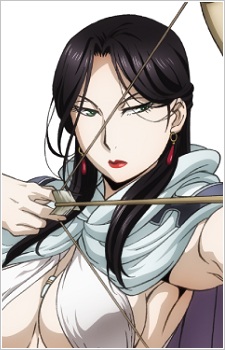
When thinking about Arslan Senki, I tend to think of this show as a mixture of fantasy adventure, war drama, and a story that really emphasizes the journey of a young prince. Arslan Senki (The Heroic Legend of Arslan) is a show that chronicles more than just the making of a hero. It delivers a tale of adventure that should be remembered like a legend. For its themes and storytelling, I can safely say that this show is one hell of a ride. Based loosely on the novels and adapting the plot of the manga written by Yoshiki Tanaka, Arslan Senki is essentially a war story.In a role that requires more than larger than life dimensions, it is epic in an old-fashioned sense. And how does it achieve that? By its sheer ability to show its rich story. The setting takes place in an alternative version of the Middle East. And from the beginning, we learn of a warring conflict that erupts between two factions – Pars and Lusitania. At a young age, we meet Arslan and he witnesses the reality of war; bloodshed, chaos, and death by the Lusitanian forces. The premise also establishes that Daryun, a former high ranking military officer gets acquainted with Arslan. The story then goes on to show the adventures of Arslan, Daryun, and others as they struggle to regain Pars. As with the way the premise sets up, there’s a whole load of potential with its direction. In particular, there’s character growth that really becomes evident for Arslan. In addition, we see character relationships that expands beyond just military acquaintances such as the relationship between Arslan and Daryun. In the beginning though, we must first learn to understand who Arslan is. Thankfully, the pilot episode does just that as we see a young Arslan from the Kingdom of Pars deal with an escaped young kid. Turns out, the kid is a prisoner that escaped and is from the nation of Lusitania. The most important part however is his reasoning for hating slavery. In essence, the show prints an image into the audience’s mind that conflicting ideologies can break out conflicts that leads to bloodshed, war, and death. It’s also clearly evident that Pars and Lusitania have different views on social equality. In particular, religion and slavery become prominent aspects of inspiration for characters’ motivations. I also have to give some praise for the show’s ability to show its reality of war. It isn’t shy to deliver violence when it comes to content. And by doing so, we can see how far some nations can go to get their message across. While essentially showing that Arslan is a naïve young man, he is also known as the prince of Arslan. By holding such title, the people of Pars seems to hold a respect for him. In particular, we meet others that join him and Daryun along the way helps him in his quest to restore Pars. The journey they take involves obstacles while Arslan himself learns about different views of various countries and factions. For Arslan himself, the young man becomes more confident and even seems to be able to influence some others. His relationship with the people traveling with him demonstrates his loyalty and selflessness. In particular, Arslan and Daryun has a dynamic relationship as the two are nearly inseparable. There’s a mutual feeling of respect the two holds for one another and Arslan treats him like a friend rather than a soldier. In his group, Arslan has a diverse range of characters. There’s Narsus who plays the role of a tactical genius as well as Elam who serves him while developing a respect for Arslan himself. Joining them is Farangis, a priestess archer with a cold yet courageous attitude. We also meet Gieve, a traveling musician and curious adventurer with an infatuation towards Farangis. All these characters come from different backgrounds but forms a group to fulfill Arslan’s ambitions. Throughout their journey, we learn more about each of them individually while characterizing their roles to define their finest moments. In retrospect, they also bring out the best of Arslan’s character as he leads them with a solid ambition. One thing that stands out about the writing of the story is that each episode adds more and more to the bigger plot. While there is some pacing issues at times, it never derides from the premise. We see the journey that Arslan undertakes towards Pars while also witnessing the political and wartime affairs that they face. The obstacles Arslan encounters are met with various results almost each time but we always learn something new about their world. While the show isn’t always able to capture the interest of the audience, it does present it in a way that is clever in terms of story development. Along the way, we also meet Silver Mask, a character that serves as the antithesis of Arslan. He is cruel, bloodthirsty, and prideful with an intent to capture the throne of Pars himself. As leader of the Luistania army, there’s a sharp contrast between him and Arslan’s personality. Almost each time he is shown on screen, there’s ruthlessness that is enforced as Silver Mask stops at nothing to achieve his goal. What does this tell about such an antagonist? It means that Arslan has a huge obstacle that he must overcome in order to prove himself as a worthy prince. The world fiction of Arslan Senki is fantastic. Although labeled as a fantasy adventure, there’s little actual fantasy elements that is adapted with the story. It exists though. There are a few instances when magic is presented but the war story elements of the series is what stands out the most. The Kingdom of Arslan is also well structured with impressive architectural design to give off its resourceful feeling. Similarly, Luisitania is a place of prosperity that can easily be seen with their welfare. Later on in the show, we are also introduced to the kingdom of Sindra with interesting aspects of its own alongside its cast of prominent characters. For everything that Arslan Senki does right, there are also some parts that can be forgettable. In particular, the comedy sometimes feels a bit oddly timed. While it’s mostly tolerable, there’s a bit of repetitiveness going on. Some of the supporting characters are also easily forgettable with what they have to offer. Not to mention, a few of them are stereotypical with their ideologies; in particular the antagonists. The romance aspect of the show is also quite stale as Gieve tries to hopelessly win the heart of Faraganis while being rejected every time. Later on, Narsus attracts the attention of a young girl that becomes a bit of an annoyance for him and the audience. Finally, the plot of Arslan Senki may not be for everyone. While I personally enjoy the direction of the story, patience may be tested for some viewers as the pacing isn’t entirely stellar. In addition, Arslan is a character that people may or may not like depending on personal preferences. If you don’t believe me, just ask Silver Mask himself. Unquestionably, there’s a familiarity with the character designs. Anyone who has seen Full Metal Alchemist would know this from first glance as Arslan looks like Edward Elric in terms of physical resemblance. After all, the character designs are based on the Hiromu Arakawa’s version of the manga for its adaptation. In essence, the character designs are fitting for someone like Arslan. He is young with his signature silver hair, compassionate personality, and resilient youth. On the other hand, there’s Daryun who stands out as a warrior with his iron clad-like armor and signature spear. In fact, almost everyone in Arslan’s group stands out in some way whether it’s Narsus’ shoulder-length hair or Faraganis’ fierce nature. While I’m not a big fan of all the character designs, I do believe that Studio Lerche captured the intention of the manga when it comes to artwork. Additionally, we have cruel weapons the historical ages, war elephants, and other instruments of war with a decent degree of realism. Violence is no stranger to this show so expect some uncensored violence and blood to be spilled. However, what I give praise for is that Arslan Senki never goes overboard with its violent nature. It’s just enough. And finally, the action is blockbuster hit that is hard to ignore and qualifies with classic moments. Arslan Senki is also known for its breathtaking soundtrack. The war-like drama orchestra combined with the riveting nature of the show brings out each episode to life. The OP and ED theme songs are also memorable for its ability to tell a story just by its scenario of important scenes. However, the real strength comes from the voice actors and actresses. Each character demonstrates a personality that we can find fitting for their role. Whether it’s Daryun’s undying loyalty or Silver Mask ’s ruthlessness, it’s very believable. Speaking of which, I had some doubts at first with Yuki Kaji playing the role of a main antagonist. However upon seeing Silver Mask’s voice and role on screen, it’s actually quite fitting. Why should you watch Arslan Senki? In the end, it’s up to perspective. If you’re interested in a war story with interesting storytelling, strong characterization, and the journey of a prince, then you’re in for a treat. Each episode expands on the story that keeps the audience wanting for more. Each episode shows us more about the characters that we want to know. And each episode captures the reality of war really is like in their world. Despite some concern with the comedy and pacing of the story, there is a lot of fun watching the show in the end. It’s not just about fighting to win a war but also making a difference for the young prince known to the world as Arslan.
Rikuson1
September 27, 2015
Arslan Senki (TV) アルスラーン戦記 Review Story (7/10) Good More Specifically (7.5/10) The story for Arslan Senki isn't anything amazing but it's not bad what so ever. My expectations for the story weren't really high especially have reading some of Kingdom (sorry low blow yeah I really should even mention Kingdom this is about Arslan Senki...) Anyway like said before the story is good but I did feel the pacing for episodes 17-23 could have been a bit better because I did indeed loose quite a lot of interesting in the semi-slice of life in a army they had going on during those episodes. Which is why Ipersonally can't give this an 8 so a 7.5 will do. Art and Animation (8/10) Very Good The art is very good and the animation (at least for episode 24 that is was amazing) everything else as far as animation was either just good or sub par. It definitely wasn't really consistent when it came to animation and art style it would go from looking good to looking mediocre quite a few art style derps here and there but not on a Toei level. With that being said if the anime actually looked like what those still pictures looked like at the end of the first outro man it would have been amazing. The CG didn't bother me as is wasn't used too much. Sound (10/10) Masterpiece/Outstanding Nothing wrong in the sound department as the Openings and Endings are amazing well chosen for such a series, the voice actors were outstanding (JP VA) and the sound effects on weapons clashing sound real authentic. Characters (8/10) Very Good The characters in Arslan Senki are very good also. With 25 episodes they did a good job fleshing out the cast and making everyone in the protagonist's group feel relevant and that's what you are suppose to do. Obviously Daryun stole the anime the dude is a best and he reminds me so much of Zhao Yun even their names kind of sound alike.. come to think of it Arslan reminds me of Liu Bei and Narsus of Zhuge Liang... hmmm maybe that's why I like them so much because I'm a giant ROTK fan.. anyway if those characters are inspired by those people it doesn't bother be because I loved them all. Enjoyment (8/10) Very Good My enjoyment for this season of Arslan Senki was a roller coaster if I do say so myself. I'm not going to lie I wasn't excited every Sunday to quickly watch this anime because like I said around episodes 17-23 my interest was at an all time low to the point were I had to put it on semi-hold and let episodes pile up, because it just felt like when I watched 1 episode a week (as far as episodes 17-23 are concern) it kind of felt like i wasted my time. But episode 24 was amazing! BUT 17-23 at least to me was the least enjoyable... Overall (8/10) Very Good More Specifically (8.30/10) There are multiple reasons why I chose to watch Arslan Senki when I first heard about an anime adaptation of this series was coming. 1) It's a war series and I apparently like those 2) The manga was drawn but the artist and mangaka of FMA so that stood out 3) The picture and character first shown when announced looked cool to me (yes that counts for something) And just going off of those 3 things alone I wasn't disappointed by Arslan Senki I'm glad I chose this series and the end of this Season definitely left it inconclusive and a lot of openings for a second season. Hopefully it gets one because it deserves one.
m-i-c-h-a-e-l
September 27, 2015
The Heroic Legend of Arslan is an adventurous tale of how a young prince is driven out of his own kingdom, and how he must become a man worthy of leading his people to reclaim his kingdom. The whole series is about war and its stratagem. This show exceeded my expectations in several areas, which is why I felt compelled to write a review. Story: I want to start with the plot since it is what impressed me the most here. It is very rare to come across a historical and non-supernatural war anime that is this good. Each battle scene is carefully planned out. This isone of those series like NGNL or Log Horizon, where strategy is the most interesting thing about the story. But on top of that, there is plenty of revenge, betrayal, and other plot twists that keep the story’s edge sharp. Another thing that impressed me about the plot was how well each episode was planned. There was never a single episode where I felt like I was wasting my time. I’ll admit Arslan Senki has a rather slow story, like most war series. However, this is simply because it takes time to unravel every piece of the plot. The audience is offered several viewpoints from different angles so that no part of the story is overlooked. Even during the parts that are slow, each episode contributes to the plot and/or character development. Characters: The characters are an important aspect to Arslan Senki. The character development of Arslan himself is very pertinent to the story. Prince Arslan is your typical heroic, young male MC: kind, gullible, easy to trick or manipulate, believes all people are good, hesitant to kill another human. The other main characters in Arslan’s fugitive travel party protect, advise, and counsel the Prince on his journey to find more loyal followers. They also teach him how to be a ruler worthy of leading his kingdom, while keeping his ideals intact. Arslan’s relationships with his 5 loyal friends also develop throughout the series. Art & Animation: The most notable point in this anime’s art style is the detail of colorful Persian patterns. I often find my eyes fixated on the pattern of a character’s clothing, a carpet, a wall tapestry, or other patterned things in the background. The color pallet of the artwork for this series fits well to the ancient Persian setting. Okay, as for the animation, there’s one blinding CGI spoof in episode 1. Please don’t judge the whole series. After that one mistake, the CGI is not disruptive anywhere else. Swordplay scenes are well done. Sound & Music: OP 1 and ED 1 are both superbly done. I didn’t care as much for the second set of OP/ED. The soundtrack is a very good fit to the setting and time period. The sound effects for each weapon are all accurate. And the voice acting fits well to the characters and setting too. ----- Arslan Senki has a few flaws here and there, so it really wasn’t perfect. But it is still far above average. I consistently enjoyed watching the show each week throughout the season. If you are interested in watching a good war anime, I definitely recommend this one. Each episode of Arslan Senki was well worth watching the whole way through.
nep-nep
August 11, 2016
Prestigious parents often bear a burden of expectations for their children. Much to the doteful disappointment of the audience however, “The Heroic Legend of Arslan” turns out to be something of a black sheep. Lovechild of original creators Yoshiki Tanaka (LOGH) and Hiromu Arakawa (FMA: B), Arslan shines a bright glow of mediocrity under the shadow of its peers. Arslan bases itself on the manga, which in turn bases itself on the original novel, which at last takes inspiration from a loosely compiled set of Persian tales. If you weren’t already familiar with the term “suspension of disbelief”, then you’ll be quite capable by theend of the 25th episode. The story begins climatically as the “undefeated” king of Pars is defeated by the Lusistinian [European infidel] army after Pars is betrayed. Our titular main character, Arslan, is then thrust into seeking the crown because apparently, inexperience and innocence are signs of excellent leaders. Along the journey, Arslan attracts several companions who force the plot forward, exploiting an array of stupidly overpowered abilities. If this summary sounds somewhat familiar, it’s because you’ve already watched Akatsuki no Yona. As it turns out, “the King returns” is hardly an original plothook. Arslan fails to differentiate itself from this association. Case in point, Arakawa goes as far as to replace Daryun’s sword from the novel with a spear, in a direct parallel to Yona boyfriend #1. The most disappointing thing about Arslan’s story however is not predictable plot structure, but rather the entire journey we take up to the final episode (queue 2nd season). When Arslan encounters problems, solutions are always in stock. Any meaningful consequences the story has to offer are whimsically avoided. The utter lack of tension stems from the fact that characters are never seriously threatened. This is fairly attributable to the abysmal performance of enemy soldiers, who switch on their autistic mode when faced with the slightest manifestation of “enemy planning”. Such mighty power seemingly retains divine superiority above all things, no matter how terrible the planning actually sounds. Antagonists rarely attempt to think of counter tactics, or even provide a contingency plan. There is little semblance of planning beyond the word “charge”, as depicted by the Silver Mask who just cannot resist the opportunity to place himself in the most dangerous position possible, imitating the likes of Bronze LoL players. And even though they constantly outnumber Arslan’s forces, there is never an attempt to use superior numbers to any tactical advantage whatsoever. In simpler terms, they demonstrate a consistently remarkable incompetency. But if tactical engagements become so predictable, then what does Arslan have left to surprise us? Magic, apparently. If you had any more than a sniffle of expectation for rationality left, then you’re oft for a nasty awakening. Slightly more halfway through episode 12, xx_sketchy_pedo_assassin11_xx phases through the ground like a clipping ragdoll, staring menacingly at Daryun’s behind before attacking [torpedoing] him. Just… why? Like many characters, magic exists solely because the writers were too lazy to provide coherent explanations for events in the story, shortcutting the pacing of plot progression. This has the added effect of cheapening out the audience’s expectations. When it is revealed that the only reason Pars even lost in the first episode was because of “magic”, Arslan’s entire premise falls apart. Given how ridiculous most of the non-magical events in the anime already are, there doesn’t seem to be much difference. The prime instigator for the intellectually-triggering planning is Narsus, Arslan’s near-omnipotent advisor. The party constantly relies on Narsus to deal with nearly every possible situation. Need tactical genius? He draws out half-baked bat-shit strategies and maneuvers like they were Yu-Gi-Oh cards. Political know-how? He may have only had court experience for a few years, but he acts the part of a cunning court wife. Family man? Somehow, this guy finds the time halfway through the series to pick up some random hobo broad. Definitely one of the less-human characters. Daryun serves as Narsus’s “Dynasty Warrior”-esque counterpart, rescuing Arslan himself countless times. He goes beyond the physically impossible, as in episode 12 where he blitzes through time and space, bullet-timing several eurocucks in order to save the prince [princess] from xx_sketchy_pedo_assassin11_xx. I took a few moments to laugh at how ridiculous this shit looked when I saw it, but then I realized that they no longer had any intention of making Daryun even vaguely human. Yona at the very least justifies boyfriend #1 by pitting his efforts against attractive dragon boys. The only time Darius even appears to struggle is during his fight against the giant, where Darius appeared to be on the verge of defeat. Or at least, until we learn that he was faking effort all along so he could one-shot his opponent. Again. Gieve and Falangies serve little purpose beyond filling in as niche solutions to problems, what with Gieve… being there, and Geese inflicting Stormtrooper-level aiming at will (not that they would have hit anything anyway). Gieve constantly attempts to woo her in an effort at comedy relief, but their relationship doesn’t get any deeper than the surface. Beyond that, I fail to understand why they even exist in the show. It’s precisely because of the swiss-knife efficiency of his party that Arslan himself undergoes minimal growth all throughout the series. The constant coddling reduces him to the role of “figurehead king”. His first foray into battle actually seems to inspire PTSD in him, as he deals with the horror of slaying a man- Or so you’d think. A few episodes later, he’s back to happily sniping down cavalry. Likewise, he gives minimal thought to his companion’s continuous slaughter of men, instead opting to save his compassion to slaves. In fact, Arslan bases the majority of his motivation for kingship on the abolishment of slavery. In the same manner as post American civil-war, he eventually learns that simply removing slavery does not always make a happy slave- Or so you’d think. Towards the end, he proceeds to announce his intention to eradicate slavery without bothering to plan for an afterwards… But that’s okay since his companions are so terribly OP he never truly needs to learn from his mistakes. This ignorance appears to be something of superior monarchal quality however, since it is the only reasoning his companions provide when asked why they serve Arslan. A truly remarkable display of loyalty. Of special note is Etoile, a fanatical tsundere crusader who’s given a chance to rise above the communal pit of shame. Her kidnaping-adventure with a young Arslan is what first inspires him to reassess Pars’s slavery, later serving as justification for seeking the crown. Their third meeting performs likewise, spurring excellently reasonable motivation in our timid prince. He finally begins to somewhat confidently takes the role of decision-maker; a quality lacking throughout the rest of the series. It seems that out of all the characters in Arslan, Etoile is the only one that doesn’t pamper or take advantage of him. There is an attempt at backstory in the second half, but sadly, it is rushed over quickly and reduced to nonimportance. Although sound design is not a common aspect of discussion, the usage of JoJo-like sound effects in combat is very overt. Scenes depicting heavy impacts are accompanied by a blearing amount of bass. What works in JoJo should, nevertheless, stay in JoJo. It sounds terribly misused in an anime that struggles to convey justification, instead suggesting that it merely exists to sound “cool”. Despite sharing Brotherhood’s character design, Arslan’s general art and animation is a far flung fantasy of a comparison. The opening battle introduces us to a use of CGI that is heavily parodied by modern cinema. An ineffectually zooming camera cuts across a blob-like engagement between two factions of generic, faceless soldiers for an inordinate period of time. This use of clay-soldiers seemingly holds true for any fight that involves large groups. Suffice to say, it is quite ugly. 2D horse animations are frequently terrible, closely mirroring the infamous “quality” horse animation in Spice and Wolf. For a series that sees fit to utilize horses in every single battle, you’d think that they’d have at least put some effort into this regard. Battle choreography is similarly held in lesser regard. Characters often show little understanding of any martial technique that isn’t a left or right slash when using swords. In fact, Gieve in episode eleven parries the same exact L/R pattern THREE times in a row, a brilliant example of what it might be like to fight Kirito’s mook reincarnation. There are of course, two exceptions to this. In the first OP, animator Satoshi Kimura (probably him) makes excellent use of 3D backgrounds in the Daryun vs Silver Mask duel to incorporate a rotating 360 degree shot around the fight, an innovative technique that not nearly enough animators take advantage of. The penultimate episode’s fight (once again featuring Darius and Edgelord) similarly excels. After whiffing his thrust, Daryun gores into a pillar, lodging his blade deeply into the structure. But instead of trying to free his blade, he gouges across the fucking thing into a follow-up horizontal swing. This no-fucks personality painted by animation certainly doesn’t come across when all we see is character mindlessly one-shotting mass produced soldiers for several episodes. In the end, perhaps you could say that this particular heroic legend just wasn’t the kind for me. You could go on to suggest that warfare was never a crucial element to the story, and that perhaps, the emphasis of Arslan should be based on its portrayal of woefully ignorant royalty identifying problems within his Kingdom’s internal practices, and going on both a physical and figurative journey to his maturity. But no matter how deficiently optimistic you choose to put it, Arslan never intended itself to be something great. Instead, Arslan basks quite happily in the rays of averageness, and we contentedly conclude that there really shouldn’t have been much to expect anyway.
Rank
#1517
Popularity
#677
Members
396,337
Favorites
1,783
Episodes
25