Garo: Crimson Moon
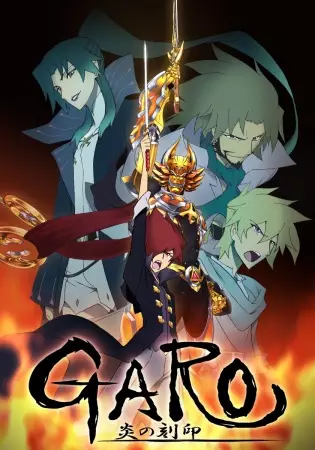
GARO 紅蓮ノ月
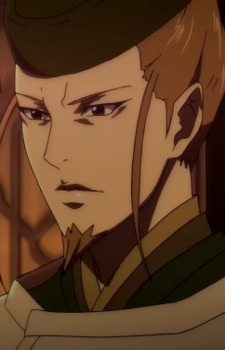
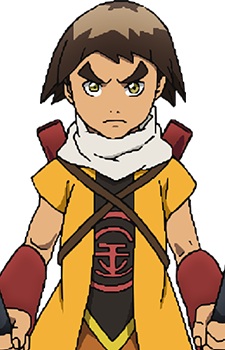
Monsters known as "Horrors" have invaded the world, entering through gates from the Makai Realm of Darkness. These corrupt, demonic creatures have the ability to seize human bodies and feed on their souls. Citizens who are out past sunset will likely never see the sun rise again, but those who live in the capital city have no need to worry—they are protected by a spiritual force field created by the sorcerer group Onmyouji. In possession of legendary armor, the Golden Knight Raikou proclaims that he will protect everyone from the Horrors. Accompanied by his attendant Kintoki and the mysterious Makai Alchemist Seimei, he strives to become a formidable Makai Knight, but Raikou is ill-prepared to handle the side effects of the armor. Disappointed by his own shortcomings, he sets out on a journey of self-discovery to master his weaknesses and prove his worth. [Written by MAL Rewrite]
Main
Main
Main
Main
Supporting
Supporting
Supporting
Supporting
Supporting
Supporting
Supporting
Agil-san
April 10, 2016
This was really a disgrace, I honestly do not want to make a review for this but considering the previous version of Garo made my top 10 anime the season it aired I felt the excessive need to write a review on this horrible alternate version of Garo. This will honestly be a slight comparison of how this anime failed to compared to it's previous version. Garo: Honoo no Kokuin is the first story told, Garo: Guren no Tsuki is an alternate universe with completely different characters with the only similarities being the casual villains and the means of defeating them. Story - 1 The settingis similar to that of the previous Garo an old medieval fantasy type setting where there are monsters called Horrors that manifest from the darkness in a humans heart. There are Makai Knights and Makai Alchemists who have the power to defeat these horros and are heavily relied upon to protect humans from this threat. Our Protagonist is one of the many Makai Knights but the armor he wears is a legendary armor that has been passed down for generations, the Golden Knight Garo. The story follows our lead Raikou, his assistant, and his mentor as they protect the city from various threats. Although the setting and idea of the show is great and almost identically matches the setting of the previous version, this series didn't have a plot until the very last episodes. Over half of the series is focused on "The Horror of the Week" having the Protagonist defeat them time and time again with no real progression. Near the end the anime made a decent attempt at creating a likable story but ruined it completely with asspulls to save characters with no reason. Not only did this not help the show at all but it severely brings the show lower than it was prior. Art - 2 The character designs were actually good, nothing too fancy but there were times in the show when I couldn't see a thing due to the overwhelming darkness. They would attempt to have fights in the dark and you couldn't see a thing other than the subtitles that were provided. If I can't see anything at night how can I enjoy the art let alone the characters or story. Sound - 5 Nothing special, the ED was pretty good to get you pumped up. Too bad the show wasn't just as satisfying Character - 1 Just as painful as the Story the characters have no development. The Protagonist suddenly and randomly gains the ability to control his power but there is no change in how he fights, it felt like it was forced in there to try and show that this character has changed but he doesn't. To nobody's surprise this Protagonist doesn't have a strong personality at all, if everyone wasn't always looking to him to save them he wouldn't even be a worthy side character to mention. Our female lead is the mentor of the Protagonist but as the story progresses she ends up being reduced to a damsel in distress. Everybody knows that this is probably the worst thing you can do to a strong female lead. Only decent character is another Makai Knight who is out for revenge due to the one who killed his brother. Unfortunately he is shoved aside to make room for the horrible main characters and eventually loses his motivation to get revenge. Overall - 1 This show really hurt me man, I only respected it and watched all 24 episodes out of love for its previous version. This anime was a pain to watch and I wish it was never made. They should have took the time to refine the upcoming movie that is a sequel to the previous Garo. Please do not watch this show and if you do, make sure you watch the Previous Garo prior.
Flawfinder
May 15, 2016
You guys remember those Marvel anime from a while back? You don't? Well that's because with maybe the exception of the Wolverine anime, they were so half-assed on the production side of things that nobody could drum up any interest for seeing anime's version of Tony Stark shoot people, and this new iteration of the Garo franchise is pretty much Mappa recreating that dark period back when they were still Madhouse because "anniversary anime" I guess. What exactly is an anniversary anime you may ask? Well it's basically when more of a franchise is created specifically to fulfill an obligatory lifetime achievement rather than becausethe creators genuinely believed there was more of the story they wanted to tell. And generally, they seem to agree with me that such things are ultimately pointless. From those godawful Tenchi Muyo shorts to the soulless Sailor Moon Crystal to those snore-worthy Digimon Adventure Tri films to the new Lupin…okay that one actually looks fine even if the writing was kinda meh…it feels like the writers decided "hey, people like this right? Well let's give them more and then collect our checks". It's sort of the same thing that's been happening with the Assassin's Creed series as of late. To those who pay attention to the franchise, you notice how all the marketing just highlights superficial things like what time period it's in or whether you'll be playing as two characters this time without actually talking about the story or any legitimate changes to the gameplay? Well when Crimson Moon was announced, the creators said it'd have a female protagonist and was going to be set in the Heian period. Oh, and it'd have a completely different team, with the director making one anime no one remembers at this point. Wasn't really much to get hyped for was it? Admittedly, even when they're being bad, Mappa's anime tend to be interesting so I was hoping to get some mileage out of that. But considering almost none of you finished this show, you can guess how that panned out. But let's talk about the actual anime, shall we? Like the advertisements said, it takes place in the Heian period and focuses on a Makai Knight named Raikou and a Makai Alchemist named Seimei as they interact with fictionalized versions of famous historical figures from that period and deal with the antics of a fallen Makai Alchemist named Ashiya Douman. Because the Japanese still somehow think this goddamn storytelling device is really fucking clever, it starts off in medias res when the characters are already familiar with each other and we don't learn who they are later or what the story even is until long after the audience stopped caring. Instead, the show goes for an episodic "monster-of-the-week/darkness-in-humanity" approach to its storytelling, which I don't always prefer, but Mappa's Ushio & Tora did a tolerable (and only tolerable, mind you) job of it by populating those stories with characters who have semi-complicated struggles with their own internal selfishness whilst fleshing out the main characters in-between. Unfortunately, Crimson Moon's episodic characters are worse than the leads, and the leads themselves are kinda lame. Raikou in particular is pretty much a Mary-Sue plot device who's only around so he can put on the armor and carve up monsters with one hit to the point that you might as well as call his Garo uniform "Deus Ex". He does have the problem that Seimei has to control whether or not he puts it on, but that's just an arbitrary restriction and other than that he has about as much charisma as my own unwashed socks if they were worn by an Australian prime minister. Seimei is a little more interesting due to being a runaway from her rich heritage, but characters only shine when their story actually matters to the overarching story, and most of her screen time is just being funny (which in anime terms, means it's not funny) with her purse/sex appeal and favoring Raikou over others. That did actually have potential when she ends up sacrificing a bunch of innocents in order to save him, but the next episode has the dude forgiving her, so so much for that. There's also a thief who dons another Garo outfit because there's always another Garo-wielder isn't there, but he's as important as the kid character who I can't be assed to dwell on, so why should I dwell on him? And I'm not even going to dwell on Douman, because I'm not putting any more effort into looking into his character than the creators did, so you can imagine how I feel for the supporting cast if they're worse than these guys. I'm sure the story looked solid on paper, but solid stuff soaked in sewage water and fed to a threshing machine is just going to be unreadable - and in anime's case, unwatchable. Far from ripping off much better Garo iterations like Makai no Hana or Zero: Black Blood, Crimson Moon rips off from every dark fantasy/historical fiction story ever and tries to do too much at once to the point that it's just bland across the board from its take on humanity's darkness to the Kaguya tale. Which is ironic, because the show is way too fucking long to the point that the creators themselves realized their mistake halfway through production. There's way too much blatant exposition to pad out the runtime and there were several weeks when an episode didn't air at all for no good reason. In fact, the planned 26-episode count was cut down to 23 (24 if you count that one episode of the production team self-congratulating themselves over their work) and the only reason I knew this was the case was because the bad guy died, the characters became all happy with each other, and there was no episode the next two weeks. It didn't even feel like an ending. Raikou took one swing at the guy, he died, the characters mourn over him, and that's pretty much it. Yeah, I wanted it to end there too, but when you don't even realize an anime had finished without looking at the official sites, you know something has gone horribly wrong. And of course, there's the elephant in the room that for a fucking Mappa anime, Crimson Moon's visuals look like absolute ass. I guess some of the background stuff is okay, but the animation looks like it was made by the unemployed siblings of the studio's janitor unit. Even by the standards of that one Ushio & Tora episode with the mongooses that had like two seconds of actual movement, Crimson Moon looks like ass. The character designs are severely outdated, the CG is even more horrendous than Mappa's first go at the franchise, and I don't think the characters even swing their swords when they fight. They just jump at each other followed by a sound effect and suddenly someone's dead. I don't understand how anyone there can possibly think this would be suitable for broadcasting, because the equivalent of this would be a KyoAni anime where the visuals looked like the original version of Kanon and the characters just talked like they're reading a bad middle-school play occasionally broken up by token fights for the entire runtime...oh wait, Munto exists, doesn't it? I could continue listing everything down that failed with me, but the bottom-line is that Crimson Moon was doomed from the moment the creators decided it was going to be a junk food-obligation series rather than something people wanted to make because they had a story to tell. It has its inspired reasonable moments, but that ironically works against it because it just makes the series more middle-of-the-road/forgettable, which is worse than being bad, and it doesn't justify why you shouldn't just watch the other Garo entries instead. At least people are still going to remember Psycho-Pass 2 for having the worst female support character ever along with all the immigrant slaughtering. Crimson Moon should have made the main bad guy a McFarlane-ish racist Asian caricature that is completely out of place in the Heian period if this is the only response its awfulness was going to get.
Tpfang56
April 1, 2016
Ahh, I see there are no reviews for this yet. Yeah, this anime does not have great ratings and it has a pretty low viewership. Well, whatever, I'll pitch in my opinion for what it's worth. Garo: Guren no Tsuki is the sequel to Garo: Honoo no Kokuin except it's not really a direct sequel. It's actually an anthology series, where the characters, plot, setting and everything else are different except for the common mythology revolving around the Makai Knights and Makai Alchemists and most of the seiyuu return for new roles. Watching the first season is not at all necessary to view this one,but it does give a little more depth on the lore. (It's kind of like the live action tv show, American Horror Story.) So. Frankly. Having seen Honoo no Kokuin, it's almost impossible for me to not draw comparisons between the two. I'm also sure most of the people who are curious about this season are probably people who've seen the last season and liked it. Instead of doing a traditional review, I'm going to be doing a compare and contrast with the previous season. --- Garo: Guren no Tsuki (GnT) is pretty much the polar opposite of Honoo no Kokuin (HnK) to me in many different aspects. I thought HnK's main strong point was its plot - decently written, if a little cliche, but overall well executed. I also liked the CGI integration because it blended in almost seamlessly with the art style, and the action scenes were also pretty damn good. On the other hand, I couldn't bring myself to like the characters with one or two notable exceptions, the art style itself (so pointy) did not look attractive to me, Daisuke Namikawa felt miscast as the main character and finally, the setting (medieval fantasy Europe) was too familiar and boring, but maybe that's just me speaking from a Western perspective. Comparatively, GnT has lovable characters that I easily got attached to, beautiful art/animation (not just the art style but color palette, shot compositions, etc), interesting setting (medieval Japan this time), and Daisuke Namikawa was /not/ miscast. I only had two complaints, one small and one big. The big one was that the plot was kind of a huge mess. It's not like HnK, which has an overarching plot that never really lets up. In HnK, with the exception of maybe three or four episodes, every episode contributes to the plot. Contrary to that, GnT is more like a "monster of the week" type show up until the last 1/3rd. The earlier episodes have small bits that set up a plot, but it doesn't come to fruition until episode 16 or so. This may sound weird, but I actually enjoyed the "monster of the week" episodes way more. It wasn't until the actual plot came in that I felt the show got weaker. Yes, look, I really enjoyed spending time with all the characters just bouncing off each other. Their interactions alone and the fantastic fight scenes were enough for this series. But the plot thread just felt... shoehorned in, and more damning than that, it was just not as well written as HnK. It was almost like the writer didn't want there to be a plot, but was pressured to include one as an imitation of HnK's formula. Not to mention, it ends up being pretty similar to the end of HnK's plot but without all the prior set-up. I think I would've easily given this 7/10 if it didn't even bother with a plot; that's how much I liked those early episodes. Even Douman, the series villain (played rather hamtastically by Tomokazu Seki) being more of a nuisance than an actual threat just ended up amusing me because of how unintentionally hilarious he was. My other small complaint was that they didn't do the CGI integration as well. Instead of making it blend in as closely as possible to the original art style, they decided to make it stand out with a sort of grainy texture. It still looks great, but I don't like how it stands out from the rest of the animation. One more thing I wanna bring up is praise for the newbie actor Masei Nakayama who played Raikou, the main character (MY SON). Unlike some other newbie actors (*coughsSatorufromErasedcoughs*), he has shown some incredible potential. I'll be keeping an eye on him from now on. Well, I think that's pretty much all I have to say. TL:DR; Animation/characters/action = good. Plot = bad. Result = slightly better than average, but quite enjoyable up until the plot kicks in. - Overall [5.8/10 rounded up to 6/10] -
Shiniya
July 17, 2021
"Light is always alongside darkness..." My review will probably be one of the most positive ones over here. I still don't get it why most of reviews got so low rating as well as the series itself. I read few of them and to be honest, it looked to me like they weren't even justified. I mean, people with Chuunibyou or School Days in favourites writing review on something they have 0 experience with, i find it rather amusing. Anyway... Story: 10 Story development in what looked like medieval age was well set. First few episodes in, it was kinda random and chaotic but as theanime continued, story basically developed itself. It's basically about people's lust and desires. How everyone can get consumed by those negative feelings. Side by side with demons aspect and superpowers, oldschool-like anime and animation itself made a great combo. Art: 9 Not 10, simply because of lack of the side characters some kind of difference. Almost every side character... like side, side, side character, was almost the same if not same. The features of faces if it wasn't someone really important was awful. Other than that, I like the old style of art and animation as well. If someone like Funimation gave it a go, it pays off to watch almost everytime. Sound: 10 Surprisingly I loved both opening and ending. Alongside with a soundtracks while basically some scene happend, marvelous. Character: 7 Lowest of my ratings on this anime. Hear me out tho. It has something to do with side characters art being same as i mentioned up there but also I was freaking lost in that city or wharever this anime was happening. I have 0 clue whenever some character spoke about something there, I have no idea where they are situated or something. Why am I saying it in "character" rating? Simply because I couldn't match the places with some of the character's story which was somehow annoying. Enjoyment: 10 Of course, 10, easily. The "bad" sides of the anime that I named wasn't that major for me that I couldn't enjoy it to full extension. Would probably rewatch it as well! Overall: 10 Obviously, it's one of the masterpiece-like anime. Don't get me wrong, if you are not used to or not enjoy old looking anime, even tho it's not that old, you better stay away from this because this won't satisfy you, not a bit. But don't forget to have open mind and don't get swallowed by those irellevant negative reviews and make your own opinion AFTER watching it!
BanjoTheBear
June 5, 2017
(This review has been adapted from my blog/reddit thread. Spoilers ahead!) A haiku I title “Moon-Filled Sandwich.” Numerous problems Garo: Guren no Tsuki Abysmal; awfulSTORY Garo: Guren no Tsuki takes place in the (coincidentally enough) Garo universe. Horrors roam the land as Makai Knights and Makai Alchemists protect the people. All the while, lots of battling and grounded interactions occur. And it’s horrible. One of the issues that the anime has is a tonal one. As can be watched, the anime is filled with depravity, death, and destruction. Yet the show regularly injects mistimed comedic relief. When the characters eat some candy or when Seimei acts playful after turning her deceased mother into a Madou Tool, the scenes come off as less funny and more awkward, considering the violence and turmoil and seriousness about them. Nowhere is this swing between dramatic and comedic more obtuse than with episode fifteen. Despite the anime beginning to head towards its final set of episodes, as well as being in the middle of its largest conflict, an entire episode is dedicated to comedy. It follows a lecherous man who cannot stop his promiscuous feelings. His character, Raikou and Kintoki reacting to the situation, and the final, cheesy heart do not mesh with the mood of the anime whatsoever. This second half of the anime also highlights the next major issue: plot structure. The first eleven or so episodes are rather repetitive. An episode starts with a person succumbing to sin (and therefore turning into a Horror), the group dawdles for a while, they visit the Watchdog Center, and then they finally defeat the Horror. While the main antagonists Douma and Douman are around, the anime during this first half does not include an overarching conflict. It’s not until the second half that the anime finally decides to include one. But it comes out of nowhere. No mention of the super-evil Rudra or the blood-red moon or even the main motivations of the evil men come about until it’s too late. Simultaneously, Garo: Guren no Tsuki has an insane amount of odd, often poor, writing choices. For instance, Kaguya is a character introduced in episode four. After she is helped, she goes away – presumably because she no longer has a place in the narrative. But she returns (officially) in episode eighteen, becoming a vital key to the plot. In other words, for fourteen episodes, she was neither important nor relevant. Another example. Michinaga, the leader in the Light Palace, uses a certain book that generates the barrier which protects the palace from outside evil. But this detail was not made known until much later in the season. Many more problems exist. The show keeps its setting within just the capital, inviting stagnation. A lot of the action contains very little actual fighting besides a couple of sword swings. Douma gets killed in approximately two seconds despite his status, power, and involvement. Random happenings, such as characters teleporting (and not teleporting) when they choose and magical powers, make the plot progression convenient rather than natural. The thematic disparity between the poor and the aristocrats receives next to no exploration especially when the same tired idea – that the rich are evil – gets repeated ad nauseam. And the list goes on. Even the ending has issues. Disregarding the fact that Zanga, the Silver Knight, disappears, the anime provides no closure for any of the different relationships, plotlines, and ideas. What the future holds is not known: about Raikou and Seimei, about the capital, and about the Makai Knights in general. Instead, the anime literally ends on “Farewell, Ashiya Douman” and a shot of the sky. To be absolutely fair, the anime does have a couple of interesting moments. Seimei choosing to save Raikou over the people and Raikou becoming incredibly tiny attempt to switch up the show’s tiring tale. But a couple of intriguing scenes interspersed throughout twenty-three episodes worth of narrative problems does not equate to a worthwhile story whatsoever. ANIMATION Garo: Guren no Tsuki’s art and animation are arguably the anime’s worst traits. Due to the centralized location, the background depictions are sorely lacking in terms of creativity. The same roads, wooden houses, and caves induce boredom through their gross repetition and missing detail. Lighting, despite the anime’s motif of light versus dark, does not impress. And misaligned faces make the show difficult to stomach. Worse still are obvious artistic errors. Disappearing cloths and reappearing hats demonstrate clearly that the anime received very little attention on a visual level. Animation levels are low throughout most of its run. Choreography for the fights tends to be nonexistent, and downtime is filled with missing frames and stiff actions, leading to characters that move in silly, weird, or broken ways. The character designs continue having trouble. For some of them, the lines that constitute the borders of their characteristics appear crooked. Douma’s beard and Raikou’s hair are the best examples. Raikou’s design is particularly lame. His weedy hair, plain face, and boring outfit turn him into more of a joke and less of a main protagonist. Yasusuke looks like a hunter instead of a thief. And Douman’s blue-and-grey-centric coloring may be fitting for his evilness, but the drabness makes his design boring – and, no, his different-colored eyes and facial scars do not make him cooler. To be as fair as possible once again, the anime is not entirely problematic when it comes to its art and animation. The arena where some of the fights take place gives the show the chance to play with interesting effects, such as shiny, floating debris and different color palettes. The CG segments, specifically in relation to the Gold and Silver Makai Knights, show a surprising amount of fluidity. The final fight, with the first-person-enemy perspective, was nice to see. And Seimei’s design – long hair, mostly purple outfit, and attractive figure – and the Silver Knight design – with its embroidery and all-white coloring – do not fall prey to the same problems that the other designs notably have. Even so, the negatives far outweigh these miniscule positives. CHARACTERS Perhaps it’s obvious at this point, but the cast of Garo: Guren no Tsuki are filled with so many writing problems that it is astounding they were even conceived in the first place. Starting with the main protagonist, Raikou is the fabled holder of the Golden Armor, permitting him the honor of becoming the Golden Makai Knight. But he is not allowed to use it all will-nilly. Seimei, the woman who watches over him, only grants him temporary usage of the armor when she unlocks the seal. It’s all done with the best of intentions, for, after wearing the armor for too long, Raikou becomes visibly shaken and weak. Early on, the anime sets up Raikou’s character in a two-fold manner. On the one side, his past is filled with death and turmoil, forcing him to not have much of a past at all. On the other side, his emotions, his disregard for his own self, prevents him from fully controlling the golden armor. It’s why Seimei keeps tabs on him; he has yet to prove his worthiness. But true to the anime’s form, his character plummets. Coincidentally enough, it’s due to two separate issues. The first is asinine. In episode eight, the anime throws Raikou’s entire background at the audience. Who his father is, the brother he didn’t know he had, and so on. Yet Raikou was not surprised in the least bit by the revelation. Yes, Raikou literally says he already knew all of this information, making his past-self conflict moot. The second is simply an unforeseen consequence. At the halfway point of the season, Raikou overcomes his emotional instability when he realizes that Seimei’s protection of him has been a sacrifice of herself. He matures slightly, and, as a result, he finally commands the golden armor without her aid. While this development is one of the first actual competent pieces of writing, there’s a problem: It occurred too soon. In essence, Raikou’s character peaks. Without any other conflicts for him to face, his character does not have anything else to do but simply be around. Indeed, for the last half of the season, he takes part in the various happenings, fights the baddies, and interacts with the other cast members. But his character completely stagnates. Many of the other characters are simply handled poorly. Yorinobu, Raikou’s (later learned) brother, seems as though he will have more importance in the overall story. But beyond crushing on Seimei somewhat, getting a quasi-girlfriend, and worrying about Raikou occasionally, he does not contribute much. To be fair, his main role is acting as a good guy within the bad guys’ camp, but other characters, such as Seimei’s father and Yasusuke, fill that role, too. Speaking of Yasusuke, he suffers the same fate. Despite obtaining the silver armor of the Silver Makai Knight, he does not influence the direction the anime takes. On more of a writing level, the show fails to make his relationship with Raikou more meaningful, and the whole “skip out on training and get right to being a Makai Knight” decision is unbelievable. Even more baffling is Kintoki, Raikou’s child assistant. Kintoki is around for the entire season, yet, besides a passing aside about him being a child still due to a curse, the anime gives next to zero background on his character let alone development for him as a person. And while it may not even need to be said, the main antagonists are awful. Two of them exist: Douman and Michinaga. Douman is the more important of the two. He has his hand in nearly every evil event, doing his best to bring about darkness. This word, “darkness,” is practically the only word in his lexicon. He says it in nearly every other line, turning his dialogue into a repetitive mess. The rest of his character does not fare any better. For the longest time, his tiresome yelling about darkness is all he has. Later on, however, the audience learns that Douman’s brother is actually Michinaga. Douman, apparently caused by familial and class conflicts, was abandoned, his face cut up. Perhaps expectantly, the anime fails to expound on his relationship with Michinaga beyond the singular conversation they hold, making the quick look into his background pointless. His conclusion makes it obvious just how lame his character is. The show tries to push the notion that, because he did not truly meld with the evilest Horror Rudra, he still has some light within him. I.e., he is still good. But it’s a feeble, ridiculous attempt at humanizing his character. Not just because it literally happens in the final few moments of the anime but also because he next to never showed any signs of goodness. His vocabulary made sure of that. Michinaga is the other main antagonist, but, honestly, it would be unfair to give him that much credit. The reason? He does nothing. He sits in the Light Palace for nearly the entire season, conniving to make his place of power safe for himself and himself alone. That’s it. For twenty-three episodes, he sits around. The kicker, though, is that when an opportunity to finally make him a relevant character – when the townsfolk are clamoring to get into the Light Palace due to the destruction wrought by Rudra – he disappears. Worse still, the anime apparently forgets about him entirely since the anime does not revisit or explain where he ran off to. It’s astoundingly asinine. The only possible positive throughout the entire cast is Seimei. Seimei’s first impression is one of beauty, yet she frequently approaches life with a carefree attitude. She is good at being a Makai Alchemist. She knows it, and everyone else knows it, too. And so the first half of the season has her mainly as a side character, teasing and supporting Raikou indefinitely. Simultaneously, the audience learns more about her past. She was the one to save and raise Raikou. Her parents sacrificed themselves for her (rather unnecessarily), causing her to leave home of her own free will. And, at that time, she took Douma (Douman’s current teacher) as her mentor. Her compassionate and dark past persists to the present. When Raikou is consumed by darkness, she takes it from him, burdening herself with the evil that plagued him. And when given the choice between saving the people and saving Raikou (again), she chooses Raikou, demonstrating where her heart and mind truly lie. Seimei is set up well, but the follow-up falls apart. Raikou, in turn, comes to Seimei’s aid – only to have her walk away from the group. Then, for several episodes in a row, she does not appear, taking her out of the spotlight and subsequently harming any type of build-up she had accrued thus far. When she does return, her roaming around, attacking her grandfather, and losing to Douma each come off as silly. Interestingly, Seimei does succumb to the darkness. Although her constant appearing, spouting a few words, and then running away, only to repeat the process again the next time, continues the silliness. The show tries to tie in her hatred of butterflies by making her evil persona use them, but her being evil and hating butterflies does not exactly correlate. Regardless, her character arc concludes when Raikou enters her mind (through her grandfather’s magic), saving her from herself. This contrast fits well with her light versus dark motif, which in turn coincides with the anime’s, ending her character on a surprisingly passable note. As a whole, though, one barely passable character out of the whole cast is simply not enough. SOUND Without a doubt, Garo: Guren no Tsuki’s strongest facet is its music and other sound-work. The first opening track adopts more of a Spanish vibe with its acoustic guitar and castanets. The vocalist, the leveled beat, and the background singers come together to create an interesting track. It doesn’t exactly fit the show – the setting and the tone are a testament to this statement – but it’s still a nice piece nonetheless. The second OP is much more grandiose. The range of the vocalists, the different paces, and the emotional instrumental compositions feel as though they match the destructive and intense scale of the anime better than its previous counterpart. It’s neither catchy nor overly impressive, but, once again, it’s a nice addition to the show. The first ending track is easily the best part of the entire anime. The cultural instruments. The background choir. The build-up in the first half that leads to the resounding relief in the second half. Combined with the catchiness and the strong vocal work, it stands above anything else that the anime has to offer. The second ED starts off strong – the metal guitar and shamisen bring about a cool mixture. But the rest of the track lacks the same finesse and power that the first ED does. At the minimum, the vocal work continues to impress even if the majority of the piece does not. As for the rest of the original soundtrack, it does have tracks reminiscent of the previous series, such as a laidback guitar for the more laidback moments and creepy, ambient tracks for the Horror-related conflicts. But nothing too memorable. In fact, the tracks can sometimes play at awkward times, especially when the jarring comedic scenes appear. Last but not least, the voice-acting performances. The metallic sound-effect for the armor was still a nice touch for the series, but no noteworthy performances were had. ENJOYMENT While watching this one, I couldn’t believe how the whole package could get any worse, but it continually proved me wrong. The characters were unlikable. Raikou barely showed any emotion, Kintoki was annoying, and Douman was lame. The action sequences were boring to watch since the Horrors never made for compelling enemies. The rough visuals had me grimacing. Other parts I couldn’t help but laugh at. Certain events or directions the anime either took or didn’t take were just plain silly. Seimei’s grandfather’s body floating into the sky made me chuckle. As did Yosusuke’s girlfriend’s Horror persona chucking sheets of cloth. All of this says nothing about the inane plot, the feeble attempts at sexual content, and the weird way in which the show depicted kid Raikou. Altogether, the anime is one of the worst I have ever seen to date. Garo: Guren no Tsuki fails at nearly every single turn. The story has no coherency. Each character lacks meaningful purpose. And the art and animation leave much to be desired. Some of the music has strength but not enough to carry the show anywhere. One would rather consume a half-eaten, moist, and moldy sandwich than whatever this anime ended up being. SUMMARY Story: Terrible, tonal issues, ridiculous plot developments, and numerous narrative pitfalls create a mess of a tale Animation: Terrible, weak artistic direction, obvious artistic errors, low levels of actual animation, and lame character designs outweigh any potential visual positives Characters: Terrible, while Seimei may be passable, Raikou, Douma, and the other important characters are clearly not Sound: Fine, okay first OP, okay second OP, good first ED, okay second ED, okay OST, and okay VA performances Enjoyment: Terrible, nothing of value to be found within Final Score: 1/10
Rank
#11128
Popularity
#4430
Members
32,807
Favorites
26
Episodes
23