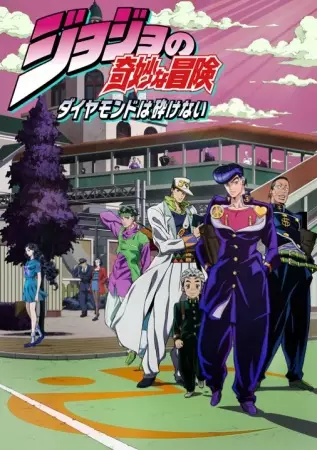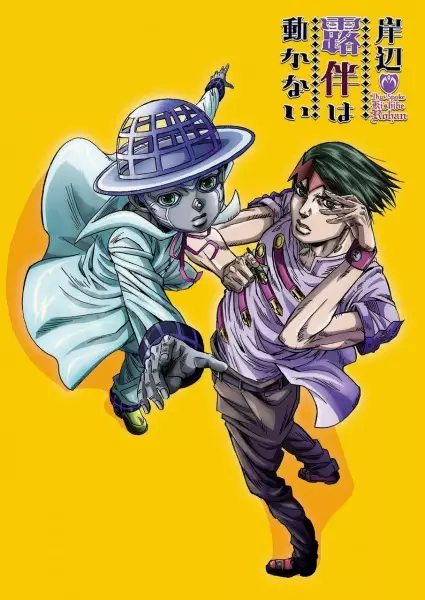

JoJo's Bizarre Adventure: Diamond Is Unbreakable
ジョジョの奇妙な冒険 ダイヤモンドは砕けない
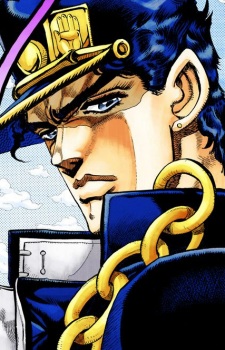
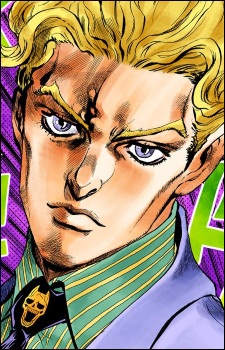
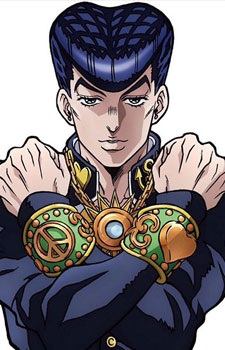
The year is 1999. Morioh, a normally quiet and peaceful town, has recently become a hotbed of strange activity. Joutarou Kuujou, now a marine biologist, heads to the mysterious town to meet Jousuke Higashikata. While the two may seem like strangers at first, Jousuke is actually the illegitimate child of Joutarou's grandfather, Joseph Joestar. When they meet, Joutarou realizes that he may have more in common with Jousuke than just a blood relation. Along with the mild-mannered Kouichi Hirose and the boisterous Okuyasu Nijimura, the group dedicates themselves to investigating recent disappearances and other suspicious occurrences within Morioh. Aided by the power of Stands, the four men will encounter danger at every street corner, as it is up to them to unravel the town's secrets, before another occurs. [Written by MAL Rewrite]
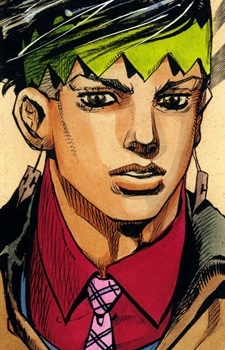
Main
Main
Main
Main
Main
Main
Supporting
Supporting
Supporting
Supporting
Supporting
UnraisedSwine7
July 5, 2021
I absolutely adore part 5 of Jojo, I wish I could inject it on my veins. If it were a drug, I would be addicted beyond repair. Part 5 begins with the protagonist, Giorno Giovanna (GioGio haha clever pun), walking through the streets of some Italian city. At first, this scene serves only to portray the degenerate state of Italy in relation with drugs and how they influence the youth. However, it also shows an important aspect of Giorno: his powerlessness and insatisfaction with the situation even if he himself is a criminal who aspires to be a Gangstar (another clever pun with the Joestar's namehaha so funny). He soon meets Hirose Koichi (a character from the worst part of Jojo, part 4 GOD I HATE PART 4) and proceeds to scam him by steali I will not proceed with this review, this is too boring. Watch Part 5. 10/10
SynthwaveCrusade
January 1, 2020
Supporting
JoJo no Kimyou na Bouken Part 4: Diamond wa Kudakenai, the 4th part of Hirohiko Araki's iconic manga series. After the most iconic manga series of all-time, stardust crusaders, what can you do? Well, you make the greatest bit of media to even scrape the heavens. [story-10/10] Jojo part 4 takes us to the sleepy town of Morioh Japan, we follow part 3's protagonist Jotaro Kujo, Jotaro is looking for Josuke Higashikata, son of Joseph Joestar, of course Jotaro is here to talk about splitting the cash when Joseph dies, and also here on official business about a murder and the stand arrows, Jotaro meets Josuke andthus our journey starts. Now to be fair part 4 starts slow, really slow, the first 15 so episodes are dedicated to exploring Morioh and expanding the cast of characters while building up to the main event with episode 17, Rohan Kishibe's Adventure and the introduction to Kira Yoshikage and Sugimoto Reimi, everything after episode 17 is what I consider the greatest piece of television, I absolutely love this part of the story and especially the Bites The Dust arc, JoJo part 4 has the hands down best story of any Jojo part. [Art-7-10] Why a seven? Well in the manga, Araki's art is flawless and is some of the greatest in the series to date, part 4 also marks a shift in Araki's manly art style of parts 1-3 to the more effeminate designs of part 5 and onwards, However, part 4's anime has some of the sloppiest animation and many character don't stay on model, this can be seen in the infamous Shinobu Kawajiri and Kosaku (Kira Yoshikage) Kawajiri scene, also Kira's model is often times off, there are also many issues with the animation, but this is made up for in the anime with the amazing still character shots that look absolutely beautiful, although there are many flaws they can be overlooked, also sometimes the animation has moments of sakuga, albeit the animation can also be very janky. [sound-8/10] The Ost is AMAZING. The best JoJo Ost to date, it has some of my favourite sound tracks, such as the incredible theme of Kira Yoshikage, which blended with the visuals is thematically fitting for kira and also a greatly composed piece, The openings are incredible, "Crazy Noisy Bizarre Town", "Chase" and "Great Days" are some of the best anime openings to date, there packed with subtle foreshadowing, metaphors and references, the ending "I want you" by savage garden, classic Australian pop/rock band and one of my favourite songs of all time. The VA work was incredible, the Voices of Jotaro Kujo (Daisuke Ona) and Josuke Higahsikata (Yuuki Ona) were phenomenal, of course I loved the voices of Kira (Morikawa Toshiyuki) and Kishibe Rohan (Takahiro Sakurai) as well as others. [Characters-10/10] easily my favourite in the entire series, seeing fresh faces such as Josuke, Okuyasu and Koichi was nice while also adding onto our veteran cast such as Jotaro and Joseph, seeing Josephs transition from street smart punk, to battle hardened veteran and eventually to loving caring grandfather and father, its bittersweet seeing his progression as a character, Jotaro turns from a brash and rude teenager, to a mentor and father figure. The new characters are great Josuke is the love child to Joseph and Tomoko, he's brash, quick witted, but passionate and kind hearted, he is one of the best Jojo's in the series, Second best JoBro Okuyasu Nijimura, is fun, loveable and dumb as shit, like Josuke, he acts more on Passion then Witt, and its also fun seeing him solve problems using brawn over intellect, of course the rest of the supporting cast is great, characters such as Rohan Kishibe, Koichi Hirose and especially Kira Yoshikage, Kira's desire to live his peaceful life is a breathe of fresh air compared to the world changing ideologies of Dio and Kars, Kira wants to live life doing what he loves as he pleases, his ideology of "why be first when you could be second?" is so contradictory to humans and is so interesting to me, everything about him is normal, until you count in the fact that he's a vicious serial killer who kills women for there hands using his stand "KILLER QUEEN", and during his time as Kosuku, I even sympathised with him, as Araki humanises him. Characters were fantastic. [Stand Powers-10/10] part 4 has some great stands "Killer Queen Bites The Dust" made one of the greatest arcs in Shonen anime history, 'Crazy Diamonds" is simple yet brilliant, I could list all of the phenomenal stands from this part (Echoes, Enigma, The hand, Star Platinum, Heavens Door etc), but if there's one thing unique about the stands of part 4, its the shift from tarot cards to the new way of naming stands, iconic 80's rock bands, albums and songs. Some of the best stands and some fo the most creative ideas in JoJo. [Enjoyment-10/10] Part 4 is fun as fuck! It's funny, action packed and most of all, engaging, I was never bored once, it keeps on the edge of your seat from start to finish. [overall-10/10] an essential viewing for any JoJo fan and a great introduction for new comers, it has mainstream ideas that anyone can enjoy while having enough to provide high end anime enthusiasts or Elitists with enough to dig their teeth into.
AshitaNoJonas
December 23, 2016
David Production was hardly a household name in the otaku community a few years ago. However, everything changed when the fire nation attacked...I mean when they released their JoJo's Bizarre Adventure adaptation in 2012! While the budget was pretty low, David Production blew the community away with their attention to detail and loyalty to the source material and JoJo's Bizarre Adventure Part 4: Diamond is Unbreakable is no exception to this. JoJo Part 4 tells the story of Josuke Higashikata, Josephs's illegitimate son. In Josuke's home town Morioh someone used a magical bow and arrow to transform normal people into Stand users. This time we getto know a little bit more about the origin of the Stand abilities, which has something to do with these arrows. Of course, Josuke and his friends have to stop them. Most of the time the crew encounters random enemies, but later they try to find out the identity of a certain someone with an especially dangerous Stand who is living in Morioh, who is the main focus of the second half of this story arc. This person is committing gruesome murders for several years but was never caught, so it's up to JoJo and his pals to stop him. The reason why this plot works so much better than Part 3's, is because it feels much more natural. In Stardust Crusader, the plot felt very video game-ish, but in Part 4 fighting Stand users is more of a daily routine and not part of a journey to save the world. Araki successfully mixed Part 3's semi-episodic structure with some slice-of-life elements. Since they never leave their hometown, there is also a lot of attention to the city Morioh itself, almost like the city is it's own character. I wouldn't go so far as call it "world building", but all these little things about Morioh plus the recurring places definitely give this arc its own flavor and identity compared to the rest of JJBA. Most enemies they fight turn into friends later on or are at least somewhat relevant to the plot later. This causes the team of allies to be very large, almost twice the size of Part 3's. However the last third of the show has very similar issues as Stardust Crusaders (too much obvious monster of the week) and some episodes are more exciting than others, but in the end, Part 4 feels much more tightly written than it's predecessor. Most of the characters are interesting and their interactions are super entertaining. Of the 4 JoJos that are introduced at this point, Part 4's main character Josuke is probably the best. He is introduced as a polite delinquent, but he gets series when it comes to his hair: when someone insults it, they're getting their ass kicked! This is pretty much Josuke's thing. There is even a little flashback about why he is so sensitive about his hair in the first place. He doesn't use it as much as Joseph and Jotaro though and his tick is pretty much dropped later on and his flashback never received any further explanation, but it was still a nice touch. The main villain of Part 4, Yoshikage Kira, is also great. He is not as "EPIC" as Dio, but he is very memorable in his own way. Unlike Dio, who was more of a cartoon villain (wants to take over the world etc) Kira just wants to commit murders without being disturbed by other people. He doesn't want world domination or anything like that, just a quiet and peaceful life. Unlike Dio or Kars, Kira feels like a person who could actually exist in real life, which makes him legitimately scary. The final battle against him was a little messy and the way he died was pretty anti-climatic, but I guess that made sense in this context and setting, since Kira is a more of a realistic villain. The fight was still exciting nonetheless and the way they used their Stands was pretty creative. As you would expect from JoJo, the fights are awesome. The Stands are much more creative than in the previous story arc and they are used in very creative ways. You can really tell how much Araki improved the fighting mechanic in this arc. This is probably the most bizarre aspect of Part 4: melting bodies together, turning people into books or trapping people in a time loop; these are just a few examples of the crazy abilities. There were even new types of Stands introduced: automatic Stands and Stands that evolve into a more powerful form over time. Sadly DiU is much less "GAR" and manly that the previous parts. The characters are also not nearly as buff anymore. This was around the time when the mangaka started to change up his art style. David Production chose to make the whole arc look more like the second half the DiU manga, instead of having this (admittedly awkward) transition from bulky to skinny. Similar to the earlier seasons of JoJo, the animation looks very low-budget at times. However, David Production makes up for that with a unique art style, great use of color and lots of crazy effects. In the end, it's a very nice-looking anime, despite some derpy faces and low-quality character models here and there (they'll be probably fixing these things until the Bluy-Ray release anyway). In conclusion, Part 4 has all the bizarre action, manly tears and likable characters that you would expect from this series and it even improves quite a bit on some of the flaws in Stardust Crusaders. Final rating: Characters: 9/10 Story: 7/10 General production value: 7,5/10 Enjoyment: 10/10 Overall: 9/10
Stark700
December 23, 2016
To anime and manga fans, Jojo is a classic that many may have heard of. Even if you’re not familiar with the franchise, you’ll bound to hear something related to Jojo somewhere whether it’d be a joke, meme, or reference. Diamond is Unbreakable chronicles the fourth expansion of the franchise and it’s among one of the most celebrated. As a personal favorite, Diamond is Unbreakable sets up for an adventure that is far more than bizarre. As the four story arc in the Jojo franchise, Diamond is Unbreakable unites a lot of similar themes from the previous series. These would include the unorthodox style of theadventures, the colorful character cast, the creative Stands that characters uses, and most importantly, its bizarre yet infectious humor. The first few episodes reintroduces a character we should already be familiar with, Jotaro Kujo. He travels to the town of Morioh and encounters a young man named Josuke Higashikata, the latest in line of the Jojo family tree. As a youthful man sporting an unusual hairstyle, Josuke is your typical teenager with a kind heart. Even his Stand (Crazy Diamond) represents his personality as it’s able to heal and repair injuries. So in essence, don’t be surprised if you see him helping out some stranger out of kindness. In many ways, he is similar to Jotaro despite their age gap. Furthermore, Josuke is a guy that I think most of us can relate to. He likes to hang out with friends at school while always eager to make more, is often curious about unusual events, and is incredibly protective of his family and friends. For most part, I think Josuke is a character that many of us will like quickly. But of course, Josuke isn’t just the main star of the show. His friends Koichi and Okuyasu also gets involved in the strange bizarre occurrences as their lives changes forever. They discover the existence of Stands as the show sets up for the many storytelling about them and their users. In some ways, the show is similar to the previous installment. However, one of the main difference is that the show takes place mostly in Morioh as opposed to a world journey. With that being said, the series does a decent job at crafting the town with its many features. These ranges from Josuke’s home, school, and the places he enjoy visiting. Then, there’s also other places that strange occurrences happen thanks to one of Dio’s lackeys and his supernatural Bow and Arrow. The storytelling of Diamond is Unbreakable follows many arcs that each feature a different antagonist, their Stand, and the problem they cause. It has a pseudo slice of life feel as most of these arcs are nonlinear in terms of plot. However, these arcs are important to develop the character cast. A prominent example would be Koichi as his Stand (Echoes) undergoes an evolution of change. It presents his development as a character from a timid kid to a courageous hero during his various confrontation with other Stand users. Okuyasu is also an example as a character that originally started out as an enemy of Josuke but changes into his best friend as the story progressed. Representing a more delinquent’s side of the character cast, Okuyasu’s personality changes as he takes devious risks to protect his friends and understanding them. Finally, I think a special mention should be given to Rohan Kishibe, a manga artist who serves more as a foil to Josuke. With his talent and abilities (including his Stand), he casts a narcissistic vibe with stubbornness. In essence, he’s the type of that guy that is hard to make friends with and throughout the show, we can see his growing rivalry with Josuke. To get the full enjoyment out of Diamond is Unbreakable, it’s best to watch the previous series and get familiar with the Jojo universe. Part four introduces many new characters, some recurring while others are part of the ‘monster of the week’ structure. Noticeable characters such as Yukako, Mikitaka, etc will be more memorable while other may not be. Unfortunately for fans of Joseph Joestar, you’ll probably be disappointed by his role for part 4 as his presence and significance is reduced to be only involved in minor story arcs. However, have no fear as part 4 also introduces one of most interesting antagonists in the entire Jojo franchise, Yoshikage Kira. As a serial killer and hand fetishist with an obsessive-compulsive disorder, you’ll recognize that his role transform the story into a darker thriller. His appearance in the show adds a unique flavor that creates an aura of psychology. It’s a contrast to the bizarre humor of the series, something that has existed since the beginning of part 4. By balancing the humor and darker elements, Diamond is Unbreakable brings out the best of its storytelling with its characters. As a manga reader, I am generally satisfied with the faithfulness of the adaptation. Only a few arcs are rushed while most of the story flows consistent with the source. I’m also impressed by how the adaptation captured the expressions of the facial reactions as it’s not always easy. Kudos to David Production for making a good promise to deliver the best it can be. In the meantime, fans will also probably notice a change in the art style of this season. The backgrounds has a much radiant style with multilayer colors. Moriah town also deceptively look simple yet many complex events develop as the story unfolds. Most impressively are the character and Stand designs. Each character looks unique ranging from Josuke’s infamous hairstyle to Kira’s trademark Killer Queen Stand. The evolution of Jojo’s soundtrack still retains its depth and presence with its theme songs. “Crazy Bizarre Town” represents exactly how bizarre the show can be while the ED theme surprisingly has a more melancholic tone. However, what impresses me most is the overall directing of the soundtrack with its battle scenarios. Iwanami Yoshikazu’s talents are recognized easily as he is able to work around between balancing the slice of life moments and the intense fight scenes. Furthermore, character voice mannerism is credible to their characters. Kira’s voice tone is perhaps the most memorable for his egocentric personality and sadism while others like Koichi will be recognized for their courage and loyalty. So what should fans look forward to most from Diamond is Unbreakable in the end? To be honest, it’s very simple. A show like this will be best enjoyed as a bizarre entertainment with what it presents. It’s essentially a series that takes creativity to extraordinary levels. Every story arc delivers some sort of unusual conflict to bring the bizarreness true to its form. The fights are crafted with creativity that rather than relying on strategy can be enjoyed with sheer entertainment value. And that really is what Jojo is about. It’s bizarre entertainment at its finest.
ZephSilver
December 23, 2016
Morioh, an insignificant town that sits out in the sun for anyone to visit and the new home for the never-ending battle carried out by one family. Somewhere in this scrambled slice of suburbia, we're introduced to the latest member of the Joestar lineage, as we encroach on what would be one of many fights to come. A new enemy Stand makes its entrance; veins protruding through swollen biceps; wrinkled brow plaster the expression of a robust figure; eyes fixated on the opposition; pompadour takes aim, a tangerine sky hanging above; onomatopoeias floods the screen—BAM! MENACING! RUMBLE!—with wall-to-wall color dancing around on the border of psychedeliaand pop art. Head titled, shoulders rolled back, chest puffed out; an epic pose is struck. A feeble old geezer hunched over in the background, hands clasping his cheek, lets out a compulsory "Oh my Gawd!" in Engrish. A powerful aura exudes from the frame of the young Joestar. A muscle-bound, apparition clad in lavender emerges from within him, as he lets out a herculean roar: "CRAZY DIAMOND!!!"..., Gritted teeth, fist wound up, body arched back—fades to black..., trumpets blare, cue intro, welcome to Jojo's Bizarre Adventure Part 4: Diamond is Unbreakable! Since 2012, JoJo's Bizarre Adventure has been spearheading a campaign to bring GAR and all things manly back to the limelight; introducing newcomers to an anime staple that's been underrepresented in the 2000s, while also shamelessly serving as a form of fanservice for veteran viewers who self-indulge in all things retro. For those people that miss the blockbuster era of beefy action heroes that were deep-rooted in the product of 80s Americana. With a dedicated following that only grows bigger year after year, Jojo's crusade for "manly ass men doing manly ass things" has proven to be a successful one. A fact that's made all the more surprising when accounting for the current cultural shift in anime that favors infectiously cute shows or those garishly showered in 2edgy4u content. Jojo stands firm, pressing forward to the beat of its own drum while giving sensitivity the middle finger as it flexes its biceps in the name of awesome. But perhaps the strongest aspect of Jojo isn't this flippant disregard towards popular trends, but the way it goes about expressing itself within it. There are a few cardinal rules that most writers try their best to abide by, one of which is maintaining some semblance of plausibility within the realm of the written work being presented. Whether the story in question is grounded in reality or contains plenty of fantastical elements, maintaining some level of plausible "cause and effect" is what helps the audience experience immersion. Even in a fictional universe that contains many otherworldly themes, there are still constants that are expected to be maintained. In the same way, the theoretical law in our universe remains consistent no matter the time or location; the same is also expected with works of fiction. Anything that doesn't uphold established in-world laws tends to be perceived as poorly constructed or just outright "bad writing." We may not always identify it up front, but somewhere in our subconscious, the "bullshit" meter is going off. And yet, even with this unspoken rule in mind, there are some stories that purposefully leave common sense at the front door. They're shows that are propelled by nonsensical conclusions, improbable physics, and pure absurdity. But somehow, despite this, or perhaps because of it, they have been adored the world over. Jojo's Bizarre Adventure is that kind of show. A show driven forward by madness, adrenaline, and a gratuitous amount of machismo. It embraces the "Bizarre" in its namesake to the utmost extent, doing whatever it pleases with total conviction and never looking back at the body count trailing behind it. And like the hyperactive installments before it, Part 4 continues to keep the ball rolling, following the lineage of the Joestar family and all the inherent problems that come with the blood-line. This brings us to the next Joestar tasked with carrying on the legacy, the ever-fabulous Jousuke Higashikata; a man of few words, unless the words addressed to him are insults directed at his ultra sleek Greece Lightening hairdo. Unlike the hard-boiled demeanor of Joutarou, Jousuke actions are driven by hot-tempered impulses, choosing to punch first and ask questions later. He wears his heart on his sleeve, an attribute that would usually be perceived as weak in the testosterone-filled world of Jojo, except for the fact that Jousuke kicks all kinds of ass with his Stand, Crazy Diamond. A Stand that grants him the ability to restore any damage inflicted to something back to its original state or alter it to its base elements. Pairing that with his hair-trigger personality makes for a formidable combo, something that many enemy Stands find out the hard way. As the aftermath surrounding Dio Brando begins to settle down, remnants of his misdeeds are still spreading when the Bow and Arrow—the weapon used to create Stands—ends up in the wrong hands. Because of this, Joutarou finds himself traveling to the town of Moriah where his illegitimate nephew Jousuke calls home. And as the Joestars team up to rid the town of Stand users hellbent on causing harm to the citizens, they find themselves encountering greater threats along the way. With a narrative that solely exists to have as many physical encounters as possible, Part 4 manages the impossible task of circumventing the trappings of episodic content while using that exact structure to create bottle episodes filled with high-octane battles. Whether it's pounding the snot out of an enemy Stand or simply going to a restaurant to eat, Part 4 is continuously pressing down on the gas peddle. For those that don't like stagnation, this sequel is a Godsend. There's no calm moment of clarity to reflect on the situation at hand, all that's left on display is brittle logical leaps followed up by gonzo wall-texts flying in with a flurry of saturated color. It's vivid, it's spastic, it's a mural hacked up on PCP. And while this commitment to never slowing down may seem like a detriment for any other show, for Jojo—a show that's as straightforward as the content being displayed—there couldn't have been a better marriage of purposeful storytelling. Jojo's brilliance is in its simplicity. It isn't a show that's out to have an intricate story-line filled with multifaceted themes, nor does it try to craft layered personalities that appear 3-dimensional. Jojo personifies the mindset of a neanderthal, where problems are solved with fists and beating enemies into submission. Loyalty is proven with actions and not half-baked words. And motivations that's as explicit as the expository dialogue being used to express them. The only thought process being taken is assuring that they properly utilize their Stand abilities to defeat their enemy with optimal results. These muscle-bound brutes painted up like Easter eggs leave no room for interpretation, what you see is what you get. This isn't to say there's no thought placed into Jojo's production. The show is littered with inventive encounters that overlap Stand abilities to create a chess game of wits, seeing both sides constantly fighting for the upper hand over one another. Matches that eventually dissolve into pissing contests to see who would cave in first. Each Stand ability is accounted for, creating interesting back and forths between the combatants. And with there being countless possible Stand abilities that could manifest in someone, the end result is no two fights being the same. The battlefield is forever morphing, with something as simple as the changes in partnership or location altering the very course of a how a match can turn out. It's this very ingenuity that demonstrates that behind the burly men clashing fists, there's still a thought process keeping the madness together. This also includes the more straightforward parts of Jojo's production, such as the naming of the characters and the reasoning for its brightly-colored world. If you've made it all the way to Part 4, then this should come as no surprise to you that Hirohiko Araki, the creator of the Jojo manga, has consciously decided to name characters after musicians and songs, mostly from western pop culture. It's an inconsequential bit of trivia that doesn't do much for the long-haul but despite that, adds to the overall appeal of his work. And with French post-impressionist artist Paul Gauguin being cited as an influential person in his approach to color theory, there's always a sense that Jojo was much more than just a whim being held up by simple admiration for a particular era. If you've ever felt like the colors used was oddly at home despite the constant clash of sassy meet gusto, that's because of this conscious effort on Araki's part to blend the two. This well-cultured sensibility is what gives Jojo such a distinct personality from its counterparts. It's an entity birthed outside of typical circular influence, having a unique appeal while winning the admiration of a broader market in the process. But let's not mistake all this appraisal of Jojo as the show being a flawless creation, it does suffer from its fair share of issues. For one, because of its straightforward approach, there's never any questions posed at the actions being taken. And as such, this is an anime that only works because of the universe pre-established before it. Had we not seen the impossible happen time and time again, Jojo would have never worked. Its absurdity disallows genuine immersion in the circumstances taking place. You're entertained but never for a second buy into the ridiculousness of it all. It's a show where you laugh at the nonsense and take enjoyment out of how committed it is to seeing it through, despite the apparent shortcomings of said actions making close to little sense. Jojo's Bizarre Adventure is always entertaining but never something to be held up as proper literature. It's the show's greatest strength but sadly its greatest weakness as well. This issue also means that all of the characters are usually dwindled down to becoming internet memes or lovable caricatures. No one is looking onto Jojo for enriched characterization. All that's expected out of it is hyperactive personalities with cool abilities trading blow for blow in an environment that allow these occurrences to go on undisturbed. This is usually the trade-off for dumb-fun entertainment. Finding a balance between the absurd and tightly written is a rarity that escapes Jojo. But what it still has is an unshakable commitment to do everything at 110%, so even when you question the logic of a scenario, it doesn't take long before you accept it for what it is to continue seeing the Joestars pummel enemies into submission. And if this fact can be accepted for what it is, then Part 4: Diamond is Unbreakable should be nothing short of an entertaining ride for most fans of this bizarre adventure. With more epic poses, more stands, more cool ass character designs, and too much awesome shit to know what to do with, Jojo Part 4 has been one hell of a ride. And with this being another successful adaptation by David Production, here's hoping it's an adventure with many more iterations to come. -Sepia bathe the screen, title card cropped in an arrow: To Be Continued-
Rank
#162
Popularity
#129
Members
1,253,274
Favorites
43,303
Episodes
39