

隠の王
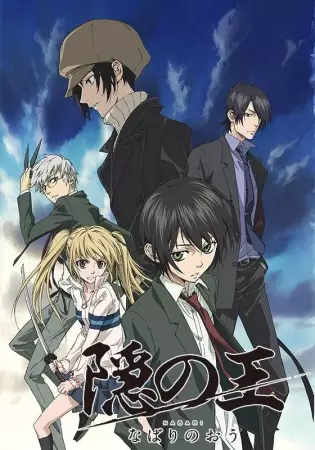
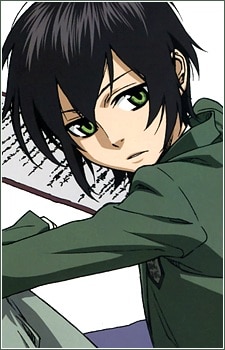
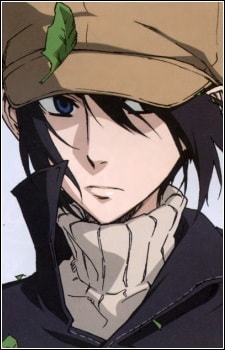
Silent, apathetic, yet mischievous, 14-year-old Rokujou Miharu is the bearer of the hijutsu "Shinrabanshou," a powerful technique many ninja clans desire so they can become the ruler of Nabari. His classmate Kouichi Aizawa and English teacher Thobari Durandal Kumohira are both secretly Banten clan ninjas who have pledged themselves to protect Miharu from his many attackers. Keeping apathetic, Miharu attempts to reject their invitation to join their ninja "club." However, after numerous attacks, he finds no choice but to join their group as a means for his survival. Slowly, Miharu gets ever closer to becoming the ruler of Nabari. [Written by MAL Rewrite]
Main
Main
Supporting
Supporting
Supporting
Supporting
Supporting
Supporting
Supporting
Supporting
RodJun828
August 10, 2014
I'm a bit skeptical to watch this anime but I'm glad I did. This anime is not for everyone. At first I thought this anime is all about fighting and action but it's much better than I thought. It's main focus is the relationship between the characters. Awesome anime, a solid 9 from me.
Overcooled
November 17, 2009
Nabari no Ou decided to take the ninja theme and put a little twist on it - the ninjas exist in modern times. I'm not saying this hasn't been done before, but it's definitely a change of pace from most ninja anime where ninjas are completely different from our contemporary culture. Nabari no Ou is about a boy named Miharu who has a powerful forbidden art called the Shinrabanshou inside him, a skill that can give infinite knowledge to the user, thus giving them the ability to grant wishes. Once his schoolteacher recognizes him, things pick up from there and he isdragged into the underground ninja world so they can seal the Shinrabanshou in his body (you didn't think using it wouldn't have a consequence, right?). At first, I was pretty disappointed with the series. It seemed to be the same old tired ninja series with nothing special to offer. They didn't execute the modern day ninja as nicely as I'd have liked them too. However, about 10 or so episodes in the show started changing focus. Yes. Instead of running around to get scrolls, Miharu was becoming obsessed with a boy named Yoite. From this point on, some really complex character relationships start to form, creating a sort of soap opera effect that keeps you watching. It gets ridiculously melodramatic at points (running in the snow at Christmas after someone, a character going into a coma, Yoite being unable to accept kindness...) but it's impossible to not get sucked in by the drama. I feel this may not be as interesting for guys though, because the relationships become borderline yaoi at a certain point, so some guys may not have the same interest in the series after the "boy love shift" occurs. The story itself ends up getting lost amongst the drama and character relationships. The epic hunt for all the scrolls is pretty laughable because the only enemy is a group called Kairoushuu....You would think every ninja clan in the world would be trying to collect scrolls to get their hands on Miharu's power but nope. Just one group. Anyways, Kairoushuu is the worst villain group ever. The villains aren't evil - they constantly help the heroes. In fact, they constantly run to them and provide them with information or even work alongside them. It creates no tension at all. Oh, and the leader? His final "battle" with Yoite ends in....5 seconds maybe? That's just pathetic. Don't even get me started on how bad the ending was. It went from EXTREME ACTION into the quaint, melancholy ending of japanese drama series. There is no plausible way for it to have been more anti-climactic. Lastly, the characters need some work. Nabari no Ou wanted to be like Bleach so they put in a hole flock of characters - many of which they don't even use for anything interesting. They build up something about a character (Oda and Katou's relationship, Aizawa's 'secret' or Hattori's assistant) and then don't touch it any further. Personally, I would like to know how Oda and Katou hit it off afterwards, or see Aizawa use his EPIC secret in abttle at least more than once in 26 episodes. Even seemingly main characters end up just spectating or flouncing around, like Kumohira-sensei. At a certain point, the designs even started to get less interesting. However, the main characters they DO focus on are pretty captivating. Overall, I can see that this series has some minor flaws (too many characters, plot could use work) but it really is very enjoyable. Some may watch for the fights, but I watch for the character relationships.
-Naami-
March 11, 2010
In life, many people (through different experiences) learn the value of human relationships; be it the relationship between lovers, siblings or friends. They learn it is okay to have selfish desires once in a while and what a person can mean to another. …If only. Thus we come to Nabari no Ou (English: King of Nabari), an anime which attempts to present multiple character relationships and the complexities of human interaction with a bit of ninja action to spruce things up. The story is one that had an interesting premise: The apathetic Miharu is told that he holds the power of the Shinrabanshou, atechnique desired by the entire ninja world named “Nabari”. He doesn’t really feel anything towards the responsibility until he befriends Yoite, a merciless killer who is on the side that wants to attack Miharu. They both forge an unlikely bond they never had before and Miharu promises to wipe Yoite existence from the face of the earth with his power. Unfortunately the rest of the show does not live up to this premise. It not only follows this summary, but the stories and relationship of those around them, as well as the entire Nabari conspiracy and plots to overthrow the ninja world. And that is where the first mistake appears. In an attempt to create an eco-system like story where everything affects everything else it dangers itself into using every cliché imaginable. Clichés aren’t necessarily a bad thing when used properly, and Nabari no Ou doesn’t, the worst cliché being “The Chosen One” seen one-too many times. Praise has to come to Yoite’s and Miharu’s ambiguous connection though. If there was a spark of originality it would be them – the friendship between the main protagonist and main antagonist. As aforementioned, there is an attempt to display meaningful character relationships and it remains just that – an attempt. The failure of this is due to the superficial cast of characters seen a hundred times, seen in a hundred different anime. There’s the spunky girl, the geeky yet strong boy, the all-knowing mysterious guy who randomly pops up, the emo and the beautiful ninja showing a bit too much of that cleavage. I don’t believe it is a bad thing to have the obvious traits in the typical character; but these characters are just outright boring and bland with nothing remotely important to give to the show. How all the characters affect and are intertwined with each other could more or less be summed up with the following motion: Yawn. Caring less about these people with such pathetic reasoning and whimsical basis for relationships and justifications would be a challenge. Take Miharu’s and Yoite’s relationship for example: Basis for such an excellent bond? Because they are both lonely. The arbitrary relationship was so irrational it might as well be deemed as “Love at first sight”, in which case the anime also had gay undertones. Miharu also becomes one of the most boring hero’s I’ve seen in any show. Primarily because he is an overly passive one. No, really, he does NOTHING. Most of his screen time consists of him crying for Yoite and waffling on about life. Now we come to the ‘ninja’ aspect. I was actually looking forward to this part as I thought if anything could redeem this show it would be the action. Again, I was left thoroughly disappointed. We all know how the ‘Ninja’ genre isn’t really taken too literally in anime since they’re about as sneaky and invisible as a bearded lady; but even so, that is no excuse for calling this a ninja anime then having no attributes to the genre in it whatsoever. To call this a ninja anime is like calling Death Note a romance just because an infatuated broad comes along and speaks about “dates” and “boyfriends” or Fruits Basket a shounen because of the odd duel. Out of the 520 minutes you would have wasted watching this show, about 8 minutes of that is filled with rather poorly choreographed action. Nabari’s uniqueness stems mainly off of the art. It easily catches the viewer’s attention with the sketch-like drawings and water colour inking which makes the entire show looks like a painting. But ‘uniqueness’ doesn’t always mean ‘good’. The low-budget quality of art becomes irritable; especially the sickly anorexic character designs which made me want to force feed them all. The music themes were assets to the show as well as being a liability. The themes played throughout the show usually consisted of high pitched violin solos which added to moments of drama – a fine piece; however it was the only piece memorable. It wasn’t that it was particularly outstanding but it was CONSTANTLY being recycled over and over again to the point where it Britney Spears’ “Toxic” would’ve sound more appealing to me. The OP song is skipable as it is too annoying to sit through 1:30 minutes of a j-pop opening that sounded like it was sung through the nose. Being an English dub fan I wasn’t impressed at all by the voice acting. Most of the English voice were just average. Brenda Palencia is an excellent voice actress to portray young boys, but her voice did not fit well with Miharu's character -- probably because of Miharu's split character at times, especially when he to play “cute”. On the other hand, the Japanese seiyuu, Rie Kuguyima did an excellent job in portraying both Miharu’s real personality and his fake one. However, there is one English performance I can truly applaud -- and that is Joel McDonald, who played the emo-like Yoite. He gave the character more personality than the art or character’s actions ever could. Choosing between the English and Japanese audio is a matter of preference -- both versions are equally listenable; so if you enjoy a certain language more than the other then go with it, since there is no extra merit to listen to the opposite language to your preference. The dialogue was definitely the worst part of the show. Firstly, I wanted to chuck a thesaurus at whoever the screenwriters were due to the fact that the word “apathetic” was mentioned every five agonizing minutes. How about words like “indifferent” or “nonchalant”? Then there was the rest of the dialogue: biggest bull I have ever heard. Nabari no Ou will make you cringe at the unoriginal waffling, and mostly unimportant dialogue. You could forward ten minutes to find that they are STILL babbling on about the same subject. A dragged out story. Annoying, stereotypical, carbon copy characters. Repetitive sound. Low budget animation. Rubbish action. And the most pretentious dialogue ever. I’m not kidding you when I say this is bad, but by all means check it out for yourself if you’re that much of a masochist.
gdavge2003
March 28, 2009
Nabari no Ou is not a ninja anime. Yes, the synopsis would disagree with me, but after watching all 26 episodes, the ninja aspect of Nabari no Ou is pretty much unimportant to the central story. Nabari no Ou is more about the relationship between Yoite and Miharu. They meet each other as enemies, but as the story progresses, they slowly become friends. Yoite wishes Miharu to end his existence using the power Shiranbanshou, while Miharu tries to master this technique to fulfill his wish. The story, is at best, mediocre. From the synopsis, I was lead to believe this series would be action-packed. But it reallyisn't. There is little to none ninja/fighting scenes, and most of the story is told through the characters' interactions and dialogues. Nabari no Ou isn't quite episodic, but I actually wish it was. After 26 episodes, there isn't really much content. Many of the events that occur in the middle of the story really has nothing to do with the main plot. If you had missed half of the episodes in the middle, you'd be perfectly fine. Nabari no Ou's story was rather dull for 26 episodes; it would've been much better had it been 12 or 13 episodes. However, the progressing bond between Miharu and Yoite was done very well, and the end, although not exciting at all, was very satisfactory and conclusive. The characters were quite weak for the most part. Nabari no Ou had a serious problem with transition in terms of character reactions and personality. For example, near the end of one episode, a certain character laments over a dreadful event and grieves. The next episode, right after the event passes, and the next arc comes along, that character acts as if nothing bad had happened. This happens many times to many characters throughout the episodes. It seriously kills any affection for Nabari no Ou's characters, and watchers really can't identify with such characters that seem obviously fictitious. The art is unarguably one of the better aspects of Nabari no Ou. Characters are quite skinny, but then again, that's perfectly normal in anime. What I really enjoyed is the background scenery. Edges and lines are not sharp, and the coloring reminds me of pastels and crayons. The backgrounds provide a really peaceful and tranquil atmosphere for Nabari no Ou. The sound consists mostly of serene background music, and during scenes of action, music filled with anticipation kicks in. Overall, the background music wasn't spectacular, but there wasn't wrong with it either. Overall, I feel Nabari no Ou could have been so much better if it was only 12 or 13 episodes long. The plot is quite simple and straightforward, and having 24 episodes with such a short plot creates repetition and dullness in Nabari no Ou. If you decide to watch Nabari no Ou, I highly recommend skipping scenes or fast forwards parts. You won't miss anything important.
Damonashu
August 6, 2011
Mixing genres; as a writer, when you mix genre you have to be careful or one genre’s over-representation can overwhelm the other, and subsequently alienate your readers. There are some genres that go well together, like romance and drama, or action and fantasy. But then there are others like drama and comedy that can conflict so much the readers rage at the sight of one or the other. There is nothing stopping such genres from mixing well, but for that to happen a writer has to take care, and in the case of Nabari no ou it doesn’t seem like the writers did. Story Nabari starts byintroducing its watchers to two worlds, the world we live in now that continues to evolve and one that hides in that evolution, evolving with it but not enough to become apparent. This turns out to be necessary for that second world, as it is apparently a world where ninja thrive. As the anime starts, its already difficult not to draw comparison to other “ninja” anime, especially when you realize that the title of it translates to King of Nabari (Nabari being the ninja world) despite the comparison you draw though, Nabari actually does do a good job of creating a ninja world in modern times. There are still fantasy elements, but that aren’t so apparent that calling the ninja “ninja” is unfitting. The problem with Nabari no Ou however, starts within the ninja world that I just finished praising. While it builds up a conflict between the four or so hidden villages of Nabari, by the time the fourth or fifth episode comes around that conflict is pushed to the side in favor of something else; a quasi-romance “subplot,” and as the anime goes on that subplot gets pushed more and more to the foreground, so much so that the ninja elements become more of an aside. This is particularly bad because there are a lot of elements in that world that should have been explained. The target of interest for example, is a magical entity called the Shinra Bansho. I use entity because there is in fact something they call “fairy lady” that dwells within the person who possesses the shinra bansho. As the story goes on it becomes apparent that she wants the possessor to use the shinra bansho but there doesn’t seem to be any reason why. At most we learn that she can steal the life of the person who possesses it, but that doesn’t seem to be her goal. Another issue that comes from the ninja elements being pushed aside is that the villain’s motive gets second gun to the conflict of the quasi-romance subplot. It is not till the last few episodes that we learn what he wants to accomplish, and even after being told what his motives are, they still get second gun to the quasi-romance sub plot. This is a case of genre clashing too, as the quasi-romance somehow manages to remain a subplot and at the same time, manages to be the main focus. Later in the anime the quasi-romance all but completely becomes the main conflict, but even then it is fragmented as watchers are never really given anything more than a shallow reason to care. This romance or camaraderie, or what have you is never exemplified in more than just one of the characters it involves saying that they have to save the other one, or that same character going on about how he and the other are so much alike. Art The art and animation for Nabari no Ou is for the most part, wholly unimpressive. Characters are drawn in this CLAMP-esque art style where most of them are this lanky archetype, with the only difference between them being slight differences in their faces, hair, and clothes. It is in fact the clothes that get more attention to detail than the overall character as many of them are decked in these very extravagant outfits. If they aren’t and they have a similar design then my overview of the art style takes form. Take for example the protagonist father who is seen in flashbacks, and one of secondary main characters Aizawa. Both of them are short haired males who wear glasses, and if it wasn’t for the fact that the protagonist father is taller and has a slightly different hair style and color, they’d look exactly alike. As for animation, well despite this being an action anime it is rarely ever pushed. For the most part the characters are talking to each other, making this anime essentially talking heads, but when there are moments of brief actions (and I do mean brief), they range in quality from static images with speed lines, to somewhat fluid movement. Otherwise things are pretty rigid. Sound The music in Nabari no ou is very much the same as the art, overall unimpressive. Despite finishing the anime only several days ago, I can barely remember the melody of the opening and ending themes, and as far as music in the show goes I can only recall a heavy use of flutes. While mediocre, I can say that the music suited Nabari’s, let’s say hushed tones. There was never a moment that called for a powerful rock ballad, and likewise the production team never used one. The music in Nabari twists toward a more classical angle, but blends in so well with Nabari that it is barely an aspect alone. Characters And now we get to what was likely Nabari’s main problem, and likewise go back to what I was saying before. As what is basically a romance anime clad in action anime clothes, Nabari fails overall at being either because it only gives its watchers shallow reasons to care. The conflicting forces after the shinra bansho don’t really get much development till the end, and the characters in the romance subplot gets next to none. This is not helped by the main character that is soft-spoken, manipulative, apathetic, and more than a little self-entitle. The writing tries to make us care about him by showing that he was wronged as well, but considering just how self-entitled it also makes him, making watchers sympathize doesn’t really work. This gets worse when you realize that the main romance (camaraderie, what have you) involves a character that is almost exactly the same. The difference between this character and protagonist is that the writing actually does make us care but it doesn’t say specifically why we care. This character is haunted by a troubled home life from their youth, and it alludes to there being a reason why it was so bad and why the character is so determined to achieve their goal, but that’s pretty much it; it stops at allusion. To further explain why characters is Nabari’s main problem is to draw attention toward its other characters; characters that seem interesting but get all of a few minutes of expansion. One case goes back to the story and likewise, the similarities watchers might draw. There is a character who wants to get revenge against another for killing their family. This is fine and all, albeit cliché, but the writing’s stubbornness to move away from the quasi-romance subplot makes this characters story an aside, much like the ninja world. Build up is frankly brief, and pay off is underwhelming invoking a sense of this plot only being here because it was (perhaps better) in the manga. This is the same for a lot of other characters. They are displayed as interesting but pay-off always turns out to be these few minute long, underwhelming scenes. Enjoyment At this point I don’t think a person needs to ask if I enjoyed this anime or not. With its unlikeable main character, and failure to mix genre, Nabari no Ou is something of a painful watch, made more so when you realize that it’s pacing is bad. Pacing notwithstanding, this is not a disdain for romance or disdain for action, but a jerking feeling I got while watching it. What I did find interesting, got next to no attention, and what I found annoying was constantly shoved in my face. Again amplifying the negativity of this, the latter was something that was forced into the main focus position. It tries to masquerade as an element of the plot, but the story’s own main character defuses this disguise by choosing a jarring reason to get involved (one that makes him more despicable when you think about it in hindsight). Overall If you’re planning to watch Nabari No Ou you should go in knowing that it is neither an action series, nor a romantic one. While those are genres you can tack onto it, this anime barely seems like it knows which one it wants to be. The characters aren’t developed enough to make us care about their romance (camaraderie, what have you) but they are push so hard into the main focus that something we might have cared about (The world of Nabari) becomes second gun even to the end. What Nabari could have benefited from was more than twenty-six episodes, and if that wasn’t an option, a willingness to explore more of its elements. It however had neither, and leaves an impression of time better spent
Rank
#3374
Popularity
#1575
Members
172,758
Favorites
1,233
Episodes
26