
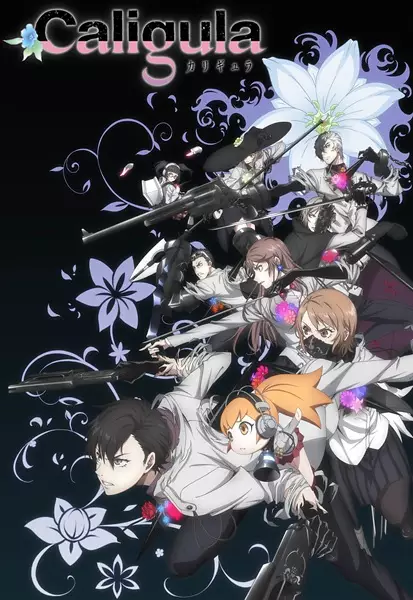

カリギュラ
What is happiness? Ever the fan of psychology, questions such as this are ones that high school student Ritsu Shikishima likes to ponder as he spends his peaceful days with his friends. His perfect world, however, begins to unravel when he hears a strange voice obscured by static, pleading for help. This voice belongs to μ, a beloved pop idol, whose singing begins to have an adverse effect on the world. Before Ritsu's very eyes, the faces of his friends and family become distorted by glitches as the sound of μ's voice transforms them into Digiheads: berserk monsters bent on the extermination of all those who begin to awaken to the true nature of their existence. Realizing that he is trapped in a virtual world created by μ called Mobius, Ritsu must now gather everyone else who has managed to realize the truth before they are all eliminated. Together, they will use their newfound powers and weapons granted by their emotions—known as the Catharsis Effect—to fight off the mysterious group known as The Ostinato Musicians as they struggle to escape. [Written by MAL Rewrite]
Main
Main
Main
Supporting
Supporting
Supporting
Supporting
Supporting
Supporting
Supporting
Supporting
CodeBlazeFate
June 24, 2018
Everyone has a different form of perception, how they see reality, and everything in it. We can see a show or movie and have different reactions to it and notice different things in it. We can have different political opinions, views on society, or subject preferences. Once you think of it, it's quite fascinating, and in many cases, outright chaotic. After dressing itself up in psychology and philosophy Caligula is a fascinating and musically endearing, if awkward, convoluted, and questionably executed foray into just how fucked perceptions are. It jumps off from its premise to deliver a unique experience in the name of establishing the credibilityto tell you something: don't get too attached to escapism, and accept reality. Just think about it. It's antagonists -Mu and mediocre cronies services mostly for their themes- are well-intentioned extremists who have indulged far too deeply into escapism. We get to see everyone be subjected to the most disgusting and aggressive versions of what we do to take a break on our daily life, as characters confront their true feelings and unravel themselves to us. People getting so lost into their music that they go ham on people, people engaging so hard in tea parties that they actually eat the fake silverware and stuff themselves so obscenely, people wishing so hard to become someone else that they end up living a fake life? This shit and more is all here! The presentation of this, coupled with the presentation of how off and disturbing the events are, is all directed strikingly. Even though the writing effectively has to handwaive potentially awkward shit about not perceiving explosions and managing to perforce yourself in a completely different body and life, it manages to work without much explanation. It’s such as shame that some revelations are so detrimental and that there are several asspulls and unexplained actions/circumstances -most of which are concerns with the second half-. Let’s not even mention how the final quarter falls apart until the final 13 minutes, as the way it opens certain cans of worms ranges from interesting to devastating, even more so than the second half already began doing. However, while the narrative was mostly well-presented, the characters are in the exact opposite scenario. There are a lot of them, both on the protagonist and antagonist side. None of them have distinctly interesting personalities or motivations sans Mu, and the sheer amount means that we have to juggle a bunch of largely uninteresting characters, several of whom don't get explored in interesting ways. Even the ones that do such as Mifune, are not very memorable despite their intriguing dilemmas and breakdowns. The protagonist (Ritsu) is the second closest thing to a real character, and aside from him enthusiastically getting into psychology and sociology terminology whilst presenting them to the characters and audience, there isn't really much to him either. Even seemingly important side/characters take forever to even be introduced beyond what the opening and closing credits show us. I guess it makes it hard to write them inconsistently, as most of them are more like vessels with singular, often abandoned traits. Good writing that does make, and even with the one good character they have, its counterbalanced brutally towards the end with a certain twist villain who’s basically Seryuu from Akame ga Kill. The dialogue is also sometimes clumsy enough to remind me that the person writing the story with the message likely hasn't entirely escaped the damages a sheltered or escaped reality has on one’s writing, perception of real people, and how they talk. Perhaps some time to iron things out and spend time with these characters experiencing the type of pain and escapism integral to their stories would make them a bit more interesting. Then again, the show is so blunt, even hamfisted about its messages that it almost hurts despite how good they are to hear, and how plentiful the themes used for it are. Studio Satelight had about as much trouble as the writing, it seems. The character designs -sans Mu- are all a tad awkward and it feels like they had to limit the animation for the sake of keeping the sharp yet awkward (and incredibly pale) character models perfectly in check. Flashbacks galore and some occasionally jarring CGI only worsen the deal, especially when the presentation makes odd decisions like occasionally reducing characters to white or other colored silhouettes, or having them not move during their walking animations sometimes. The fight scenes are pretty terrible too, with Akame ga Kill sound effects and jank as hell animation, when there is any. It all temporarily comes crashing down in the finale -along with the writing-. Shame given that the directing and presentation by Junichi Wada makes several sequences engaging, using static to really sell how off things feel, while constantly showing different visual perspectives and changing up the lighting and colors when things go insane. It's like the direction is doing its damndest to obfuscate the terrible production and only barely succeeding. The visuals for the opening are pretty captivating though, with a more unique filter and overall darker and more mind-bending style. Speaking of the opening, "Paradigm Box" by Ritsu Shikishima (Chiharu Sawashiro), Shougo Satake (Shunsuke Takeuchi), is one of the better openings of the season, with nice vocals and a somewhat unique feel in places (notably right before the chorus). The ending theme "HYPNO" by Kotono Kashiwaba (Rie Murakawa), Naruko Morita (Ari Ozawa), Mifue Shinohara (Rie Takahashi), Suzuna Kagura (Minami Tanaka) is also a worthwhile listen, even if it feels like forcing it to be 90 seconds stretches it. The vocal tracks performed by Mu are even more fun to listen to, and the lyrics are pretty good at reflecting the overall themes of each song that relate to the show (as well as the RPG game the show adapts). Sure, some get replayed quite often, and the rest of the OST is mostly just decent with the exception of the track "The Fairy of Dreams", but that doesn't stop me from listening to this OST on my own time. It’s a shame this show isn't as well-received or as great as it could be, since its messages are beneficial, even important for the anime community and Japan at large to hear. If only it was as worth the recommendation I wish to give it, as it was certainly entertaining in its madness and ideals. Regardless, it isn’t bad, so if you prefer the message to anything else, or want something out of the ordinary, perhaps this isn’t a bad choice to consider.
Nayout
June 24, 2018
Caligula is the adaptation of the videogame "The Caligula Effect" released on June 23, 2016 for Ps Vita and was released in the West by Atlus Usa in 2017. It also has a remake released a few months ago for PS4 with the name of "Overdose "including several playable improvements and even a new route as a traitor by the name of "Lucid " The story is quite simple even in the video game, where what most stood out were his characters and how they manage to overcome their insecurities to escape Mobius, all written by Tadashi Satomi, the father of Persona series. Now entering theadaptation as such, the first thing to mention is that it is not a faithful adaptation to the game, it is an original story based on the events of the game so you can see perfectly without having played the game and even responds better than the game . Talking open about the whole plot is difficult because any type of information (like the synopsis that has MAL taken from the official page of the game) is to ruin the experience of this by the same thing it is best to enumerate as many their successes as their problems. -It is not a series to watch without paying attention, the series is full of small details that enrich the plot and not only this, to understand many aspects of these is recommended to see twice the series, it is incredible how many details escape on ose They pay attention for not understanding it since it uses psychology as a fundamental point in these. (Ritsu explaining to Marie in the first episode, the final battle over the Johari Windows, Ritsu's clothes and how it is applied in his behavior, Episode 11 and the use of the baum test to understand his problems). The problem is often does not do well and leaves very ambiguous messages that only cause problems to understand the plot as episode 5 in which although Ritsu mentioned why the episode happens in that place, it is not a direct message. -Many of the characters are not sufficiently developed by several problems, the first the game only develops by optional events that are outside the main plot, this makes it difficult to treat them without breaking the rhythm of the plot and not only that , without falling into a repetitive structure such as the game. The game and its plot are a succession of dungeons where each musician is hidden with some history while we have a free time to raise the affinity with our friends. This is one of the biggest problems, although he tries to present them and even present the reality of the musicians (something that does not make the game) he feels quite awkward in his execution, but the good thing is that he tries to do that at least let's know who they are and how Mobius affects them. -The series does a better job representing the world, we present the problems that Mobius is leaving in real life and also mention that it is Mobius in itself something that the game does not either since everything presented about Astral syndrome is something original of the anime and that manages to explain in a more coherent way the narrowness of his world and does not leave the ambiguous message that the game leaves. -The animation is another big problem but it is not something so annoying from the middle onwards (like the first episode and when they walk to the store Ramen), the good thing is that the art of the game is quite well representing and even makes works beautiful as when Ritsu communicates with U by changing the gray color palette completely or even, the faces of the characters in specific situations (Mifue's face in episode 3 or Kentaro's in the Shadow Knife episode) Already, musically like the videogame, it is very good, since the Opening is interpreted by the same characters and that the Ending is interpreted by the girl only reinforces the fact that Caligula focuses a lot on the details. The Insert Song represented by each theme of the musicians and even the original songs like Utopia are perfect and the value they have are mostly for the lyrics, each letter represents the personality of a musician and manages to know more about them with so just read a little of them, is something that for example other universes such as Ar tonelico apply a lot in their soundtracks, is not just music to accompany, it is music to learn and understand. The whole plot could be difficult to understand even in the middle of the series, but an answer, even many of the problems of this chaotic story are made on purpose although sometimes they do not solve them in the best way it still makes sense. It is a series to see it without stopping, fixing on those details, reading everything. All their problems come for the characters and their development derives from an irregular structure in the video game but manages to present everyone and give them a background even if this is not the best way. PD:The analysis is done with the mediocre English that I have.
Karhu
June 24, 2018
Caligula is what White Album 2 had looked like if it had followed its predecessor's footsteps and made its girls more obviously inanimate objects. The story of this masterpiece of nothing is a weird one. Gay man who wears a rose instead of necktie gets stuck inside imaginary idol world where he is surrounded by sad people who all share the same music taste. When their favorite band starts playing, they go berserk and try to kill everyone. The best part is how dramatic this all is. Tables flip over in slow-motion like it's Game of Thrones killing Starks. Guy fails to solve some problem inclass and everyone bullies him like failing in it is the single most embarrassing thing in existence. Girl experiences a mental breakdown at dinner when people glutton and have no table manners. Gotta wonder why everyone is so sad in this otherwise rose-colored world. All our characters are the practically the worst and most empty version imaginable of Danganronpa 3's cast. The girls are so invisible in the series, I can't even tell them apart despite them having different hairstyles. Outside hyper active megane who someone with low standard could even argue to have a personality, and the little hand doll-sized flying loli, not a single one of them adds anything to the series. The dudes aren't much better. Everyone looks super gay, and the small bro gangs only radiate cringe. Even so, our dudes create the best moments in this series with so overdramatic, over the top facial expressions (which cover roughly 5% of the airing time) that it became the sole reason why I even bothered to finish this series. In one way, this show is what Jojo's Bizarre Adventure would have looked like if it was made by Brainbase and every single thing about it was the polar opposite of what it is now. Perhaps this show had potential (it didn't), perhaps its source material game was better (it wasn't), but with certainty, I can say that 95% of this series is utter nonsense and there is not a single reason to care about anything that is going on. The animation. I have but one factor to comment on. Walking. Whenever anyone walks, they don't really walk. They do look like they are walking, but they don't move forward. Moreover, the characters don't even have shadows so it looks like they are floating still in space while trying to walk. Fluid, and beyond hilarious. From the musical noise department, this show is just fantastic. Scenes where our dudeouses get scared and yell like 10 seconds straight, are comedic cold. Not even 4kids has achieved this level of believability, and we are talking about Japanese seiyuus here. In terms of enjoyment, I laughed few times in situations where you clearly were not meant to laugh. Other than that, this show offered me nothing. The sole best part of Call Igula is how people are recommending it for the fans of Angel Beats due to their similarities and vice versa. By all means, if you are into that shit, watch this too.
dadnaya
June 24, 2018
I have to confess, the only reason I decided to watch this anime was because of two words: "µ" and "idol", I thought maybe I'd get some Love Live references here. Ha. Well anyways, Caligula was pretty much one huge mess. The concept shown to us in the sypnosis isn't so bad, and indeed the concept of being stuck in another world and trying to escape from it- isn't so bad. But as the story went on, it turned out to be a horrible mess. We barely get to know what really is happening in the series, and as the story progresses we get more twists that mademe even more confused. Just because there are twists and psychological quotes every episode doesn't make it automatically good. We get all the backstories dumped into us, making us "feel" the characters, but at the very least we had diversity in the characters. Oh, and then there are the bad guys, the Musicians, who like the imaginary world but they have to kill the ones who want to escape from the current world- just because. We've gone for 12 episodes without a clear direction, and only once in a while there was a clash between the "good" and "bad" forces, with no meaning behind. For some reason, whenever µ sang, everybody went wild. Pretty weird concept to make the enemies "awaken"... The OP/ED were nice. The artstyle (on purpose?) was made to be grim, Using the colors of gray, brown and black, you can see the whole anime being "lifeless" and... unappealing. Conclusion: This anime seemed like an advertisment for µ songs. And no, these aren't "µ's" the idol group from Love Live, but this is just "µ", the inferior idol. 5/10 Feel free to skip it.
somaisbatman
June 24, 2018
TL;DR it's bad. But if you want some convincing, here you go. I was going to ignore Caligula entirely, until I heard that Tadashi Satomi was tangentially connected to the project. Satomi is a scenario designer who used to work at Atlus. He’s responsible for Persona 1 and the Persona 2 duology, which happen to be some of my favorite games. Caligula seems to be his current project, at least Caligula the game. That’s right, this show is a video game adaptation, which is never a good sign. Anyways, this show is particularly frustrating because for a while, it straddles the line between a flawed showwith potential and a total slugfest. I had to keep watching not because I enjoyed it, but because I wanted to see if it would ever get better. It didn't... The first episode is vaguely interesting in how off everything is. Seriously, things are just wrong. The main character says his lines and is repeatedly ignored by everyone, like he never said anything. Characters repeat lines and actions multiple times. The audio levelling is busted, with one female character in particular being significantly louder than everyone else for no apparent reason. These aren’t the signs of a totally broken show like Hand Shakers, they’re a little more subtle, and I’m still not sure whether they were intentional or not, because it would thematically make sense and these problems never show up in later episodes. Either way, the protagonist’s rose-colored high school life is a lie, he learns he’s trapped in a fake world Truman Show-style, and he tries to outrun his mysterious pursuers and figure out what’s going on. This second episode is, unfortunately, probably the best the show ever gets. It’s the only time there’s a real sense of desperation, as afterwards our protagonist forms a resistance team and everyone gains superpowers. In order to introduce and flesh out some of the more important characters on this resistance team, unfortunately named the Go-Home Club, Caligula opts for character-specific episodes, where one character in particular meets face-to-face with one antagonist (oh yeah, there’s an entire antagonist team called the Musicians). The idea behind these episodes is to have the antagonist act out their personal philosophy, and then either have the protagonist explains why it’s wrong or have the philosophy just collapse upon itself. These episodes are where some of Caligula’s worst aspects bubble up. Caligula has bad politics. There’s no other way to say it. And this matters a lot in a show that frames itself around philosophy and trying to be “deep”. At its core, most of the Musicians have flawed ideologies because they focus too much on self-indulgence and isolation. In action, however, this plays out in increasingly baffling ways. The first antagonist is an obese dude who didn’t take care of himself IRL, so with the powers of this virtual world, he pretends to be a cute petite girl and have dainty little tea parties. For once I’m going to ignore the potential trans subtext (the only intent seems to be to further demonize and condemn). This is such a textbook message for a show that prides itself on being interesting and philosophical. A guy is fat so he pretends that he’s not, and that’s why he’s the villain. Was this really the most pressing thing on Satoshi Tanami’s head? For reference, Persona 2 also has an arc about fat-shaming, but it goes the complete opposite route. It ties fatness to bullying and guilt, and concludes with the positive message of loving someone no matter what they look like. The second arc is even more nonsensical. It features a shut-in antagonist convincing the protagonist to hide herself away in the library forever, and cut off all her friends. During this conversation they bond over psychoanalyzing Gollum from the Lord of the Rings. To me that doesn’t seem like isolation, that seems like making a new friend over shared interests. Watching the two get along pretty well kind of defeated the message of the episode for me. Episode 5, however, is where the politics go from underwhelming to actively regressive. Unsurprisingly, it’s the gender politics episode. Our antagonist is a woman who runs a speed dating service: all the girls feign interest in the guys, and then take them to the bedroom, where they proceed to drain the men’s energy or brainwash them or something sinister like that (this show is surprisingly hard to follow). The gender reductionism really hits hard. Every single man in this episode is a lustful sexual beast who only wants to be stepped on by women, while every single woman is a succubus who manipulate men into these situations and suck their lives and memories away. This is a crappy generalization to make, and it only gets worse once our protagonist escapes her role as a seductress, gains free will, and challenges the antagonist to…a beauty contest. Even after gaining agency, the only way she can defeat her foe is through male worship. The show gets bored of character episodes for a bit and starts making ensemble cast episodes after the halfway point. These are the worst ones, unbelievably slow, stupidly unfocused, and the blandest cooking in any anime. And there’s two in a row. By now we’re in the endgame episode-wise, and yet the show is still trying to throw new minor antagonists at us? I guess that would make sense in an RPG game, but it’s nonsensical for a show to do it so nonchalantly. Even weirder is that fact that our new villain of the day is just a flat up torture-fetish murderer instead of being motivated by petty self-interest like the other villains. It’s a strange change of pace, especially when they lurch into the lighthearted that same episode to talk about how bullying isn’t okay. Watching Caligula was an act of emotional labor. Not that it was intense and draining, instead it was so shallow and boring that it felt like a crappy day job. I had to force myself to sit down and shove these episodes into my eyelids. I don't want to do this to myself. At this point I’m phoning this review in as much as Caligula feels phoned in – a lot. Please understand. Tadashi Saotomi, what happened to you.
Rank
#10794
Popularity
#2726
Members
79,699
Favorites
110
Episodes
12