Flavors of Youth
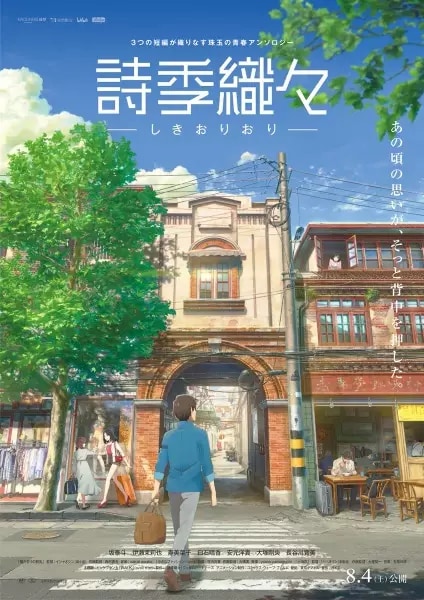
詩季織々(しきおりおり)
The rigorous city life of China, while bustling and unforgiving, contains the everlasting memories of days past. Three stories told in three different cities, Shikioriori follows the loss of youth and the daunting realization of adulthood. Though reality may seem ever changing, unchangeable are the short-lived moments of one's childhood days. A plentiful bowl of noodles, the beauty of family and the trials of first love endure the inevitable flow of time, as three different characters explore the strength of bonds and the warmth of cherished memories. Within the disorder of the present world, witness these quaint stories recognize the comfort of the past, and attempt to revive the neglected flavors of youth. [Written by MAL Rewrite]
Main
Main
Main
Supporting
Supporting
Supporting
Supporting
Ethan_07
November 17, 2018
Each story has a beautiful ring to it. The first story, depicts the story of the love towards food and shadowing the relationship between a grandmother and grandson behind it. It inspires us on how important it is to appreciate the moment while it lasts. The second story, reflects on the relationship between two sisters, how their life influence each other and the beautiful they share, supporting each other despite the fights that they had. The third story, has just shown how we all make mistakes and yet the time cannot be rewinded, what is done in the past has already gone. You could only continue your life,make a better tomorrow, either to fix your past mistakes or enjoy the present moment with your loved ones. Slight note: There's an end-credit scene. Watch until the very end!
Protogeist
August 6, 2018
I wrote a review for this movie, but it seems like it didn't get saved, cause now it's gone (maybe I accidentally deleted it). So here's a VERY summed up review of the anthology movie mostly so I can go back here if I ever forget why I liked the movie Short 1: Had good animation but looked very weird sometimes. The story was very plain and so was the main character who didn't get any development either. The music was okay Short 2: Had much better animation, characters, and story, but the music was still just okay Short 3: Had a great story, good animation, and okaycharacters and music. All together: they all had a consistent theme but used it in different ways making it interesting
Kirik0h
August 4, 2018
The tripartite anthology "Shikioriori", is deeply ingrained in Chinese culture and recent Chinese history, in particular that of China's rapid economic development during the 1990s, so it pains me to read so many reviews that seem to exhibit no awareness and no understanding of the cultural context and demographic to which this film targets. 1) Sunny Breakfast For non-Chinese people, or those who have not grown up in Chinese-influenced societies like much of South East Asia, you may not know that food is widely recognised as the most important part of Chinese culture. That Chinese people often greet each other with "Have you eaten" and that Chineseparents will express their love for their children not with "I love you" but "Have you eaten/there is food" is merely one of the many culturally ingrained aspects of Chinese culture where food is often the basis for family bonding and socialising. In "Sunny Breakfast", Xiaomin contemplates the ephemerality of people and things in life, with his most cherished experiences relating back to his favourite noodles. The whole vignette takes the form of Xiaomin's inner thoughts and soliloquising as we follow his life's journeys as we observe snippets of the memories he looks back to, as he feels his life is nothing more than a tasteless existence, that no longer has the "flavour of his youth" about which he reminisces and from which he begins to learn. The extended metaphor and the experiences he goes through are very much those that most ordinary Chinese people that live in cities post the late 1980s when Deng Xiaoping begun the process of transformation Shanghai to the megacity it is today. For a short story, "Sunny Breakfast" does well in encapsulating the experiences many young Chinese adults will have gone through and the thought processes they felt. In the whirlwind of time, it is easy to forget the impermanence of that which one grows up with and just that alone is sufficient material for a short story like the first of Shikioriori's to explore. 2) A Little Fashion Show This is the most straightforward and least attached to Chinese culture of the three and may be more accessible emotionally and storywise to MAL's Western base. It is a short story about cherishing those close to you and how family, as well as recognising the bilateral nature of such relationships. Perhaps the weakest of the three, its simplicity nonetheless means that its narrative is clear even if the experience of viewing it feels a bit rushed as the plot proceeds from one to the next, with little time for the nuanced introspection and characterisation we had of Xiaomin in the previous film. I consider this to have been the weakest entry as its appeal to pathos is not particularly convincing and could have benefitted from more introspection of the sisters rather creating an antagonist, whose purpose had little value beyond advancing the plot whose message could have been achieved without so I felt it to be more shallow than the others. Luckily, being in the middle saves "Shikioriori" from giving a bad first impression or a disappointing finale. 3) Shanghai Love Even though it's a homage to Byousoku 5 Centimeter, I think it's more of an indictment of MAL's demographic that this film is being likened to all of Shinkai's other works when really it shares very little with any of his works. That a mere story of 2 adolescents in love that faces struggle is enough for people to liken "Shanghai Love" with Byousoku 5 Centimeter is more of a testament to the lack of repertoire MAL's demographic has surrouding romance as a genre where people view romance as dating and "who ends up with whom" rather than romance as being a medium via which to explore human relationships, emotions, and growth etc. Regardless, that doesn't change the fact that it does not come close to reaching the sheer emotional profundity and character authenticity and complexity Byousoku 5 Centimeter achieved, nor the surgical precision with which Shinkai's film explored its themes. "Shanghai Love" is more about Shanghai and Chinese culture than it is really about love. The story surrounds 3 friends who through various circumstances end up on different life paths that lead to our protagonist to ponder on his present and future, sparked by a reminder of the past. What I found impressive in this story was the way Chinese familial structure, relationships, and familial expectations are all accurately woven in the context of 1990s Shanghai which faced rapid modernisation, gentrification as well as technological development - themes that were all deftly used as metaphors in this romantic tale. It is the longest of the three but aptly works as a conclusion to this anthology. Whereas the first focused heavily on one's past, the second on the present, this final film goes one step further using its additonal time to encompass the future and the film's ending culminates into an emotionally rewarding experience that feels like chicken soup for the soul. --Final Thoughts-- Shikioriori is a Chinese production made for Chinese, or at the very least, Eastern audiences. Its audiovisuals are strong owing to its production committee and brevity but nothing exceptional. But crucially, it takes advantage of the time it has to provide a reflective and heartfelt piece about the transience of life, youth and on grasping the future, in a context that is often very ingrained within modern Chinese society. However, these themes are universal and I think audiences from all over the world can relate to the problems and feelings our protagonists hold, in a succinct package that can be digested separately in 3 parts, if you feel you don't want to commit to something long. I think for a lot of mainland Chinese millenials in their twenties, there is something even greater to pontificate upon and extract from Shikioriori, a film that I personally thoroughly enjoyed, and captured me in its reminiscent and phantasmagorical atmosphere.
dcasparov
August 4, 2018
This is going to be my first review! (LIGHT SPOILERS) Story: 7 This movie is an anthology that is composed of 3 stories. I'll briefly comment about it one by one. "A Sunny Breakfast" 6/10 it comes off as an introduction story of an adult lingering the remnants of youth. The story doesn't really progress instead it comes off poetic and nostalgic. But that's just it. "A Little fashion show". 8/10 A story about two sisters with different careers that separates them from living a kind of lifestyle yet they share the same roof. It's pretty decent to look at it as a whole but somehow it lackedsomething. It's still predictable as it is but what brought significance to the 2nd story is that they managed to breakthrough and intermingle their different passionate careers, showing the good side of sisterhood while approaching adulthood "Love In Shanghai" 9/10 To be honest, the last part made me cry. It's well invested with emotional flares with full of mishaps that breaks the bond between two supposed-to-be lovers. It' starts slow then gradually gives an aching slow burning experience. Cliche as it may sound. The whole execution of the events caught my attention and I felt like that I wanted it to be separate from the anthology because it deserves a movie itself. It can be as good as Garden of Words or nearly good as Your Name. Overall. It's very decent. The stories are well narrated. The score is deserving enough since it really followed the movie's theme.—the different viewpoints of adults looking back at their tracks from their youth—ranging from familial love, love for career and the love from someone. Art: 10 As expected, it was from the studio Haoliners and ComixWaves (The one that animated Your name, Garden of Words, 5 centimeters per second etc). I'm never disappointed by their past works so does now. From the city landscapes to the delicate food animation, the color schemes and the tame character designs. The art just gave the movie the realistic vibes. That way, I felt more resonated and connected while watching it. Sound: 9 The sound is very varying from each stories. It was all distinct yet somehow forgettable. But the best part is that the orchestration is so good, it managed to weave out my emotions while the protags narrates their story. And also, for me, the sound always worked with the art/animation in tango. They are always intertwined. And in this movie, they gave us a full-scale combo for a beautiful, radiant and emotional anthology. Characters: 7 The protagonists in every story did their roles properly in every story. Their personalities made them appear more natural and realistic. But somehow, they still lacked a little bit of substance. But I can't really blame the short amount of time. It's hard to read a character when they appear just 30mins or less and nothing more. Enjoyment: 8 Even though some parts felt boring, the narrative is very good altogether with sound and animation that it kept me relaxed and watch patiently until it ends. Overall: 9 It's a must watch!! Don't watch with full of expectations so you could enjoy and appreciate it fully. It's not very twisty like Your Name. Watch it alone in a calm environment with a nice cup of tea. This is a grounded movie anthology with full of bittersweet yet radiant stories of nostalgic youth!
kekekeKaj
May 18, 2019
There are two things you should know about "Flavors of Youth": 1. It's a great anime. 2. You probably won't think it's a great anime. "Flavors of Youth" strikes me as an inaccessible anime - particularly to western audiences - and not just because of its meandering, introspective nature that would put a lot of people to sleep. I would describe it as a cultural piece that, to fully appreciate, you not only need to know about Chinese culture, you must have been submerged in it at some point in your life. On top of that, the anime homes in on a very specific Chinese generation: the generation whogrew up there around the 90s, the generation who witnessed China's rise to one of the world's largest economies. My generation. Perhaps that's why I struggle to recall the last anime with which I felt such a deep personal connection. "Flavors of Youth" captures the nostalgic feelings of my childhood spent in 90s China with such authenticity that I was utterly unsurprised to find the chief director is a Chinese close to me in age. If you're not someone targeted by the anime's laser-like focus, if you haven't the life experience of a certain time and a certain place, then "Flavors of Youth" likely feels like a poor man's Shinkai anime. This view is no doubt enforced by its nature as a work co-produced by CoMix Wave Films, a studio with strong associations with Shinkai. But despite the obvious influences, this anime also stands on its own three feet (because it's an anthology comprising three stories). With subtle social commentary and Chinese culture permeating through every pore, "Flavors of Youth" is far more than a cheap Chinese knock-off; it possesses its own identity and its own goals, with even the main locations for the stories - Beijing, Shanghai, Guangzhou, the three largest cities in China - carefully chosen as the faces of China's economic boom. The central thread that runs through the stories is "youth". More accurately though, it's about "seishun", or "qingchun" in Chinese (they use the same kanji). While those terms seem directly translatable and therefore interchangeable, that's true only in a literal sense. Words in different languages can have the same literal meaning but vastly different connotations; "seishun", made up of the kanjis for "green" and "spring", possesses a certain poetry and an association with a culturally romanticised view of the morning of one's life, and the word "youth" simply can't capture the strength of the meanings and feelings invoked by it. The anthology opens with "The Rice Noodles", which isn't so much a story as it is an expression of feelings, subtly blended like the seasonings of a delicious bowl of the titular noodles. The bare premise is about a guy named Xiao Ming (which is, incidentally, probably the most common name for fictional protagonists used in the Chinese education system, frequently seen in example sentences and essays) yearning for the taste of the noodles of his childhood which he ate with his grandmother. The noodles do so much of the heavy lifting in this story that it's practically the main character - it has strong associations with the memories of Xiao Ming's grandmother and with the nostalgic days of his seishun, in addition to being a metaphor for the values eroded by China's rapid economic expansion. While having practically zero plot, "The Rice Noodles" is thematically rich. To understand the commentary, you need a bit of background. China, like a lot of Asian countries, has a strong food culture - not in the French-esq, fine dining style, but of the local street food variety. The streets and avenues are often dotted with street food stalls and cosy, family-run restaurants serving startlingly good food within tight-knit communities. As the country embarked on a decades-long growth spurt, the local restaurants got gradually replaced by more commercial restaurants and chains, particularly in large cities. On the surface level, Xiao Ming laments that the noodles from the commercial restaurants just aren't as tasty as the ones he ate as a youth, as they have less of the wholesome ingredients such as wood ear mushrooms. On a deeper level, the anime laments the loss of old values as people chase after money in an increasingly materialistic society. This isn't just a case of looking at the past through rose-tinted glasses: China's economic rise has very much been a double-edged sword. On the one hand, hundreds of millions have been lifted out of poverty, and people's living conditions massively improved; on the other hand, since adopting aspects of a capitalist system, Chinese society has become a caricature of western consumerism, with people worshiping at the altar of money and material items, and scheming to become rich by whatever means, even at the cost of community, family and moral values. This is why the country's become plagued by scams and scandals in recent years. Where once people didn't even bother locking their doors, now they draw their curtains when counting their cash. But let's pull back from these dark reflections; "The Rice Noodles" does end on a positive note: even as the protagonist acknowledges that he can never recapture his seishun, the fate of the noodle shop brings hope of triumph through adversity, and of the return of non-materialistic values. Sometimes it takes a rough patch in our lives to makes us realise what is truly important. The visuals play an important part in "The Rice Noodles", and it's a precursor of what's to come, both in terms of strengths and weaknesses in the animation and artwork. "Flavors of Youth" generally looks pretty, in a substandard-Shinkai kind of way, but falls short in the character animation department. This is particularly obvious in "The Rice Noodles", where the character animation lacks smoothness in some places, and looks overly smooth and mechanical in others. I remember in particular the scenes of people perfectly poised on bicycles, peddling in perfectly cyclical motions and moving forward in perfectly straight lines. But the weaknesses are more than compensated by the details of the background scenery, where the animators managed to capture the streets and buildings of rural and urban China with remarkable fidelity. Even in the visuals, the noodles steal the show: "The Rice Noodles" may not exhibit the scenery porn pervading Shinkai's works, but it can boast of food porn. I found myself salivating to the beautifully rendered noodles on screen, and could almost smell the aroma wafting from it. The strength of the visuals whisked me away to distant times and places and immersed me in its scenery and atmosphere ... but the magic only works because those times and places exist in my memory. The second segment, "A Little Fashion Show", has more of a plot than the first, telling the story of Yi Lin, a fashion model worrying about becoming too old for her job, and her relationship with her little sister. While not bad, it's probably the weakest of the three anthologies. I found the story a tad over-dramatic, and it resonated with me less than the others, though the reason might be because I'm a guy experiencing a story dealing primarily with problems for women. "A Little Fashion Show" tackles the loss of seishun in a more head-on fashion than the other stories, in particular its implication for Chinese women. Age-ism is a problem for women worldwide, especially when it comes to an appearance-based careers like modelling, but Chinese women feel it more acutely than most. While it may seem absurd to say that Yi Lin is raging against the dying light of her career, it's also fair to say that strong stigmas still exist in Chinese society for women like her, who have reached a certain age without getting married and settling down with kids. And as one of a vast number of career-focused, unmarried women in her generation, Yi Lin is certainly not going gently into that good night. Her story is one of defiance: defiance against an industry's bias for youth, and defiance against a traditional society's expectations for women. But it's also a story of defiance against something else. The other topic "A Little Fashion Show" deals with is of family and parenting. And if the first topic I mentioned didn't resonate with me personally, this one certainly does. Yi Lin lives with her younger sister as their parents had passed away. Tradition dictates that Yi Lin, as the eldest one, should play parent to her younger sibling and take good care of her. And Yi Lin tries to do exactly that. To a fault. During a heated argument between the two sisters, Yi Lin busts out the what is possibly the most memorable line in the whole anthology: "Who do you think I'm doing this for?" This line, along with its classic variant "I'm doing this for your own good" are immortal conversation enders weaponised by Chinese parents against their disobedient children, so I'm sure it triggered a familiar, visceral reaction in many others as it did in me. Family and Confucian values underpin Chinese society, and children are always expected to be obedient to the parents who pour their souls into raising them, because parents always know best. Of course, that's not always true, and even when it is, sometimes children need to be allowed to make their own mistakes. The tragedy is that while many of us grew up knowing that, when we become parents ourselves, we often end up acting just like our own parents. In acting as a parent towards her sister, Yi Lin ends up making the same mistake as a typical Chinese parent: she does not realise her sister has grown up, and does not respect her rights to forge her own path in the world. Ultimately though, "A Little Fashion Show" doesn't explore the theme of rebellion against suffocating parents too deeply. However, this rebellious spirit roars into life in the third and final story, "Love in Shanghai". Better directed, better animated and better written, "Love in Shanghai" is in a different league to the other two stories. Like the headline act of a gig, it finally steps up after the supporting acts have warmed up the crowd. While Shinkai's influences are rooted in all three stories, they go especially deeply in "Love in Shanghai", all way down to the communication gimmick used as the central lynch-pin of the story. "Love in Shanghai" features the budding romance between the protagonist Li Mo and his classmate Xiao Yu, and its development across multiple snapshots in their lives. The craftsmanship of the story is impressive, managing to spin an intriguing little mystery around everyday settings. Deliberately paced and carefully plotted, "Love in Shanghai" also delivers at its zenith a perfectly weighted emotional punch. For those reasons, a lot of viewers should find this enjoyable, and certainly more accessible in comparison to the other stories. Nevertheless, I expect those who grew up in China to feel a deeper connection. One reason is the familiarity of seeing overly demanding parents putting academic achievement ahead of everything else. Several scenes depict the literal heavy-handedness of Chinese parenting, and the lack of fuss over them - while may seem shocking or unbelievable to some - is exactly what makes the depiction feel genuine: it really isn't too far outside the norm. Straining against the kind of parenting symptomatic of a culture that emphasises strict social order is the burning teenage spirit of rebellion, and it spearheads this last love letter to seishun. "Love in Shanghai" celebrates seishun in all its glory: its inherent ephemeral beauty as well as the emotional baggage; it embraces the flaws of that time in our lives: our hotheadedness, our prideful stubbornness, our naivety, but also acknowledges the purity, the idealistic dreams and fiery determination not yet dampened by the cynicism of experience; and it accepts all of that as part of growing up. Like the other stories, a lot goes on beneath the surface of "Love in Shanghai". The spliced timelines exhibit the pace of change in Shanghai over a decade: some shots of the same scenery highlighting the rapid erection of high rises in the city, others of old town areas underlining the rate at which the old buildings gave way to the new. While I did not grow up in Shanghai, the scruffy outward and interior appearances of the buildings felt exceedingly familiar as the same scenes and changes played out in other cities across the country. Despite all the progress, run-down areas still exist in the latest timeline (and even now at the time of writing), their presence exposing the shabby underbelly of a developing nation hiding beneath the veneer of a glittering, modern cityscape. The regeneration of housing is a contentious topic, and one the anime also touches upon, with the sprinkles of dialogue hinting at the tension between the government's desire to modernise and the needs of people - particularly the older generation - to hold on to something achingly familiar. A brief scene of a TV showing the 2002 football World Cup gives a nod to the first - and so far only - appearance of Chinese men's team in the finals. Despite being only a couple of seconds long and lacking any related dialogue, the inconspicuous shot subtly marks the landmark event as a source of pride. The amount of information and feelings that "Love in Shanghai" manages to convey through minute details in animation, dialogue and story is simply astonishing. After watching "Flavors of Youth", I was tempted to make a quip about how, despite being an anime heavily inspired by Shinkai, it affected me more deeply than any of Shinkai's works. But that's not really a fair comparison: Shinkai's anime aren't tailored to someone with my experiences, whereas this anime is. For example, while I may have understood on an intellectual level how "Your Name." connects with a people constantly battling natural disasters like the Japanese, as an outsider I can't really *feel* it. So it's worth noting the important meta-lesson that "Flavors of Youth" serves up: that our reaction to a piece of art isn't just down to the art itself, but its intersection with our identity and the lives that we have lived. So for me at least, "Flavours of Youth" is a great anime. Personal rating: +2.0 (great)
#4072
Popularity
#1406
Members
195,766
Favorites
452
Episodes
3