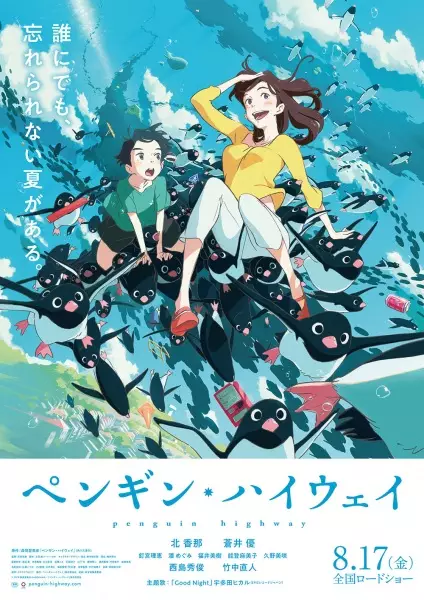

ペンギン・ハイウェイ
For a child, Aoyama has knowledge comparable to an adult. As such, he is often teased by his classmates. He also has a crush on the friendly woman he recently met at a dental office. One morning, penguins start mysteriously appearing around his neighborhood. Nobody knows where they came from and how they managed to get there. Aoyama is determined to find out more, and he joins his new crush in researching the penguins. As time passes, they discover a levitating sphere which they nickname "The Sea." Whatever goes into The Sea does not come back out, and the only things that can destroy it are the penguins. However, something horrifying is created when the penguins do... Penguin Highway follows Aoyama and the woman's research on the mysterious penguins' origin, as well as the many difficulties Aoyama faces throughout his investigation. [Written by MAL Rewrite]
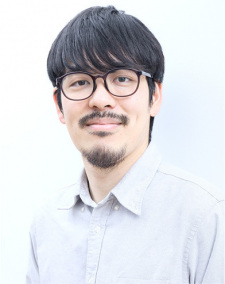
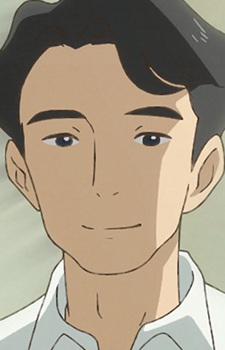
Main
Main
Supporting
Supporting
Supporting
Supporting
Supporting
Supporting
Supporting
-HippySnob-
August 24, 2018
"Penguins inexplicably appear in a suburb some distance from the sea, and a grade-school boy seeks to solve the mystery, in this humorous and at times philosophical novel for young adults that puts author Tomihiko Morimi's playful sensibilities on full display." Adapted from the most finest work since Tatami Galaxy, The Night is Short, and The Eccentric Family "As the wind blew, the grass sparkled, wet from the morning dew. There was a squeaking noise that sounded like the school’s floors creaking. In the middle of the huge empty lot, there were a number of penguins waddling around." Going embark into superstitious child-oriented but with eccentric wholesomeness fromwithin every sense of direction and far detail like in most avant garde Satoshi Kon's films. The Mindsets of capturing the essence by it's captivating caricature can leaves a very own boundary. Visuals are usually vivid and featured through of such memoir abstract detail through surrealism. Despite all the connections between the two, both The Tatami Galaxy and The Night is Short Walk On, Girl Penguin Highway are also self-contained stories that can be enjoyed on their own. That said, they really are best enjoyed together. Each one provides its own nuanced perspective on the contrary between life and youth, and the fact that those perspectives are sometimes lightly contradictory just makes their insights that much saturated. The similarities are pretty obvious, and both stories arrive at similar places by the end, with the protagonists breaking out of self-precognition cycles and learning to live more emotionally fulfilling lives. As if that wasn't enough, The Studio Colorido and his team went and recreated all of the stylistic flourishes and ambiguous format between providing the reluctant art for Morimi's original novels and often the lightning-fast absurdist monologues and ideologies. A heaping dose of surreal imagery and cartoon exaggeration, matching and at times surpassing the visuals of the TV series. When watched back-to-back, it's probably the closest animation could get to the feeling of reading both books, in that the stories are different but the pacing, dialogue, and artwork all feel like they sprout from the same mind.
fillyy
November 12, 2018
Penguin Highway is an anime film about a boy who is mature for his age but still has some things to learn as a growing boy. He is a genius kid who finds great interest in researching new and bizarre phenomena. The film is structured quite well and uses a lot of metaphors through the animation and storytelling to represent the coming-of-age of his character. This film does have a bloated run-time of about two hours and it compromised some of my enjoyment. The dialogue is poorly written and attempts at humour in the film don't quite cut it. I do appreciate the representation ofthe mystery behind the penguins and the phenomena as a metaphor to discovery, exploration, and learning. This film is good to analyse as it presents metaphors in an effective way to tell a story. The animation is decent for the most part. There are moments of extremely fast motion and travel that are depicted in this film which ends up being poorly animated. The animation in these select few scenes felt lazy and sloppily animated. The animation still deserves some praise. The soundtrack is quite good. I liked the transition from the introduction to the opening theme. The songs used throughout this film fit the scenes' moods and added a sense of joy. I love the ending theme as the credits roll after a satisfying ending. The characters were written and developed well in this anime film. The sense of the boy's determination and excitement of further developing his research is portrayed well. Some of the characters' actions felt a little forced but there was one scene where there was a conversation with the boy and his sister which tied up to the ending and connected all the dots. This film doesn't fully explain itself until the very end but it is satisfying to see the films ending scene nonetheless. To be honest, there were moments that I didn't enjoy watching but I did enjoy the ending quite a bit. The lead up to the ending wasn't enjoyable and this film takes its time to fully explain itself. The humour in this film along with a lot of the dialogue didn't feel like it quite fit in the film which impacted my overall enjoyment of this film. I'm not sure if I would recommend this anime to anyone but I do have to say that it's an anime film that has a lot of metaphors and imagery that can be analysed and interpreted differently to discover a completely different and beautiful meaning behind its message of growing up, the reality behind maturity, and overall life events that occur when maturing and growing up. You might like this anime film if you like interesting coming-of-age tales.
YTG21
March 4, 2019
Very good movie with excellent visuals. Recommend it. Worth your time. Shame it didn't get hyped as much as other good anime movies.I would give this a solid 9 plus. This movie is about a pretty smart and curious kid who happens to fall in love with a dentist. The dentist is an actual mystery as the little boy happens to unravel that mystery. The kid is not like super genius but your above-average kid with keen scientific experiments.Do watch the movie with good quality. Because the visuals will blow you away. Don't want to spoil the awesome experience by saying more. Do watch this if youhave spare time. The reason I liked this anime is because of the smooth story, slight feel of romance ( hardly any romance here), awesome visual and good action. Very pleasant experience for me as I was able to fetch a good copy. I liked the characters and the story build up. Normally anime don't have morals or messages...but I felt like the movie made me remember that we all have to leave the world one day.
Saacool
February 23, 2019
So this is probably the visually best animated movie I've ever seen. If you know you're going to see it, see it on the biggest possible screen, you won't regret it. That said its not without its faults, there is one overlying issue, and a couple less intrusive issues that mean my enjoyment does need to be qualified. First and foremost the art is easily 10/10. Just absolutely gorgeous graphical quality, solid animation, the framing occasionally questionable but that's an issue for later. The story on the other hand suffers heavily. I could just leave it at: "This movie only exists for visuals" but theres definitely alot to be said, its too bad there isn't enough committal to any individual theme. Through the story the themes that come up off the top of my head are: "Scientific process," some level of "Trusting others," "Understanding love as one comes of age." among others The first is in service of the mystery element in the plot, which is executed passably. While I personally didn't think it was a well constructed aspect, this is probably enough of a plot/conflict to tide over casual viewers. The second only comes up explicitly once or twice, its not given enough emphasis to feel substantial but it comes up often enough that it felt like it could be built on. The third is a lot more pathos appeal, I don't if I can judge it, its probably more up to the viewer if the pathos hits them towards the end. There is an issue stemming from this theme though, its used to justify a lot of male gaze, which definitely isn't a great excuse There are a number of minor themes that don't really get worked through, like the use of chess and/or science to bridge the generation gap. Or bullying and redemption, and offshoot themes from there. Just generally speaking characters are not used all that well throughout the work, although they aren't egregious either. That lacking overall writing and theming being the biggest issue aside, in terms of smaller issues there are a number of tonally off scenes towards the beginning (some of which i suppose are meant to pay off towards the end but others are pretty straightforewardly out of place). There is the odd obsession with boobs. Its not necessarily an issue until towards the end, a scene with very "subtle" framing around two mountains, and then at the conclusion where it just awkwardly comes to mind. There are a few more points to be made but those are the most jarring. (The former not likely to be an issue mid watch but the latter definitely immersion breaking). In the end its still greatly enjoyable just off the visuals, its just too bad that for the most part the writing is just a means to an end.
Haustlaufivindi
January 15, 2022
A very peculiar anime that is not quite suitable for a mass audience. But those who will like it, like me, may well get such moral, intellectual and aesthetic pleasure from "Penguin Highway" which watching other animated movies will hardly bring. First of all, it should be noted that although this movie is about children, it is not at all for children and not even for most teenagers. Rather, it will resonate with young adults and mature people, especially with those who were or are fond of science fiction, and will immediately recognize the roots of “Penguin Highway” in Lem's “Solaris”, Lewis Carroll's “Alice inWonderland” and Heinlein juveniles. Probably fans of Satoshi Kon's surrealistic narration will also like “Penguin Highway”, although the drawing and the general mood here are not close to him, but rather to the creations of Studio Ghibli. As if opening the “door into summer”, this anime, along the mysterious penguin highway, will take you to a childhood full of miracles and aspirations, plunge into the atmosphere of a summer adventure, a fairy tale and a warm ocean of sincere love, accompanying your journey with excellent symphonic music filled with allusions to Bach and Bizet. For all its magic, "Penguin Highway" is full of subtle psychological observations and sketches related to the everyday life: protagonist's (Aoyama) childish curiosity and openness of mind to the new, encouraged his father, Aoyama's little sister's awareness of mortality, his inescapable absorption by the vortex of love, when Aoyama sits enchanted by the face of the sleeping Lady, feeling joy and marveling every tiny detail which makes it perfect, his boyish interest in his beloved's breasts (which he even turned into a kind of "psychological anchor", as thinking about these Lady’s charms helps Aoyama cope with anger and irritation), Aoyama's stoicism and gradually acquired ability to understand others, immature manifestations of Hamamoto's jealousy and Suzuki's love. Such a combination of realism and psychologism with surrealism can lead to the false conclusion that the "Penguin Highway" is a representative of magical realism. But it is not so - this is hard science fiction, which, like Lem's "Solaris", raises the question of the limitations of rational knowledge and, like Tarkovsky's interpretation of "Solaris" and C.S. Lewis` philosophical essay "The Abolition of Man", supplements it with the question of the ethical boundaries of scientific research and the significance of love and morality, their relations with rationality when confronted with the unknown. Perhaps the main asset of "Penguin Highway" is the wonderful characters, especially the couple of main characters. Aoyama, although a ten-year-old boy, is as far from your “ordinary schoolboy” or the stereotypical child in anime in general as possible. Our hero is a true follower of the philosophy of stoicism, like reincarnated Marcus Aurelius. He is confident, fearless, extremely intelligent, adamant and charismatic. His character is so vividly and boldly spelled out that the rest, even rather non-standard characters except maybe for his beloved Lady, noticeably fade against his background. Aoyama has strong logical mind, an irrepressible thirst for knowledge, a vivid imagination, a strong character and firm principles. He, as a real philosopher, is driven by love for truth and love for beauty, and also by love for the Other, which does not allow him to turn into a complete egoist. He is passionate about solving mysteries, although Aoyama's logical mind sometimes makes it difficult for him to understand the feelings of those around him. Thus he seems incomplete, lacking insight and empathy. On the example of the protagonist, the anime has a good moral message, including with regard to raising a boy who is not just a "enthusiastic nerd", like secondary character Uchida, but also quite a courageous, even fearless young man, who does not shy away from violence, if necessary, as well as a loyal friend and a principled person with an unshakable sense of dignity. He builds and orderly follows hierarchy of values, not wanting to compromise it in his pursuit for the ideal, putting all his love and reason into achieving it. To match Aoyama there is the aforementioned Lady ("onee-san" in the original, which literally translates as "older sister" but in the context means Miss or Young Lady) - beautiful about 20-year-old girl with graceful hourglass figure, kind, cheerful and witty, who in her free from spending with Aoyama time, is engaged in fixing holes in teeth (she is dental assistant) and in the space-time continuum. Aoyama is utterly in love with her, deeply caring for the Lady, enjoying watching her face while also being passionate connoisseur of her magnificent bust. However, like Aoyama, she is also incomplete, being overly dreamy and carefree. The Lady often spends time with Aoyama, teasing him, chatting and training him to master the game of chess. There are also slightly more stereotypical secondary characters - Aoyama's friend, a timid nerd Uchida, the excellent student Hamamoto who is in love with Aoyama and jealous of the Lady, the hooligan Suzuki who is in love with Hamamoto and jealous of Aoyama, the wise father of Aoyama, Aoyama’s little sister - they all create beautiful backdrop, enriching and advancing the main narrative. The town in which Aoyama lives has already been studied by him, the surrounding world is logically ordered, and the plan for the future, in which Aoyama becomes a great man and marries the Lady, has been drawn up and is not subject to discussion. Interestingly, the beginning and end of the anime are accompanied by approximately the same, self-confident remarks by Aoyama which at first sound like empty boasting and yet perceived completely different afterwards. But then chaos bursts into the carefully built rational little world of Aoyama - in a town far from the ocean, Antarctic penguins appear from nowhere. Of course, this ridiculous event challenges the wunderkind's mind and worldview. He immediately rushed to hypothesize about the causes of the phenomenon - from lost pets or falling out of a zoo van, to mutated crows. However, events take on a completely irrational turn when it turns out that the penguins are created by the Aoyama's beloved Lady, and a giant sphere of oceanic water hanging in the air is found in a forest clearing outside the town. The Lady herself does not quite understand who she is, how she creates creatures and asks our little hero to solve this riddle. So Aoyama faces the real Mystery - at the same time his scientific and love interest, which can quench his thirst for knowledge and beauty. The novel (by Tomihiko Morimi) on which this anime is based as well as the anime itself have clear references to Stanislaw Lem's novel "Solaris" (Aoyama even mentions "Stanislaw Syndrome" at the dentist's) which has strict sci-fi narrative, questioning rational cognition. However the Penguin Highway novel was heavily inspired not only by the Lem's novel itself but by the Tarkovsky's interpretation of Solaris in his 1972 art film as well which is full of symbols and metaphors. “Penguin Highway” takes Tarkovsky's vision on the main problem (that the correct solution of the problem of relationship between the subject and the object of scientific research, the way to approach the Mystery, is to treat it not like a mere abstract object, but through empathy and love, applying high moral standards while doing so) and replaces Kris Kelvin (main character) who in the movie represents the right way to treat the Unknown but was tormented by guilt, with Aoyama - pure child with clear conscience. "Penguin Highway" basically deals with the same epistemological problem as "Solaris". This problem of limitation of rational cognition and ethical restrictions of dealing with the unknown is profoundly explained by Tarkovsky in his interview and by C.S. Lewis in "The Abolition of Man". Tarkovsky puts the main problem this way: "The only thing that can be done is to try to take a critical look at the ways of our cognition: through the fight against stereotypes of thinking, with those blocks of logical stereotypes that often replace minutes of reflection for us. Facing something unknown will necessarily require strict moral discipline. That is why the father of our hero says that everything is very fragile there, meaning rather the inertia of human thinking, the way of human behavior in the face of this unknown: as yet unknown. And not for the purpose of preserving themselves, although this also matters, but for the sake of not injuring the unknown, which human thought touches for the first time". C.S. Lewis deals with the same problem in the “The Abolition of Man”: “It is not the greatest of modern scientists who feel most sure that the object, stripped of its qualitative properties and reduced to mere quantity, is wholly real. Little scientists, and little unscientific followers of science, may think so. The great minds know very well that the object, so treated, is an artificial abstraction, that something of its reality has been lost… Many a mild-eyed scientist in pincenez, many a popular dramatist, many an amateur philosopher in our midst, means in the long run just the same as the Nazi rulers of Germany - Traditional values are to be ‘debunked’ and mankind to be cut out into some fresh shape at the will (which must, by hypothesis, be an arbitrary will) of some few lucky people in one lucky generation which has learned how to do it. The belief that we can invent ‘ideologies’ at pleasure, and the consequent treatment of mankind as mere υλη, specimens, preparations, begins to affect our very language… I suggest that from Science herself the cure might come… The regenerate science which I have in mind would not do even to minerals and vegetables what modern science threatens to do to man himself. When it explained it would not explain away. When it spoke of the parts it would remember the whole. While studying the “It” it would not lose what Martin Buber calls the “Thou”-situation”. One might think that a conflict cannot but arise when Aoyama falls in love with the Lady - the same phenomenon becomes both the subject of Aoyama's scientific interest and the subject of his love interest. Modern science had rejected many moral norms and is trying to remove the "rigid fetters" of any ethics, denying objective value and turning even man into "nature" - subject to dismemberment, study and modification. Sartorius in the “Solaris” argues that conducting experiments on “visitors”, including performing autopsy, is totally acceptable - he considers such behavior to be “humane” and in line with scientific approach he believes in. As Lewis describes this worldview: “we have been trying, like Lear, to have it both ways: to lay down our human prerogative and yet at the same time to retain it. It is impossible. either we are rational spirit obliged for ever to obey the absolute values, or else we are mere nature to be kneaded and cut into new shapes for the pleasures of masters who must, by hypothesis, have no motive but their own ‘natural’ impulses… A dogmatic belief in objective value is necessary to the very idea of a rule which is not tyranny or an obedience which is not slavery. Without the dogma of objective value, no power is possible except tyranny, and no subordination except slavery”. Aoyama faces with what sooner or later any inquisitive and honest mind faces - beyond a certain limit, that is limit of rational cognition, beyond the "end of the world" lies something unanswered, something which can not be reduced to rationally comprehensible object, and only choice left is either to believe that this Mystery is nothing, chaos, which has no meaning and value, or there follows recognition of the existence of absolute values, axioms that cannot be proven, but on which the Universe and logic are based. He came to the point where, in the words of one of the heroes of "Solaris" by Soderbergh, "there are no answers, only choices". Aoyama's choice was the recognition of the existence of axioms - the Lady, by herself, is more valuable than trying to solve her Mystery at the expense of harming the Lady. She is not a soulless subject of study, an abstract chaos of the primordial ocean, “nature” which is to be explored and tamed. For Aoyama the Lady is a person, self-containing value, and love for her, which is also rationally incomprehensible, means much more for him than thirst for knowledge or recognition in the scientific world. For Aoyama the Lady, in Buber's words, is not "It", but "Thou". He doesn’t want her to be harmed. Feeling the threat that other scientists may deny the Lady her self-value and turn her into an abstract subject of scientific research destined to be heartlessly dissected (as it happened with "visitors" in "Solaris"), Aoyama first tries to dissolve his small research circle, so that information about the abilities of the Lady may not become known to other scientists, and finally refuses to reveal the Mystery of the Lady to Hamamoto’s father. Aoyama sacrifices his scientific curiosity and his chance to become famous in order to save the Lady from scientific enquiry. There is an anecdote told by Aoyama early on in the movie in which he compares the Lady's breasts and his mother's breasts, which are abstractly belong to the same category of objects, but in reality affect him completely differently. In fact that's how aforementioned epistemological problem may be simply illustrated: the subjects of scientific study should not be treated as abstractions, but rather as quite specific phenomena, to each of which, despite the quantitative similarity, a special, qualitatively different attitude should be formed. The object, stripped of its qualitative properties and reduced to mere quantity, is not wholly real. Aoyama's love, openness of mind and honesty with himself allows him to calmly go where many confined scientific minds stumble - either due to self-deception, or weakness of mind, or even maybe due to outright thirst for power and wealth. "The serious magical endeavour and the serious scientific endeavour are twins: one was sickly and died, the other strong and throve. but they were twins. They were born of the same impulse... There is something which unites magic and applied science while separating both from the wisdom of earlier ages. For the wise men of old the cardinal problem had been how to conform the soul to reality, and the solution had been knowledge, self-discipline, and virtue. For magic and applied science alike the problem is how to subdue reality to the wishes of men: the solution is a technique; and both, in the practice of this technique, are ready to do things hitherto regarded as disgusting and impious... You will read in some critics that Faustus has a thirst for knowledge. In reality, he hardly mentions it. It is not truth he wants from the devils, but gold and guns and girls... In the same spirit Bacon condemns those who value knowledge as an end in itself: this, for him, is to use as a mistress for pleasure what ought to be a spouse for fruit. The true object is to extend Man’s power to the performance of all things possible. He rejects magic because it does not work; but his goal is that of the magician". Aoyama is alien to such an approach - he does not seek to use knowledge in order to gain power over the Lady, to subjugate her, to use her for his own purposes against her will. In this sense, he is not a modern scientist, but rather a philosopher in the classical sense, a natural philosopher, or even a theologian. He strives to knowledge only in order to walk along the narrow, accessible only to a few, "Penguin Highway" to meet again with the one he loves - with the Lady, to return to the Mystery, beyond the "end of the world" - the limits of human rational cognition, where is "God playing around". So once selfless monks, exploring the world created by God in search of traces of God, laid the foundations of genuine science in Western European monasteries, which was only later profaned and made practical instead of formerly popular secular magic and alchemy, which were abandoned. Another layer of the "Penguin Highway" is the interaction between male and female, where the male logic of Aoyama is called upon to unravel and structure chaos - the “primal ocean” which represents feminine principle of the Lady, which is the Mystery, opposite to the light of Aoyama's Logos. After all, the Lady herself does not understand who she is, why she appeared and where she draws her strength from. Like the heroine of “Solaris” she doubts her humanity and reliability of her memories before her meeting with Aoyama - perhaps she is manifestation of the Ocean created out of Aoyama’s dreams. Although the Lady has the energy of the chaos, a huge potential for creation, she is not able to streamline and control it without Aoyama, who brings meaning, structuring the world and Lady's abilities. Tarkovsky said that "Solaris, as it was, materializes the vilest thing that was in these people, as if it moves a mirror towards them, and they are forced to look at themselves... A man and the Ocean, roughly speaking, cannot understand each other for a single moment, because they have nothing in common. And we are talking about the fact that contact - if we can talk about contact - first of all arises here in the soul, in the spiritual sphere: for a man. But as they communicate, something else happens that Kris himself does not expect. From this "scheme" Harey - from communication with him - turns into human. She is animated as a result of this feeling of love and became real human being". Indeed, even though Aoyama structured the chaotic nature of the Lady by his rationality (Logos) it is through Aoyama's love the Lady became real human being. Her imitation of Aoyama's strictly rational experimental approach to solving problems (by abstinence from food) leads her to creation of numerous Jabberwocky which ate penguins and thus enlarged the Ocean from which the Lady drew her energy. This "rational" yet selfish scientific approach of hers potentially may have lead to the catastrophe. However Aoyama's sheer love and worry for the Lady evoked reciprocal love in her. Love means so much for Aoyama that he even sacrifices his scientific curiosity and his chance to became famous in order to save the Lady from scientific enquiry. She in turn loves Aoyama so much that she sacrifices her presence in his world in order to protect it from destruction. Thus Aoyama's male rationality in interaction with Lady’s female chaos gave it structure and allowed her to understand herself, but it was Aoyama’s love for this alien being (the Lady) which aroused reciprocal love in her and led her to selfless act in order to save Aoyama (in a way, like Harey sacrificed herself in "Solaris" in order to save Kris). On the other hand, through love for the Lady, Aoyama is also "humanizes" in a way - he goes beyond the boundaries of his ego, overcomes the narrow limits of any egoism, even scientific, and puts Lady's well-being above his own good (when he gets sick, he worries about her more than about himself), learns to understand other people not only logically, but through empathy. Symbolically here both male and female became complete through their mutual love - the Lady learns about herself, of how to use her abilities and accepts her responsibility to repair the hole in the Universe, while Aoyama gains empathy and insight through his love for the Lady, realizing that rational analysis and theoretical hypothesis are not the same with reality, that abstract object is something different than particular phenomenon, that not all mysteries should or could be solved and that if they should, they must be treated carefully in order to avoid harm. He grew up through realization that answers he seeks for, including the answer to his love for the Lady, lie not in the field of rational cognition. The other characters of the anime reacts differently to the Ocean, which represents different approaches among humans to the Unknown - fear (Uchida), aggression (Suzuki), strictly abstract interest complicated by jealousy (Hamamoto), etc. But there is no dialogue between these different points of view like in the movie interpretations of “Solaris”. Aoyama does not seek to convince anyone of the humanity of the Lady, unlike Kris, who is trying to prove, first of all, to himself, the humanity of Harey. Aoyama, on the other hand, simply acts out of strong convictions. And the mood of “Penguin Highway” is completely different than that of “Solaris” - bright, similar to the sad joy of the last days of summer with the sound of “Summer Moved On” by a-ha. There are many psychological observations in this movie regarding childhood (first love, relationship with parents, openness of mind, dealing with bullies, awareness of mortality, etc.), but it would be a mistake to consider "Penguin Highway" as a coming of age story. Indeed there is no development of Aoyama's character - the anime opens and ends with the pretty much the same speech of the protagonist. In fact "Penguin Highway" represents idea which is opposite to coming of age. It is about returning to innocence, to child-like pure heart, open-mindeness and to the immediate perception of the world. The only scientist (Dr. Kris Kelvin) in the “Solaris” who managed to establish contact with the Ocean did it not through rational observation, but through empathy - he established emotional connection with Solaris through his deceased wife, recreated by Solaris. Yet as her death was his guilt (at least he blamed himself) this connection could not last long as both of them were tortured by Kris' guilt. So the only solution for Kris to reach Solaris was to return to his roots, return to his home and innocence - to childhood. Solaris materialized his dream by creating his old family house and his father on the Ocean's surface - it was clear reference to the "The Return of the Prodigal Son". Tarkovsky's movie begins and ends on Earth, in the protagonist's house. We can find reference to this in the anime, when the Lady tells Aoyama in his dream that "she has always been on Earth" as well as river which ends where it begins and words that "everything ends and returns to where it started". "If you go far enough, you return to where you started" says the Lady to Aoyama, stating that she is on Earth despite Aoyama's travel to another planet. While saying good bye to him later in the movie, she hints that he'll be able to solve her mystery after becoming astronaut and going to space - "then I want you to come and find me". This also alludes to Kris' returning to home from the space in order to reach his ideal, but in the same way this "returning" of Kris was symbolic as in reality he comes to replica of his home which was artificially recreated by Solaris as Kris at last become able to establish communication with the Ocean through empathy. Aoyama is virtually Kris which has returned to his childhood, with clear conscience, highly intelligent but still innocent. The Ocean (manifested in the Lady) and Aoyama also established connection not through rationality, but through empathy, through mutual love, which gave common ground to completely alien beings. For Aoyama the same "returning to home", returning to the Ocean by penguin highway (it is a path by which penguins go to and from the ocean), in other words reaching his ideal (the Lady), means to grow up "good adult" not just intellectually, but first of all morally, through realization of limitations of rational cognition. Thus Aoyama’s growing up lays through overcoming rational reductionism which in a way means returning to childhood when phenomena precepted immediately as particular and whole. The answer to the Mystery lies out of the reach of scientific approach in the rationally incomprehensible sphere of human spirit and only through devoted love and determined strive for the Lady Aoyama may be able to reunite with her - the Mystery. However, the complex epistemological message of the "Penguin Highway" will not at all prevent you from enjoying watching this anime without understanding its meaning at all. Many will enjoy the bright, beautifully drawn summer adventure, the feeling of childhood, enchanting music and the atmosphere of a fairy tale, the psychological observations, the relationship between children and parents, not to mention the unusual, humorous and loving relationship between Aoyama and the Lady (however, in order to perceive this unusual relationship, many may need to experience the same level of struggle with stereotypes of thinking and accept openness to the perception of the unknown, as scientists in their study of Solaris). Someone may perceive this anime as a children's fairy tale or a coming of age story, someone as magical realism, a surreal adventure or a first love story - all these will not interfere with enjoying this wonderful masterpiece. This movie is so unusual and magical that it easily became my favorite anime.
#1997
Popularity
#2306
Members
104,064
Favorites
366
Episodes
1