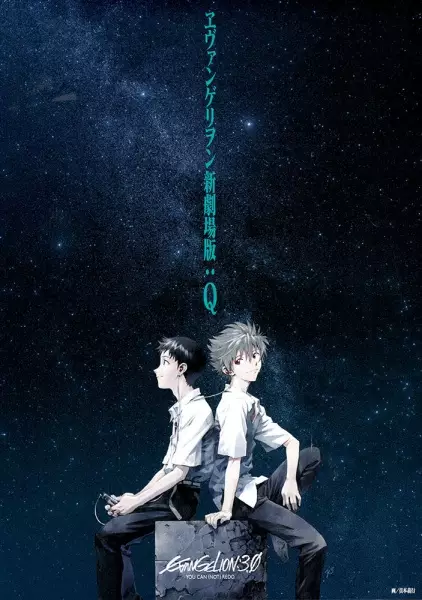





Evangelion: 3.0 You Can (Not) Redo
ヱヴァンゲリヲン新劇場版:Q
Fourteen years after the Third Impact, the Earth is a post-apocalyptic wasteland, human civilization is in ruins, and the people Shinji Ikari knows are almost unrecognizable. Trapped inside Evangelion Unit-01, he is recovered from space by Asuka Langley Shikinami and Mari Illustrious Makinami, only to find himself a prisoner of WILLE, a military faction led by his former guardian Misato Katsuragi. Cold and bitter, his former allies view him with suspicion and refuse to support him as he comes to terms with the consequences of his actions. A hurt and confused Shinji is rescued from WILLE by Rei Ayanami and returned to NERV headquarters. There, he meets and quickly befriends the enigmatic Kaworu Nagisa, who offers him warmth and insight into the state of NERV's war with the Angels. But Shinji and Kaworu's brief respite lies on the eve of a new battle, one in which Shinji finds that his enemies are no longer Angels but former comrades. In this bitter confrontation to determine the future of the world, Shinji will learn first-hand that the past truly cannot be undone. [Written by MAL Rewrite]
Main
Main
Main
Supporting
Supporting
Supporting
Supporting
Supporting
Supporting
Supporting
Supporting
Xukapy
November 20, 2012
I just watched Evangelion: 3.0 and I have to admit it was not what I expected. Having watched the previous 1.0 and 2.0 I knew that there would probably be new characters, new music and scenes, but I did not expect that there will be so many! It's almost a completely new movie, quite different from the old story. Evangelion has always been apocalyptic and this can be seen much more in 3.0 than in the previous 2 movies. While watching it you can feel that the end is coming. There are so many new and never before seen things (really really cool too)! Themusic, the art, the action scenes ,the EVAs and the plug suits, everything is perfect and blends into one unforgettable movie. It was hard to keep up with all that was happening and I wish it didn't end that quickly, I wish there was more! And there will be more. Like before, there was a preview of the 4.0 movie after the credits of 3.0 and yes there will be more new things (it's really tempting to write what they are but I don't want to ruin your enjoyment)! I think that any EVA fan will not be disappointed. Just watch it whenever you can (preferably on a big screen). It will make you think and wonder a lot because, as usual, not everything is explained but this is EVA after all. I know I want to watch it again!
Erenle
April 29, 2013
[Spoilers obviously] I saw Rebuild 3.0 about a month ago, and during that time I didn't think much of it. It was just another movie in the series, and I didn't analyze it to any significant extent. The action was intense, the plot seemed interesting at the time, the animation quality was superb. Recently however (coinciding with the UTW BD subs release), there has been an influx of discussion posts about 3.0, and I figured that there had to be a reason for such a community reaction to the movie; there must be more to think about. So I went to re-watch the movie again with abit more acuity and that's when I came to a conclusion: The movie was a huge cop-out. Evangelion 3.0 answered no questions. I am in no way exaggerating when I say that the movie was better at taking away things that we previously knew rather than clarifying anything for us in the Rebuild series. This is itself is not a bad aspect of the movie, as it can be attributed to two things a) Studio Khara wants us to ask a lot of questions and get curious so that we'll buy 4.0 b) Anno is trying to be clever and allow the viewers to emulate Shinji's confusion after 14 years in sleep by giving the viewers that same confusion. The second option seems much more likely, and in such a case I could say that it was executed well. Shinji probably had no idea what in the world was going on during the entire movie, and I can reciprocate that feeling. If I had to make a list of everything that was left unanswered or simply pulled out of Khara's ass, it would have to be: 1. Why did there have to be a 14 year time skip? The teaser at the end of 2.0 did not imply a time skip in any way and I don't think there was even a need for such a long one. I expected the story to pick up immediately after Kaworu speared Shinji and it could have easily done so with much less clumsy exposition ("Hey Shinji, let's play play Shogi. Oh yeah by the way your mom is the soul of Unit 01 and all Reis are clones of your mom. Oh, and you suck at Shogi.") 2. Why was everyone a dick to Shinji when at the end of 2.0 it seemed like everyone was fine with him going all out and even egged him on? It was also clear at the end of 2.0 that Shinji did not cause enough damage to obliterate the Geofront as shown in 3.0, as Kaworu stopped him beforehand and everyone had evacuated to a shelter of some sort. The desolate wastelands and weird spinning moons and chalices were never explained and were most certainly not Shinji's fault (as the teaser in the end of 2.0 shows a clear afternoon sky and a calm Geofront shortly after Shinji gets speared). 3. Why did WILLE need to break from NERV? It was not NERV's fault that Shinji's supposed Third Impact happened, and it's not like anyone knew of Gendo's Human Instrumentality plan (which I assume was already on the way, because Kaworu seemed prepared enough). There's doesn't seem to have been a need for Misato to have broken from NERV, as NERV wasn't doing anything wrong. It feels like the existence of WILLE in 3.0 is just there to give a conflict without any real depth. 4.What's the significance of having the two spears be Longinus types? How does that even happen and why in the world did that make a difference? 5. Was there any reason to have Unit 06 to contain the Twelfth Angel? I thought Kaworu was pretty comfortable using Unit 06 and I'm not sure why the Twelfth Angel would even be needed to start Instrumentality. Also, how did Kaworu "fall" from the first Angel (which is supposed to be Adam) to the Twelfth Angel and why did that make a difference? Heck, I'll go as far as to say that the entire scene at the bottom of the Geofront was just pulled out of Khara's ass, there was literally no context for anything (Lilith is dead for some reason. Just go with it, we're not going to explain.) Those are just five big ones that I named off the top of my head, but I'm sure there are plenty of other plot holes and unexplained things that I'm missing. 3.0 definitely had the well-choreographed fight scenes and beautiful animation to surpass it's predecessors in spectacle, but it was just that: spectacle. Every significant plot device (WILLE and Wunder, two Lances of Longinus, Adam's Vessel, etc.) just appeared out of thin air and was force-fed into our minds at a lightning-fast rate. Of course I don't go into anything in the Evangelion franchise expecting answers. In fact, answers are the opposite of what I usually expect from anything Evangelion. However, there is a difference between using unanswered questions in context with previously known facts to generate suspense and curiosity and just taking a bunch of haphazard ideas, animating them, and throwing them in no particular order or significance into a movie that was three years in the making. In fact, I walked into 3.0 fully anticipating a high level of suspense and ambiguity. I would have left satisfied, but instead all I got was Studio Khara telling me, "Hey, everything that we told you before doesn't mean shit. Now here, take all of these incidental plot lines and characters that we just came up with and expect you to care about with no context and go enjoy yourself a movie." In fact, none of these things would even have effected me if it weren't for my biggest peeve with the movie: the way Rei was treated. Okay, sure I can buy that original Rei wasn't salvaged from Unit 01. But don't try to play off this new Rei clone as being developed in some way and expect us to care about her or feel anything when she makes the supposedly miraculous decision and decides to eject from Unit 09. No Hideaki Anno, we've spent two movies geting to know the first Rei and seeing her develop from the stoic white-haired nonchalant to a character that can actually warm up and make Shinji happy. It's perfectly fine if she gets killed off for shock factor and for another burden on Shinji's conscience, but that in no way works if you simply introduce another stoic white-haired nonchalant and try to develop her in the same way. Let me guess, this Rei dies/disintegrates/becomes an Instrumentality Trigger too? Big deal. Maybe I had too many expectations of the movie. Maybe I shouldn't have gone into 3.0 with security in my thoughts. Maybe I'm simply not watching it properly or maybe I even missed everything important in the movie (What more can there be? We already know that the all the imagery and symbolism is just there to look flashy). But even if I had a complete and 100% understanding of everything that could have led up to and been in the movie (which is not really the intention of the Evangelion series, and is probably not possible), 3.0 still had a lazy and bullshit execution of a plot. Sure, anyone can go ahead and tell me that I am meant to be confused all I want, but a line must be drawn between confusing your viewers intentionally and failing to make a cohesive and coherent storyline. TL;DR: Hideaki Anno pulled 3.0 out of Khara's ambiguous (albeit well-animated) ass.
PunishedHametsu
January 19, 2013
It’s been over three long years since Studio Khara’s brilliant Evangelion 2.0 graced our unprepared eyeballs and earholes with its fresh and exciting take on the classic anime series. Fans grew antsy and expectations ran higher than ever for this third film in the Rebuild of Evangelion tetralogy to deliver the goods, and Neon Genesis mastermind Hideaki Anno knew he really had to shake things up with the newest installment to keep everyone flocking to theatres and DVD racks in enthusiastic anticipation. And he shook things up alright. Picking up where part 2 left off, You Can (Not) Redo — or Q Quickening, if you’d rather– begins with a mesmerizing six minute sequence in which Studio Khara blows 75% of their budget on Asuka retrieving Shinji’s unconscious body from outer space by shooting the shit out of some artificial angels. It’s lavishly animated and beautiful on multiple levels, keeping the viewer on the edge of their seat as pretty colors light up the cosmos. The action is insane, even jaw-dropping, perfectly setting the film up to be an action-packed thrill ride. And then Shinji wakes up. Do you remember the preview at the end of Evangelion 2.0? Yeah, none of that happens in this movie. Instead, the remainder of the film is a joyless husk; a cheap imitation of NGE that plays out more like self-indulgent fanfiction than something written and directed by the original creator. Following a fourteen year (yes, fourteen) time skip, in which no one has aged a day — a minor inconvenience that is apathetically hand waved near the outset — protagonist Shinji Ikari enters a world in which everyone hates him but refuses to say why. Poor Shinji is just as confused as the audience by this, but all of his requests for clarification seem to result in a reply of “don’t touch anything”, “be quiet”, or “fuck off ya twat”. Misato now commands a fleet of flying battleships, her goal being the destruction of remaining NERV personnel. While this could have been an interesting storyline had something — anything — built up to it, this motivation comes completely out of left field and feels extremely unsatisfying. It is then that Rei, who Shinji was told died in the last film, suddenly shows up to whisk him away to the now-desolate NERV headquarters. The audience is subsequently left wondering why the hell Misato’s fleet hasn’t completely wiped them off the map yet, as their staff consists entirely of Gendo, Rei, Kaworu, and Fuyutsuki. That’s not a joke either; their staff is literally half the size of the average internet forum's before Shinji shows up. By the time the fairly predictable climax rolls around, viewers will have been left utterly bored by almost an hour of nothing interesting happening. The film is mostly set in drab, empty environments — and if that was meant to be symbolic in some way, Khara failed miserably. Plot twists from the original Neon Genesis Evangelion occur in ways that are presented in a much less compelling manner this time around, and the bulk of these scenes simply feature Shinji being kind-of-but-not-really depressed and the expected yaoi ship-bait between the leading man and Kaworu. However, their interactions feel more manufactured than before; an attempt at shallow fanservice rather than a pivotal moment in the protagonist’s character arc… a character arc that hardly even exists in this film. That's not to say that their relationship was particularly well-written in episode 24 of NGE - far from it - there just wasn't enough meat for it to be expanded upon at this level without some major rewriting. Their storyline works more for the concept than it does the execution in both instances, and the way it was presented in the original series, while certainly out of left field, made it seem like it had more depth than it really did. In 3.0, it just happens, because. It didn't really seem to affect Shinji much outside of moving him to the next plot point. But it's unfair to make such a blanket statement at this point in time; the final movie could definitely do some interesting things with Shinji/Kaworu. Fans of human interaction and actual dialogue will no doubt be distressed by the fact that Kaworu is the only likable character and how the interesting dynamics and relationships of past Evangelion works have been completely discarded in 3.0. Rei has maybe twenty lines total, the majority of them being “I don’t know” and “that is not my order”. Gendo says all of one sentence to Shinji and only has a couple more lines after that. Ritsuko exists solely to deliver exposition and disappears after the first act. Misato is basically a new character. Mari speaks almost entirely in one-liners. Kaji doesn’t even appear. The story as a whole is mostly inconsequential and serves only to undermine what was accomplished in the previous two movies. Nearly everything established or built up in 1.0 and 2.0 is either ignored or demolished in part 3, leaving the fourth and final movie to probably function better as a standalone piece than part of a film series. I hold NGE (and the other Rebuild movies) dear to my heart and consider The End of Evangelion to be among the finest films ever made — animated or otherwise — but even my love for this franchise cannot make You Can (Not) Redo look like a good movie. Sure, it excels in the A/V department (as expected), but it has no soul, meaning, or purpose. Anno’s heart is nowhere to be found in this glorified fanfic; it’s a stylish Eva knock-off at best.
FishM_Gabbajow
September 14, 2014
Evangelion 3.0: You Can (Not) Cop Out Harder This movie. Oh why this movie. Coming from someone who has seen the series in it's entirety multiple times, I can in fact confirm my verdict on this film without seeing it's successor. This film is bad. Really bad. "Cop Out" isn't even coming close to describing it. We take all the established material from the previous films and just throw it away, like a used dish sponge. We change characters without explanation, break canon with no explanation, do stupid things for no reason, and don't even take a second to tell you what you need to know. Now, this maybe okay in some fiction, but it never makes sense in this movie, as all the people who could explain and would are here, but won't. getting from one scene to another isn't even straight forward. The teaser at the end of 2.0 may be implied to happen in between movies, but that is such an awful excuse for making this movie so nonsensical. The story is no longer stand alone in the sense that it can be narratively coherent by itself. This movie is fully reliant on what it's successor will do. What is 3.0? insanity and set pieces. and even the set pieces fall flat. If I could compare this film to something, I'd say it represents everything wrong with some of today's anime. Recreating the same things over and over, overusing CG, relying soley on action, breaking continuity with no explanation, and breaking characters with no explanation. This movie ends without answering anyone's questions, and only creates more. Your only solace here are the visuals and the Soundtrack, both of which are great. Even then, they don't make this movie worth watching. 2.0 was one step forward for Evangelion, and 3.0 was a trip and fall into the abyss.
mister_deaf
April 27, 2013
Neon Genesis Evangelion is a legendary series which made its First Impact in the anime industry seventeen years ago. Boasting a cast of characters as intricate as the plot itself, Evangelion has earned both pride and glory as one of the pioneering anime series that has garnered massive audiences and acclaim around the world. But this praise is not without being sullied with controversy. Indeed, the original Neon Genesis Evangelion adaptation was notoriously known for its unconventional plot, its extensive complexity of drama and its indescribably upending conclusion which had left even those most hardened fans mad with confused outrage. The Rebuild of Evangelion tetralogy of filmswere produced with the aim of doing justice to the original series. Now the question remains: Has Hideaki Anno, the Neon Genesis Evangelion series creator, stepped closer to the completion of his beloved Evangelion as he wanted it to be? Rebuild of Evangelion: Evangelion 3.0 Q Quickening takes off fourteen years after the Near-Third Impact that was triggered at the end of Rebuild of Evangelion: Evangelion 2.0 You Can (Not) Advance. After this lengthy period of time, everything that we have come to familiarize ourselves with from the two preceding movies has been drastically and irreversibly transformed. Be warned and brace yourself as you watch this next instalment of the Evangelion series, for this is -the- Evangelion that you are facing and it will not fail to throw you off your rocker regardless of how well-anchored your chair may be. There is no shortage of action in this film and Evangelion 3.0 delivers quite the powerful punch. The opening sequence is merely a taste of the intense combat that is featured throughout the film. An entire set of new EVA units is introduced in this latest instalment for each of the young pilots. The new mecha units have been redesigned and upgraded to beefier and vastly more powerful versions of the predecessors, which is no surprise considering the large time lapse that has taken place. However, unlike in previous conflicts, the battles that are now being fought are not simply between Mankind and Angels. With the advent of the Near-Third Impact, loyalties have shifted and Misato Katsuragi’s anti-NERV organization WILLE now wages a brutal war against NERV with its flagship the AAA Wunder that possesses enough insane power to kill even God. The dramatic changes unveiled in Evangelion 3.0 do not simply limit themselves to merely new EVA units and circumstances. Surprisingly, the most unsettling transformations occur at the human level. Past allies have become each other’s mortal enemies in this desperate and merciless battle to determine the future of Mankind. Evangelion 3.0 paints a grim blood red future which is personified by the redesigned returning characters and on the newcomers to the cast. The atrocities of war have been made apparent on the battle-hardened and gloomy faces of the cast. It is quickly ascertained that humanity harbours a great contempt for a tragically oblivious and ignorant Shinji Ikari and it is implied that the responsibility of a dreadful sin weighs on heavily on his shoulders. Ironically, much to the contrast of the entire world that has changed around him, Shinji Ikari manifests no change whatsoever despite the time that has passed since his last conscious thoughts. Veterans such as Misato Katsuragi and Gendou Ikari return with menacing demeanours and sporting superfluous eyewear. Unit 02-Dash EVA pilot Asuka Langley Shikinami makes a stunning return with a magnificent eye patch and her trademark tsundere compliments. Fans will also rejoice with the coming of Mari Illustrious Makinami’s glasses and her perpetual state of latent sexual attractiveness. Kaworu Nagisa makes his debut as the new EVA pilot and steals the hearts of many with his enigmatic charisma. In essence, Evangelion 3.0 features the original cast whose colours and identities that have been completely repainted with the red gore of war. Evangelion reprises its role as an animated psychological trip straight to the mental asylum, but unlike the original adaptation, Rebuild of Evangelion manages to fall into the boundaries of comprehension that mere mortals possess. The film itself takes on a grim atmosphere and maintains a subconscious aura of mystery that shrouds the audience in ignorance. Many details concerning the events that occurred within the fourteen year time lapse were meticulously withheld for a large part of the movie and the culmination of this tension has a tendency to leave its viewers in a catatonic state of shock. Near the film’s conclusion, viewers may expect to suffer symptoms of post-traumatic stress disorder and exhibit inexplicable confusion with many unanswered questions that will hopefully be resolved in the series finale. Currently, I can attest to that deranged and disturbed mental state. The musical score of Evangelion 3.0 composed by Shiro Sagisu is an artistic masterpiece in itself. The music features a harmonic symbiotic relationship between orchestral instruments, choir and electric guitars surprisingly added to the mix. Most strikingly of all, the piano pieces steal the spotlight. Kaworu and Shinji’s piano duet vastly contrasts the doom-and-gloom atmosphere that Evangelion 3.0 boasts, but their light musical presentation was a refreshing welcome which provided a brief respite to the other heavy piano pieces that reflected the grim circumstances. Hikaru Utada’s fans will also scream in delight with her return to the musical scene with the melancholic Sakura Nagashi featured while the curtain of credits draw to a close. With the long-awaited and highly anticipated Evangelion 3.0 aweing its audience with top-tier animation quality and a masterfully executed story reaching its conclusion, viewers will be left with even more questions and angst as they wait for the Rebuild of Evangelion to draw to its inevitable close. Evangelion 3.0 leaves much to be desired, and perhaps to the dismay of many, its direction may be out of the comfort zone that was presented in the preceding films. It seems that the producers are hell-bent on pursuing the near-suicidal mission of saving the original Neon Genesis Evangelion ending, and in order to achieve this daunting task, they employ the same tactic of “screwing over Shinji as many times using the most dastardly means that they can possibly conceive.” After all, it is Evangelion, and it is a necessity that the remake lives up to its reputation. One can only dream that they succeed, and I look forward to that day. Now returning to the initial premise of embarking on this arduous and lengthy journey; have we come one step closer to answering Hideaki Anno’s goal of remaking Evangelion as it he wanted it to be? Alas, that is a question which can only be answered by Anno himself. However, as witnesses of his artistic masterpieces, each individual of his audience is privy to their own answer to that question. With this, I thank you for reading mine.
#1459
Popularity
#524
Members
487,837
Favorites
2,229
Episodes
1