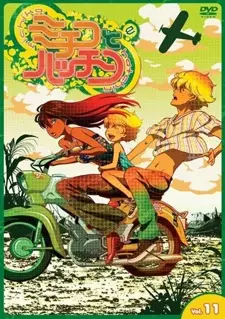

Michiko & Hatchin
ミチコとハッチン
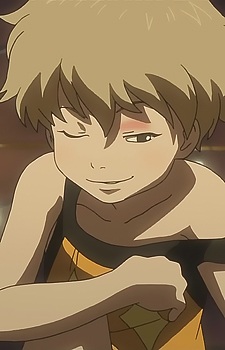
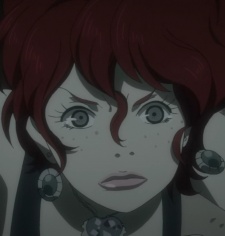
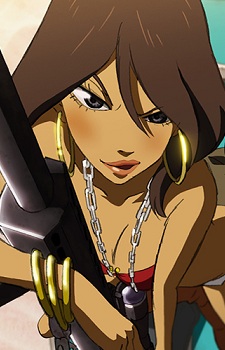
Under the unrelenting heat of the South American sun, hardened criminal Michiko Malandro breaks out of a high security prison for the fourth time in search of a man from her past. Michiko finds a clue in the form of Hana Morenos, a young girl trapped under the fists of her abusive foster family. In her powerlessness, Hana fantasizes about the day when she is finally whisked away from her captors by her very own Prince Charming. Little does she know that her fated prince would turn out to be the buxom and husky convict who charges in atop a stolen motorbike, claiming to be her mother. The unlikely duo chase down their dreams in the sun-drenched land of Diamandra, navigating through the cacophony of betrayal, poverty, and child exploitation rings hiding in plain sight. However, wind of Michiko's manhunt soon reaches the ears of criminal syndicate Monstro Preto, and a storm of gang warfare begins brewing over the horizon… Michiko to Hatchin is the story of vibrant people and their clashing agendas, and of all the unlikely human connections drawn together by one elusive man. [Written by MAL Rewrite]
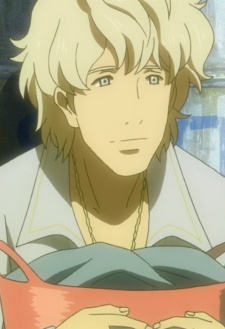
Main
Main
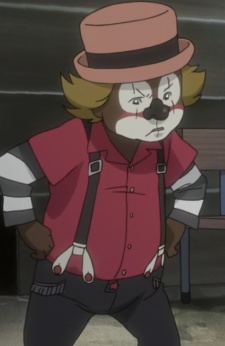
Supporting
Supporting
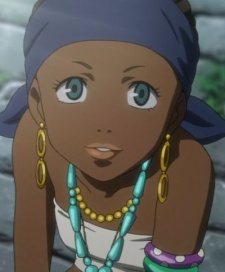
Supporting
Supporting
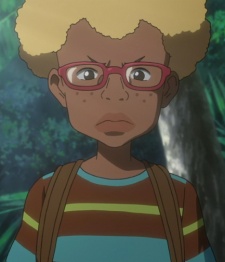
Supporting
Supporting
Supporting
Supporting
Archaeon
March 21, 2009
What would you get if you crossed Thelma & Louise with City of God? You may get complete drivel, or you may, if you're very lucky, get something like Michiko to Hatchin. Manglobe, the production company (and the brains behind), Michiko to Hatchin, have really pushed the boat out with this anime. But then again, they're no strangers to success or quality, especially as they are the company responsible for Ergo Proxy and Samurai Champloo. The series was directed by Yamamoto Sayo and is effectively her first full time at the helm of a production, and whilst this may have been a gamble on the partof Manglobe, it's one that certainly paid off as Michiko to Hatchin has a certain "fresh" quality that I haven't seen in anime in a long time (not since Cowboy Bebop in fact). The tale is about an escaped convict named Michiko Malandro and her quest to find her lost, and supposedly dead, lover Hiroshi Morenos. In order to achieve this, she "kidnaps" a girl who is supposedly Hiroshi's daughter, initially thinking that she would know where Hiroshi is. However the world has changed during her years in prison, becoming at times more brutal and less forgiving. The decision to set this tale in a quasi-South American (Brazilian), country was a stroke of genius as the creators and director could do things that would never have been included had the show been given a more staid setting. In addition to this, the characters themselves are able to have that little bit more "flair" about them because of the setting, something that initially detracts from some of them until one realises that the gaudiness is all simply part of that character's persona - more on that later though. Now fans of Ergo Proxy and Samurai Champloo will know that Manglobe are able to produce some stunning visuals, and Michiko to Hatchin is no slouch in this department. From barren deserts to lush jungles, from slum shanties to sleek factories, the level of detail is excellent, and well above that of many recent titles. In addition to this, the various settings in which the story takes place have a certain realistic quality about them that belies the fact that this is an anime. In addition to the great scenery, the characters are extremely unique and well designed, again, adding to the sense of realism about the show. The leads and immediate supporting cast are individuals to a tee, with each character possessing a certain lifelike quality that many anime would find difficult to match. One area where the show really excels is with the animation. It's rare to see such lifelike movement in anime, and in many ways the fluidity and natural motion in Michiko to Hatchin represents a step up from that of Samurai Champloo. Sound is another area where this show works very well. The effects are extremely well chosen and choreographed, and while some may be overwhelming, this is actually purposeful because of the situations the characters may find themselves in. The music used throughout the series is atmospheric and refreshing, and is reflective of the Latin-American feel of the show. The OP, a track called "Paraiso" by the Japanese jazz band Soil & "Pimp" Sessions, is an excellent piece that harks back to the classic "Tank!" of Cowboy Bebop fame. Unfortunately the same cannot be said of the ED, "Best Friend" by Karutetto, as it is a bit too "boy-band" for my tastes. One of the truly great things about Michiko to Hatchin is actually the cast. Manglobe and Yamamoto took the somewhat surprising, move when they chose the actors, opting not for established traditional seiyuu but for established screen actors. However, this seemingly risky choice has paid off in spades for the series. Maki Yoko (Battle Royale II: Requiem, The Grudge), is extremely versatile as the sexy, pouting, hotheaded, and somewhat childish Michiko, whilst Ohgo Suzuka (Year One in the North, Memoirs of a Geisha), is truly excellent in the role of Hatchin as she provides a depth of character that is rare to find. Which neatly brings us to the characters themselves. Michiko is willful, headstrong, selfish in the extreme, and very childish. Hatchin is somewhat shy and nervous, but also responsible, tidy, and hates laziness. Both leads are extremely well defined from the outset, something which is reinforced as the relationship between the two is extremely combative (the pair are effectively polar opposites). Others like the terrifying Satoshi Batista or the terrier-like (i.e. always chasing Michiko), Atsuko Jackson are also well defined from the start, and through the first few episodes it may be difficult to see how any of the characters are actually developing because of the strength of the characterizations. One reason for this is because both Manglobe and Yamamoto decided against using normal anime practices for developing characters, and instead chose a far more realistic and subtle approach. One needs only to compare the relationship between Michiko and Hatchin (or even Michiko and Atsuko), at the beginning of the series, with their behaviour towards the end to see exactly how much they have developed as characters. An example of this is the fact that Michiko is initially very much an annoying, sexy, pouting, selfish jerk, however at the end of the series she reminds me of Balsa from Seirei no Moribito. Hatchin, Atsuko and Satoshi also undergo this extremely subtle development (you'll see how much by episode 20). I thoroughly enjoyed this series for many reasons, the main one being the fact that this is a show that is not afraid to show the casual brutality of its setting. There will be some out there who didn't like the way the series ended, however I found the conclusion to be very much in keeping with the essence of the series, whilst at the same time being far more realistic than the endings of most other anime. Michiko to Hatchin is a rarity in the medium, and should not be prejudged on the basis of one or two episodes. The complexity of each character, the harsh, unforgiving setting, the sometimes brutally real actions of individuals, and the extremely subtle development all serve to make this one of the best shows of 2008, and one of the best anime to appear in the last decade. At times Thelma & Louise, at times City of God, at times Laurel and Hardy, this anime possesses a style and flair that surpasses that of Samurai Champloo - a feat by any measure. Given the quality of this series, and its previous titles, I'm rapidly becoming a fan of Manglobe.
WishMeLuck
May 17, 2011
In a world plunged into an immoral wasteland, it is often difficult to find friends and comrades that you can believe in. The cold brutality of the situation may be that you simply can’t. But sometimes a slight glimmer of hope remains amid the tumult and chaos, that maybe perhaps you really do have a partner out there, a comrade that will stick with you and care for you to the very end. The world depicted in “Michiko to Hatchin” is this wasteland, a setting fraught with greed and death amid the indigent and the impoverished. This is South America (Brazil), or rather a variation ofit. From the gritty alleys, to the squalid shanties and the lush and viridescent landscapes, Manglobe doesn’t disappoint. The setting is not only a beauty to look at but is also something unique and rare that allows the show to take wing and travel regions that are distinctive yet still within the realms of what was initially established. Through this director Yamamoto is able to channel the genius of Watanabe and the result is something unlike any other that challenges and perhaps even surpasses works such as Cowboy Bebop and Samurai Champloo. The story chronicles the lives of mainly Michiko Malandro, an escaped convict on a desperate hunt to find a supposedly dead man that was once her everything and Hana Morenas nicknamed Hatchin, the apparent daughter of this man and who Michiko initially thinks is the ultimate clue to helping her achieve her goal. The premise is set, but the main plot is less prominent than what many would expect. In this show it is merely used as a device to tie in many self-contained stories together and give the show a satisfactory conclusion because ultimately this show isn’t about the goal, it never was. The show is about the journey and the bonds that are broken and healed along the way. And the stubborn, immature Michiko along with the self-righteous, mature Hatchin are characters real and charming enough to carry you through this journey and not let you go. The show also has an astounding soundtrack that lives and breathes nearly as much as the characters do. The energetic soundtrack fits every beat and every pulse of this high-powered train ride, yet also smoothly transitions towards a more melancholy nature when the situation calls for it. Through this the music is able to create remarkable scenes of raw emotion and immeasurable charisma that echo and persist long after you have finished the show. The animation is no slouch in its department either. One of the reasons why Michiko and Hatchin feel so startlingly real is that they look and move like real people as well and while there are times where the animation quality may drop, it still stays very consistent throughout and lends to an experience that is both aesthetically pleasing and emotionally stimulating. Ultimately this is a series that as well as examining the lengths in which people would go to accomplish their goals, more importantly looks at the bonds that are formed during that time. Michiko and Hatchin go on a dangerous adventure together as a tornado of a tag team, and through this are able to form a relationship that overcomes the trials and tribulations that come their way and even the long and arduous chasm created by time. It is a bond both honest and deep that lies in juxtaposition with the superficial and vapid bonds congesting the streets of Brazil, a strong bond of indomitable love and unending trust. And though there are many instances throughout the series where the two characters pull each other down with their flawed personas to the extent that you would think they are better off without each other, it becomes evident later on how much they need one another, how much more they are able to accomplish with each other as their platforms. The show does well to depict two sides of a relationship, one of anger and disarray during quarrels and also one of a serene and resonant beauty during the rare moments of an embrace and while the show is far from deep or a riddled literary piece of work, it does well to show the power of friendship and love in a realistic manner and the way in which it is able to travel the void of time and always be there right when you need it, proving that love is far from a burden, but rather a privilege. The privilege of being responsible for another. Sayo Yamamoto’s first work is by no means perfect, but through its unique setting, remarkable soundtrack and captivating characters, she is able to construct a show filled with raw emotions and a flaring style constituting to a heartening, disturbing and riveting journey that in my book is nothing less than a masterpiece.
Jodyqt
November 27, 2013
Anime that are set out of Japan whilst not as uncommon as many may think are still few and far between but what is even more rare is an anime that takes place in Latin America. Michiko to Hatchin is representative of everything that is uncommon but amazing about the anime industry: it has style, nice characters, a unique setting and a vast array of themes, and whilst at times it is harsh it never forgets to be light-hearted in its ingenuity. Michiko to hatchin's story is rather unusually executed; my original impressions was that the series was episodic but upon completion that statement was afairly inaccurate description, but in saying that I still find that each episode is 'episodic' in its own way. Each episode does contribute to the story being told, but interestingly enough they also provide detail on many background details: such as the lives of a group of kids growing up in the slums Sao Paulo, or even settling in on the business motives of an organized crime network hosting a bullfighting tournament or a prostitution ring etc etc... To its credit these many moments scattered throughout the series helped maintain my interest throughout the series entirety; each scenario was new and refreshing, each life had something different to offer. Unfortunately, criticisms still need to be considered, as whilst all these many moments managed to pique my interest. I could only feel that they somehow seemed to be a foot-hold in grabbing the viewers attention because the actual story seems kind of trivial in comparison to many of the side-stories. This observation still only further justifies why i believe this series to be good, as it came up with such a variety of side-stories that managed to maintain a consistently high level of quality, that made the long journey all the more worth it in the end. One thing that I wanted to point out upon entering this series, is that at the period of time in which Michiko to Hatchin is set. Brazil was going through a revolution. I was personally a little disappointed when I discovered that this series covered very little of that historic event. Not to discredit the series for this because instead of doing that, it's vivid portrayal of life in Brazil at the time seems particularly plausible and in many ways makes up for my disappointment. Underneath every garbage bin and behind every building, the place oozes with a deep sinister corruption. Everything from the police cover-ups and false justifications, money laundering, prostitution, you name it, this series probably has it. A positive to all this, is that the series doesn't try to make a bad name out of all of this. It simply lets its vision unwrap itself never bombarding its audience with moral preaching. This is the lives of these people, are they happy with it? Maybe, maybe not, but at least they are making a living out of what they got, and if what they have is morally ambiguous then why not use its absolute best. The actual story whilst being rather trivial as I mentioned earlier is twisted around with the many side-stories adding a bit to the series worth. What irks me though is the motivations behind the foundation of the story, our main character Michiko being one of the soul main characters comes across as ditzy and in many ways, really gullible which does little to help with story progression, and most of the story is moved forward by side-characters. Even with these criticisms, I still must say that Michiko to Hatchin's ending is probably one of the best conclusions to an anime series that I have ever encountered. One problem I have found with many shows is that they take too long to conclude or the exact opposite where they don't have a conclusion. Michiko to Hatchin falls fair and square into the middle. Covering everything that it had previously established and no noticable plot threads are left unresolved without seeming to rushed or too slow. One of the most notable things about Michiko to Hatchin's story is its interesting cast. The show takes the time and effort to construct a diverse quantity of personality and character traits. I do have a couple of issues with some minor and the main characters, some minor characters (not many) are occasionally used as plot conveniences but even these characters still get some level of development. Emphasizing that this series waste's no time in establishing its characters personalities, ambitions and motivations, which is certainly a good thing. One of the best things about watching this series was watching Michiko and Hatchin's characters develop as the series played out, they're an unusual and possibly eccentric combination of mother and daughter. Many times I began to wonder if they are even related, like at all, but as a member of the audience, I could feel a relationship present, whilst being slightly unorthodox it was not an impossible relationship to envision. It is entertaining to watch as they interact, learning from each others mistakes. Watching the unusually mature Hatchin take care of the naively reckless but caring Michiko, and vice-versa. My complaints with some of the characters, are that their motivations are occasionally very vague. A good example would be some of the interactions between Michiko and Atsuko, a few of the outcomes from there encounters are occasionally poorly explained and sometimes a little stupid. Without giving away any spoilers, there was one particular scene where I was screaming at Atsuko in my head for not carrying out a particular action that she had tried so hard to achieve but in the end didn't carry it out. The reason? Well I might have missed it because the motivation behind it was sort of precarious but the consequences for iit rendered their reasons completely arbitrary. Our main character Michiko isn't without fault either, very prone to some questionable actions throughout the series, chasing someone who is clearly trying to get away from her just seems to be a motivation that is slightly beyond my comprehension. Other than these complaints it was an interesting cast nonetheless and despite these people's shortcomings, these actions (even the ones that I previously mentioned) never felt out of character and becomes a small plus in my book. The Art whilst not anything spectacular is very clean and this quality is constant throughout the entirety of the series. The most notable moments are seen in the many action sequences. Each scenes choreography was well animated rarely ever resorting to cheap techniques (and if the series did they were very well disguised). Each scene had a fluidity all on its own, it was fast-paced when it needed to be, retrospectively it was slow when demanded and normal between these many moments. Each frame never felt out of place when actions were being displayed. I mention this because the sheer breadth and style of the many action sequences in this series never lets up and the art knows how to dictate the adrenaline pumping moments and thus contributes to the series well-established atmosphere. One of the best things about Michiko to Hatchin is the background designs. Never before have I seen a 3rd world/2nd world country presentation as detailed than I have in Michiko to Hatchin (with a possible exception of "Flag") in an anime/manga series. Everything from the large open spaces accompanying a desolate road; to the slum, crime ridden districts of Brazil's many cities, towns and communities. The level of detail that goes into many of the locations emphasize the tensions building in each district and community. The character designs across the board are very commendable, and I loved how all the characters have a degree of acceptable realism to them. Whilst Michiko the main lead has a busty accentuated figure, her figure is complimented by the shows diverse characters and as mentioned previously with their large range of personalities, the same can be said for each character's designs. Figures often appear in a versatility of chubby, well-groomed and formal, poor and hungry, old and young character types. Serving to make the characters far more relatable, increasing the series impact. One particular aspect of the art that I wish to take into consideration is actually the opening and ending credits. One thing I loved about this series was the mesh of beautiful textures that I witnessed upon entering and leaving every episode. With a hint of photo-shop thrown into the blend of pseudo-phantasmagorical art reminiscent of a retro-American psychedelic hippie movement. Michiko to Hatchin's soundtrack is a well-made and thoroughly appropriate soundtrack with a collaboration of string instrumentals, mostly of the ukulele and acoustic guitar, with a common accompaniment of percussion instruments such as the timpani, bongos and such. A lot of the songs in the series ost are wildly and energetically presented, catering to the fun and adrenalin-soaked and occasionally sexually fused atmosphere that the series provides. Some of the tracks are particularly memorable, most notably the opening sequence with its bubbly bebop jazz style. Effectively melding its complex harmonics making it an absolute blast to listen to, with the show forcing me to listen to it every single time I started a new episode, and that is definitely a good thing. Each track adequately sets the tone of each scene and never fails to boast an exciting entourage. Overall I see no reason to complain about the ost. It is effective, different and great to listen to. Overall, this show does have a couple of faulty points, where entertainment value can be somewhat lacking on a couple of occasions and at times I felt the characters make stupid decisions but they are few and far between. And as I mentioned before, rarely do those stupid decisions seem out of character, so if anything it helps benefit the series. Altogether this series is a quality adventure taking place in an untouched landscape. It has a positively balanced story with non-repetitive scenario's, the show never tries too hard at what it does and loves to revel in its own world. It knows its limits and actively makes use of that boundary. It is a vision that is both refreshing and entertaining and I would recommend it to anyone who shares a delight in venturing into a world of interesting characters and constant thumping of a glorious beat in every background. Story 8/10 Characters 7/10 Art 7/10 Sound 9/10 Enjoyment 8/10 Overall 8/10
Yardhouse12
July 20, 2023
Michiko to Hatchin is really good show. I've heard that the show was inspired by a trip Yamamoto and her girlfriends took to Brazil after she went through a breakup, and it's very obvious. Most of the men in this universe are shitty people, but the most meaningful and special relationships the characters form are those between women and girls. And as a 20-something year old woman, I watch my pals bounce around from crappy boyfriend to crappy boyfriend only to ultimately come back to the support network of their female friends. That's not to say that all romantic relationships are bad or that everyonein them is unhappy, but I think there's a very specific time in a lot of women's lives that this show plays off of. And I know that in my own life I've really come to cherish and love the women that I call my friends, much like the relationship between Michiko and Hana. The show understands that these friendships aren't always sunshine and rainbows and that can be women really complicated, but even at the characters' worst I still see a lot of realism. It's not a perfect show, it spins its wheels a little towards the end and the animation takes a bit of a nose dive, but the message is so great. The clothes are stylish, the music is great and it was coordinated by Shinichiro Watanabe. I definitely recommend it.
maazu
August 17, 2015
Have you ever felt the need to watch an anime that butchers the Bechdel test in every episide, centered around two incredibly strong and well-rounded female characters? Then look no further. Michiko e Hatchin follows the two unlikely comanions on their journey to find a man from their pasts, and in the course of the show we see wonderfully written characters going through beautiful character development. The two main characters - as well as many of the recurring characters - go through important character development, and it's so fabulously excecuted you don't really notice it until it hits you hard. As well as being fullof female characters, the cast is diverse, showing a wast collection of characters from different races and backgrounds. Of course, the characters aren't everything in a show. The story is enjoyable and exciting and keeps your attention throughout the entire series. This is as much a story about finding oneself as it is about finding Hiroshi, maybe even more so. As both Machiko and Hatchin figure out who they are and what they want, the grow closer and learn the meaning of true love and understanding. The story deals with various issues connected to living on the road, being poor, supporting a child etc., and it shows us that even an atypical family is a family, however small, and that even if you call yourself a family you may not actually be one. To summarize, Michiko e Hatchin is true feminist writing about finding oneself and eachother, and it's truly beautiful.
Rank
#1048
Popularity
#1257
Members
221,343
Favorites
2,670
Episodes
22