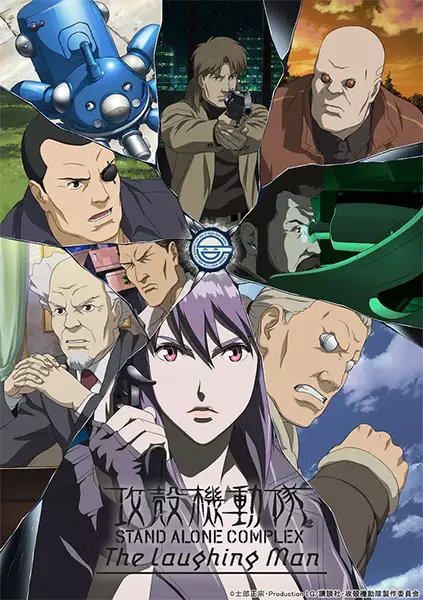

Ghost in the Shell: Stand Alone Complex
攻殻機動隊 STAND ALONE COMPLEX
In the not so distant future, mankind has advanced to a state where complete body transplants from flesh to machine is possible. This allows for great increases in both physical and cybernetic prowess and blurring the lines between the two worlds. However, criminals can also make full use of such technology, leading to new and sometimes, very dangerous crimes. In response to such innovative new methods, the Japanese Government has established Section 9, an independently operating police unit which deals with such highly sensitive crimes. Led by Daisuke Aramaki and Motoko Kusanagi, Section 9 deals with such crimes over the entire social spectrum, usually with success. However, when faced with a new A level hacker nicknamed "The Laughing Man," the team is thrown into a dangerous cat and mouse game, following the hacker's trail as it leaves its mark on Japan. [Written by MAL Rewrite]
Main
Main
Main
Main
Supporting
Supporting
Supporting
Supporting
Supporting
Supporting
Supporting
Archaeon
September 28, 2009
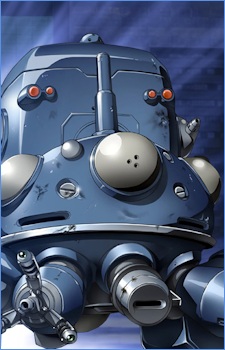
Many anime fans consider the 1995 movie "Ghost in the Shell" to be a classic of the first order so when the Stand Alone Complex series was released six years later, many were sceptical as to how good it would actually be (and I will admit to being one of those people). Production I.G. managed to put everyone's fears to rest though, just not in the way we all expected (I'll explain in a bit). Ghost in the Shell: Stand Alone Complex is a series that really doesn't need any introduction. The original movie proposed a disturbingly plausible future for mankind that is akin to thework of Philip K Dick and William Gibson. The series however, deviates from the movie's premise in a number of ways, some of which are not obvious at first, partly because of how the series is laid out. SAC isn't a sequential series, and is actually made up of two completely different plot elements - Stand Alone and Complex. The Stand Alone episodes focus on the work of Section 9 as they investigate various cases, while the Complex episodes focus on the main plot - The Laughing Man. This has caused a certain amount of confusion for some people who were expecting a series that developed in the manner a "normal" anime would, especially as the Stand Alone and Complex episodes were interspersed with each other. Where the series really shines though is in the complexity of it's story, characters and setting. The biggest change between SAC and either of the movies is that the focus is not on "individuality". Instead, SAC takes a far more societal perspective, and the Stand Alone episodes are actually essential in this respect. Without them, the viewer would remain unaware as to exactly how the members of Section 9 fit into the workins of society and government and, more importantly, how they fit with each other as a team. Each member of Section 9 is a survivor after all, and the Stand Alone episodes highlight this fact in a way that the movies never could. The Complex episodes that form the "main" story arc can be watched as a separate entity, as is proven by the release of the compilation movie in 2005. The problem with this though, is that the viewer is far less familiar with the workings of Section 9 or the influence of it's chief, Aramaki Daisuke, within the political, police, military and business sectors of society. With regards to the stories in both Stand Alone and Complex, they are very well scripted. The change of themes between SAC and the movies has been accomplished in a unique and inventive manner, with far more focus on poiltical machinations, schemes, plans, plots, second guesses, double jeopardies and outrirght confrontations. The series is extremely successful in it's depiction of a society that has begun to stagnate, partly because of the usage of cyber culture, with Cyber Brain Sclerosis being a metaphor for this deterioration. One of the truly great things about SAC is the debates that occur in most episodes, some of which are slightly surreal (in the middle of a gun battle for example), but all of which provide the viewer with a perspective on what is occuring that is sometimes surprising. Some may find this philosophication to be off putting, but SAC, indeed the entire Ghost in the Shell franchise, was never intended to be all glamour and no substance. In terms of art and animation most viewers agree that SAC is a step up from the original movie, even though the series had a much lower budget per minute of animation than the either of the movies. One of the upshots of this is that, whilst the majority of the series is extremely well animated, especially in terms of blending CG and normal animation, there are occasions when the foreground action does not conform with the CG background. Even with that flaw though, the series remains extremely well animated and choregraphed for the most part, and aside from that issue I mentioned, most other problems are simply nit-picking. I will mention one thing about the animation though. SAC is particularly noteworthy for it's fairly accurate portrayal of combat. Unlike most action anime, there are no glamourous finishing moves here, no power-ups, no fly-by-wire martial arts, etc, etc. Instead what we have is what one would expect in this sort of scenario, a group of tough soldier-like veterans who fight to win. Sound is another area where the series excels and, in many respects, SAC is actually superior to the movie in terms of it's effects usage, voice acting and score. The dubs for both Japanese and English are extremely well done, with the English dub adopting a far more intuitive approach instead of an outright translation. The voice actors for both dubs are extremely well suited to their roles, with Tanaka Atsuko reprising her role as Kusanagi Motoko from the original movie along with Ohtsuka Akio and Yamadera Kouichi (Batou and Togusa). Mimi Woods, who played the major in the first movie, has been replaced in the English dub with Mary Elizabeth McGlynn, and I have to admit that I much prefer McGlynn's portrayal to Woods' as her voice has a cadence and that is far more suited to the role. Given the length of time between the original movie and SAC, it's only natural that there would be some changes to the cast. On the whole, SAC is well served by it's voice actors, and the changes to the cast have actually improved the quality and delivery, making the characters that little bit more believable than they were before. The music for SAC was composed by the great Kanno Yoko, who should need no introduction. The often inspired creations add a depth and tone to the series that goes beyond anything achieved in the original movie, however most people will simply focus on the OP and ED. "Inner Universe", the opening track to each episode, has become one of the most played anime songs in history, a remarkable feat given that the lyrics, written by Origa (Ol'ga Vital'evna Yakovleva), and Shanti Snyder, are almost completely in Russian. The track, sung by Origa and soprano Benedict Del Maestro, is striking in that it blends several different genres of music. The ED, an alternative rock track titled "Lithium Flower", is another rarity in anime as it is one of the few songs written and sung in English. I could wax lyrical about the music in this series, especially as I'm a huge fan of Kanno's work, however I think you all get my point already. One of the biggest differences between SAC and the original movie is the inclusion of the other members of Section 9. In the movie they were either bit parts or alluded to in conversation. Here, however, they are characers who not only have a role within the framework of the story, but individuals in their own right. The major characters like Kusanagi and Batou have also undergone a tranasformation, not in terms of looks but in terms of persona. Each of the main characters feels more "real" than they did in the movie and, while this may be due to the fact that the series can give more background, this is still a very noteworthy achievement as anime in general is notorious for offering poor characterizations. Possibly the most fascinating and interesting addition to the series are the Tachikomas. These A.I. controlled "mini-tanks" sometimes act as comic relief, however their main pupose is to highlight how humans in the series are becoming more robotic, whilst beings like the Tachikoma are becoming more human. This is one of the reasons why the Tachikoma are presented with childlike voices and qualities, especially an insatiable curiosity. SAC is one of the few anime that, in my opinion, can only be "enjoyed" in purely subjective terms. The complexity in both its story and characters, combined with its technologically plausible setting, ethical debates and philosophical arguments, means that whilst there is a lot of action, there is actually a point to it all instead of it being just mindless violence. This is very much an intelligent series for intelligent people and, while there are some who won't enjoy it, I found the blend of action, mystery, philosophy and thriller to be truly excellent.
Supporting
Fleure
December 9, 2014
The relationship between man and machine is one often fantasized by artistes in diverse mediums. It’s a subject matter that fully intrigues and it's not hard to deduce why: it parallels heavily with our own society. The unwavering quench to advance collective technologies and the relative dependency on machines has drastically grown with the ages. Authors, artists, social critics, and scholars from all walks of life have adopted this framework and produced some of the most imaginative works that not only entertain, but step beyond the fictional realm to perhaps foreshadow a similar tomorrow not too far away… One such examination is the Ghost in theShell: Stand Alone Complex (GitS) series. Revitalizing the cyberpunk genre and honing in on various veins of society, GitS is a series that revamps the boundaries of typical sci-fi/cyberpunk story-telling. Set in the future, the first installment of the Stand Alone series trails the respective missions and cases dealt with by an independent, elite unit established by the government titled Section 9. The manner in which the story is structured is peculiarly fascinating: the show is divided up by stand-alone episodes and "dividual"/complex or simply the pivotal episodes that deal with the central case of the laughing man. Therefore, GitS can be considered largely episodic. That by no means indicates a lapse in quality as those stand-alone episodes fulfill many functions; one being, to present an encompassing view of the society depicted and the individuals that compose it, especially the leading cast. It is especially effective because a large part in appreciating this narrative is understanding the intricacies of the world it offers. To put it simply: nothing is done in vain. With that being said, this is a tale that unfolds slowly. Although, it is a crime-centric series which would imply a certain degree of action, it is smartly and properly utilized. This is a multi-layered show and each layer is carefully peeled and explored. Composed of exceptional writing, intuitive expositions, and an extensive setting, GitS manages to create a consistent flow without relying on an array of shock values or incessant action fillers . Furthermore, the action isn't used superficially or gratuitously, but as an auxiliary measure to provide a worthwhile experience. This isn't the series to go to for fast-paced and continual action; it has long tenures of recurring dialogue and expositions, which can be detractingly slow for some. Regardless, the pacing is well-seasoned; allowing for a more effective and comprehensive outlook of its society. The GitS society is composed of cyborgs, humans, A.I, and other mechanically-altered beings/machines. Consequently, one can imagine that certain inquiries are bound to rise up. From ontological speculation to political turmoil ; from corporate debauchery to ethical breaches; the series inherently sets up a plethora of topics for the audience to ruminate upon. The core of GitS is embedded in its concepts of “ghost” and “shell” which are extrapolated further to craft the philosophy of the series. Created truly in an ineffable manner, it borrows from a handful of philosophical narratives and works of literature to construct a hyper-“cyberized” realm which draws upon the aforesaid concepts and generates the Stand Alone Complex; yet it is also able to simultaneously maintain an air of authenticity. Even though the dominant focus is on macro/social-constructs, there are some other very interesting nuances. For example, the disillusionment that accompanies “upgrading” one’s body is subtly depicted by various events such as cyborgs not being able to indulge in their favorite foods because their new bodies have no need for savory sustenance. The perpetual paradox of clinging to one’s humanity by physically losing it is wonderfully crafted. One can't help but ponder upon where the attributes of "human-ness" start and end. Additionally, that paradox is juxtaposed quite ingeniously by the addition of the innocently intuitive Tachikomas (A.I -robots), who throughout the show, question concepts such as individuality, free will, fate, freedom, life, and death which are essentially synonymous with the history of human thought. Where there is humanity lost, elsewhere it is “found”. GitS shows us that it’s precisely where we least expect it, by “our own” design, can it resurface. What GitS must be endlessly praised for is its uncanny ability to combine various disciplines such as: literature, ethics, philosophy (to name a few), and incorporate them in a relevant and meaningful way. There is both insight and context to almost every concept, reference, and quote that was used in the show. All of this is swiftly integrated and explicitly reflected through the laughing man case. Furthermore, literary devices such as motifs, allusions, and references are implemented elegantly within the narrative, rather than as a detached component. A recurring flaw that occurs in similar works is the constant abuse of irrelevant references, quote dropping, and other superfluous insertions that serve no purpose whatsoever other than to give the false impression of depth or intelligence. This series manages to avoid that and instead, provide perceptive commentary without breaking immersion, while also resonating deeply with the viewer as it frequently serves as a reflecting mirror of the reality in more than one way(s). In a society where machines are questioning their existence, humans are questioning their humanity, and amidst it all, the marriage between man and machine is eternalized; GitS takes a very neutral stance and just reports, rather than preach. This is a notable technique because it abandons the didactic tone and allows room for personal introspection/interpretation, rather than force-feeding a subscribed ideology. Embracing its thematic heart, GitS offers a level of unmatched profundity. The characters of GitS are equally fascinating-- not as glamorized mouth-pieces-- but as integral entities that provided a kaleidoscopic view; one seeped in many colors. “One-woman army” Major Motoko Kusanagi is undoubtedly the driving force of the series. Her attributes aren’t necessarily unique, but convincing given her role. She serves as a concrete pillar for her team and as an intriguing lead for the series. The rest of the characters are also well-maintained and created with care and purpose. A point of true admiration is how the show expands on the collective struggle of the team in accordance with the prevalent themes and ideological undercurrents. Furthermore, the dynamics between the characters are assiduously constructed and are focal to the characterization aspect of the show. There is a surprising amount of depth in the dialogues between the members of Section 9 and those they pursue, which often times is the only portal into understanding the respective character’s persona. Though the characters remain somewhat innately enigmatic, they serve a pivotal role in providing different views on other characters and the world that they occupy. One caveat that lightly burdens the series is the lack of [balanced] development of the characters on an individual level. There were some members that were rarely elaborated upon even though they were essential to the team. Some characters changed while many remained the same—which isn’t necessarily a fault--but the series could have taken it step further to add a deeper element of empathy. Sporadic and detailed snapshots were provided for certain characters which were a delight, but tantalizing nonetheless, for they often incited the urge to want more. The characters were generally solid, but alas, there was a lingering emptiness—a feeling of something “lacking”. The connection that is often forged between the audience and the characters they watch or read is important but due to the “dehumanized” nature of the series, GitS was underwhelming in that aspect. Although, it can be easily argued that it remained true to its ambitions and what it was trying to achieve, the overall experience could have slightly improved if individual characterization was given more weight. Despite that, the characters were all interesting and maintained the allure of the GitS world with grace. Aesthetically, the series does not disappoint. GitS has this precocious ability to show and tell, which allows it to manifest into an unforgettable audio-visual-sensory experience. The art and animation are commendable not just because of fluidity and style but because of well it intertwined with overall atmosphere. The visuals and sound work hand-in-hand to provide a front-and-center view for the audience, thus producing a remarkable atmosphere. For example, the urban metropolis, sprawling with celestial skyscrapers and engulfed in a sea of endless lights-- is often infused with a continual dark and destitute tone-- that is partly depicted by off-setting the vibrancy with shifts in darker colors and shades. One can feel the alienation dripping off the atmosphere and embrace it as if it were their own. Truly, the animation and art style provides a very visceral experience. Further complementing the atmosphere is the sublime soundtrack of GitS. This doesn't come as a surprise to many considering Yoko Kanno is the woman behind it all. From the OP to the overall background music, GitS provides a euphonious journey for one’s ears. The meshing of various dialects and fusing distinct styles-- such as jazz, classical, and electronica-rock-- all are combined to assemble one of the most spectacular soundtracks that will surely find a place on one’s playlist. In essence, Ghost in the Shell: Stand Alone Complex is truly a gem that paints a very interesting picture of not just a potential future, but also of one that parallels the present. As humanity continues to leap towards a rapidly changing future and form a holy liaison with its pursuit of technological advancement, many of us can’t help but ponder upon where all these efforts will take us, and more importantly, whether they will be worth it. Until then, astute creators and artists will continue to prophesize and fulfill their roles as latent harbingers. To exploit that imagination and satisfy one’s curiosity comes the GitS: SAC narrative that should be experienced by all those who are interested in such a reverie. Graced with the wisdom of a sage and the creative curiosity of youth, Stand Alone Complex is a tale that can be thoroughly relished on various planes of cognition and enjoyment.
GonzyChan
August 19, 2013
Science Fiction has come a long way from stories involving the unknown reaches of space by the works of Jules Verne and H.G. Wells to stories that draw social implications of our society from famed authors George Orwell and Phillip K. Dick. There is little doubt that anime productions have tackled a lot beneath the limits of the genre ranging from Space Opera to Cyberpunk. One series that is often considered one of the most popular in the anime Sci-fi genre is Ghost in the Shell. After the movie's success, directed by celebrated director Mamoru Oshii, we now have Ghost in the Shell: Stand AloneComplex, but this time without Mamoru Oshii involved with the production. Considering how well Oshii directed Ghost in the Shell, people were skeptical about whether Stand Alone Complex could get the best out of the movie in quality storytelling and animation. Long story short, it did almost every aspect correctly. The way the story sets up isn't just following one main story: the Laughing Man plot arc. Instead, it follows a formulaic style that makes us support the Section 9 team going after various cases worldwide. An argument against the show's credit is that the Stand Alone episodes deviate from the main focus of the Complex episodes that chronicle the Laughing Man plot arc. I would argue that the Stand Alone episodes are essential to deal with a considerable amount of character development for our main characters. Some of the episodes offer memorable story arcs that aren't important to the overall narrative. Still, they continuously show how immensely well crafted the writing is in not only the dialogue but of how well put together the world is in the show. What's so great about the world of Stand Alone Complex is the writers' subtle details in the account, such as the political and social plateau of how the world works that genuinely make it a living, breathing world and not a superficial one. As character development goes, Stand Alone Complex stands out because it gives a lot of time to put forth plenty of depth with each on-screen character. It doesn't just apply to the main characters. Many of the side characters in each episode that we come across have a deep level of characterization to where they aren't just these one-sided antagonists who do evil. They're just ordinary people who are in this situation because of the society they're living in. Each specific main character has their own uniquely written personality that shows their presence in the show. Handled with great care and precision, they all play out so well with each other that they make you care so much for their struggles and relationships as coworkers trying to handle any given situation they meet. Chemistry is crucial in tying together a well-rounded cast of characters and Stand Alone Complex hits the nail on that part exquisitely. Batou and Kusanagi are especially two of the best characters, only by how well the chemistry is between the two from their interactions and personalities. Many consider the most poignant Ghost in the Shell saga is its music. Outcomes to famed composer Yoko Kanno producing all the music in Stand Alone Complex and providing a profoundly layered texture to the overall atmosphere in the show. Shows typically set in a futuristic setting rely heavily on electronic-sounding orchestration mixed in to feel more natural within the landscape of the environment. While there are indeed a lot of that to experience through the ears, Yoko's brilliant blend of Jazz, Electronica, and Classical musicianship combine each other amazingly well to give the soundtrack its unique style that she is widely known for. I find Kenji Kawai's score in the Ghost in the Shell movie left more of a profound impact on me in how it incorporates a lot of dark ambiance into the atmosphere. However, there is no denying the creativity that Yoko put into the score, and ignoring it would be insane when discussing the show. Usually, anime movies have the upper hand as having stellar animation and art, while TV anime have a limited capacity in the level of budget that film studios have. There are, of course, exceptions to this, and Stand Alone Complex is one of them. Sure the animation isn't as fluid as the movie. Still, how the art's quality perfectly compliments the ascetic vision that the artists were going for it's a real accomplishment to experience. How the city looked, the characters all having a distinct look that makes them recognizable the moment we see them, and how the 3D models of the machines flow with the 2D animation of the characters work with each other sublimely. It is haphazard to call Ghost in the Shell an action show since it relies heavily on Noir aspects of tone and pacing, unlike in your typical action show, where the pacing is more fast-paced. However, once it does delve into action territory, that is where the animation and sound take it to the next level of technical genius. The fluid motions involving characters fighting each other still hold more to this day than many other action anime in terms of animated fighting sequences and gunfights. The sound effects of machines and gunfire feel authentic and genuine, which puts you on the edge of your seat as you're transported into the scene. So yeah, as I said, the show on the technical level is surprisingly still amazing to look at as it once was ten years ago. One other aspect of Ghost in the Shell that is often noted when discussing the series is its profound philosophical themes. The movie delved into the ideas of consciousness and ethics of A.I. At the same time, Stand Alone Complex is mainly centered on political corruption and conspiracy theories that involve the book "The Catcher in the Rye." The one part where it does delve deeper into is when we follow the Tachikomas and how they describe the "Ghost" in each machine through their A.I. Oddly enough, it works even though these childlike voiced machines seem as though they were there for comic relief. The political themes thrown into the plot don't have nearly as much impact as the writers thought they would have. The way it's told through a conventional storytelling style does not try to seem as though they wanted to make a big political statement. That's not the same as saying that it's a significant knock on the show, but it's something that I felt would've been much stronger. Whatever the case, Ghost in the Shell: Stand Alone Complex will surely leave a strong impression on people on what makes a story stand-out as one of the most well-crafted entries in writing great characters and a large detailed world. It is by no means a show that you can like for the action or the great animation because that is only one-third of what makes Stand Alone Complex so deep in its overall philosophy and story. Well-written character progression, great world-building, and fantastic animation all combined into one glorious experience that will inspire anyone who wants to get into writing stories for years to come. Grade: A
amaity
April 22, 2007
The 'Ghost in the Shell' movie was already a ground-breaking anime, inspiring such works as 'The Matrix' and 'Animatrix'; the TV series just takes it one step further. Unlike the movie, the TV series focuses on Section 9 and their exploits rather than the deep philosophical quandaries presented in the movie. The over-arching storyline of "The Laughing Man" leaves you flabbergasted as it unfolds like a cherry blossom. Conspiracy and intrigue are the main strengths of the story where nothing is quite as it seems. Perhaps the only flaw are some of the convoluted dialogue that might put off someone who'slooking for a typical no questions asked, "wham bam, thank you ma'am" kind of action anime. GiTS will make you think and recollect the minutest of details. The anime demands your full concentration and attention and makes you appreciate the complexity of the plot. Coupled with some superb action sequences with synchronous heart thumping music by Yoko Kanno, GiTS delivers a great experience. The animation is as good as it gets, nothing less is expected from Studio I.G. It's a great improvement from the movie (then again the movie was made in 1995, almost 6 years before the TV series). The first series neglects to really look at any of the characters in depth, except for "The Major" - the deus ex machina of the series. They remedy this in the second season (see my review for GiTS: SAC 2nd Gig). Unlike the Major in the movie or manga, this Major suffers neither from constant self doubt nor erratic behaviour. However, a little more character development for the other players would have been nice. Don't put off this series because you didn't like the movie, this is a whole new ball game, as the cliche goes. Then again some of the more hardcore fans of the first movie believe that the TV series diluted the core philosophical issues and rather gunned for a audio-visual spectacle. There's nothing wrong with that I say, this is still one of the most captivating anime series I've seen. Highly recommended.
klemon_qhap
April 27, 2008
I haven't written any reviews for any anime so this may be a bit rocky. -.- Story: Stand Alone Complex is definetly not your normal anime. Just the name should give away the fact that this is a different kind of anime. What i have to say about the story of Ghost in the Shell is that it is really confusing. If you are looking for an anime that you can sleep through then keep looking because even if you are able to read the subs (i like to watch only subbed anime =) then there is still a high possibility that you won't get what's goingon. The reason I didn't give GITS a high score in the story category was mainly because the plot wasn't steady as it should have been. I actually didn't even know what the plot was until the very end of the show. Instead what i got was a bunch of random episodes that mostly didn't correspond with each other. Its just not that enjoyable... Art: Hmm...what do I say about art? Art these days usually doesn't have the major mistakes it used to back in the old days. I gave art a 7 because although it didn't have anything wrong with it, I still didn't like it. The art in this show is more realistic than that of others (as in if you see an old guy you also see every wrinkle on that old guy...). The thing is I just couldn't fully accept the style of this anime's animation. Sound: If by sound does that mean sound effects, voices, or music? In any case I would still give it a 8. I didn't notice much in sound effects besides what would sound normal in reality (guns, footsteps, ect). As for voices for the characters, I thought all suited the characters exceptionally well. The main reason I gave this category a 8 was because of the music and background music. The main theme song turned out to be one of the best anime songs I have heard. It also really set the mood for what this show was trying to be. Character: The characters in this show did not do much of a job in any development. Mostly they were just there and none of them had much of a story. What I look for in a character is a sense of attachment which is exactly what i didn't get in GITS. Instead I felt like I didn't care what happened to any of them and actually felt like the show would be better without some. One character I did like was Tachikoma, but that was only because it was a giant fighting robot with machine guns and rocket launchers that had the personality of a child (who doesn't find that funny?) Enjoyment: Well this series did have its ups and downs (mostly downs) and i ended up feeling like it would have been better if i didn't waste my time. The fact is I couldn't get into this show because there was no character development, little plot, and it made cyborgs sound boring and useless. If your looking for a show where you can't wait for the next episode to begin then i suggest that you don't watch this show...
Rank
#208
Popularity
#631
Members
422,297
Favorites
8,974
Episodes
26