The Heike Story
平家物語
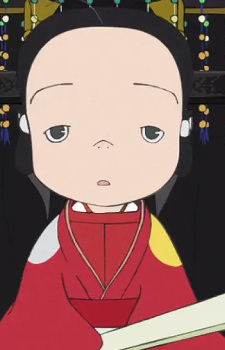
The Taira clan, also known as the Heike, holds immense authority over Japan. When a young girl, gifted with an odd eye that allows her to see the future, foolishly disrespects the clan, her father pays the price of her crime with his life. Soon after, as fate would have it, Taira no Shigemori—the eldest son of the clan leader—stumbles upon the same unfortunate girl, who now calls herself "Biwa." Biwa informs him that the downfall of the Heike is imminent. After learning of the great injustice Biwa suffered at the Heike's hands, Shigemori vows to take her in and care for her rather than let her be killed. In an era of rising military tension, the Heike are in the midst of a cunning struggle for power, and bloodstained war is on the horizon. Shigemori, whose eyes allow him to see spirits of the dead, is both anxious and hopeful to prevent his clan's demise. Biwa, however, is reluctant to reveal the future to him and must adapt to her new life filled with both happiness and sorrow in this pivotal chapter in Japanese history. [Written by MAL Rewrite]
Main
Supporting
Supporting
Supporting
Supporting
Supporting
Supporting
Supporting
Supporting
KANLen09
November 24, 2021
The Heike Story, Heike Monogatari, or more objectively documented in Japanese history books as: The Tale of the Heike. No matter what you call this show, I see it as 3 words: a cult following. It's so pleasant, fresh and refreshing to watch a historical work like "The Tale of the Heike" which was already very well documented in the history books throughout centuries as an epic account throughout its many translated derivatives, and the well-known 3-person team of director Naoko Yamada, scriptwriter Reiko Yoshida, music composer Kensuke Ushio who were once stationed at KyoAni making "A Silent Voice" and "Liz and the Blue Bird" beforethe well-beloved studio's unfortunate-and-fateful arson tragedy, came together to produce this show being adapted from Hideo Furukawa's 2016 work of the same name, translated into modern Japanese. Which if you read it in context to the series of events, having to see this notable event in animated form, while it will not beat the essence of the original work, at least this show is a statement piece to add to that work. This 13th-century historical epic depicting the rise and fall of the Taira clan that's set during the Genpei War between 1180-1185, this story comes to us from a 3rd person's POV perspective of Biwa, a young girl and traveling biwa (the instrument) minstrel. And the first thing that you should be aware about Biwa is of the uncommon trope of a character that has heterochromia, which if you have watched shows like Wonder Egg Priority before, you know that there's a legit story to tell behind those pair of differently coloured eyes. And in the case of Biwa, her "origin" story is that she is the daughter of a biwa hoshi (lute priest) who got killed by guards of the Taira clan after she unintentionally insulted them, and she dresses up as a boy in order to avoid detection from the Taira assassins. Biwa is brought into the Taira clan after her blind father got killed through the help of Taira no Shigemori, the next in-line heir to the clan, in the midst of the Genpei War and needing to claim supremacy to spread the Heike name far and wide. Being the eldest son of the monk Kiyomori, the irresponsible and hard-headed leader of the Taira clan, Shigemori is a true taskmaster of what he does to keep his clan alive, no matter the hard tasks and internal strifes between family members (most especially the leader Kiyomori) in concern towards the raging war against their natural enemies, the Genji. Like Biwa, Shigemori is also heterochromic, but as opposed to Biwa foreshadowing the future with her pair of eyes, Shigemori on the other hand, can only see the spirits of the dead. But the two come together because of the fact that they're both heterochromic of seeing the future and who dies in various periods of time, and knowing Biwa's resentment on the Taira Clan for killing her father, this fact is only known in the most secret of secrecy between the two as Biwa is taken into Shigemori's family disguised as the usual orphaned child to be a companion for his wife (Tokuko) and 4 children (Koremori, Sukemori, Kiyotsune and Arimori). The fact that both Shigemori and Biwa have "merged hands" is just for one sole purpose: to avoid the downfall of the Taira clan (and simultaneously the Heike) and with the amount of foreshadowing done between the two, they make amends to save the people they know that will face death imminent at specific junctures of their lives. But don't forget that as much as Biwa can only do so much to help the loved ones around her, her main role is to serve to chronicle the events of the Taira clan's rise and fall. Playing the biwa as the events are documented through solemn song, Biwa's voice gave some atmospheric pressures thanks to her VA Aoi Yuuki, and the juxtapositions of how both the Taira clan and the Heike are slowly but surely squandered of their control provides a sense of realism for a time period that many of us would've preferred to be in just for a day, and nothing more. Truth be told, I always get goosebumps whenever Biwa plays her lute to depict the winners and losers growing towards the Genpei war, and not just for Aoi Yuuki's distinct vocal performance, but also that Kensuke Ushio's magic for BGM around those periods are the ones that you'll really feel that it hit the hardest as you see people die for glory, valor and especially not to be humiliated by a rival clan like the Genji. Remember, pride back in those days are akin to today's high-standing political positions, only that the olden days have more weight to carry people and moral with them. It's for this reason where the story really shines, and as complex as the Tale of the Heike gets with many characters, locations and motives that you will not understand if you're that type of person who likes to have a fix on the content, but it's meant to tell a much bigger story: a larger than life story that only some like Biwa have the privilege to witness while helping others out of their rut if it's possible. We are also seeing this in a 3rd person perspective, so we're also in Biwa's shoes to really see what'll happen in this epic journey of proportions unimaginable. Your mileage may vary depending on whether it makes or breaks your experience. Historical work like this, there's bound to have characters which may seem like a lot of actors running around a traditional town going places, and unless you're the type to really analyze what these characters add to the mix (I sure as hell understood), then this will also prove as a miss point to you. I have watched many historical live-action dramas that has the setting be like this (most of it are Chinese-based but it's similar), and can largely understand the adage of "too much cooks spoil the broth". But for a show that's based solely on this time period, you have to understand that there's a lot going on under the hood from royal families to ordinary townsfolk, because every fateful decision will be carried down to the people, and these decisions have serious implications to affect not tens but hundreds and thousands of people, affiliated or not. For example, taking Biwa into context as she journeys and dictates the life of a Heike, there's not one single person that is the sole cause for many to act. It's through meticulous and calculated actions to think for your own people, starting from the top-down royalty, and when pride and ego comes into the mix for characters like Kiyomori, the downfall is just as striking as the rise to fame, even if albeit a short-lived one. Everyone's decision matters, and not one character is wasted because he/she feels redundant to the entire story, which says a lot about character dynamics, especially for one rooted in the historical complex. Unsurprisingly, you should already know of the 3 names by now: Naoko Yamada, Reiko Yoshida, Kensuke Ushio. These 2 ladies and a man have very prolific portfolios of works to their name, and the departure from KyoAni to Masaaki Yuasa's studio Science SARU marks a brand new chapter where this feels like the old Madhouse standards of Masao Maruyama being flexible with his staff to do what they want to do with creative freedom. Nevertheless, The Heike Story also really glows with vibrancy and colour throughout the entire show, and since "Eizōuken ni wa Te wo Dasu na!" a.k.a "Keep Your Hands Off Eizouken!" was a significant mouthpiece for Masaaki Yuasa's studio in 2020, that excellence carries over in this show, and I can never get bored of watching visuals done the same that are made different which gives it a very unique feel of watercolour oozes. It's mouth-droppingly gorgeous, I'd say so myself. Making things better is the OST for the show, part of which I've already covered especially for Biwa's song recital tunes. Hitsuji Bungaku's OP is really good that's not worth even an episode's skip, and agraph feat. ANI's ED "unified perspective"...I don't know if you're feeling this with me, but there's a sense of duality, not just with the black-and-white visuals. It almost seems condescending to have monochrome colours to show Biwa's state of mind, and I guess the two-toned, mostly instrumental song is there to provide context of perspectives that somehow, work really well to give a ghastly vibe. Does it really hurt for me to say that I want more of the trio's work portfolio, now that The Heike Story is offically added into the list that stands alongside KyoAni's films? Hell yeah, I suppose. The consensus is that you don't just watch shows that are done by well-enough reputable people, entities or even companies, because what concerns us is the real meat of the show and its contents, and for a work that's based on a centuries-old book, The Heike Story is a story worth telling for the many generations to come, and you and I both form the cult that will spread this underrated work that has gone under the radar for time past and present. Let this story not be gone and left in the dust in the future, and I applaud Naoko Yamada, Reiko Yoshida and Kensuke Ushio for the substantial effort for this underrated anime that's one hell of a learning journey through Japanese history.
SingleH
November 24, 2021
I love Yamada Naoko, and the last thing I expected this to be was a disappointment. Think about whether or not you'd be excited to watch a light novel adaptation because its fans swore by it. Now replace “light novel” with "14th century epic chronicle,” and instead of getting an adaptation which enlivens the story, you get the screenwriters reading the SparkNotes summary of the original text out loud while periodically inserting their own headcanon at the most inopportune times and reinterpreting the setting in a similarly jarring fashion. A historical text of this nature had simply too much ground to cover, and an elevenepisode TV anime didn’t give them nearly enough time to do so. They had to juggle the half-baked emotional lives of the Taira Clan, the manufactured backstory and narrative relevance of their anime original protagonist, Biwa, and the extensive formal narration sequences stringing the story together. Needless to say, the resulting anime is a bit of a mess. What’s worse is I know this is all most likely Yamada’s own fault. A director has a team of episode directors and storyboarders on projects not because they don't want to do all the directing themselves, but because most of their time is spent being showrunners who oversee creative decision making, and it seems KyoAni's tightly knit team and the constant presence of Ishihara and Takemoto really supported her more than anyone originally thought. Deciding to add so much anime original content only to cram the rest in with it was stupid, and it quickly became clear Reiko Yoshida had no idea how to pace such an unruly source material, the likes of which she's never handled before. Anyone who hasn’t read the original text will find this rushed adaptation to be completely impenetrable. However, considering this show’s lukewarm reception even in Japan, any source material unfamiliarity which international viewers may have isn’t really the problem. The show is just plain boring, and everyone other than Biwa has the presence of a completely forgettable potato. Speaking of Biwa, this show feels like feudal Japan sanitized for the social justice generation. Yes, underage arranged marriages are bad. War is bad. Classism is bad. But these are all fundamental aspects of feudal Japanese society, and to have our obnoxious little Greta Thunberg protagonist scream in the faces of warlords about their moral bankruptcy and have them respond with goofy anime smiles and laughter instead of doling out punishment is just plain stupid. AstralBread wrote a preliminary review where he described Biwa as a protagonist who “simultaneously has zero presence [and] is a giant eyesore,” and I couldn’t have said it better myself. The story tries to prioritize a vague sense of climax towards the end, but in the early episodes, it absolutely refuses to make any necessary cuts. They’ll sideline important characters to focus on those who quickly lose relevance without even including their whole story because limited screen time didn’t allow, so what you’re inevitably left with is a bloated cast of increasingly inaccessible names and frustratingly identical faces, an anime original and out-of-place protagonist who gets inserted into plotlines she obviously has no place in, and partially developed characters with butchered backstories to whom you say goodbye shortly after meeting. The animation is usually fantastic, which is surprising considering Science Saru has always been an absolute clown show. Yuasa burned out as soon as he realized producers couldn’t be artists, and he put Eun-Young Choi in charge of the studio despite being deeply out of her depth. They hire way too many foreigners, many of whom are total amateurs and not used to Japanese work ethic, and worst of all, they take on more projects than they can realistically handle as a studio. They were doomed from the start, and up until now, they’ve been incapable of making even a ten episode anime worth a shit for Netflix, one of the richest entertainment companies on the planet. I figured there was no way they would be able to keep up with Yamada's unrealistic KyoAni standards, and the production would fall apart as soon as she failed to deal with the industry’s incompetence plaguing a project of hers for the first time in her sheltered career. However, I can’t even grant them this, because their chosen color palette is so dry and dull, the animation can look bland even when it moves well. This is yet another case where I’m forced to blame Yamada herself, because the Director of Photography, Kazuto Izumita, worked on absolutely gorgeous anime like Great Pretender, Ousama Ranking, and Rolling☆Girls, so it can’t possibly be one of those cases where the DOP wasn’t supervised closely enough by the director. She obviously had a vision, and it obviously didn’t work. It’s a respectable passion project, and it has lots of beautiful shots and impressive sequences of animation, but it’s the most style-over-substance rendition of classic literature you could possibly imagine. Thank you for reading.
Spirit_Chaser
November 24, 2021
Heike Monogatari is a beautiful series rich of meaningful emotions that the viewers will come to experience. It feels like a dream that slowly turns into a nightmare. It's a series that feels it has the same spirit Odd Taxi and Sonny Boy had. That being that it's a passion project trying to sincerely write a good series that doesn't use the cheap types of tactics mainstream anime uses to pull in viewers. I love anime that take risks, though they become the highlights of the season, the dedicated viewers have to accept that hardly anyone will watch them or appreciate what they tried todo. This series has flaws, but what frustrates me more is the mob of people who have lost touch of what writes even a decent series. Thus, trash like Mushoku Tensei and 86 become the most popular ones; the ones that will be hailed as masterpieces in the years to come, while a series like this, that is significantly better, will fall into obscurity and though appreciated, that group will be small. That is the fate of anime like this and that's an even greater tragedy. Biwa goes on with the ability to see people's futures. For her it's suffering to see what she has to see, and her frustration goes on as she feels powerless to be able to do anything about what the visions show. The Heike are filled with loveable and well written characters. They struggle to carry their clan as they travel, look for support, and battle against those that want them to disappear. As for the flaws, the story was obviously told very fast since the staff only had 11 episodes. Some of the characters I liked the most felt rushed. The music, though I enjoyed it, felt strange in the way it was executed. The opening and the ending are my favorite of the season, however. The fights are sometimes grandiose, and sometimes slideshows. Despite it's flaws, it's a solid 9/10, and I hope more passion projects with the skill and ambition of this appear soon to relieve me of mainstream anime.
Dramaddict
November 24, 2021
While many people were kindly disheartened by Naoko Yamada’s departure from KyoAni, I see it as a logical step forward in her already auspicious career. Yes, KyoAni is unquestionably an industry leader, pushing the envelope on how visually marvelous anime can be, but at the end of the day, KyoAni still caters to a broad audience—they wouldn’t be as successful as they are if they didn’t. With her latest films being “A Silent Voice” and “Liz to Aoi Tori,” Yamada has been dipping her toes into more experimental media for some time now, and with that requires creative freedom not as easily available at thatbeloved studio. So her transition to Science SARU—one of the most experimental anime studio to come out in recent years—serves as an exciting foray into the world of arthouse; and adapting a poem as ancient and dense as “The Tale of the Heike” makes this project all the more ambitious. But regrettably, that ambition might’ve been too great. For those who don’t know, Heike Monogatari is basically the Japanese equivalent of the Iliad and Odyssey; it’s a tale as old as time passed down through many generations. To adapt such a story would be a task so gargantuan, even the most talented of screenwriters would cower at its premise. And yet, Reiko Yoshida—who’s pretty much written all of Yamada’s works—stepped up to the challenge. I respect it, but the narrative was...messy, to say the least. The show kind of expects you to fill in the gaps yourself, but as a Westerner who isn’t too familiar with Japanese literature, the plot lost me more often than I’d like to admit. But that isn’t my fault. The job of a show is to tell a story, not to tell a story I’m supposed to already know: it’s just poor adaptation. There are way too many characters sitting around and talking about the plot, things just happen and I have no idea why, and it has the same problem as The Godfather where there’s a bajillion characters I can’t keep track of (it doesn’t help when so many of their names end with “mori”. Yamada just wasn’t set up for success with such a convoluted script adding so much confusion to the whole experience. On top of that, it was bizarre to see a script play so far away from her strengths as a director. As evident from interviews in the past, Yamada describes herself as a “method” director, taking pride in her ability to get close to her characters’ thoughts and frame of mind. And looking at her filmography, this is her first time directing a story that isn’t set in modern-day Japan, and she seems out of her depth here. Biwa, as an observer-type main character, has next to no presence in the story for most of the runtime, and for a historical-political drama, none of the other characters were all that relatable either; it felt like she was grasping at straws when trying to portray them. Why? There’s too much dialogue. Her characters aren’t allowed enough space to express themselves. Yamada’s style focuses on empathy and all the little emotions we hide in our body language and facial expressions. A common theme among all of Yamada’s works is the deep anxieties the future can hold, and that fear has always been communicated through subtext. I don’t even want to call it subtext, because that implies there are lines of text to read in-between, and her best moments are when there IS no dialogue, conveying emotions purely through audiovisual mastery. Oftentimes, Yamada’s characters aren’t able to process the emotions they’re dealt with. The beauty of K-on is in the senior's naive ignorance of their transient lifestyle. Tamako Love Story captures the unease of facing others’ feelings, including your own. And if “A Silent Voice” didn’t make this clear, emotions are more than just words; it’s not something that can be described, only felt, and she’s consistently delivered on that delicate intimacy until now. Heike Monogatari falls into that anime trap where everything’s overexplained. Characters that somehow have the self-awareness to psychoanalyze everyone including themselves is a trope I despise in drama. So to have Biwa, a literal child, flat-out say that she’s “frightened of the future” in such a pronounced manner was jarring, to say the least. To make matters worse, the show feels tonally all over the place because Yamada was trying to get TOO artsy with it. I never thought Yamada would be one to use vapid metaphorical imagery, but alas, I was wrong. The most egregious example is in episode 6 where Kiyomori sees smoke in the shape of skulls to symbolize his guilt and fear of the recently deceased. Wow, how deep. I swear it looked like a parody scene straight out of Adventure Time; it was horrendous. If it was any other director, I would’ve burst out laughing. And the final nail in the coffin to this bizarre mess of a show is the music. Ushio Kensuke—a composer that previously worked with Yamada on “A Silent Voice” and “Liz to Aoi Tori”—has started to become monotonous. It feels like he’s recycling old ideas in an almost self-plagiarizing way. His music is wonderfully hypnotic and captivating, seducing his audience into a more contemplative headspace to explore the character’s emotions. It was gorgeous, really, but this time felt lackluster and out of place. There were moments with goofy percussion, then 2 seconds later comes the more metronomic pulse of a sentimental piano. Instead of easing the audience into a lull, he’s just telling us how we’re supposed to feel, and that’s annoying. Also, for a period piece, I’m not a fan of him using modern instruments in the soundtrack. Sure, he made sick music in “Devilman:Crybaby” and “Ping Pong the Animation,” but why the hell am I listening to a brisk techno beat in a show set in the Heian Era? And it’s not like it’s a fusion of culture like Samurai Champloo. I honestly think the biggest crime here is the rushed pre-production. I didn’t think Yamada would resort to the occasional still image. Naoko Yamada is a director that excels with time. Back in KyoAni, she had the liberty to completely redo K-on’s character design (a decision that paid off dearly) and she had the luxury to spend 2 trips to London in preparation for K-on the Movie. From what I can tell, Science SARU seems to be facing overproduction issues to the point that Masaaki Yuasa—a director synonymous with the studio—says he himself is burnt out and needs a break. That’s why Yamada’s here. They’re trying to look for freelance directors to diversify their catalog so Yuasa doesn’t have to do everything himself. A classic tale of too much anime, not enough workers. It’s depressing, really. I know I’ve been mostly negative on this review, but that’s only because of my exorbitant expectations for the show. I mean, it’s not all bad. I liked some of the flower imagery. Whenever older Biwa starts hacking away at the biwa (what a dumb idea for a character name) with an intense staccato, it gave me chills. I love the background and how it gives it off the feeling of an old scroll. And I especially love the shots where Biwa is framed with one eye and the other is hidden off-camera. Depending on what eye is shown, it conveys a lot of what she’s thinking. Everything that could’ve gone wrong went horribly wrong, but Yamada still managed to pull out a show that looks better than the vast majority of anime I’ve seen. It was too artsy, too ambitious, but I’d rather have it be too ambitious than not at all. This shows that Yamada is still a top-tier director, but also a painful reminder that no artist is infallible. Despite all of that, Yamada continues to be my most favorite director—not just in anime, but across all media. Having one disappointing project doesn’t change the fact that she created what I believe to be 4 consecutive masterpieces, nor does it diminish the deep catharsis they brought me at points in life I needed it the most. Sure, it could be that this new direction is actually pretty good and I’m too close-minded to see her vision, so I do look forward to revisiting Heike Monogatari after several months of reflection. Thanks for reading!
umiygm
November 25, 2021
"Tomorrow. The next day. After this. In the future. Far in the future. Even farther. One day. Now I can look up for the future. Good things happen too." How do we overcome suffering and how stories that have been told over and over again through generations can help us accept the nature of life, it's ups and downs? The director Naoko Yamada was one of the survivors of the arson at Kyoani studios in 2019 and her first big work after this awful trauma is the retelling of what is arguably the most famous story of Japan, and the way I see it, this haseverything to do with the events of 2019. The Tale of the Heike (Heike Monogatari) is a work of historical fiction describing the events of the Genpei War during the end of the 11th century, but these facts are know to anyone nowadays. Just like the main character, we can glance "into the future" and read the future of each one of the characters that is presented to us during the series, so what's the point? The point, I believe, is the deeper meaning behind the original tale and is expressed in the quote from the anime above, among other scenes. We suffer with the tides of life. Nature teaches us about the impermanence, the mighty fall, those who live happily today might suffer tomorrow. And yet, life goes on. Accepting impermanence as the real truth of life and remembering those we lost not with grief but with gratitude can help us overcome whatever might happen. Just like in the period described at the tale, we too live in a period of rapidly change in society, big historical events happening at our doorstep, and we might see ourselves as victims of chance and the fast changing of tides. But the acceptance of impermanence and the memory of the past can help us endure and acquire wisdow. Just like no power, happiness and good fortune lasts forever (the lesson the Taira clan learned the hard way), so is suffering and pain. After all, good things happen too, and no matter how hard things might be, there should still be a reason to look up for the future. On a technical level, this work is a masterpiece. The exposition being played by the biwa player singing the respective parts of the original tale reminds you that this is a story that has been told through oral tradition, at the same time, the mixture of modern music makes the quick description of battles and political events more dynamic. Overall, the story chooses to focus more on the characters of the Heike clan than on the battles, which for the most part is a great choice. Special mention to Saori Hayami as Tokuko, which was simply the perfect choice, specially in the last episode where you can really hear the director speaking through the character on the themes I talked above. One small issue is that the events and characters are hard to follow if you never heard of the story before, but nowadays with the internet, an overview of the events is at one click distance, and I don't think the goal of the anime was to give a historically complete description of the events anyway. Also props to Aoi Yuuki's biwa and her singing of the tale. I would totally buy a complete version of the tale singed by her if that ever becomes available. In short, don't let yourself be discouraged by not knowing about the actual history behind it before watching. If you really get interested, you would be falling into the Heike Monogatari rabbit-hole sooner than you think. Go ahead and enjoy the most beautiful animation of 2021.
Rank
#1112
Popularity
#2494
Members
92,552
Favorites
854
Episodes
11