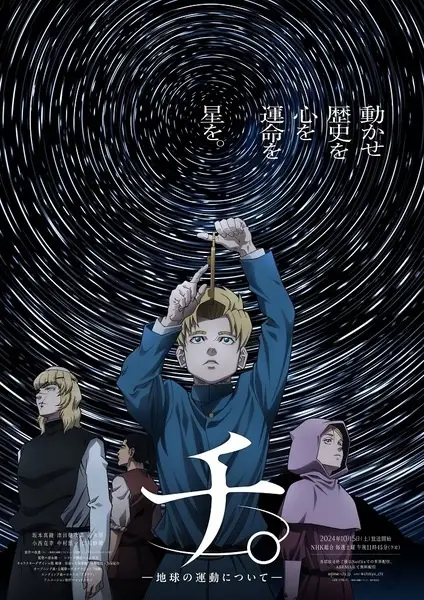
Orb: On the Movements of the Earth
チ。―地球の運動について―
Twelve-year-old prodigy Rafal believes in living rationally, so as to earn praise and respect from society while not being led astray by his emotions. To this end, he publicly states his intention to study theology—the academic field held in highest regard in early 15th century Poland. However, an encounter with a mysterious man upends Rafal's life, sparking an illogical desire to instead pursue his passion for astronomy. Rafal is determined to prove the beauty and rationality of heliocentrism—the theory that the Earth revolves around the Sun. This belief is considered heretical by the powerful Church, which promotes geocentrism—the Sun revolving around the Earth—as the sole truth of the universe. Those whose beliefs do not align with the will of the Church suffer unfathomably gruesome consequences. In pursuit of evidence for a heliocentric model of the universe, Rafal grapples with obtaining precise calculations and building empirical theories. His greatest challenge, however, lies in conducting this research discreetly—lest he wish to meet the same fate as other heretics. [Written by MAL Rewrite]
Main
Main
Main
Main
Main
Main
Main
Main
Supporting
Supporting
Supporting
seikanaru
May 20, 2025
It has been 20 days since I finished Orb, and as it has haunted my mind every day since, I decided to write this review. I really wish this series would get more appreciation outside Japan because I never thought an anime could make me feel so hollow yet so alive. Objectively, I would give it 9/10. No, this is not a Potocki joke. I absolutely love the characters, soundtrack, voice acting, and many more. Still, there are indeed moments where I feel the execution is less engaging and starts to fall off-- but it soon bounces back with a very impactful scene. It's a bit ofa slowburn. I feel like the latter part of the story is the weakest, too, like many reviews may have mentioned, but it's like... An 8 with the other parts at 10. The animation sometimes looks stiff, even when the character is just talking. Minor, but noticeable. And one small nitpick is having to turn my brightness to max because the anime is dark (literally). It also may not be for everyone. I was skeptical at first because of its rather straightforward, simple synopsis, but I decided to give it a try. I would like to formally thank myself for doing that. People who love flashy action scenes, people who don't like serious stories, people who think the Earth is flat, and people who just hate to think may not like this anime. But if I can make one suggestion... Regardless of preferences, this is one of those anime you'd have to watch at least once in your life. It genuinely makes me appreciate the world, and in turn, my life, a lot more. At the very least, please try to watch it until episode 3 or 4. If you're still not feeling it, perhaps this just isn't for you and that's okay. But personally? It's a 10/10. The feelings and impact it left me are so, so strong, I'm confident I will remember this anime for the rest of my life. I wish I could wipe my memory of it and watch it the first time all over again, and I'm sure I'd still fall in love as hard as I do now. I still tear up when listening to the OP song, Kaiju by Sakanaction, and have played it on repeat (the original MV is also amazing and describes Orb well). The dialogue, characters, and story... they all will inspire you. And generations after. Overall, the show left a very deep, Orb-shaped hole in me, and honestly, I feel empty. I know something will certainly fill it up in the future, a new work of art that I will love. Fantasy-shaped... Comedy-shaped... Mystery-shaped... Game-shaped... Another masterpiece in the future will certainly fill the emptiness. But it will never be the shape of an Orb.
Supporting
SuperUnoCard
May 29, 2025
In an anime landscape dominated by flashy action, predictable tropes, and endless romantic tension, Orb: On the Movements of the Earth arrives like a whispered secret—subtle, profound, and unrelenting. This show isn’t about supernatural powers or epic battles; it’s about the quiet but monumental struggle of ideas against oppression. It explores a time when challenging the church’s teachings wasn’t just heresy—it was a death sentence. On the surface this is a show about how science won out over backwards theology. Science is fucking epic and it beat the church's stupid }&oRBass with facts and logic. Thanks to our modern perspective on the model of the universe,that is an easy way to interpret this show. However this is really an anime about how the state and the prevailing belief system we live under exists through violence and and terror. It wasn't just people being backwards that kept people believing in geocentrism--it was torture, murder, and fear. The only hope for escaping such a regime is to be ready to suffer and die pointlessly; until you and your fellow heretics can overwhelm its enforcers, who will basically always win, nothing changes. All that the heretics can do is to "simply accept the nightmare that confronts [them]." Only those who are truly determined to lose everything else for their beliefs make any real contribution to the furthering of those beliefs. And beyond simple torture, the state is always ready to exploit anything someone cares about: friends, family, possessions, works, in order to ensure its interests are put above all else. The show is accurately nightmarish in its depiction of state power and willingness to violence. The main villain of Orb is one of the most genuinely terrifying people depicted in animation since Ed Wuncler from The Boondocks. It's also an anime about the hope of discovery and the personal fulfillment of having complete conviction in your own beliefs. People who seemed to be in complete despair despite believing in the eternal paradise afterlife of church orthodoxy found much greater hope in the belief that the church was wrong. The idea that prevailing ideology is wrong and there is a better way is a powerful motivator, even allowing many to believe that destroying the prevailing ideology is worth sacrificing themselves and handing the torch to the next generation. This is a show that visually depicts the highest beauty, with incredibly gorgeous images of the unfiltered night sky as we would see it without modern light pollution. It also depicts the horrors that people are capable of, with marathon torture sessions in dark basements--however, it is not torture porn, and does so in a tasteful way. The character designs are unique but fitting for medieval Poland; no one feels out of place. The background art likewise is fantastic. There is also great attention paid to the lighting; since this was pre-electricity, scenes are often much darker than they would typically be, and used in a way that add a lot of tension. The characters are well-developed, even when they last an episode or two. Each has their own unique motivations, fears, relationships, quirks, and arcs. The longest-lived character seems to be a constant, but by the end has clearly started to change. It would be easy to say that you're rooting for the protagonists to prove their beliefs, but that isn't actually true. They add the very real complexity of people who believe things that are true and want to prove it, but are awful people who you don't really want to win. This show is a gem, a rare anime depiction of European history that really works. Also c'mon the show is named "Orb". Watch the Orb show. Orb. Orb. Orb. Orb. Orb. Orb. Orb. Orb. Orb. Orb. Orb. Orb. Orb. Orb.
NachoCheese0531
July 30, 2025
“By replacing fear of the unknown with curiosity we open ourselves up to an infinite stream of possibility. We can let fear rule our lives or we can become childlike with curiosity, pushing our boundaries, leaping out of our comfort zones, and accepting what life puts before us.” — Alan Watts Humans fear what they do not know. Throughout all of history, humans have constantly battled between the past and the future. Innovators come and create new inventions that can improve the livelihoods of millions. However, nestled deep in the human mind is the age old question of: "What If?". What if these inventions backfire andend up hurting more people than its supposed to help. What if these inventions result in a loss of jobs for many. What if these inventions open up a destructive pathway that erases the culture that held many together not long ago. What if the world ends because of this. What if evil erupts from this. What if this happens. What if that. What if. What if. This insistence on what if ends up hindering the progress of humanity. It creates fear. A deep desire to return to what we know as comfortable and safe, despite it sometimes being incorrect and hindering further growth. These topics are what becomes the central theme for Orb: Striving for advancement despite oppression from those holding onto their fears of what they don't know. However, while many times this is done with things like medicine or technology, in Orb, this is done with the belief of heliocentrism. During the middle ages in Europe, the Catholic Church held a belief that everything revolved around the Earth; geocentrism so to speak. This is because of the belief that we are the children of God and thus, are the most important being in the universe next to God. However, that belief is not physically true. Earth revolves around the Sun, yet at that time, very few knew and believed in that. The issue was, that belief was dangerous to the Church. It questioned everything that faith was centered around and the Church believed that if this belief became the norm, people would lose their minds and would be at war with each other. They believed that there was no way the Catholic faith and heliocentrism could coexist and lead to a peaceful world, so, they oppressed the belief. Anyone that was found practicing heliocentrism was deemed a heretic and suffered harsh punishments and even death. These issues happen to become present within Orb. In Orb, the story starts off with a boy named Raphael. He is an extremely talented kid with a knack for astronomy. He constantly questions the world around him and only believes the truth when he can prove it with science. During his childhood, he was helping the Church take care of heretics, one of whom was named Hubert. Without spoiling too much, Raphael ends up becoming convinced and believing in heliocentrism and gets hunted by the Church and eventually imprisoned. However, he hid his notes in a box for future astromers to eventually discover. This eventually leads into the main story about making sure heliocentrism survives and thrives. Throughout the story, each character ends up facing difficult decisions. The work that they are doing is dangerous and they have to decide whether they want to continue proving the theory and helping it reach the public eye, or hiding from it. However, each astronomer, or pioneer chooses to ensure that the theory lives. They put their life on the line and power through torture just to see their beliefs come to fruition. For each of them, there are different motives as to why. For some, curiousity: they want to inspire a new generation of astromers and scientists to uncover the mysteries of the world. For others, personal gain: They want for their name to be forever written in the history books or to make vasts amount of money so they never have to worry about poverty again. Lastly, personal conviction: Some view this theory as a way of righting their wrongs or helping fulfill the dreams of friends. For some, this is simply their world view. Each character has a different motive that inspires them and it allows for their development and background to become complex and interesting. No character in this story gets boring and they all develop wonderfully. However, that is not the main theme of this story. The main theme is history. Every invention has an inventor, however, what if there were people before that inventor who developed the idea or schematics for the invention. What if there were those who had discovered the theory of relativity hundreds of years before Einstein did. While it could be true, we will never know as all those people have been forgotten in history. Orb explores this theme through 4 acts. In each act there are characters who research and develop heliocentrism, however, oppression from the Church eventually results in their demise. Despite this, each frontrunner is able to keep the documents of their research alive and pass it down to the next generation of believers. The issue with this though is that the researches themselves no longer have a name. They no longer have anyone who remembers their work. They only have their writings with no name to them. They become lost, forgotten in time. Even if heliocentrism survives, they will never be remembered or acknowledged for their work, however the idea still persists and gets passed down through time. By the end of the story, the theory, well a fraction of what remains of it, simply the name: On the Movements of the Earth, reaches the hands of Albert Brudzewski, the teacher of Nicholas Copernicus, who, if you don't know, discovered heliocentrism. Consequently, the story changes from taking place in the Kingdom of P to the Kingdom of Poland, highlighting that we are now in a period of time that is remembered in history, rather than being lost in time. The story explores how we as humans, continue to fight and fight for what we believe in, no matter the hardships. And eventually while we might be forgotten, the legacy we left behind still remains and lives on. Lastly, the main antagonist of the story is flawless. He is up their with Johan Liebert from Monster as the most complex and interesting villains in anime. Nowak, the antagonist, constantly prevents the theory from being published. He tortures and kills many of the protagonists and constantly acts as a needle in the back of heliocentrism. However, his reasons as to why differ throughout the story. It starts from him doing what the Church tells him to becoming an act of revenge to acceptance of his role as the villain and embracing it. His character development is flawless and makes the story infinitely more intriguing and suspenseful. Every time he's on screen, he creates tension and suspense even if his interactions are friendly. He's a flawless villain and makes the story all the more perfect. In the end, this anime is amazing. If I could give it over a 10, I would. The themes are complex and deep and honestly makes you re-evaluate your outlook on life and what you believe in. It personally gave me motivation to pursue my degree more and become a frontrunner in that world so I can be remembered in history. All the characters in the story are well fleshed out and the show contains stunning music and visuals. Thus, I highly recommend this show to anyone with any interest in science or philosophy. 10/10
JettGroove
March 20, 2025
I've been living for almost 30 years and it is difficult to surprise me with anything in the mass media, but “Orb: On the Movements of the Earth” managed to do this in every possible way. The only anime that combines and explores themes of science, history, philosophy and religion in the unique setting of medieval Europe. Orb is incredibly inspiring in the search for the truth about our universe, it gives hope that our civilization will get through future challenges and preserve humanity despite any level of possible severity and cruelty. Story revolves around the opposition between heliocentrism and geocentrism in 15th century, perfect forpeople who are mesmerized by the elegant beauty of outer space. It’s hard to explain originality of the narrative without going into the spoilers, but what can be said is that author takes an interesting approach, showing how hard it was to retain knowledge and pass it on back in the days. Speaking of historicity, Orb is not 100% precise and embellishes the events so anime can be more entertaining, for example, one of the characters has a “pear of anguish” in his arsenal, which most likely has been invented only in the early modern period (circa 1600), long after the events of the Orb. Viewer must understand that historical tag doesn't lock work of art into the confines of documentary and at the same moment does not prevent it from showing genuine facts that can be verified. What I like even more is the characters and the diversity of their convictions, views on faith in God and the meaning of life. Agnosticism, theism, atheism, deism – you can find representation of almost all popular beliefs here. It’s easy to connect with anyone from the main cast, even antagonistic Nowak can evoke empathy, there is no absolute good or evil. Uoto has a talent for reconciling contradictions, he can write a balanced personality with emotions and rationality rolled into one. Moreover, through these characters he accurately shows what consequences blind faith or reckless pursuit for knowledge can lead to. Art and animation are magnificent, while quite static dialogue scenes dominate, when it comes to action Madhouse delivers detailed and fluid visuals. Swordplay looks gorgeous, stargazing shots are breathtaking and creative work with visual symbolism is mind-blowing, especially in the openings. Though, I can't help but notice that in the last two episodes the quality of detalization in some frames has dropped. As for the music, it perfectly complements what is happening on the screen, if cosmos could sing, it would sound exactly like Kensuke Ushio’s OST. While opening theme by Sakanaction is already become iconic, I am a little bit sad that Amazarashi’s “Cassiopeia keiryuujo” wasn’t used at all, in spite of the fact that it could have been a first-rate ending theme a cut above “Aporia” and “Hebi”. The way Orb ends is extremely satisfying, makes you doubt and plants the seed of “Thaumazein” in your heart, forcing to analyze everything you saw in the anime and awakening the desire to research. It may seem confusing to some, but in reality you just need to be attentive and not overcomplicate things. Lastly, it will be realized that the sun occupies the middle of the universe [modern astronomy does not distinguish any center of the universe, which again proves that we should not stop doubting]. All these facts are disclosed to us by the principle governing the order in which the planets follow one another, and by the harmony of the entire universe, if only we look at the matter, as the saying goes, with both eyes. (C) Nicolaus Copernicus. On the Revolutions of the Heavenly Spheres, Book 1, Chapter 9.
Chuy_diazz
March 17, 2025
Orb on the Movement of the Earth was beautiful. What this anime did was similar to Nadia Comaneci's performance at the '76 Olympics. A routine that impressed everyone, and all you can do is give it a 10. Every movement was designed to connect with the past, present, and future of the story. The anime begins with Rafal, a fictional character, and continues with Albert Brudzewski, who would become Nicolaus Copernicus's teacher. Connecting the story of the anime with real history, you could say the second season of the anime is in our history books. Orb's story has it all: drama, emotion, action, regret, tears, but aboveall, it does a great job of making you remember all those who sacrificed themselves for the truth and making you follow the nature of the human race by being curious and looking to the future. Many people say Orb is a story about the church, religion, and the Inquisition. But Orb doesn't fall into telling a story from a place of victimhood; it doesn't try to say "we are the good guys and the church is the bad guys." It tries to go beyond religion and seeks to exalt faith. It's not a faith in a particular God, it's a faith in whatever allows us to keep moving forward. It could be a God, money, or even knowledge; what matters is not what you believe in, but how your beliefs motivate your actions. Protagonists, villains, and supporting characters—none of them are unnecessary; they all have their reason for being, contribute something to the plot, and then leave. They all had a role in the story, and when that role was fulfilled, they were immortalized through a memorable death. Honorable mention goes to Nowak, who was the one who accompanied us the most on this journey, and his entire story arc begins, develops, and concludes masterfully. Nowak was more than a villain; he was an inquisitor, a former mercenary. He was cruel, but he was also a believer, a hard-working man, but above all, he was a good father. Orb, for me, transcends the "it's a good anime, I recommend it." It's a feeling. Orb communicates so many things that the message I understood is very different from what you might understand. That's precisely what makes it so rich, because the anime itself tells us that one cannot make a great change independently; that it's better to share the knowledge you have and learn new things to strengthen your knowledge and ideas. By doing this, it invites people to actively seek to share their feelings, ideas, and points of view with the community. This way, you can transform your initial opinion of the anime into something richer and more complex. There could be bad things, maybe there are, but even in that, you need that feedback exercise because maybe what seems good to me seems bad to you, and vice versa. Beyond seeking a discussion, it's about generating a debate to build a truth about the anime. Analyzing every angle through the eyes of many people. Orb is an anime that reminds us that, aside from being a personal hobby, there's a community we can talk to and uncover the truth behind what we consider "our truth." Orb, I will never forget you and I will always carry a part of you with me.
Rank
#57
Popularity
#992
Members
280,412
Favorites
7,082
Episodes
25