
Buddy Daddies
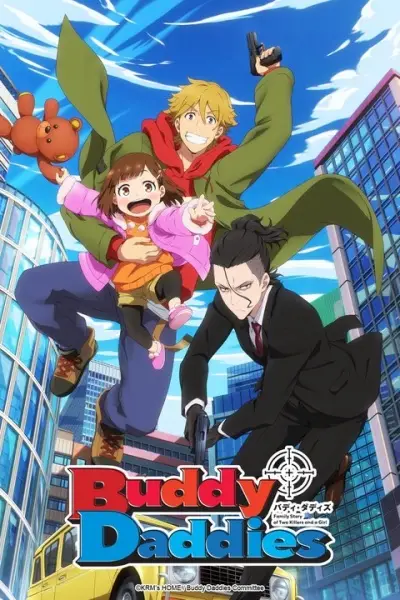
On Christmas Eve, four-year-old Miri Unasaka arrives in Tokyo completely alone, in search of her father. The bright lights and merry atmosphere guide Miri to a big hotel and a man with a delicious-looking cake. However, the child has just unknowingly walked into the center of an elaborate, foolproof plan for assassinating a dangerous mafia boss. Professional assassins Kazuki Kurusu and Rei Suwa live together, fleeing memories of their grim childhoods and avoiding emotional connections. When their mission goes awry and they end up bringing Miri home, there is only one reasonable thing to do: return Miri to her mother. But the girl's innocent laugh and pure worldview quickly enamor her to Kazuki, who secretly enjoys playing a parent, and it is not long before Rei's impenetrable heart makes room for Miri. Miri's every move is unpredictable, and Kazuki and Rei find raising an energetic child harder than any of their missions. Although it presents a great risk to their careers, Kazuki and Rei—both assuming the affectionate nickname "papa"—decide to provide Miri with a normal childhood despite all the odds stacked against them. [Written by MAL Rewrite]

Main
Main
Main
Supporting
Supporting
Supporting
Supporting
Supporting
Supporting
Supporting
Supporting
KANLen09
March 31, 2023
In a P.A. Works' board meeting: Producers: Hey, did you know that there is this popular show called Spy X Family making waves recently? It's the story of a family of spies raising an orphan child. I bet we can make an imitation of that! Mitsuhito Tsuji and Toba Yosuke: Not to worry, if that is your primary concern, we got you covered. For we have a story to tell of the same, but different! P.A. Works has for almost its lifetime as the designated "original anime" studio, produced some hit-or-miss shows of the last few years, that watch any one of them, you'll know that it's unmistakablythe studio's signature trait. And this season, together with director Yoshiyuki Asai (of Jun Maeda's Key anime adaptations that went from bad to worse), scriptwriter Vio Shimokura of Nitroplus (of last Winter's haphazard Tokyo 24th Ward) and series composer Yuuko Kakihara, the "shameless copy" that is Buddy Daddies comes to knock the hearts of people the same like in Spy X Family, and in a good way. At first glance, I bet you can even tell from less than an inch away that Buddy Daddies and Spy X Family feels awfully similar, from the unlikely family nature down to raising the said child herself. But in this show's case, it's down to producers Mitsuhito Tsuji and Toba Yosuke for solely anchoring the show's themes, having the real parenting experience to tell its generic story with a unique plot. The reason being, that the former was at the point of just starting a family himself, and the idea of having assassins, whose paths are normally covered in blood and death, raising children, would make for an interesting story plot. This is aided by the latter mentioning that 'becoming a family is a big theme' in the story, and that he thought it would be interesting as a work to be able to create a sense of comedy with such fine details, using the expertise of their staff to ascertain the intricate levels of parenting, with Tsuji specifically proclaiming "to include a lot of 'parenting'" in the anime. As for what Buddy Daddies is all about, as opposed to Spy X Family of a spy husband and an assassin wife with the obnoxious and playful child, it's the idea of same-sex assassins taking care of the exact same obnoxious and playful child. 28-year-old Kazuki Kurusu and 25-year-old Rei Suwa, both are buddy assassins who serve and complement one another in the areas that they are well-versed in: Kazuki on intel and execution from his good communication, with the slight negative on his gambling that is a deterring factor on his overall luck; Rei on combat agility and style of coolness, though he lives like a NEET who plays his video games all night, leaving household duties to Kazuki, who gets annoyed easily at his incompetence when it comes to cooperation in the house. And no thanks to the typical assassination mission that they have been entrusted to take care of their targets, they are left with the clueless addition of a child: 4-year-old Miri Unasaka, wandering alone without her parents, only to unknowingly step into the prohibited line of "guns and smokes ablazing" that eventually, is taken in by both assassins to take care of her, thinking that both Kazuki and Rei are her quote "biological" fathers. The perfect gangster househusband like Gokushufudou a.k.a The Way of the househusband's Tatsu, with the perfect Yazuka caretaker like Kumichou Musume to Sewagakari a.k.a The Yakuza's Guide to Babysitting's Toru Kirishima, along with Spy X Family's Anya Forger, makes for a combination that is the definition of "same same, but different". The "unlikely parents raise a child together" trope is quite old, it's even shown in Western media as early as the late 1980s with the 1987 film "Three Men and a Baby", which only proves that this trope has been used as a basic structure in TV and film for decades. How Buddy Daddies used this generic story structure to wield into this plot, producer Toba Yosuke mentions that the idea of having assassins, whose paths are normally covered in blood and death, raise children was interesting. Furthermore, two men raising children who aren't related by blood is a modern story where values are diversifying, he thought that a 'family not related by blood' and 'two people of the same sex raising a child' are both great themes. This is exemplified by producer Mitsuhito Tsuji exclaiming that both Kazuki and Rei have either "lost love in the past" or are the kind "who doesn't know love," that has their self-humanly examination changed, slowly but surely, thanks to Miri. Adding to that, the Buddy Daddies are basically new to raising children, so he thought it would be interesting to see how they would deal with her with the challenges further compounded due to their occupations, which Yosuke clarifies that "they are in the shadows and can't talk to anyone about their position." But still, things like childcare and such, both Kazuki and Rei embraced Miri to the max, no matter how obnoxious she can be, acting just like kids of her age to give her the world at large. This is so, because both Kazuki and Rei lived very different lives before becoming buddy assassins: Kazuki was expecting a child with his wife (Yuzuko), until tragedy struck of his hidden job profession that caused his pregnant wife's death, and he has the survivor's guilt since then. For Rei, he is the son of his own family assassin organization, led by his father Shigeki, whom the cafe owner Kyutaro "Kyu-chan" Kugi is the organization's covert mission's center handler to due out missions for both him and Kazuki. Anything that doesn't satisfy his father's standards of a professional assassin, Shigeki would strike after his own son, and he got so annoyed and overburdened, that he left the organization, which is where he met Kazuki in the first place. That, with Miri's arrival from the unfortunate circumstance of being the buddy assassin's target, and her mother Misaki earning her life as a prostitute and despising the fact that her unplanned pregnancy with Miri was a mistake, lunging the overly enthusiastic 4-year-old towards the buddy assassins, thereby converting them into Buddy Daddies. But once the "Family Story of Two Killers and a Girl" converge together, it becomes a story of how to juggle jobs with parenting, though this is of the extreme approach being of assassins and fathers. The one negative sentiment would be that it focuses more on the comedy than on the actual parenting, its strongest selling point being glossing over what would otherwise be a generic comedy. Playing up the fish-out-of-water angle, delving into the hijinks of two guys who are vastly out of their depth, but rarely touches on their unexpected career, despite the clear potential of such a unique premise. From there, these two contract killers have to take on their most harrowing assignment yet: parenting, which is rare and lack any sense of real danger. No doubt that they are entirely unequipped for fatherhood, struggling to learn the ins and outs of basic childcare -- understandable, considering the nature of their professional experience. Miri, their charge, can be irritating on occasion, but this adds a certain level of realism and charm to her character. The result is a series that, while serviceable as a comedy, fails to meet its full potential. But, if you don't necessarily care about the intricate details in-between, this show is truly yet another P.A. Works' care and thought put at 110% of the heartwarming and comedic elements (especially with Miri's bonds together with the Buddy Daddies) that will make one feel the "aww" feels, coupled with happiness and sadness when the assassin angle takes over, threatening to derail the trio's unkempt family life. It's full of action, drama and comedy enough to keep viewers interested from start to finish, and it's all a good and refreshing time, especially in this kinda mild Winter 2023 season of not a lot of standouts. As usual, you can always count on P.A. Works to deliver the best of their production caliber, and not once did I ever feel disappointed at the studio continuing to be experimental with their many ideas, even if it does work or not. Great action and impressive visuals round out the animation side of the show. The music is yet another highlight of the show. The OST by Katsutoshi Kitagawa of Round Table, it's one of the most unique this season, combining funk with Western-like inspirations. If you're wondering why the OP song "Shock" is THAT good and catchy, it's composed and sung by Ayase of Yoasobi fame. The Vocaloid songwriter has always been tasked together with singer Ikura as the famed duo group producing theme songs for shows like Beastars, the most recent being Gundam: Suisei no Majo a.k.a The Witch of Mercury, and already set on next season's Oshi no Ko, for his breakout title to be this OP song, it's just the perfect song for such a show like this. This, like the ED song "My Plan" by DURDN, I love the city-pop-like feeling that this emits, especially when this couples with Miri's easy-going nature that's of her plan. And honestly, both songs are not just great, but there for a reason, which is to showcase the heart pangs of the Buddy Daddies and Miri in their respective perspectives. A clone/carbon-copy of Spy X Family, that Buddy Daddies is not, even if it's that close of a comparison to call it the "Dad" version of it. Really, we're only just starting 2023, and this show is more than just one of the best shows of the season. It's fun, it's endearing, it'll make you feel like you're a parent (even if you are or not), and above all, it's just a great anime to watch with kids, if you have any. P.A. Works, I humbly welcome you into 2023 with a shotgun's bang, right out of the gate. Give Buddy Daddies a watch, you will DEFINITELY NOT be disappointed.
SpRayquaza11
March 31, 2023
Finally, a child who acts like a child, not a moeblob who only exists to fan the meme engines and churn out popularity. It may be a lesser-known fact (Due to everyone hating on my spy fam review since it was a negative one), but I really did not like Spyx family after the first 6 episodes, They did everything ideally, just like buddy daddies over here, by first introducing some badass and sabotage specialists, helping us get used to the action then dropping the Kid who is actually adorable, behaves like a kid, makes mistakes like one and is essentially the reason for changing hertwo daddies for the better. In spy family however, Even after going through two Cours we are effectively stuck in a forever loop, the main character's parents are the same as when they have introduced no development, no interesting arcs nada, only the same gags which use the same formula and only when Anya is on screen does watch anything make sense. Buddy daddies help us taste gag humor, adorableness, and character growth all in a neat small package while actually giving us good tips and insights on childcare, In spyfam it's completely natural for a kid see you practice extreme violence while also reading your most obscene thoughts XD. Plot 8/10 Kazuki and REi were initially hitmen with no regard for anyone or anything The whole procedure of them initially thinking of miri as a pain, to eventually getting attached to her and also growing to genuinely care for her shows us the journey of these two hitmen who slowly get changed by their daughter, the kids usually are molded by their parents but it was nice to see like in real life , children do tend to bring out the best in their parents., Some of the Rei Hitman arcs were rushed over and Kazuki eventually was kind of the main focus (I guess since his story is a little more vanilla).I liked the fact that unlike generic anime hypocrisy, the mother too got a second chance just like Kazuki and rei. Characters 9/10 Small but neat package of characters, the side characters other than kyuu chan are relatively uninteresting and the main villain is a classic cliche type of guy. The character development arcs were quite nice .... it was rushed but they managed to get the point across and the growth was made apparent. Sound and VA 8/10 I liked the OP{ and ED both , they are quite the bangers and have clearly gotten the highest budget , the ED is full of MIRI DRIP and helps its rewatcha ability , the Voice Acting is amazing especially Miri and most of the Gags are able to land because of the VA s. OST is average. Animation and art 7/10 generic PA works art style, the animation can climb a few points depending on the importance of scenes , but is otherwise pretty standard. Although it does not have the budget of spy family I feel is a much better childcare anime , spyfam may slightly edge it out as a comedy anime , but buddy daddies is still an amazing show which manages to stay in the realm of reality and yet still be an interesting watch. I can easily recommend it to everyone.
Mcsuper
March 31, 2023
I know, the first thing anyone brings up when talking about Buddy Daddies is that it’s like Spy X Family, and while I get that sentiment, there are quite a few fundamental differences between the two. If you value more slice of life, over the top comedy, Spy X Family will be more of the anime for you. If you value more of a focus on child-rearing, Buddy Daddies may the anime for you. Buddy Daddies does have its share of plot development, which was a common complaint for Spy X Family, but I can’t say that the plot development was particularly ground-breaking or welldone overall, but it did nail some of the emotional moments nicely. To provide a gist of the story, four year old Miri Unasaka wanders through modern day Japan one day looking for her father, and ends up smack dab in the middle of an assassination plot that goes wrong, and ends up being taken in by the two assassins, Kazuki Kurusu and Rei Suwa. This newfound task of balancing taking care of a child while continuing on their jobs as assassins is understandably difficult, but they make it work, and raise Miri well. Needless to say, they work in a dangerous environment, and the moral ambiguity of keeping Miri around even when she would be increased danger was an effective theme that was explored as well. The effort at a meaningful plot was there, but I think the season was too short get through all the conflict that was explored. The main thing I did appreciate about this show was that it’s decently realistic, especially with Miri just being a normal little kid. Yes, she was a little annoying at the start, but many kids are loud and obnoxious when they’re little, and Miri portrays a semi-realistic little kid. Kazuki and Rei also slowly grow into their father roles, and I did enjoy the slower development for them in terms of taking care of a child. They started out lazy and not wanting to take care of Miri, but little by little they come around to love her, and likely would willingly lay down their life for her. The cast definitely grew on me as it went along, which made the increased stakes near the end of the show more effectively executed due to that. I genuinely felt worried for them at times. There’s a good mixture of themes at play here, as there’s a balance between comedy, action, slice of life, and a bit of suspense as well. The strongest themes to me were probably the slice of life comedy aspect, as the moments where Kazuki, Rei, and Miri just hang out together were quite wholesome, but the underlying assassin plot did play its role as well, and while it got a little darker than I expected, the villains weren’t all that great, as their motives aren’t all that interesting. Production for this show was alright, with some decent animation and direction overall. The sound direction was a little weird at times, as some of the action scenes, especially at the beginning, had very goofy music that didn’t really fit the tense atmosphere, but it got better with time. OP and ED are also quite good. Overall, a relatively enjoyable series with its ups and downs story-wise, but I still had a good time with it. If you’re looking for a wholesome comedic series, you’ll get that, but if you’re also looking for some action and emotion mixed in, it’ll deliver as well. It’s not anything insanely special or ground-breaking, but it’s something I’d recommend for sure.
SomeApplePie
April 3, 2023
“Wholesome”, “spoiler-free” (vague) review for those with short attention span: Buddy Daddies has great emotional beats and some good character dynamics. There are also a few things that it delivers quite well given its non-traditional family setting and its more grounded approach to child raising. However, the series also drastically fails to fully commit to its setup and often reverts to convenient plotlines for emotional impact. Restricted to only 12 episodes to show its full take on the recently popular crime-childcare genre, it still managed to somehow stick the landing but also ended with a lot of missed potential. Perhaps, it could be somuch more if it has more episodes but given what we have, nothing really stood out in the end. It doesn't mean it is unworthy of being watched though. Buddy Daddies is still an enjoyable and often heartwarming show with its own charm to deliver in the found family trope. For those who want me to elaborate (yes, there will be spoilers): ● Being a child in anime When it comes to shows where a little kid is set as one of the story’s main characters, I usually look forward to how they will write the child since, most of the time, younger children are placed on the sidelines while the whole story revolves around the adults. Of course, this is just fine depending on the story’s purpose but I also appreciate it if the narrative actively includes children without them being mere plot devices. After all, children are smarter than they seem. However, having this type of younger child main characters may often be difficult to portray in media (if you are writing an isekai, you can probably just cheat and put an adult into a child's body). Stories like these would require kid characters with their own motivation and perspective in the story without losing a significant part of their childishness or any distinguishable trait in their personality. Watching Buddy Daddies, I was led to believe that Miri is one of the most realistic kids in anime. I partly agree with these claims on a surface level. In a way, Miri is pretty spot-on as a 4-year-old kid -- which may be due to how P.A. Works had incorporated the actual experiences of their staff and their kids into the show. She is cute, annoying, and adorable as most children can be and as the plot demands it. However, and this is where my disappointment starts, I also felt that the writing for her lacks the characterization I initially expected from her role in the show. Throughout the series, the best way I can describe Miri is that she is a caricature of a real child. She can be more cute, more annoying, and more adorable exactly because she is oftentimes an exaggerated representation of what we usually attribute children to be. Even her often illogical cheerfulness and ignorance despite her surroundings are also part of this exaggeration (it is also convenient to the plot as it avoids difficult questions from the child). This makes it harder to pinpoint what makes Miri her own unique character outside of her just being a “realistic” kid. In fact, she often felt like an amalgamation of all the obvious things we see in children packed into one. And it worked. We have another child who is quite believable as a kid but also does not actively become anything more than a convenience. Of course, this is not entirely a bad thing. As I’ve said, it depends on the story and the story of Buddy Daddies only needs a “realistic” child to work around the energy it’s going for, and Miri as a plot device seems to work well enough in the show itself. However, given this and the way she is written, Miri's behavior will undeniably be shoved down to the viewers since she is also made to appeal using her "realism" as a kid. That's her whole schtick. Understandably, less tolerant viewers might not find her as adorable as the creators expected her to be, but for others, Miri, as a more general depiction of a 4-year-old, might actually be more relatable. ● Family story of two hitmen and a girl With how Miri is written, Buddy Daddies expectedly centers its narrative around Kazuki and Rei’s struggles as parents and as individuals while Miri drives their motivation for change. This brought the series into a more grounded and familiar territory. Kazuki and Rei are hitmen and both are inexperienced at parenting (Rei more so) but the charm of the series lies within these moments, too, where the parents struggle to be parents. The series is at its best when Kazuki and Rei interact with Miri. Both of Miri’s papas have rather good and heartfelt moments with her which solidifies a lot of the blooming relationship between parent and child. The shenanigans which ensue and the often emotional moments which it brings are what really shine in the show. Buddy Daddies also dwells on the more realistic aspects of parenting and this helps bring more of that sense of relatability to the show, especially for viewers who are parents or who are looking to be one. Buddy Daddies also introduces a more non-traditional family setup given how two same-sex parents are taking care of a child. I find the concept of this quite refreshing within the anime childcare genre. Moreover, Kazuki and Rei being both Miri’s fathers weren’t made fun of or made to be different by other characters within the show. One can expect that sending Miri to daycare would bring in more questions and the typical homophobic remarks, but there was none of that. They made it feel normal because it is and I like that kind of representation (however, as I would tackle more below, the show also comes with quite a few issues of its own in this regard). ● Entertaining and spontaneous adoption Buddy Daddies started with high energy and some absurd action moments in its first two episodes. P.A. Works fight scenes are mostly good and viewers might be reminded a bit of Akiba Maid War (another P.A. Works original from last season) whenever Kazuki and Rei do their hitman job. The show’s jazzy, spy-esque music also adds a lot to the energy of the series. There might be some minor gaps in the animation and the backgrounds are sparse especially when there are more movements but P.A. Works did a great job with the budget they had. Going back to the story itself, Buddy Daddies seemed like a pure comedy at first glance. Indeed, the first two episodes give the vibe of a darkly comedic show with how nonchalant Rei kills off people, especially in the first episode where he killed Miri's father while the child happily jumped into Kazuki's arms. Killing off the father is a wild and spontaneous set of circumstances that contributed to the comedy and tone of the show but also added flimsiness to the "adoption" excuse, at least in the first two episodes. Around Episode 3, we are introduced to Miri’s mother, Misaki, who sent her daughter alone to find her father. The writers show Misaki as regretful of her motherhood due to her difficult situation in life which gives her more nuance and promises a lot more from her character in future episodes (or perhaps not). Anyway, the main point of this episode is that it establishes the found family by giving a more valid reason why they should stay together. Behind the scenes, both Kazuki and Rei’s past played a role in their eventual decision. Kazuki decided to take in Miri due to his own wife and unborn child dying in the past while Rei, as shown in the flashback in the same episode, is reminded of his abusive father and how much he doesn’t want to be like him after Miri stated that the role of fathers is to protect their child. Since Miri’s mom won’t have her, Kazuki and Rei (although not explicitly) made the decision to take care of her in Episode 3 which solidifies the family right from the start. I think Episode 3 is one of the show’s strongest episodes although I also felt that the family was easily established together by convenience and lack of commitment. For a show which focuses on parenting more realistically, I expected more struggle from Kazuki and Rei from letting Miri stay with them given their job and their past. I should say that the emotional attachment from the main trio is rather quick to establish without much constraint (more so for Kazuki who settled willingly into the “mother” role in the family) but I also acknowledge that this isn’t really a major gripe in the first part of the show. It also goes along with Buddy Daddies’ spontaneity and overall tone. However, this convenience and lack of commitment also reared its head stronger than before at the latter part of the series, and I think that’s where the show began to be quite disappointing. ● Rushed, sloppy and convenient drama The latter part of the series is where the story shifts gears and ventures into a more serious route. Kazuki and Rei’s conflict as hitmen centers around whether they can change for the better. How they decide on this is the main focus of this part of the series. However, the convenience and lack of commitment I mentioned before are more apparent here since outside of its family and child-raising dynamics, everything feels less cohesive in terms of writing the more dramatic, hitmen aspect of the show. What really disappointed me is how it handled its last few episodes. Frankly, the show started to reveal more of its loose structure in Episode 7 where it speedruns through Kazuki’s past and character conflict without much of the buildup. This episode also included two female characters, Kazuki’s wife and his sister-in-law, who are introduced within a single episode (with Kazuki’s wife revealed to die from a tragic incident) to just help resolve Kazuki’s grief and then promptly forgotten for the rest of the series. However, the final nail in the coffin is Miri’s mother, Misaki, being re-introduced in the latter part of the show. Misaki came back after almost a year only to be revealed that she is now dying from cancer. The last time she was seen was in Episode 3 and although that episode gave a bit of nuance in regards to the role of a mother, especially in contrast to how Kazuki willingly became the “mom” of the household, it also felt like it leaned towards a more antagonistic view of the “irresponsible” mother. Anyway, not only did the show give Misaki cancer but also made her regret her choices and wish for change in regard to sending Miri away. The writers opted for a cheap sympathy move which became truer for Misaki since after giving the woman cancer, they also shoot her off in the next episode she was re-introduced! Episode 11 is one of the worst episodes of the show because none of what happened there is necessary. Meaning, the family can still stay together without the already dying Misaki being killed off by another assassin. It just felt so much like tragedy for tragedy’s sake. It felt almost emotionally manipulative. But it was convenient, isn’t it? Now, Misaki cannot take away Miri from Kazuki and Rei. Now, the family can stay together without any difficulty or complexity. This also made me rethink the whole purpose of the show. There is nothing wrong with plot devices but when you have the majority of female characters in the story like Miri, Misaki, Yuzuko (Kazuki’s wife), and Karin (Kazuki’s sister-in-law) be mere plot devices to drive the development of the two male leads, I have to admit some bullshit. I can say the writing is bad especially when the choice to avoid the easy, convenient but problematic path is an option. But what now? In the same episode, Kazuki and Rei announced that they are now going to become a real family! Very apt. The woman's body is not cold yet. But we shouldn’t care about how the family came together again this time (first by killing Miri’s dad, now by killing her mom). The most important thing is the found family being together again (we have to stay wholesome here, people!). Okay, so let's leave it as it is for the time being and discuss the finale of the show. Rei’s final confrontation with his father leaves a lot to be desired. For context, Rei’s father was never shown to care about his son in the entire series (not like he’s present much anyway). But in the finale, Rei’s father seemed to have a change of heart. I understand Rei’s choice of not killing his father (defying the cycle of violence and all that) but one of my major criticism is that his father still feels unpunished, especially in contrast to how the story had treated Misaki. It is also assumed that after that confrontation, Rei’s father never bothered with the family again even though he had been shown as strict in acting on the organization’s ideals and had been a significant part of Rei’s trauma. Again with the show’s convenience and lack of commitment. It is quite disappointing from a writing standpoint, especially when it could have been more. ● The “Buddy” Daddies There’s quite good development between Kazuki and Rei as individuals (Rei more so) and as parents to Miri. However, I felt like the show barely show us Kazuki and Rei growing together or caring for each other outside of being co-parents to Miri, even just platonically. To explain further, Kazuki and Rei had been living together even before Miri came into their lives. When Misaki came and took Miri away, I thought they will continue to stay together since even without the child, the two can be a family unit. I mean, what were those family developments for? But, disappointingly, the first thing they thought was to leave and pursue their separate goals. This made previous family moments ring hollow. There seemed to be no care between them. Not even a struggle to let the other leave. I know we are not going to get an actual gay couple. P.A. Works had been forcing the narrative of Kazuki liking women from the first episode until the last (of course, bisexuality exists but given how P.A. Works had been shoving this narrative I don’t think so). However, I also felt that them being queerplatonic or just “buddies” (for the straights) was barely explored well enough either, especially given the way P.A. Works seemed afraid to depict them as “too gay” by not giving them actual moments to acknowledge their care for each other. It is just frustrating. The writers just can't commit to anything. In fact, almost all emotional moments in the show centered between Kazuki or Rei being with Miri but almost never without Miri. There are some moments in the end but it also felt sudden and half-baked given how unexplored it is in previous episodes. I also expected a bit more balance and less heteronormative view in the household roles. I mean, Rei did improve, to be fair, but for most of the show, Kazuki is obviously given the role of the stereotypical mother in anime. It did lend to the comedy but again, it could have been more. Honestly, everything could have been more in this show, and I wish it did since I actually enjoyed it overall. But it ended without lasting impact. There is no feeling of it being earned. The lack of commitment and the extreme amount of conveniences just made me disappointed. ● I guess, a summary of this review: Could Miri’s character be more than just a plot device? Yes. Did the series successfully show Kazuki and Rei as buddies? No. Did the series successfully show Kazuki and Rei as gay? No. So, what are they? Gay. Do you think the show handled Misaki well? No. Is the ending rushed? Yes. Are you disappointed with the show? Yes. Do you think Buddy Daddies could be better? Definitely. Did you still enjoy it? Yes. Do you think there will be another season? I don’t think so.
Hellmika
February 10, 2024
Eng: I was soooo sad when I saw that this anime is only for one season! It's one of those animes that you watch and leave with a warm heart and a sugary mouth, the two daddies are so cute even though they're not a gay couple, still, the story is very interesting, it has its degree of emotion and plots, because at the beginning of the anime you're like: "Omg how cute!!!" In the end, you're crying hahah but anyway, Buddy Daddies is one of the best anime about family and don't even tell me that it's a copy of Spy x Family because theyare COMPLETELY different, the only thing in common is having a little girl as the protagonist. If you're having a bad day, watch this anime, I'm sure seeing Papa Rei and Kazuki taking care of little Miri and her saying she loves them will make you happy again. Pt-Br: Eu fiquei tãoooo triste quando vi que esse anime é de apenas uma temporada! Ele é um daqueles animes que você assiste e sai com o coração quentinho e com a boca açucarada, os dois papais são tão fofos mesmo não sendo um casal gay, ainda sim, é bem interessante a história, tem seu grau de emoção e plots, pois no início do anime você está: "Omg que fofos!!!" No final, você está chorando hahah mas enfim, Buddy Daddies é um dos melhores animes sobre família e nem venha me falar que é uma cópia de Spy x Family pois eles são COMPLETAMENTE diferentes, a única coisa em comum é ter uma menininha como protagonista. Se você está tendo um dia ruim, assista esse anime, tenho certeza que ver Papa Rei e Kazuki cuidando da pequena Miri e ela dizendo que os ama vai te deixar feliz novamente.
Rank
#565
Popularity
#775
Members
349,805
Favorites
3,605
Episodes
12