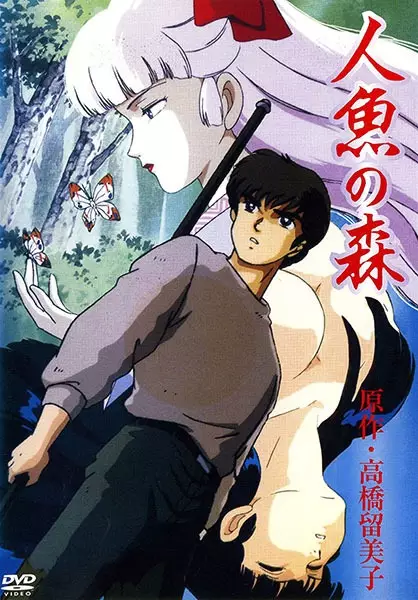

Mermaid Forest
高橋留美子劇場 人魚の森
According to an ancient legend, mermaid's flesh can grant immortality if eaten. 500 years ago, Yuta unknowingly ate a piece of mermaid's flesh. For centuries, he travels across Japan, hoping to find a mermaid, thinking she may be able to make him a normal human again. When he finally finds one, he discovers that she and her companions have been raising a girl to be their food so they can eat her and take on her youthful looks. That is how mermaids stay young. Yuta kills the mermaids and rescues her, but she has already eaten some of the mermaid's flesh. Although he had to kill the mermaids, Yuta isn't too disappointed. Yuta's once lonely existence is now over, as he has found a companion in Mana. And Mana, who had been trapped in a small hut her whole life, finds delight in even the simplest of things. Together, Yuta and Mana attempt to seek out more mermaids, trying to become normal humans again. (Source: ANN)
Main
Main
Supporting
Supporting
Supporting
Supporting
Supporting
Supporting
Supporting
Supporting
kufreabia
May 6, 2008
If you are currently watching a long series that occassionally takes 2 week breaks (think Bleach and GrayMan), and you want to fill that spare time with some short, enjoyable anime, then you are obliged to see Mermaid Forest. STORY: Mermaid Forest to me is a story of endurance, love and ultimately a moral theme follows through it. The writer of this anime is famous for many love animes, so it is no surprise this anime would eventually end up being one too. The whole story is like reading a book, with different chapters. Usually each episode represents a chapter. The theme of the show isconsistent through each episode, and I believe that is a good strength of the anime. I also enjoyed the fact that this anime employed the use of filler episodes to flesh out the main character. I did not think that could be done with 13 episodes, but it was well done - :) What then could be wrong with mermaid forest's story to earn a seven? Here is where the story fails: It does not connect with the audience in the way most animes do, but being that it is a fantasy story, we may overlook this fault. Another problem with the plot is that the series of events occur in such cliche formats that they tend to become annoyingly predictable. ALthough this does not detract the enjoyability, it does not strengthen the overall anime either. Finally, my last problem was that the story, in my opinion, was not, in the large view conclusive. I found this to be really disappointing as the final episode was so good!!! ART The art of this anime is unique because it deceives you. It gives you the feeling you are watching an old school anime, while it has all the feel of a modern art-anime. This series was made in 2003, but the drawing is reminiscent of such anime as in 1987-1993. I do not think this detracts from the story, but actually makes you feel like you are watching a show from the past. As for this, I believe the art of the anime is consistent with the theme of immortality, which recognizes the timelessness of the art form used. I liked it, and give it a 9 for art. SOUND The sound track for this anime was actually good, once you get used to it. I liked it. Overall, the sound for the anime is commonplace, and has nothing special going for it. CHARACTER Character development is actually biased here. Whereas there are two main characters in this anime, the focus for the entire story is the man. As unfair as this sounds, it is not so bad. Eventually, you get to realize that one of the two main characters is simply playing a supporting role - and that is all you will ever get in terms of depth from this character. Now, this is not really a problem as this anime is, at best, a filler. I guess with more episodes, there would have been much more work put in. The main character is well developed, and this is done by using fillers to build the individual. And you can get to see his overall frustration with his long life, and his search for humanity. It is painful to see his search go on for so long, but it is helpful to understand what he has been through. CONCLUSION (with a little spoiler) I did enjoy the anime. i did not come to it expecting much, therefore i did not leave disappointed. I believe many people would like the anime once they begin to watch it, but I know some people will utterly dislike this piece of work = and i think that is ok. You either like or hate, but i don't think you can love it. The one thing i can say for those who watch this anime is that the last episodes are really good. I actually cringed at one scene. I hate to name drop, but the last episode would draw to mind the great anime "MONSTER." For that reason, it is worth watching. My biggest problem was the scene that made me cringe was the scene that also disappointed me! I just thought that the anime should end on a note of the man finally finding rest from his journey. This did not happen, and that alone killed this series for me. I like conclusions whether happy or sad, just end the thing! OVERALL Sorry for my long review, but if you wish to kill time between episodes of a long series that just took a short break (think bleach, or grayman), then this might just do it.
Tsukiouji
May 17, 2012
Mermaid Forest is one of those great underrated anime series based on one of Rumiko Takahashi’s creations. She is the creator of some well known anime/manga series like Inuyasha, Ranma, Maison Ikkoku etc. However, Mermaid Forest is a bit darker and contains a well-balanced mix of mystery, suspense, horror, supernatural, drama, tragedy, and love/romance, along with a few light moments. I can’t put it into words, but for some reason this anime has the same feel and reminds me of the type of anime from the 80’s and 90’s (as the other reviewer described). It was very nostalgic watching this and even the parts thatwould make the story weak or ridiculous made it stronger to me. Story- If you are looking for something fun and lighthearted with the usual beautiful mermaids, this is NOT the anime to watch. The story is about the travels of Yuuta and Mana, who both attainted immortality by eating some mermaid sashimi (if you don’t know what sashimi is then you are missing out on life!). They are searching for mermaids to try to find a way to become normal humans again. Some of their travels tie into Yuuta’s past (Yuuta is 500 years old), and the episodes do a great job of combining past and present, somewhat similar to the “Highlander” series or movie if anyone is still familiar with that. During their travels, they come across other people who fell victim to or were affected by mermaid flesh. The story arcs are usually 2 episodes each—short enough to avoid filler material that longer anime falls victim to yet long enough to build an actual well-developed story without cliffhangers. The stories are tragic and very touching, and I really can’t understand why it’s rated as it is. It should be a 9 in my opinion. Art- The art and animation is a bit dated but if you are familiar with Rumiko Takahashi, then you will feel at home. The animation itself doesn’t contain anything spectacular, but this anime is more story-driven and makes up for it that way. Sound- The opening theme fits perfectly—mysterious, sad, the sound of a lonely journey and memories. The ending theme didn’t really catch my attention. Characters- Yuuta makes me laugh because one minute he’s skillfully killing mermaids faster than Blade killing vampires and another he’s getting stabbed and killed by a lone lady with a knife. Sometimes I wonder where his 500 years of skills went. We also get to see what someone might feel after living for such a long time. As for Mana, she’s an enjoyable character because everything is new to her yet she’s always getting into trouble. She’s probably responsible for Yuuta getting hurt 99% of the time. As for the other characters, I thought they were pretty well developed for the amount of time given. Overall, this was a very enjoyable anime for me and would be great for those who want to watch something with an older feel to it like the days of Akira or Gundam, or to the older crowd who wants to reminisce about how anime used to be.
Zirgo
July 16, 2007
Mermaid Forest tells the story about a fisher man named Yuta that, because he has eaten Mermaid flesh, now is immortal and is in search of a Mermaid to make him normal again. During his travels he encounters other people experiences with Mermaids and find a female companion named Mana to share his adventures with. The story is linear but with flashbacks from Yuta\'s life. The overall feel in the anime is that it is drawn in very traditional ways and the techniques feel like that of older animes, but the series is actually produced in 2002. I think that this anime is one that devidespeople into two camps,, either they like it or they don\'t. It doesn\'t stand out much and there isn\'t a clear red thread that goes through the series but the stories are interesting at some points. So overall a good experience, but not the best I have had. In the end a totally watchable series and it\'s somewhat thanks to that it\'s not more than 13 episodes.
Benkyouespanol
August 27, 2018
Note: this is the text version of my video "mermaid forest: should we desire immortality". It contains spoilers, read at your own discretion. This is a thematic analysis of the anime mermaid forest in which I’ll be examining the arguments it makes against and in favor of immortality. Arguments against: 1 – immortality would result in suffering and loneliness. Mermaid forest shows that many immortals would live lives of suffering and loneliness. For instance, Yuta suffers several painful deaths only to come back to life, ready to suffer through more of them. In other words, he’s in a constant loop of suffering. Yuta also suffers emotionally as he isgrief stricken by all his loved ones who predeceased him. The immortal woman from the first episode suffers emotionally. The mermaids, who were her only companions, lost their human forms after failing to eat Mana. This left her in complete isolation. Towa suffers physically because of the agony caused by her mutated arm. She also suffers emotionally as she was isolated and didn’t get to experience much throughout her life. Big Eyes suffers physically as his entire body was mutated. He also suffers psychologically because of his isolation and because of the guilt he feels towards the people he killed while he was unconscious. Nanao’s mother suffers physically as she was left with a painful scar which never heals. She also suffers emotionally as she is left without a child. Natsume and Nae both die but are resurrected thanks to mermaid liver and mermaid ash. Their resurrections are imperfect, and they come back as shadows of their former selves. This causes suffering for both themselves and those around them. Masato’s non-biological mother suffers emotionally as Masato forces her to look after him until her immortality wears off. She is unable to pursue her own ambitions and must instead look after a psychopath against her will. Mermaid forest tells us that immortals may feel lonely as they would constantly outlive all the mortals around them an in some cases they would be outcast from society. It also tells us that immortals would suffer more than mortals as they can experience painful, traumatic things that mortals are incapable of experiencing. Therefore, immortality shouldn’t be desired as it would mean a prolonged life of suffering and isolation. 2 – immortality would bring out the worst in people. Mermaid forest suggests that immortality would bring out the worst in humanity. For example, every few centuries the immortal woman from episode one steals a child from a nearby village. She feeds them mermaid flesh, and if they become immortal she feeds them to the mermaids, so they can maintain their human forms. She sacrificed many innocent girls for her own happiness. Episodes 2 and 3 centres around the ideological conflict between the Sakagami pirates (who desire immortality) and the Toba pirates (who don’t desire immortality). The Sakagami pirates have desired their moral standards and will do any heinous act to achieve their desires. In contrast the Toba pirates live a much more minimalistic, content and moral lifestyle. You could argue that the desire for immortality corrupted the Sakagami pirates, making them act immorally. On the other hand, the Toba pirates avoided the desire for immortality and in doing so maintained their morality. It also brings out the worst in the two sisters from episodes 4 and 5. Sawa’s desire for immortality causes her to use Towa as a guinea pig, and in doing this she ruined her life. Sawa’s actions also brought out the worst in Towa. She deeply resents Sawa for ruining her life and plans to get her revenge by force feeding her mermaid flesh. The mermaid flesh and the desire for immortality caused the sisters to act immorally towards each other. Towa also tried to kill Mana, so she could fix her broken body. Natsume’s father sells ordinary meat to people, telling them it’s mermaid flesh. What he did was extremely unethical: not only did he flat out lie to them, he also encourages them to desire immortality while they are unaware of the consequences that would come from it. He also tries to use Yuta’s liver to permanently resurrect the princess. Because of her desire to have an an immortal child, Nanao’s mother tries to feed mermaid flesh to both Nanao and his son, therefore endangering their lives. Echiro thought he could undo his crime of murder by bringing Nae back to life using mermaid ash. However, Nae’s resurrection is imperfect and he ends up causing even more damage. He learns that some crimes can’t be undone. Because of his godlike immortality, Masato forgets how to empathise with other people and uses them as pawns to achieve his goals. Mermaid forest tells us that some people may abandon their morals to become immortal, and that and that its godlikeness may cause immortals to forget how fragile mortal life is. Therefore, immortality shouldn’t be desired as it may cause some people to disregard their morality. 3 – the risks in finding immortality are too high. Mermaid forest suggests that there would be great risks in trying to attain immortality. Its lore tells us that not only are mermaids incredibly rare, but your chances of becoming immortal from eating mermaid flesh are very slim. There’s a much larger chance you’ll either die instantly or mutate into a creature called a “deformed one”. The odds are not in your favour. The Sakagami pirates were all wiped our due to their desire for immortality, as none of them could stomach the mermaid flesh. Yukie, Masato’s babysitter, was just about to get married. She had a promising future, but she was robbed of it when she became a deformed one after Masato fed her mermaid flesh. Freak accidents may also occur after eating mermaid flesh. Firstly, there was Towa, who stayed young on the outside but continued to age on the inside. Her arm was also mutated while the rest of her body remained human. Secondly, there was Bigeyes, who mutated into a deformed one but still maintained his human mind. Finally, Nanao’s mother was left with a painful scar which never healed. The three characters I’ve just mentioned all ate mermaid flesh. However, none of them lived for ever and their lives were made worse because of its effects. The effects of mermaid flesh are so unpredictable that there’s no guarantee you’ll end up with your desired results. Mermaid forest tells us that we’re unlikely to achieve immortality and by pursuing it we may do ourselves more harm than good. Even if we do become immortal, it may come with some horrific side effects. Therefore, immortality should not be desired as we are unlikely to find it and we may severely harm ourselves while looking for it. Even if we do find it, it mightn’t be what we hoped for. 4 – immortality still doesn’t guarantee eternal life. In mermaid forest immortals aren’t entirely un-killable: they can be killed via decapitation or by mermaid poisoning. Yuta and Mana make a lot of enemies throughout their life time, many of which use these methods to try and kill them. In episode 1 the mermaids try to poison Yuta with mermaid poison. In episode 5 Towa tries to chop off Mana’s head. In the final episode, Masato tries to chop off Yuta’s head. Despite being immortal, the threat of death still hangs over them. Bigeyes was immortal, but he died after Yuta decapitated him. There’s also the rare case of Masato’s mother, who’s immortality wore off over time. Despite seeming to be immortal, she didn’t live forever. Natsume was immortal but she had one weak spot: her liver. The monk took her liver and she died. Mermaid forest suggests that even immortality would have its limits and that in certain situations it wouldn’t be able to protect us from death. Therefore, immortality shouldn’t be desired because even with it there’s no guarantee we’ll live forever. 5 – immortality would cause us to value our lives less. In the video “Stephen Cave on the Philosophy of immortality” author Steven Cave explains that the fear of death gives our lives meaning. Without it we would never achieve anything, and we wouldn’t enjoy life: “…it’s the fear of death rather than love of life often that’s motivating us. If people complain they don’t enough time, why do the watch so much TV? It doesn’t seem when we look at the way people behave that lack of time is the problem. On the contrary, when you look at how much time we waste that life is already too long. So long that we become complacent and we waste great swathes, so many hours. In fact being conscious of the fact that our time is limited is what makes us really value an appreciate the time that we have.” (source: cave 2013). I believe that Cave’s theory can be applied to Yuta. It’s made clear that Yuta doesn’t want to commit suicide, rather he wants to become mortal again. He’ll often say things like “I want to live, grow old and die an old man like a normal person” and “I cannot live, I can only survive”. Immortality has made him value and enjoy his life less. He wants to become mortal again to restore value to his life. Mermaid forest tells us that if we had an infinite amount of time we may be unsure of what to do with it and we may become unsatisfied. Therefore, immortality shouldn’t be desired as it would make us value and enjoy our lives less. An argument in favour of: Immortality would be bearable if we knew what to do with our time. With all the arguments it makes against immortality, you may think that mermaid forest sees it as a bad thing in any context. However, this is not true. Mana is an immortal, yet she is often depicted as happy and optimistic. Clearly life isn’t just about suffering for her. Yuta also mentions that his life has gotten better since he met Mana. Despite the suffering that comes from being immortal, the two became much more content after meeting each other. This is because they both found a reason to live in each other. They now have the goal of protecting each other, and if they both stay alive they’ll both still have that goal. In other words, it’s a potentially infinite goal. This is reflected by the show’s ending: they never find a cure for immortality, but they remain optimistic because they both have each other. You could also argue that Natsume and Yuta may have been happy if the father and the monk hadn’t interfered and they had left together with each other. When Natsume dies the monk offers to bury her, but Yuta replies, “Don’t touch her, I’ll bury her myself.” His bitter response suggests that the show is critical of the monk’s decision to kill Natsume. This could mean that eternal life shared between two people would be better than death. Mermaid forest tells us that immortality would be unbearable if there was no point to your potentially eternal life. However, it may be bearable if there is a point to it. Therefore, immortality may not be a bad thing if you have a reason to live for an eternity. This argument can be countered however as such a goal would be near impossible to find. To quote American novelist Susan Ertz, “Millions long for immortality who don't know what to do with themselves on a rainy Sunday afternoon.” (source: Ertz) This is evident in the show as it took Yuta half a millennium to find that kind of goal. Before that he was miserable. Yuta and mana are also the minority: this kind of goal is very rare, and most immortals may never find one like it. Therefore, immortality may not be desirable as it would be incredibly difficult to find a goal that would last an eternity. Conclusion: Mermaid forest seems to be strongly against the idea of immortality as it shows more of its disadvantages than advantages. It theorises that it would lead to an increase in isolation, suffering and immorality. It also suggests that it would be difficult and dangerous to become immortal, and even if we did there’s no guarantee it would protect us completely. Immortality may be bearable if we have a goal that would motivate us to live an eternity, however, such a goal is very rare. The verdict: in most cases we shouldn’t desire immortality, unless we have a good reason to live for an eternity. Sources: •Stephen Cave on the Philosophy of Immortality, uploaded to Youtube May 23 2013 on the channel "Filip Matous". •“Millions long for immortality who don't know what to do with themselves on a rainy Sunday afternoon.” A quote from Suzan Ertz, date unknown.
Sesshomaru
November 30, 2020
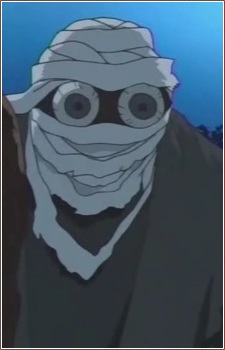
劇場 人魚の森 the 2003 series Mermaid Forest is based on Takahashi Rumiko`s short stories, which were later published as a manga series in three volumes. The anime series is atmospherically gloomy and eerie enough to make one cringe in their seats. The idea is based on Japanese mythology, in which mermaids are unsightly and vicious creatures. Story: Based on folk legends and the plot is told worthwhile (7/10) Note: The story was designed with a horror element in mind for its time. From today's perspective, it may not be as tough anymore, but it is still sometimes brutal. The Manga Mermaid Saga (Ningyo Shirīzu) consists of three volumes.The first volume "Ningyo no Mori" was adapted into an OVA in 1991 and in 1993 the second volume "Ningyo no Kizu" also received an OVA version. Both OVAs are worth seeing, just like the TV series released in 2003. However, due to its brutality, especially in the last episodes, the series is not for the faint of heart. The last two episodes were originally not broadcasted on TV and could only be purchased. The origin of the story can be several folk tales or myths. The most familiar to me and, in my opinion, the most suitable is "Happyaku Bikuni". If you are not interested in the mystical reference, skip the text marked with brackets. [brief digression] A fisherman from the province of Wakasa caught an unusual fish and gathered friends for inspection and tasting. After it became known that the fish had a human face, no one ate it. Unfortunately, one friend had drunk too much and carelessly passed his piece of meat of fish to his daughter, who asked him if he had brought her a gift. Sober, he tried to correct his mistake, but the meat had already been eaten. Since nothing happened at first, it was forgotten. The daughter grew up and got married. As the years passed, her husband and the world around her grew older, but she did not. The woman eventually became a nun, because she could no longer bear the recurring marriages and widowhood. She wandered the country and ended her existence after an incredible 800 years in her homeland near the Kuin Temple. [end of digression] Takahashi Rumiko story is slightly modified, but the reference to the above mentioned legend is obvious. We get to know Yuta, who, as the legend has it, became immortal after eating mermaid flesh and surviving unharmed. Like the nun in the legend, he now wanders the world in search of a solution to his infinite loneliness. By chance he meets the young Mana, who endured something similar. Brought together by the same fate, they now travel through the country together and master different adventures. In an episodic narrative style, the two main characters meet many very different people who are connected to the legend of the mermaid flesh in various ways. Characters: MCs simple structured but antagonists become a bit more complex towards the end (6/10) Not badly characterized, but an academic degree is also not required to grasp the characters. On the one hand, the cast consists of the two protagonists, but the variety results from the different antagonists and secondary characters. Yūta: First we get to know Yuta, one of the two main characters. The odyssey of the young fisherman begins when he and his comrades eat the meat of a mermaid. Yuta does not yet suspect that he has become immortal. He married and lived normally until he discovered that his wife grew older and died, but he did not. Only now does he fully understand the legend, and he heared the rumor that only a mermaid can help him to return to a normal life. Thus begins his journey as an immortal in search of a mermaid, which will last over five centuries. Going back about 500 years from the creation of manga, one arrives at the reign of the Ashikaga Shogunate in Muromachi jidai or at the beginning of the very exciting Sengoku-jidai, in which very famous people like Nobunaga Oda and later Ieyasu Tokugawa determined the fortunes of the era. Yuta is kind, helpful, and makes friends with many people he meets on his travels, and with the historical reference, some of his quirks become a little more understandable. Mana: The young woman has grown up under strange circumstances, which inflict her the same fate as Yuta, and so they become companions. Since she could never leave the village, she is naive and very curious. But she is also very smart and grasps her situation quite rationally, but she cannot comprehend her emotional world because she has had no interaction with other children, friends or her own family. Antagonists: There are many opponents but not all of them are real antagonists. In some stories Yuta and Mana just interfere, and then try to solve the mystery. Ōmanako (big eyes): I think his role and the episode that goes with it are very well done, as it shows that regardless of outward appearance, everyone was originally a human being. Yukie: No opponent, in the true sense of the word. Yet her role is extremely important, even if it doesn't look like it. But with her the inner conflict of the last angagonist I want to describe becomes clear. Masato: A childlike appearance and attitude paired with the experience and loneliness of an immortal for centuries, have left behind only a tortured human soul, that acts only cruelly and heartlessly like a monster. At the beginning, he may have tried to replace his parents who died again and again, but they increasingly became his servants, whose personality and nature he abused in a diabolic way. This thought, an experienced personality in a childlike but immortal body, is also used in many vampire anime. To cut a long sentence short, if you want to see a really evil antagonist, this is the right place. Visuals: More could have been achieved in terms of animation (6/10) The art dates back to 2003 and is of course a bit old-fashioned, but at the same time the beautiful and elegant drawing style of Takahashi-san is unmistakable. From a 2003 perspective, the art is very stylish and has a slight retro touch that builds a bridge to the earlier OVAs. Personally, I like it very much that the mutability of the mangaka is also well expressed. This becomes especially clear when you compare the action-packed "Mermaid Forest" saga with its dark and brutal atmosphere to the very funny Ranma 1/2. The gloomy and sometimes brutal atmosphere is made very good by the use of many dark colors as well as good light and shadow effects. For example, through the use of dimly lit settings and dark contrasts. Gore fans might object that many depictions of violence are too mild for a horror anime, but this is due to the fact that many of these components have been toned down for TV broadcasting. It is also often argued that the anime lacks detail, which I would counter that the anime was drawn and not developed with CG. The drawing style is very close in design to the original and has details, such as different hair tones, but they are more subtle than one is used to from today's CG standards. However, one difficulty of the hand-drawn work is that character and art in general can vary greatly from episode to episode. Animation reveals the age more than art, but I think it still works for its time and the story it tells. However, those who love more modern, fluid CG animated designs may not like the classic styles or the use of still frames. On the other hand, I think it is a plus that the use of speed lines has been abandoned. Sounds: BGM, OP, ED are very good, as is the VA (8/10) When it comes to BGM, a distinction should be made between OVAs and the series. The music for the first OVA in 1991 was composed by Kawai Kenji, and the musical arrangements are really beautiful. Norihiro Tauri composed the music for the second OVA in 1993, and as for the vocal themes of the OVAs, I especially liked the title: Walk of Time "時 の 漂泊」 " by Hirotani Junko. But also the title: Mori wo Nukete is very beautiful. The title song in the 2003 series is "Like an angel" sung by Ishikawa Chiaki. The mood, the arrangement of the song and also the voice seem very familiar if you know the OVA. It is not the same song, but it has the same effect on the listener. A very nice arrangement and Ishikawa's voice sounded very pleasant. You can hear that she is a talented singer who has been singing since childhood. The end song is entitled "Mizu tamari" (水 た り ま り) and is sung by the Japanese singer Kayoko. The title is different than expected, it is more peppy than one would expect for the end of the series and has a very nice melody. Both the voice actors as well as the dialogues are good. On the one hand, I noticed the performance of Oomoto Makiko as the voice of Masato. While it's not uncommon for a young boy to be voiced by a woman, but Makiko Oomoto-san embodies the character of the role very well. On the other hand, I really liked the voice of Gouri Daisuke in the role of Ōmanako. Gouri-san's deep and growling voice fits the role well and has impressed me in other anime for the same reason, such as Inuyasha in the role of Kyokotsu. Mermaid Forest is one of the underrated works of Takahashi-san. In contrast to her other works like Inuyasha or Ranma 1/2, it tells a very depressing and mysterious story with very little comedy. The show is entertaining and if you watch it at night, you might get a shiver down your spine. I gladly recommend the series, as well as the two OVAs. For the critic I would recommend the manga, because it is even a bit more violent, the art is a bit nicer and there is one more story (Yasha no Hitomi). As always, thanks for reading and have fun watching.
Rank
#4574
Popularity
#4542
Members
31,112
Favorites
90
Episodes
11