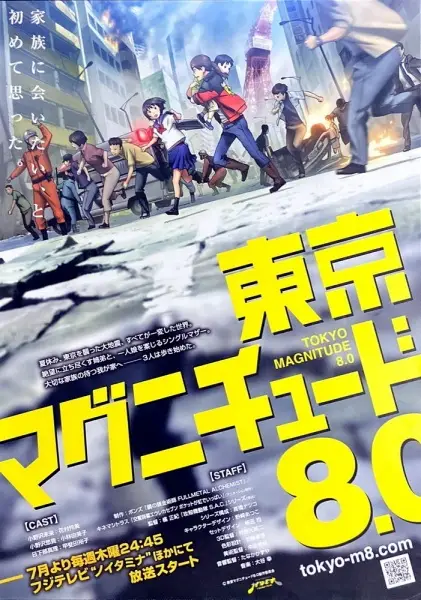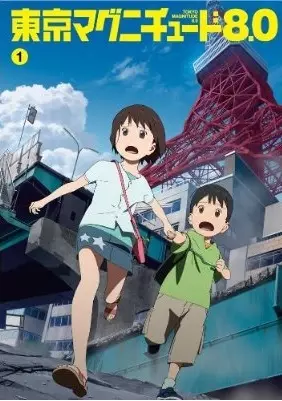



東京マグニチュード8.0
Middle school student Mirai Onozawa is dissatisfied with her family circumstances and, in a moment of frustration, wishes to tear everything apart. Unfortunately, these destructive thoughts seem to come true in the form of a magnitude 8.0 earthquake just a few moments later. When summer vacation begins, Mirai reluctantly takes her younger brother Yuuki to Odaiba, where a robot exhibition that he wanted to go to is being held. However, while they are in the exhibition center, the fury of a major earthquake shakes the Kanto region; helpless, both kids witness the devastating power of this natural disaster as it brings the city to its knees. In its aftermath, they stumble upon Mari Kusakabe, a motorcyclist and single mother who decides to help the young siblings. Aiming to return to their homes and reunite with their families, the group sets off on a long and hard journey through the decimated city. [Written by MAL Rewrite]
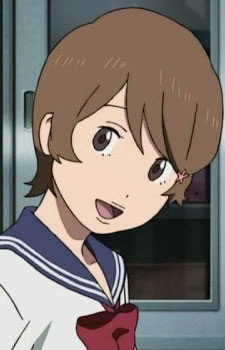
Main
Main
Main
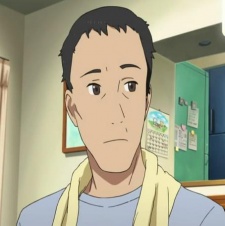
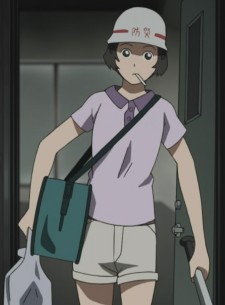
Supporting
Supporting
Supporting
Supporting
Supporting
Supporting
Supporting
Supporting
SamFury
September 25, 2009
======== Constructive Criticism would be appreciated through either PM or Comments ======== She's Breaking Bit by Bit Tokyo Magnitude 8.0 is something special. A human story told through naked eyes, this show did something that a lot of anime hasn't done for me lately, spark an emotional connection. It gently nudged me through the tale of a young girl named Mirai, her little brother Yuuki and a motorcycling delivery woman name Mari, as the world around them shattered into pieces. Tokyo is crumbling; foundations are upheaved, buildings are leveled, and bridges are twisted till the tensions snap, as a magnitude 8.0 earthquake roars. Fires break out like crimson rashes,burning away homes all over the Kanto region. From the wake of the chaos, people stumble and endure, somehow crawling back home. Mirai and Yuuki are tremendously endearing. Mirai is terribly pessimistic, always believing that fate has a bone to pick with her. She snaps at her brother for being her antithesis, a hopeless optimist at heart who believes that everything has to turn out alright. The older lead, Mari, serves as a nice foil to the pair, level headed and calm; she serves as a guide and guardian to the children. It's easy to appreciate how each character grew over the course of the tale; Mirai gaining a drop of her sibling's positivity, Yuuki gaining a touch of his sister's pragmatism and Mari learning she's not so invulnerable, as they hobble over the fractured roadways and splintering scenery. The plot focuses on the trio as they trudge their way back to their families. The urgency is palpable as snapshots of destruction litter each episode from radio snippets to television clips. The three are twisted by stress and struggle to best figure out a way to deal with death and disaster. Even Mari, grounded and collected, stumbles from this tightrope. Tokyo Magnitude 8.0 is fueled by emotion and the most fundamental instinct any human has: to survive. It starts off slow, but it builds like a powerful crescendo into an unforgettable ending. Production The art and animation are inconsistent. I love how most of the character models were plain, unadorned figurines on the broken canvas of Tokyo. It lets the viewer focus on the detailed scenery; the cracks veining through the pavement, uprooted trees, shattered windows, twisted steel, and burning buildings. The artists captured the ruination and didn't seem to want ornate models taking away from it. On a more technical aspect, the CGI that is sprinkled throughout is done well, opting for a distinct cell-shaded look. It was irksome to find the animation to be uneven and, at some points, even choppy. It's a shame, considering how much effort and thought was put into the art direction. The music is nothing amazing, but it works with the show. The score moves with the ebb and flow of the small group's journey, cascading gently with the moments of calm before beginning to tumble with scenes of tragedy. I didn't quite enjoy the OP by the Abingdon School Boy, the upbeat tempo being too much of a contrast to the carefully paced tale. The voice acting is commendable for weaving the powerful tale. Mirai's faltering voice, echoing loneliness, pulled at my heartstrings, while Yuuki's voice brought a smile to my face. Watchability and Enjoyment The story slowly burns itself, never exactly rushing within the small frame of eleven episodes. I took Tokyo Magnitude 8.0 in tiny doses, an episode here and there. Nothing really pushed me to watch the next episode until I reached the last quarter. Things really pick up in the last three episodes, as the journey winds to an end, for a strong conclusion. It was only then that I felt satisfied with my investment in the series and appreciated the first eight episodes. Closing Thoughts It's the realism that shook me. Every episode began with a disclaimer stating that the series was based on seas of research and simulations. Sure, the science is well and good; but it was really about the 'human' realism, overcoming the hopelessness. Tokyo Magnitude 8.0 is a great anime, worth a watch by anyone who appreciates a good story.
Vigrazzi
October 11, 2015
This anime is really bad. I watched this anime and suffered through it's entire 11 episodes. First of all I think some explaining is needed. I live in Chile, and I experienced three earthquakes of over 8.0 in the last 5 years. I have a niece 12 years old now, and in 2010 she was frozen solid with the 8.8 earthquake, she didn't move unless told to do so. This anime LIES about how people react to earthquakes. Story: 3 This show follows a couple of brothers and their amazing adventure in an all-too-shaky japan. How they UNREALISTICALLY live through all the aftershocks and find out that friendshipand family bonds are stronger than 10.7 megatons of energy. Little tsundere-chan happens to have tremor immunity, because after standing in a dancing bridge, she walked head first inside a crumbling building. The land shook too much for a 8.0 earthquake, and Japan being Japan, it's highly unlikely for their buildings to be that poorly built. That is NOT how people react to these events. Children like tsundere-chan end up traumatized and the odds of rebellious shit are null. HEY THE EARTH JUST SHOOK HARD ENOUGH TO DESTROY BUILDINGS AND BRIDGES, LETS JUMP INTO THE WATER. really japan? I also loved how people were free to walk wherever they wanted, almost as if there were no institution to keep public order. Art: 6 Bones did a "meh" job, though the CGI sometimes made background people look like zombies. Sound: 3 Aww come one! That is no way near to how an earthquake sounds... SFX's were unnatural and didn't fit whatever was going on. Aside from music, sound sucked. Character: 4 From the hyper annoying little brats to the extremely irresponsible lady, characters gave off a feeling of "I don't give a fuck about earthquakes". No, really. I insist, children become a bundle of stress and panic. If aftershocks are too strong, they may develop tremofobia, which happens a lot with kids. But tsundere-chan was fine enough to bitch at her little brother, that, ladies and gentlemen, is not stress nor panic nor fear nor related to earthquakes, that is being whiny. K KIDS IMMA GO LEAVE U GUYS ALONE AND BRB!!... really lady? Enjoyment/Overall: 3
Wasabi
September 18, 2009
Tokyo Magnitude 8.0 is a breath of fresh air amidst all the crazy ridiculous shows filled with giant mecha, deadly monsters, hot chicks, and moe guitar plucking girls. It takes a seemingly normal life of a bratty teenager and literally shakes up her world as she confronts the very face of humanity. Story [9]: Mirai is one of those bratty teenagers who is entering that stage of life where they just simply hate everything and anything. Being dragged to a robot exhibition by her younger brother Yuuki, in Odaiba, a catastrophic earthquake hits Tokyo and the city falls into chaos. The story follows Mirai's journey homeas she is accompanied by her brother and their guardian, Mari. It slowly paces itself through 11 episodes as Mirai and co. meet new people, and face the reality of such a life altering event. The pacing does seem slow at times, and there were certain events that could've been handled better, but it comes to a strong end as she reaches her destination. Art [7]: The animation is definitely not the strong point of this show. The character models were mediocre at best, and there were parts where it was just simply full of QUALITY. The backgrounds however, were designed quite well plus a mixture of CGI models interacting in the background gives it life. The OP and ED were done well consisting of montages of a ruined Tokyo. For a show that's not focused around sexy looking chicks or big bad explosions, the artwork by BONES is acceptable. Sound [8]: There wasn't a lot of memorable music in the show but it does the job. The BGM is calm and serene as it is sharp and chaotic, and fits most of the scenes well. It's not like you really need some jarring suspenseful action music when you see buildings falling into pieces and such. The voices fit the characters well. Mirai sounds like how a teenager should sound. Yuuki and Mari's voice job was done well too. They should like their own age, unlike some other characters in other shows where 16 year old girls would have deep silent voices, etc. The OP, done by abingdon boys school, doesn't exactly get you pumped up and excited, but rather brings a sense of melancholic urgency. The ED fits in where it should be. An ending theme of everyday life as Mirai and co. look forward towards their destination. Character [9]: There wasn't a huge cast nor was it centered on many characters. The show reveals how humanity can react in such a crisis. There will always be the rash unreasonable people but there will always be the shining lights of hope who will assist you when you need it most. Mirai got the brunt of all the development that was there in the show. She started off as a bratty teenager who rejects everything around her, like a prepubescent teenager should be, and slowly changes through the show as she faces the harsh reality that she's in. Yuuki is pretty much the catalyst in all of her development as he's the basic opposite of Mirai's initial personality. Yuuki was your typical happy kid. As the show progresses, we see a more mature face to his chippy exterior as he traverses through the desolate Tokyo city. Mari was their faithful guardian as she led them through the ruined city, in search of her own family. Mari started out as the cool, responsible, and protective character but as she finds out the whereabouts of her family, it is revealed that she is human just like everyone else. Enjoyment/Overall [9/8]: Tokyo Magnitude 8.0 is not filled with giant beam shooting mecha. It doesn't have scantily clad magical girls. It has no moe school girl clubs nor giant tentacled monsters. It is a slice of a possible life that faces Tokyo in the modern day. The show may have its setbacks, but it is a show that reveals what realities we take for granted. It takes the everyday lives of regular people and turns their world upside down in the aftermath of an event that can happen to us all.
AnnoKano
December 12, 2012
Among the debris of high school comedies and unoriginal harem anime that we find dumped at our feet every season, there is normally one or two series which look salvageable. Perhaps they have a premise that sounds interesting or an unusual art style. It may even just look like something that won't be filled with tsunderes and panty shots. For those who find themselves feeling dissatisfied with the majority of anime on offer every season, these titles provide a sense of hope. They are like a light at the end of a long, dark tunnel. But there is a downside to these shows that seemto promise so much, and that is that sometimes they fail to deliver. What sounded like an interesting premise has become nothing more than a change in setting; the eccentricities of that peculiar art style have been overlapped by substandard animation. We have escaped the torrent of lingerie, but still have to contend with that annoying tsundere character. Tokyo Magnitude 8.0 suffers from all of these faults to varying degrees, and it is an almighty shame, because it absolutely was not inevitable. While the emotional tale of two children caught in the middle of a natural disaster of an unprecedented scale will be enough to take in some, those who are not easily swayed by sentimentality will find themselves searching for the substance here, and be left feeling incredibly disappointed when it fails to materialise. The problem of Tokyo Magnitude 8.0 is twofold: the first is the nature of earthquakes and disaster relief; the second are the leading characters, the pre-teen girl Mirai and her younger brother Yuki. These two forces alone are largely responsible for the complete collapse of the show. The idea of a series which has a realistic take on an earthquake is one that would seem enticing to most; so often are stories of natural disasters exaggerated for dramatic effect that the idea of portraying them as they are in reality is quite refreshing. However, the reality of earthquakes is that they involve somewhere between ten seconds and two minutes of sheer panic and terror, after which they subside completely, barring the occasional aftershock or delayed building collapse. After the initial danger has passed and you've made your way to safety, it just becomes a matter of waiting to be rescued. Spending several episodes on ‘waiting to be rescued’ would of course be incredibly boring, and the creators recognised this. For this reason the children set out on the highly perilous and ludicrously impractical task of making their way back to their home, inconveniently located on the other side of one of the world's largest cities, which has just been struck by one of the most powerful earthquakes ever recorded. However as unlikely as this story seems, this is not the least of TM 8.0's worries: because even though it gives the cast a goal to work towards it still doesn't provide them with anything interesting to do on the way. There are times where we break away from the dullness of the main story, but sadly these are no more satisfying than the main plot. There is the occasional brush with danger, where an unfortunately timed aftershock will strike as the cast are stood underneath a swaying lamp post, are walking around carelessly inside a structurally unsound building, or just happen to be walking underneath a suspended grand piano... oh, what a rotten bit of luck. Alternatively the distraction will be minor sub plot. This will invariably take the form of a side story involving people the main characters encounter, and is always aimed at making the viewer realise that no matter how big you think your problems are, there is always someone worse off than you are. Some might say that a story about two young children separated from their parents by an earthquake would have already achieved that goal, but for some reason the writers decided that the point really needed to be hammered home; probably because otherwise people might notice just how uneventful this show really is. The experience of watching Tokyo Magnitude 8.0 feels somewhat similar to a being a passenger on a long car journey, a resemblance made all the more uncanny by the two annoying little children that accompany you throughout its run: the annoyingly self-centred preteen brat called Mirai, and her eternally optimistic young brother Yuki. Let us be grateful that this is one journey we can stop whenever we feel like it, without having to apologise to Grandma. While the series does not have a 'narrator' as such, Mirai takes the role of the main protagonist, and acts as our eyes and ears as we make our way through what was formerly known as Shibuya. Immediately this presents us with a problem, because unless you're a twelve year old yourself or are amazingly conscious of how you behaved at that age, then you are going to find it incredibly hard to identify with Mirai; and harder still to sympathise with her. What's so remarkable about her character is that she manages to remain her vain and selfish old self throughout the show. Almost unmoved by the catastrophic event she is stuck squarely in the middle of, not to mention the suffering all around her, she struggles to find the time to worry about anyone else for any longer than two or three consecutive scenes. It is hard to ignore the conscious effort being made to portray her character as human underneath all that self-absorption. That it seems so improbable only amplifies the problem; it's not hard to picture a twelve-year-old acting conceited, but to behave that way during the aftermath of a major earthquake? Surely there is a point when instinct takes over, when the shallow front crumbles to reveal the scared little girl who is just old enough to recognise how powerless she really is amidst the chaos all around her? It's all just too much. While Mirai's character is annoying, she does have one redeeming quality and that is that she is not annoying as her younger brother's character. A little boy so filled with naivety and youthful optimism that it reaches out and pokes its finger down your throat. His very presence irritates his sister and she makes no attempts to hide her contempt, but Yuki doesn't bat an eyelid. He continues to talk, laugh and smile through it all, never once letting her nastiness form so much as a crack in his perpetual smile. While his character is much more believable than Mirai's is, because while it seems unlikely a preteen who is entirely aware of her situation would be able to distract herself enough to be self-conscious, the idea of a post-toddler not appreciating the gravity of the situation seems plausible enough. The problem is that while it is believable, it's still incredibly irritating. It all makes sense, but it's not in the least bit intriguing. Our two little darlings may be the leading roles but it is the guardian angel figure looking after them who is the true star of the show. While she is perhaps a little too idealistic to be believable, watching her is at least bearable. Her name is Mari and like all strong women she is a single mom who runs her own business. Needless to say these qualities make her not only dependable and quick-thinking, but also give her that caring instinct necessary to make someone go out of their way to help two lost young children. Of course, as the series progresses we become more and more aware of the imminent danger faced not only by Mari's young child, but also by her elderly mother. And of course, this does nothing to weaken her resolve to help our heroes or indeed to attempt to save her own family. It's a lovely thought, but sadly not one that seems terribly realistic. It's not all a shambles though, because the artwork for Tokyo Magnitude 8.0 is of a reasonable standard. As a product of the Bones animation studio, it shares similar qualities to their other work- although the animation takes a noticeable plunge when compared to their cinematic works, which though hardly unsurprising or unique to this studio, since these are their most prominent titles it seems to become more noticeable. The backgrounds are fairly well detailed, although it should be noted that the promotional artwork is misleading in this respect. The animation is solid but alas, it does not attempt anything interesting either. The soundtrack however fits the show like a glove; the opening and ending theme is precisely the sort of music we would expect a pre-teen like Mirai to listen to, in other words Japan's answer to Linkin Park. The angsty sounding pseudo-metal, aside from being incredibly irritating, utterly fails to capture the seriousness of something as catastrophic as an earthquake. And if anything, this only emphasises the main story's failure to do so. As for voice acting, well I can tell you that the two main characters from the show are children. I believe no further explanation is necessary. Reflecting on the points that have been brought up over the course of this review, as well as its overall tone, it should not come as much of a surprise that I did not think much of Tokyo Magnitude 8.0, and have gone to great lengths to justify that position. However while that may explain my overall perspective on the show it perhaps does not adequately explain why I dislike it so passionately. This was alluded to at the beginning of the review, but I would like to elaborate on it further before I conclude. Irrespective of the quality of the finished product, Tokyo Magnitude 8.0 remains an example of something interesting; it shows a new direction for anime to take in the future. As it turns out, on this occasion it was a failure, and ultimately it failed to provide anything 'new' at all. This is the fault of the writers, who failed to make the best possible use of the great opportunity before them. Nonetheless, it has proved to be a success and TM 8.0 has managed to win awards and many fans. Do I think that it is worthy of such praise? No I don't, but I am very happy that it did, because it opens up more opportunities further down the line. If more animation studios recognise they can dare to be different, then they will. And from there it is simply a matter of finding the creativity or the talent to make something truly worthwhile. At the same time, the fact that TM 8.0 was not something great is the source of frustration, because while further opportunities may exist further down the road, at least one opportunity to make something fresh and exciting has presented itself, only to be squandered to provide some Land Before Time rip-off for twenty first century Japan. And just like real earthquakes, we can never quite work out when the next one is going to strike.
DangoSadge
March 11, 2011
In Loving memory of those who died in the 11th March 2011 Tsunami tragedy. (Note to people, I'm not making a joke out of this review as I do with my other reviews) So yeah, it's the latest news everyone is currently talking about. However since I'm not in Japan but I do want to have a feeling of empathy towards them so I decided to continue watching this series after dropping it. And I agree this is the best time to watch it (for those who have not) to get a feel of the situation Tokyo Magnitude 8.0 is something unconventional. So you've seen before an animeservice about zombie outbreaks but how about something nearer to the fine line of reality? Sure, the story takes place in Tokyo whereas the current circumstances takes place in the north-eastern area of Japan, and based on this story, it was an 8.0 magnitude, whereas in reality this one is WAY bigger, a scale of 8.9. A natural disaster is always best told through the perspective of the 1st person rather than reported by the news network, which is what this anime is all about. Of course who would want to see their beloved land of the creation of animes and manga to be destroyed (though a lot of trolls and haters would joke about it) this is no laughing matter. The story centers on three individuals as they try to live their best in their state of despair. Kusakabe Mari, Onozawa Mirai, and Onozawa Yuuki, three distinctive characters but with the same goal of returning to their families after enduring the tragedy. What holds before them is nowhere near anyone's guesses. What the anime have given us is a sense of realism. There's no macho superhero here to save them all. All you get is an everyday people, with their everyday life, trying to cope with what is in stored for them. I wont spoil further into the story as this is something you must experience for yourself. The first few episodes may be slow but it picks up fast during the climax of the story. I have heard criticisms and experience first hand the artwork of this anime. Although I much impress by the production of the CGI, there were other parts that needs serious amendments. The scene where countless of buildings are destroyed in an instant (not to mention the destruction daily routine of an average person) would send chills in your spines. Music is mediocre but blends in well with the scenario. The voice actors for each character brings out their true nature in the series. Their passionate voices during emotional scenes would send heart throbs throughout me during the course of the entire series. Though I would prefer a shorter or movie version of this anime, eleven episodes may tend to drag the story longer than it is needed. As I've said before, the story only started to get interesting nearing the ending. (But that doesn't mean you should just go skip it till the ending) Still it was enjoyable to watch nevertheless. No matter who's power you believe was responsible for this destruction, (God, mother nature, or even humans themselves) it gives us time to ponder, are we doing anything beneficial with our lives right now? Why are we wasting time reading manga and watching anime when disaster could strike anytime? Now you have a reason! To support back the rebuilding of Japan. Thus, don't only stop at watching free anime on streaming tubes, go buy yourself an original copy of the DVD!
Rank
#726
Popularity
#894
Members
313,223
Favorites
1,816
Episodes
11