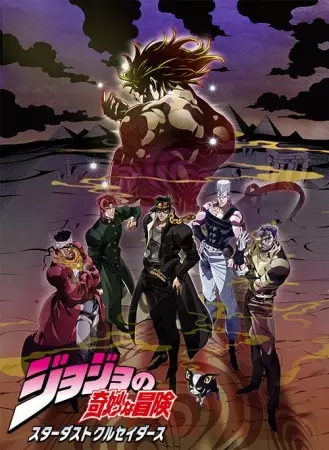

JoJo's Bizarre Adventure
ジョジョの奇妙な冒険
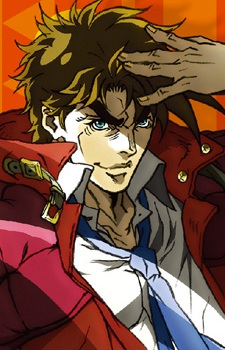
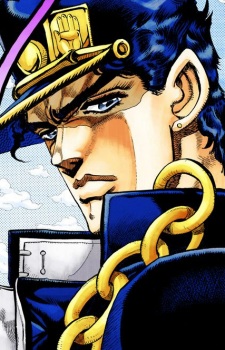
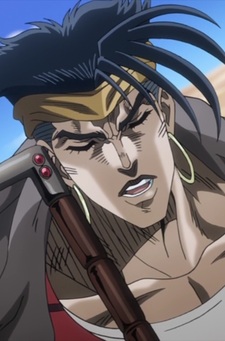
Kujo Jotaro is a normal, popular Japanese high-schooler, until he thinks that he is possessed by a spirit, and locks himself in prison. After seeing his grandfather, Joseph Joestar, and fighting Joseph's friend Muhammad Abdul, Jotaro learns that the "Spirit" is actually Star Platinum, his Stand, or fighting energy given a semi-solid form. Later, his mother gains a Stand, and becomes sick. Jotaro learns that it is because the vampire Dio Brando has been revived 100 years after his defeat to Jonathan Joestar, Jotaro's great-great-grandfather. Jotaro decides to join Joseph and Abdul in a trip to Egypt to defeat Dio once and for all.
Main
Main
Main
Main
Main
Main
Main
Supporting
Supporting
Supporting
Supporting
jmoriarty84
October 12, 2008
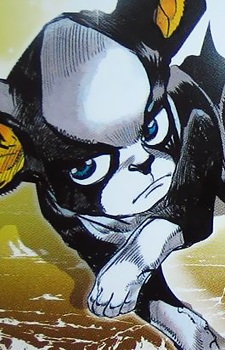
This anime series is based on the 3rd story arc of the manga, Stardust Crusaders. Though I strongly suggest you watch this anime, it will be confusing if you have no have familiarity with the first two story arcs of the manga which is a a major draw back. Though the DVDs do have an extra that narrates them, it’s not that fun if you don’t read them first hand because you really see the transitions each story arc goes through and they are all captivating, and still continues to be that way as the manga progresses even after Stardust Crusaders. Obviously when Araki createdJojo, he already had the first 3 story arcs in mind and does an excellent job of exhibiting his magnificent creation he intricately planned out. The manga is currently licensed by VIZ but I strongly disapprove of how they only releasing Stardust Crusaders and skipping out on Phantom Blood and Battle Tendency. You really need to see the first two story arcs to learn about the origins of Dio and of Joseph, and reading it as a whole, you just see the build up was all for that moment. The fact that some factors of Jojo are complicated to explain does not negate its quality, but only amplifies it because it really makes you curious and alert to how its so original in a certain way. The fact its supposed to be unorthodox really makes it unique in a different way. The supporting cast have their own unique qualities and personalities. Like Kakyoin may seem cold and distant like Jotaro from an outside point of view, he’s very loyal, compassionate, and very formal. I say it really helps when Hirotaka Suzuoki is your seiyuu. Polernarf is somewhat of the comic relief of the series despite his serious intentions. It’s just when it comes to comic relief characters in action anime and manga, they tend to be good will and natured. And then there’s Iggy, the stand using dog. Even though he is a dog, he sure has a helluva an ego. Initially, the manga had a Hokuto no Ken like approach to it. Sometimes you’d wonder if Buronson was the artist himself because the styles were exactly alike because of the massive bodies and the execution of stiffer fights were also present. But the art tends to evolve when Araki begins to make the bodies of his characters more lean and cut. Something lets say you can compare to the designs of the Battle Royale manga. But then he’d use water colors in some of his paintings on the covers to give it a somewhat more artistic distinctive look. Especially with the weird poses. I’m not saying it’s gay or metrosexual or however you wanna call it, I say it is probably meant to reflect on how Jojo is just weird, but in a cool and captivating way. The art is somewhat 80s with the clothing and the massive bodies, but when you look at it in comparison to the manga where it currently is with the Steel Ball Run arc, the art is becoming more leaner and more modern by current standards being more stereotypically anime with big eyes, but Araki still uses the weird poses and the water colors on his covers. So if you read the manga from start to where it is right now, like Morikawa Jyoji’s Hajime no Ippo, you’re going to see an evolution to the style. But I really like the sense of fashion he puts into his characters and gives variety. Like Jotaro’s Japanese punk clothing you might see in Bebop High School. Especially with the long school boy trench coat. And Joseph now has this Indiana Jones look. And Abdul looks culturally authentic. And Polernarf as confirmed by SNK would of course be the model of one of Team Japan’s favorite fighters, Benimaru. And in the manga, the cyborg Nazi stroheim would inspire Guile’s design in Street Fighter II. The stands of course are just unbelievable. Some of them are weird, and some of them are just frickin’ sweet. Like Jotaro’s stand, Stardust Plantinum has an Azteck warrior look to it. I have no idea how to describe Dio’s stand, the World. It’s humanoid like Stardust Plantinum, but has all these cords and looks all tubey. It looks likes some sort of hyro powered fighter or something. Joseph’s stand Purple Hermit is just a bunch of purple vines but has its use. So you’re going to see a lot of variety with the art and design though not necessarily too distinct in comparison to some action anime or manga of this nature except with the execution of the action. Now time to talk about what makes this anime stands out, but not necessarily that recognizable to other anime and manga fans outside of the land of the rising sun. It’s definitely the fights. The final battle is just breath taking. On my list of top anime manga fights, Dio vs Jotaro hits number one. It’s an all out battle for the fate of the world. Despite how wild and crazy this fight is, I really love how strategy and intuition is still present in the fight, though it’s not necessarily as technical as you’d see in a martial arts oriented anime like street fighter. If you had to put the mind games of L and Light from Deathnote into a physical plane or in layman’s terms, “a fist fight,” this would be it. You’re not going to see these fights in Dragon Ball Z, in Naruto, in Hajime no Ippo, History’s Strongest Disciple Ken’ichi, Flame of Recca, nowhere but Jojo. The original Jojo fights in the first two story arcs were more martial arts based being all Hokuto no Ken like and all and still entertaining in their own respective rights. But its good when you start from the beginning, you see the evolution to where it is now. But with this anime or manga being old, I kind of don’t like the dark resolution. I understand it’s a dark anime, but for me, it’s kind of hard on the eyes. Well, this oav series has no specific big name band doing any opening or ending themes nor is there any lyrical open and ending themes at all. I think it would have been cool if they did something like that for this anime. The background music is still very excellent and gives an eerie and spooky feel to it. I like it a whole lot. I don’t know what else there is to describe with the music. Though it is good, it doesn’t really stand out though certain songs do match the intensity and other emotions of the situation. The voice acting in this was dead perfect. Kosugi Juurouta as Jotaro was excellent, though I don’t think this is how a Japanese 17 year old should sound. But he makes Jotaro sound very intimidating, intelligent, and tough. I love the emotion he gives and he really brings the battle cries and the phrases of Jotaro to life. Like whenever he’s throwing multiple punches, he cries ora ora ora ora ora ora ora. And he’s always saying yare yare daze you can say something is along the lines of “oh well.” Nobuo Tanaka as Dio Brando was just amazing and couldn’t imagine anyone else doing it. I love how they give an echo effect to his voice, especially when he uses the powers of the World to freeze time. And he really brings out the psychotic sadist that Dio is with the way he yells and screams. He’s got that battle cry of “WRRRRRYYYYYYYYYYYYYYYY” and “muda muda muda muda.” Meaning it’s all useless if you wanted to translate it in a very literally loose way. I understand that in the Phantom Blood movie, Tanaka was replaced by veteran Midorikawa Hikaru. He’s done a lot of roles himself. Though I have yet to watch Phantom Blood, I just can’t imagine Midorikawa playing somebody like Dio and I don’t think he’s ideal for villains. But until I watch that movie and review it, I’ll give a more accurate judgement.
Supporting
SeriousRatings
April 21, 2012
Style - If there's one thing JJBA has in abundance, it's style. The art and animation in this OVA is absolutely wonderful. The character design is very stylish (I don't mind the fact that everyone looks like a bodybuilder), and the animation is fluid. The fight scenes are awesome. 3 out of 3. Character - The characters have some recognizable personality but are not fully fleshed out. Jotaro is a bit of a thug - he broke D'Arby's finger for attempting to cheat at poker. Polnareff is a manchild, he is arrogant and constantly gets into fights for no good reason. That's about all thatcan be surmised from the little amount of character building that happens in this short OVA. There are practically no scenes devoted to character development, so we really don't get to know the characters in depth. Actually most of the character development happened in the 7-episode prequel OVA. The Joestars want to save Holly and the other team members are there to get revenge on Dio. So the overall picture is there, but the characters aren't quite fully fleshed out. Overall 2 out of 4 for having undeveloped yet sound characters. Story - The story is pretty much nonsensical. Stands are somehow related to Tarot cards? This is never explained or explored. The villains are extremely inefficient at trying to kill the protagonists (I suppose if they were efficient, then the protagonists would never succeed) for example Hol Horse confronting Polnareff in the middle of the street and telling him about how his gun stand is superior to Polnareff's sword stand. Dio Brando being terrible at using his stand. Vanilla Ice acting like a complete idiot to get hit by Iggy and killed by Polnareff who was lying on the ground right in front of him. Jotaro suddenly developing the time-stop ability OUT OF NOWHERE just to defeat Dio. Polnareff jumping in to save Jotaro just as Dio is about to decapitate Jotaro. Dio landing exactly on Joseph's body after getting furiously punched by Jotaro. The entire stand thing makes no sense and the whole story is based around stands. It is truly bizarre. 0 out of 3 for not making any sense. Oh and also, I might add that chocolate EXPANDS when molten, so the whole idea of D'Arby melting chocolate to make more room for an extra coin to be dropped into the cup makes no sense at all. Overall 5 out of 10 for having undeveloped characters and a completely nonsensical story.
MasterGear
November 11, 2010
This OVA series is based on the third part of the popular, long-running manga series JoJo’s Bizarre Adventure, known as Stardust Crusaders, and the condensation from a 152 chapter strong series to a 13 episode OVA series results in the removal of a lot of material from the original work, condensing it into almost a ‘summary’ of the story, with several of the key fights highlighted and detailed. In some cases, as such with the final episode and several other times during the OVA, the events are changed due to some dramatic licensing from the directors, but this does not directly impact the storyline whatsoever.It is not required, although recommended, that you read the original manga before watching the OVA series, as this shows the full depth of the story and many of the battles which the OVA series misses out, but by no means are unimpressive. The story of the series is quite strong, with an interesting premise with the introduction of Stands to the series - psychic manifestations of the user’s fighting spirit. The somewhat formulaic presented goal to ‘defeat the big bad and save the damsel in distress’ may seem a stereotypical goal, but it is drastically subverted throughout the series, and this is one of the primary reasons as to why JoJo’s continues to excel as a brilliant series through its intuitive and genre-breaking storylines. The characters are well developed, despite the condensing of much of the manga storyline into the creation of the OVA – Jotaro’s badass demeanour and sharp wit are complimented well by the supporting protagonist cast – the humble and loyal Noriaki Kakyoin, the lecherous and somewhat ‘comic relief’ character of the series Jean Pierre Polnareff, the light-hearted and intelligent Joseph Joestar, the direct and intimidating Muhammed Avdol and the rebellious but occasionally helpful Stand-using dog Iggy. As you can probably tell, these personalities clash quite frequently, and the character interactions are quite meaningful in allowing the audience to interpret the characters fully and become really drawn into the plot’s progression. Stands are the primary innovative feature introduced in this series in particular, and the Stand concept is present up until the current part, Part 7 in the manga, and there are plenty of reasons as to why this is. Stands add a new dimension to combat, and just because many of the Stands look physically bulky does not mean the battles become fistfights – the vast majority of battles in JoJo’s are won not by the physical strength of the users, but by their wit and cunning, and the usage of the environment and their powers to secure an advantage. Expect many underhanded tricks and death-defying attacks, and these only add to the trope-breaking that JoJo’s exhibits. In terms of visuals, it is clear that the directors have put a lot of effort into imitating Hirohiko Araki’s distinct and interesting art style, and in some ways, they manage to succeed, but it was always going to be difficult to recreate the flamboyant poses and eye-popping visuals that Araki creates in the manga. The 90’s animation in the later episodes is well done for its time; despite some niggles with jagged edging, but these can really be overlooked. The prequel episodes created in 2000 have a much darker and deeper animation style, and this is also quite visually impressive. The variety of clothing and fashion sense that Araki creates exudes brilliance, and this is well replicated in the OVA, adding to that same atmosphere that was created in the original manga. Despite the lack of an opening or ending theme, the audio in the OVA is also very well done – the backing music adds a very eerie and mysterious feel to the series, and the score backs the events of the series well, with no particular songs standing out over the others, but still managing to capture the emotion and tension of the situation. The voice acting was also excellent and in character, particularly the voice actors of Jotaro and the supporting protagonists, along with Dio’s voice actor, who breathed life and emotion into the characters and captured their essence and personality that was presented in the manga. My final rating of 9/10 is a result of the combined praises that I have given the series over the past paragraphs. The only lost point was due to the condensing of the storyline, which was indeed required to fit into the 13 episode limit, but still leaves several loose ends which can only be understood if the watcher has already read the manga, which, to be fair, really should be the only reason as to why you are planning to watch this (if you have or are planning to read the manga). While this OVA series is very exciting to watch, it does not match up to the excellence of the manga, and should not be viewed as an alternative to reading the manga, as you will simply miss so much of the experience which makes JoJo’s Bizarre Adventure so captivating.
Quelandoris
March 26, 2016
Stardust Crusaders's OVA is, lets be perfectly honest here, pretty bad overall. It removes a lot of the more entertaining fights in favor of streamlining the series for a 6 episode run. The visuals range from outdated to just plain bad, the characters look strange, even compared to Araki's art style, the colors are faded and washed out compared to Araki's more bright and flamboyant style, which is a damn shame. The sound design is bad in most places, until you get to the very last episode, which I will cover later. The voice acting is flat and lifeless, sound effects have no impact, and thescore is just background noise. Characters and stories are what faired the best. Even gimped by a small budget and a short episode count, Araki's writing is wonderfully tense and eccentric. Things feel rushed and a few major plot points are skipped, but its Jojo through and through. Everything I just said can be completely ignored for the last episode. The fight with Dio is absolutely stellar. Unbelievably good. The colors are still washed out, and Dio's voice actor doesn't bring the right energy, but it's wonderfully directed and animated, tense the whole way through. The sound effects for The World are amazing, and I love the choice to make Dio moving in stopped time just a simple disappear and reappear. No need for flashy lights or sound effects. The entirety of the last episode is a much watch for any Jojo fan. The rest is kinda meh.
raviwe
October 28, 2024
Jojo's Bizarre Adventure is, in my opinion, the greatest manga I've had the pleasure of experiencing. However, this adaptation manages to butcher almost everything that makes it exceptional. If you're an Araki fan, consider this your free pass—you do not need to watch this. If you're not familiar with the series, prepare for a story in the middle of other stories, with so much left unexplained that it quickly devolves into an incomprehensible mess. With that said, let’s delve into what Stardust Crusaders (the actual name of the part this anime tries to adapt) is about and the themes it explores. We’ll also discuss how thebeginning might be misleading, how effectively it tackles its thematic elements, and how it compares to other parts of Jojo's Bizarre Adventure and its anime adaptation. So, what is this show about? Each part of Jojo's Bizarre Adventure revolves around a central theme of humanity, often tied to karma—how actions shape fate, family, and community. While each part introduces unique themes, they all contribute to this broader framework. Stardust Crusaders concludes the first trilogy of the saga, focusing primarily on heroism. Jonathan Joestar embodies the traditional hero, with a sense of honor and courage, albeit dated. Joseph Joestar builds on this by showing that true heroism involves deeper ideas, effort, and willpower, refining the hero’s spirit. Jotaro Kujo, the protagonist of Stardust Crusaders, takes it further, suggesting that patience and hope are the true essence of heroism. This initial trilogy explores what makes a hero through these evolving perspectives. Unfortunately, none of this comes through in these six episodes. If you haven't read the manga, you'll likely be left wondering what the point of this adaptation even is. First things later, let’s talk art direction. The art strays from Araki’s original style, taking itself too seriously. While it does reintroduce some horror elements omitted in the 2015 adaptation, making for tense battles and a suspenseful tone, the pacing is erratic, and the voice acting lacks passion. The English dub is slightly better but still falls short. Even though the horror is closer to the manga’s original atmosphere, it somehow still misses the mark. The body horror, in particular, is poorly handled. In the JJBA we know and love, body horror is detailed and intricately grotesque, transforming human figures into striking, surreal forms. Here, though the characters are put through violent scenes, the bleak atmosphere replaces the manga’s iconic grotesque detail with a more muted visual impact. So, how does it start? For reasons unknown, the adaptation kicks off with Iggy’s introduction, with no explanation for why they’re in Egypt or what a Stand even is. Then, we’re abruptly shown a mysterious blood cult, left without context or any real point beyond a weak nod to fans: “You’ll understand if you read the manga.” It doesn’t mislead, though—it’s unintelligible from the start and continues that way throughout. I intend this to cover the 2000 addition to this adaptation, and it addresses at least the stand's point. However, it compensates with a lot more unexplained stuff. What about the characters? The characters, too, are surprisingly mishandled. These are phenomenal characters, but in this adaptation, over half of them feel purposeless. Avdol and Iggy could’ve been swapped out for a torch and a paraglider, and the plot would barely shift. Joseph’s presence feels almost token, as he contributes little beyond simply being there. Polnareff and Kakyoin do retain some of their pivotal scenes from the manga, but they come off feeling strangely forced. The adaptation cuts out bonding moments between characters, leaving us to wonder why this Frenchman feels such attachment to a dog who, up until now, was only shown farting in his face. What about the story itself? While the adaptation does change some things from the manga, which I appreciate as a fresh perspective, the alterations are, however, random and poorly executed, adding nothing meaningful. Some cuts from the manga lead to scenes with no real impact on the story, and vice versa. They don’t even address certain aspects that logically should’ve changed. For instance, if the characters have 50 days to confront 28 enemies, cutting down to eight enemies should reduce this timeline. Yet, the timeline remains unchanged. Then, what did I think of it as a whole? As a standalone work, this adaptation falls flat and adds little beyond some visually cool fight scenes. Overall, I wouldn’t recommend this to anyone—neither to fans nor newcomers. I often give up to 2 extra points for the deeper meanings, this work is getting those because it is still part of JJBA. Otherwise, I would give it a 2 (terrible).
#1973
Popularity
#1764
Members
149,220
Favorites
1,997
Episodes
6