侍ジャイアンツ
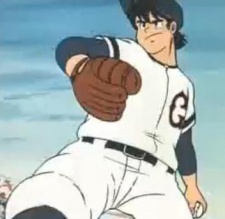
Ban Banjou is an insolent wild boy who was raised on the rough sea in Tosa, southern Japan. He joined the Tokyo Yomiuri Giants in Japanese pro baseball league such a baseball pitcher noted for the blazing fastball and the worst control. He fights hard battles against his rival batters, developing his incredible pitching magics.

Main
Main
Main
Main
Supporting
Supporting
Supporting
Supporting
Supporting
mathemagican
February 13, 2022
Samurai Giants: The show featuring Nagahama Tadao fresh off Kyojin no Hoshi leading a staff roll that could make any one's mouth water with expectation including Ishiguro Noboru, Osamu Dezaki, Yoshiyuki Tomino, and a young Hayao Miyazaki on deck, theres no end to what a viewer could expect, and never once did Samurai Giants ever disappoint. Its worth mentioning here before i delve into the content how I even ended up watching some random baseball anime from the early 70's with less than 200 completed members in the first place. The truth is, I had been recommended Touch by some friends, and Idecided that it would be worth understanding the tropes of baseball anime which Adachi's work would play off of, and Samurai Giants is the first major production following the towering Kyojin no Hoshi. Looking at Samurai Giants from the surface, it seems exactly what you might expect from a show attempting to live in the shadow of a trend setter baseball show about a star pitcher, following its own pitcher: Banba Ban. Banba is introduced as a reckless and emotional highschooler known to throw punches first and pitch so wildly his batting opponents cant help but shiver in their boots. Banba is a man who hates bullies, and this sets the stage for his incredible character arc to maturation as a person, a player, and a pitcher. A show about a pitcher is always going to focus on the pitch itself, and Samurai Giant's take on the pitching mind game is to pit the most creative monsters against each other. Each of Banba's takes on ways to throw a ball to psych out the sharpest batters out there is unique and entertaining and each plays well to Banba's wild nature, while all of his rivals never shy away from his insanity. From a trope perspective, Samurai Giant's path to live in Kyojin no Hoshi's shadow is through Banba's wild pitching, and the growth of Banba as a player along the way. Visually, man, this show looks great. Even ignoring the remaster quality increase, this show uses constantly engaging frame composition and a color palette that never fails to say something about the scene. The staff never seems to shy away from using what ever color suits the moment and that works as a strength all the way. The OP and ED's are largely made of clips from the show but the music performance is endlessly catchy. At the end of the day, Ive found yet another untranslated show the wider western anime audience is missing out on and I hope to see this show get the fan release it honestly deserves.
Chuy_diazz
April 24, 2024
A journey through Madhouse chapter 1. Before starting I want to make it clear that I don't know why I'm doing this, but the idea is to visit each and every one of MadHouse's works throughout its history. This is because it is my favorite studio and I am crazy enough to see it all. Second point to highlight, since this work is not so accessible, I ended up watching it without subtitles, which is why this review is based on my mere interpretation, since I do not have any understanding of the dialogues. Regarding the anime, it's nice to know that the beginning of this journey isa spokon. The idea of seeing a spokon made it easier to start this journey, and everything was easy until it started. The plot focuses on a boy who is a baseball player on his high school team, he is a good hitter but as a pitcher he lacks complete control. He is recruited by a professional team and the story develops from that point. It has several positive points, starting with the mention of concepts that are still valid in current baseball spokon. Concepts such as the three-dimensional strike zone were already used at this time, which shows that the work has a great understanding of the sport. Another point is that the characters, both the protagonist and the rivals, used their daily life experiences to improve their pitches or their swings when hitting. An example of this would be the protagonist using his experience as a fisherman to invent pitches with different heights simulating that he is standing on the same waves of the sea. The negative is that although he has a good understanding of the sport, he does not show complete games or let the other members of the team show off. Everything is focused on the protagonist and the matches are reduced to a mere inning so that the protagonist can show off. The work has a big loop that makes its protagonist look a little tantrum. This loop consists of the protagonist developing a new pitch, the batter cannot hit the ball, at the end of the game the rival batter goes and trains in a barbaric way and in the next game he manages to hit the protagonist's magic ball, which generates He becomes depressed and retires (in the middle of the game) to try to invent a new pitch since the last one is of no use to him because it was already hit. Instead of increasing his repertoire of pitches, he tried to be a One Trick Pony with a difficult pitch to hit. This refers to the sports issue, because history also has its flaws. You don't need subtitles to understand that the actions of this anime bordered on criminality. It is incredible how many ways they could find to seriously injure a minor in an official match. It is noted that in the 70's they did not know the concept of "Security". In conclusion, although we are looking at one of those historical animes, since it was one of the firsts spokon anime in history, it is not worth visiting. Finding it with subtitles in the Roman alphabet is already a challenge, and seeing it without subtitles is crazy. Please love yourselves and don't be like me.
zettai-jin-stray
December 15, 2025
Samurai Giants is possibly the best baseball anime out there. It has a classic TMS feel with Yatsuo Otsuka’s timeless animation, which is very energetic and lively in only so few frames. Banba Ban (hilarious name) is wild, fierce, and a bit rude and poor mannered, his friend on the team, Hatsuma, who’s more serious and mature (not really in a tsukkomi way though), helps him train. It’s not an amazing drama or anything like Dezaki would do at TMS but it is entertaining. Speaking of Dezaki, he boarded the first episode, and a number of famous staff have episode direction and storyboard work suchas Tomino, Satoshi Dezaki, and Noburo Ishiguro. But what most makes the anime is the art direction of Shichiro Kobayashi, with one of his first standout roles as art director. He has a very pencilly look at times here, a rough but calculated style. For a baseball anime, you might not expect there to be so many scenic locations, and while there is a lot of standard field practice and stadiums, there’s a surprising amount of miscellaneous travel. There are episodes where Banba and Hatsuma go to forests, a small isle, the mountains, and so on. For the training, it’s somewhat ridiculous, with Banba having a special move where he spins around in circles with his bat in a cartoony way. In one episode, they train by tying themselves to a rope and dangling from a cliff upside down while swinging to better their aim, aside from the typical games and rivals that’s some of what you can expect. The anime is available in high definition with only a fansub of the first episode.
Rank
#7405
Popularity
#12420
Members
2,128
Favorites
5
Episodes
46