Gunbuster 2
トップをねらえ2!DIEBUSTER
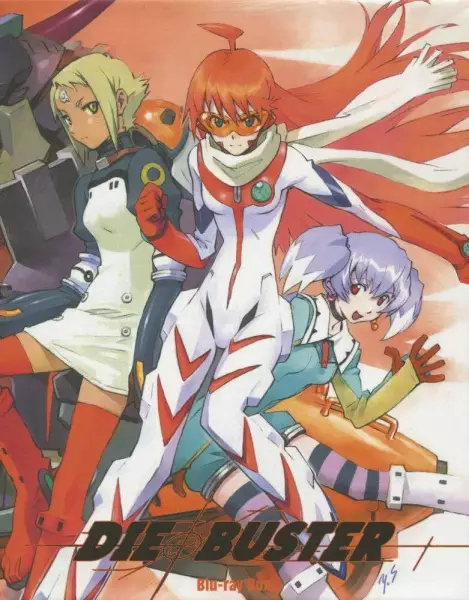
Generations have passed since the war with the Space Monsters started, and none remain who know how it began, with even records of those times being scarce. It is a lost cause, but humanity still fights against them, relying on the "Topless": a group of elite space pilots with special powers that allow them to use the Buster Machines—the last hope against the Space Monsters. Nono, a girl from a remote Martian town, has heard tales all her life of the legendary pilot "Nono-Riri," and wants nothing more than to leave her humble life behind and follow in the footsteps of her idol. Though she has no idea of the dangers that lie ahead, nothing will stop her from achieving her dream. While Nono is down on her luck, she chances upon the lonesome Topless pilot Lal'C Melk Mark, and decides to stake her entire future on following Lal'C, no matter the cost. [Written by MAL Rewrite]
Главный
Главный
Главный
Второстепенный
Второстепенный
Второстепенный
Второстепенный
Archaeon
October 27, 2009
Many people will know the name of Hideaki Anno, in particular because of Neon Genesis Evangelion. His directorial debut though, was an OVA called Top wo Nerae (known as Gunbuster in the West), and whilst NGE has many, many advocates, I will admit to being one of the few who consider his debut work to be superior in almost every aspect. That said, I approached the sequel, Diebuster, with a degree of trepidation, in particular because the directorial reins had been handed over to Tsurumaki Kazuya, who also directed FLCL, NGE: Death & Rebirth, and the first two installments of the NGE remakes. To sayI was surprised by the end result would be an understatement. Top wo Nerae 2 takes a bit of getting used to, especially for fans of the original series. The style, plot and scripting are very different to the original OVA, however the feel of the show is remarkably similar to it's predecessor. Part of this is because the story is set around ten years prior to the final moments of Gunbuster, at the very end of the 12,000 year period. Humanity is still at war with the "space monsters", but they are more able to cope now thanks to the efforts of the Fraternity, which is made up of teenaged pilots who possess "supernatural" powers (known as "Topless"), and their Buster machines. The story begins with Nono, a clumsy girl living on Mars who dreams of being a space pilot. She runs away from home to follow her dream, only to find that reality is very different. Through a chance encounter she meets a Topless called Lal'C Melk Mark, and is completely bowled over by the experience. She follows Lal'C into space, ultimately to meet her destiny. In all honesty, the plot is actually the weakest part of the whole OVA. Although the story is well paced and the scripting is tight but flowing, there are some obvious homages to Gunbuster which, all told, the show could really have done without. That's not to say that all the references are bad, especially as this is set within Gunbuster's timeframe. It simply means that the show is too reliant on knowledge of the original OVA at times, and would have been better served by trying to be more original on occasion. The biggest problem though, is that the director and the writers have tried to cover this by making Nono a fan of Nonoriri, the girl who saved the Solar System thousands of years ago. This attempt at deus ex machina didn't sit too well as it gave a certain falseness to the characters thoughts, feelings and actions at times, especially on the occasions that mirrored occurences from the original OVA. However, while the story may have it's problems, it is actually enjoyable for the most part, and it's to the credit of the writers that a number of flaws can be forgiven (not all though, more on that in a bit). One area where the show does excel is in it's animation. Gainax have, once again, produced some stunning work in terms of character movements and set piece action sequences, and it's fair to say that in this department Diebuster is actually better than Gunbuster. The character designs, created by Sadamoto Yoshiyuki (who was also the character designer for FLCL), are very good on the whole, although they are, at times, a tad cartoonish. The backgrounds, especially the renderings of space and it's wonders, are very well done, and some of the visual effects used in the show are truly inspired. The OVA does fall down though, in it's usage of nudity. Where the original series also had a degree of nudity, it's usage was minimal at best (aside from the bath scene), with the most prominent example being Noriko's famous shirt ripping moment in the final episode. Diebuster, on the other hand, seems to take any excuse to show the fans some skin, and whilst there are times when this mimics the first series, there are far too many occasions where it serves no purpose other than to please the fans. I'm all for pleasing the fans, but Tsurumaki and Gainax should have tried to do this in a different way instead of choosing to be "cheap". Diebuster is very good in terms of it's sound effects, not simply in their usage, but also because of their timing. The sound department has paid a great a deal of attention to matching specific effects to the on-screen action, and whilst there are times when the sound is a veritable cacophony, closer examination will reveal that each individual effect stems from an individual action, item, character, etc. In truth, Diebuster is one of the few anime that is worth watching with surround sound to truly appreciate the quality of the effects. In terms of music, the show has a generally martial tone to the various thematic pieces, however these are offset by some mellow tracks that work well with the more relaxed moments. The show has a certain feeling of continuity because of the music used throughout the series, some of which is taken directly from Gunbuster, while others have the same feel. The ending theme in the final episode is very much in keeping with that of the original series, and given that both OVAs finish at the same point in time this, like many of the other tracks, is well used and choregraphed. Once again though, Diebuster is let down by something simple, in this case, the OP and ED. Where the ED from Gunbuster was a pretty staid ditty about love, the OP had a "get up and go" feeling to it that was reflective of the whole OVA. Diebuster, on the other hand, has two J-Pop tracks for it's OP and ED, both of which don't really reflect any aspect of the show, and seem to have been chosen to make the OVA more "trendy". That said, the voice acting was very good throughout the show. Fukui Yukari's Nono possessed a bubbly personality that was tempered with determination, while Sakamoto Maaya's Lal'C has an aloof, and slightly disgruntled air about her. In terms of acting ability, the cast is truly excellent, and while there are occasions when they do ham up their roles a little, this is very much in keeping with the "excessive" feel of the OVA (more on that in a bit). As for the characters themselves, they are the second weak point for Diebuster. Nono, in terms of the story, possesses no real motivations other than to be a space pilot. While she is most definitely an enjoyable character, she doesn't actually develop in any real way, as much of her drive and conviction remains the same even after her memory returns. Much of the development in the show actually happens on the part of Lal'C, especially in the way her thinking changes to reflect that of Nono. Unfortunately, the show has a number of recurring characters who really get little to no development, and whilst it's true that this is only a 6 part OVA, if all the development was only supposed to occur on the part of the main characters, then the director should have focused on this instead of making lame attempts to round out other characters, a case in point being the furore involving Tycho and Buster machine Quatre-Vingt-Dix. The time could have been better used to round out the story instead, and it's ironic that while Diebuster hasn't done this, Gunbuster actually did. To many it may seem as though I don't like Diebuster, especially as I'm an advocate of the original OVA, however nothing couldbe further from the truth. I found Diebuster to be very good, however not in the same way as Gunbuster. The reason for this lies solely on the shoulders of several people, including the director and character designer. Like many directors, Tsurumaki has tried, and in some measure succeeded, to stamp his mark on the series proper, and his influence, along with that of certain other staff members, is readily apparent throughout the anime, so much so in fact, that there are occasions when Diebuster resembles FLCL or Tengen Toppa Gurren Lagann more than it does Gunbuster. This is not a bad thing though, as it does give the OVA a different feel to the original, but therein lies the problem as well. Where FLCL and TTGL have an excessive, over-the-top atmosphere that is prevalent in Diebuster, the original Gunbuster opted for a quiet heroism that was truly touching, and nowhere is this more apparent than in the final episodes of both OVAs. The final scenes in Gunbuster are quiet, with an emphasis on personal sacrifice - the needs of the many outweigh the needs of the few being the most appropriate sentiment. Diebuster, on the other hand, opts for a much flashier ending, with lots of noise and action, and to be honest, very little emotional impact. In truth, Nono's transformation scene and what follows is actually far more memorable than the ending itself, which says a lot about the actual scripting of the show. The problem, at least for me, is simply this: the entire series is supposed to be about how far humanity will go in order to survive. Given that fact, the method chosen to combat the "space monster" in the final epsiode doesn't equate with the core of the story, especially as there are other planets in the Solar System that would have been more suitable. That particular method was an attempt at mimicking the usage of Buster machine #3 in the first OVA which, unfortunately, doesn't have the same effect, mainly because the element of personal sacrifice for the greater good is missing. It may sound strange to say this now, but Tsurumaki et al could have easily channeled their collective creativity into creating a show that not only captured the spirit of Gunbuster, but also encapsulated the style of FLCL and TTGL, and, in all honesty, a show like that already exists - Giant Robo: The Day the Earth Stood Still. That said, Diebuster is surprisingly honest in a number of ways, the main one being the fact that it makes no excuses for it's numerous homages to the original OVA. While there may be those who think that using so many references is simply a method of capturing fans of the original anime, this method gives the entire show a feeling of continuity that is so often missingfrom sequels. On the whole Diebuster is a great addition to the franchise, and while it has it's flaws, it's definitely a worthy successor to Gunbuster. While the story and characters may not be as good as the original OVA, Diebuster has a style and flair of it's own that elevates the show to a whole new level. I wouldn't say that it's truly equal to Gunbuster, but it comes very, very, close.
Karura
December 12, 2007
It is important to note that this is a continuation, and as such, will be reviewed under the assumption one has seen the prequel. Lets get down to it. Top wo Nerae! 2, alsno known as Diebuster is the indirect sequel to Top wo Nerae/Gunbuster. I enjoyed this short OVA substantially because of its presentation. Plot The story follows a girl called Nono who wishes to be a "Topless," which is basically an ace mech pilot to put it simply. Instead of dragging the story out with pointless episodes and scenes you often see in 26+ shows, Diebuster goes straight to the point and sticks with it.Most of the scenes show multiple different conflicts (whether they are big or small) which are tied together with the main plot quite nicely. Pacing is great, but since it's so short you might forget some of the smaller details as the series goes on. Visual/Personality This anime brought with it a wide variety of moods and atmosphere simply due to its visual direction. In terms of overall quality, Diebuster falls by today's standards however considering its age, the key animations were memorable to say the least. The fights were all very fluid, everything in the scene seemed like it was flowing together. Usually, emotion is hard to convey, however Diebuster was able to successfully convey those emotions through its visuals. Not only that, but character design was excellent, they managed to turn a basic style suit into each character's individual style, and personality wise, none of them (at least to me) seemed to follow the stereotypical route. Sound Diebuster had a good OST when it comes to sound. The BGM's were nice and, all though not Gurren Lagann-type memorable, they stood up there with some of the good ones. The voice acting was pretty good too (see emotions being memorable). Some might argue Nono's voice was annoying, but I liked it. Even the enemy grunts/noises, those were superb, for grunts and noises anyway heh. Everything that had a distinct sound keep that sound though, for example beams sound like beams or explosions sound like explosions, but when tied with Diebuster's BGM, it sounded better. Lets not forget the OP and ED, both of which totally owned face. Groovin' Magic stands to be one of the best songs, at least in my opinion, to match this series (plus it was done by Round Table feat. Nino, who are one of my favorites). ACKO's Hoshikuzu Namida is a catchy single as well, pair it together with the slideshow ending, it's perfect. Enjoyment The reason I enjoyed this so much is because of the memorable scenes and the similarity between the original. Gainax seemed to keep the trend of hotblooded epicness going after they finished Diebuster with Gurren Lagann, which doesn't relate to Top wo Nerae at all, but they all share the same principles. If you are a fan of mecha, shounen, or anything of that sort, I'm am confident Diebuster will give you some enjoyment. Overall All in all, I give Diebuster, rather Top wo Nerae! 2, a solid 9 out of 10. I have to admit, those seeking to watch this typically already know what they are getting into. A story about believing in yourself and overcoming difficulties and struggles; these things are common to us all.
CodeBlazeFate
May 18, 2018
Some things need to stand alone. Sequels are a gamble, especially when the time gap between original and sequel grows and grows. They tend to be put under more scrutiny than their predecessors, as they not only have to deal with standing tall as installments in their own right, but they need to provide merit as a sequel to a product that never needed one. The trickiest prospect involved is the anniversary sequel, as that is where you’re most likely to enact the gambit. Some projects of this nature can pay off in a way that respects the original and becomes its own product, perhaps evensucceeding it in the process. However, not everyone can do a Turn A Gundam, and instead, some make Diebuster. Put it simply, it fails both ways. As a series, it features mediocre at best and largely uninteresting characters, half-assed power-up moments, and tons of convoluted and barely explained sci-fi superpower bullshit & worldbuilding. When the highlight in terms of memorable character moments was a rape attempt, you know you’ve fucked up. As a sequel, Diebuster’s almost insulting. The writers made a completely different type of show -a mediocre one at that- a sequel to Gunbuster. It would be like making Aldnoah.Zero the sequel to Macross. As such, everything about the already poorly-crafted and convoluted world-building (galaxy building?) is brimming with incompatibility. Buster machines are now biomechanical machines that can only be piloted by people with some hereditary superpower gene rather than robots that take skill for any able-bodied person in general to pilot. They each come with different powers including the ability to freeze space creatures in space with quantum temperatures, and controlling and turning other ships into creatures to use during battle via psychic powers or something akin to that. They have colonized entirely new planets with futuristic military technology, yet transportation technology and all things not inherently related to war against space creatures has yet to advance beyond 2004 —the year this OVA first aired— until the finale outright contradicts that. The finale also proves that it takes place during a specific portion of the original’s finale, as if to self-destruct while getting its idol caught in the explosion. Additionally, whereas Gunbuster used real, hard science for its science fiction, Diebuster uses pseudoscience superpower nonsense. This and more serve as only a taste of how incompatible (for lack of a better word) the world-building is, and why crafting a coherent world is always important. Otherwise, we get two pieces that just cannot fit. There’s also the fact that the mere existence of the events in Die, even discounting the monumentally awful finale, ultimately sully the finale of the original Gunbuster. Not only did that show end phenomenally, but it did so in a way in which no real sequel could be warranted. Gunbuster ended so conclusively that to continue would be to retroactively take back part of the point of the finale. This isn’t even touching on the world-building. This show really should have been its own thing. It would have been a mediocre at best show, but better a mediocre separate celebration installment than a show that accidentally knocks over its predecessor’s grave, especially when said predecessor became one of the two foundational anime of its studio. However, it would probably require heavy rewrites towards the end in particular. After all, the more it goes on, the worse it gets, peaking in its concluding episodes in terms of sheer atrocity, as the show stops caring almost entirely and ends up outright nullifying the ending of the original, at least canonically. To cover the positive —read: superficial— aspects of this asteroid, the music is better than last time, and the visuals are still mostly well-crafted. Even with the awful mech designs excessive amounts of usually terrible CGI, the show’s visuals are worthwhile. The character designs are fine enough -particularly that of Nono- and the action animation is smooth, kinetic, and kept track of extremely well...as long as the characters aren’t running. It may not hold up compared to the immaculately detailed and stylized predecessor of yore, but disregarding that leaves you with visuals that were on par with that best at the time, at least animation-wise. The sense of scale is quite large, to add on top of that. Lastly, the music is honestly a tad superior than the original, at least when it isn’t remixing tracks. The OP and ED themes are ok and the background music is serviceable, though that is all I can praise. Ultimately, the more this show goes on, the more horrible a sequel it becomes. As if it wouldn’t be a bad enough show on its own, it just had to throw a classic series under the bus in a drunken attempt at paying homage and joining a franchise. Barring the prospect of bastardizing a returning cast, Diebuster commits every sin a sequel can commit -including ones I never thought were possible- and ends up shattering itself into pieces upon its obnoxious attempts at trying to send-up and one-up. On its own, it's a mediocre turned bad show too ambitious for its own good. As a sequel, it is so...so much worse. Way to go Gainax, producing the worst thing in your mainline repertoire to celebrate 20 years!
pachu
January 8, 2008
After watching Gunbuster/Top wo Nerae! i was crazy wanting to see more of the history, and then i saw Gunbuster 2/Top wo Nerae 2! To my surprise, on the first scnenes, it appears to be totally different or not correlated to the 1st series. Then, like the 1st series, it began popping aliens, space and kinda different mechas? Different you say? Yes, the Top wo Nerae 2! mechas look much more like the EVAs than the 1st series mechas. But on the first chapters you note that this 2nd series battles are much MORE OVERPOWERED than the 1st series. With you think that Dragon Ball Z isoverpowered, think again, Diebuster 2 is the winner. Overall, the anime has interesting art, looking like FLCL (it is the same director), the songs are great, and the action is intense like the 1st season. But the good thing you will find in the end, i will not say, because it is a spoiler, but it will make you happy.
Detri
November 2, 2007
This is simply the best OVA, and perhaps series ever produced. Basically an alternate telling of Gunbuster, but as a parallel of sorts. The original series, from the 1980's, didn't get too much recognition until Gainax really hit mainstream with Neon Genesis Evangelion. Diebuster, from the director of FLCL, takes a lot from that series as far as animation style, and improves upon it greatly. The six episode OVA has some of the best art and animation and just does an incredible job overall.
#1745
Популярность
#2628
Участники
84,676
В избранном
903
Эпизоды
6