
From Up on Poppy Hill
コクリコ坂から
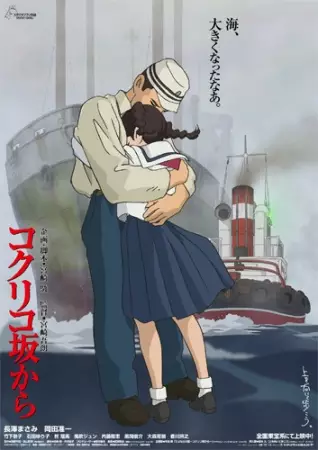
Atop a hill overlooking a seaside port sits a boarding house named Coquelicot Manor. Since the building is run by her family, Umi Matsuzaki carries out many of the duties involved in managing the small establishment, such as preparing meals for her fellow boarders. When she isn't at home, she is a student at the local high school—one that is currently dealing with a small crisis. In anticipation of the upcoming Olympic Games, a beloved old clubhouse is set to be demolished to make way for a modern building. As a result, a large part of the student body has banded together, working tirelessly to prevent this from happening. Umi finds herself helping the newspaper club to spread information about this cause where she befriends Shun Kazama, whom she gradually begins to fall in love with. But Shun is an orphan who doesn't know much about his origins, and when the two begin searching for clues to the boy's past, they discover that they may have a lot more in common than either of them could have thought. [Writtten by MAL Rewrite]
Главный
Главный
Второстепенный
Второстепенный
Второстепенный
Второстепенный
Второстепенный
Второстепенный
Второстепенный
Второстепенный
Beatnik
July 22, 2012
Well that's two lacklustre Ghibli movies under Goro's belt. On one hand I can understand Hayao supporting his son in his career, yet on the other hand this blatant form of nepotism is doing nothing but showing that the Miyazaki magic will disappear when he does. Goro doesn't deserve to be making Ghibli movies just yet. Maybe gaining more experience doing other things would prepare him for that special of roles, but instead what we're left with is his experimentations and learning process stamped with the Ghibli logo. It's diluting the brand. His two films aren't even pandering to mainstream audiences; that’scertainly not a complaint that can be directed at him, but his films are just directorial missteps that don't utilise the tools of animation to their best potential. It’s as if after the drubbing he got for Earthsea he thought to himself “I’ll direct a story set in 60’s Japan, the critics will like that!” Earthsea was a disappointment on every level. There are some detractors of that opinion, but the general consensus from viewers is that Earthsea is far low on the list of Ghibli films you should watch. From Up On Poppy Hill at least has some modicum of charm and old school aesthetic about it that keeps it from being a complete failure however. The last thirty minutes are the best with more pace, urgency and melodramatic moments, but it’s a slog to get there. The animation is not special in any way other than bringing to life 1960's Japan with typical Ghibli detail. The story is a simple coming-of-age tale that lacks any life or bite. There is a revelation that sparks things up somewhat, but even that is ultimately diffused. Hayao himself co-wrote the script with the screenwriter of Earthsea, and I like to imagine he tried to make the clubhouse scenes lively in order to bring life to the story. The music, like everything else with this film, is inoffensive and bland. Joe Hisaishi is not in sight. There's just nothing here to latch onto and keep in your memory as something to return to. I can recall numerous scenes and musical motifs of previous Ghibli films, but from this all I will recall is the main character pulling up a flag. There are no creative scene compositions, no efficient editing tricks; no passion in the bringing of this tale. The last thirty minutes had developments that could have made a better film by themselves, in a manner similar to Grave of the Fireflies. When Hayao made Ponyo, you could see his childlike passion for the project in the bluray extras, and you can see it in the work itself, it's bold and full of life, and contains the most amazing depiction of sea waves I've seen in animation. Goro needs to ask himself why he's a director, and for our sake he needs to find the answer on his own time, and not on Ghibli's dime.
totorolover33
October 8, 2013
When people hear the words 'Studio Ghibli,' many have come to expect a masterpiece. This is both a blessing and a curse; whilst this does mean that more people watch these (usually pretty amazing) films, it also means that people can mistake 'imperfect' for 'bad.' I can't speak for everyone, but I actually really enjoyed From Up on Poppy Hill. The characters were likeable - not particularly in-depth or rich, but likeable - and the quirky supporting cast were always there to pick up any slack. In fact, I would say that the supporting cast is one of my favourites from a Ghibli film sofar, beautifully designed and entertaining to watch. The story was engaging, too: a simple teenage romance with a couple of surprising plot twists and an ultimately uplifting result. It may not have been full of drama and suspense, but the film had that wonderful Ghibli charm to it, reminding me of some of their other simpler works: Only Yesterday and Whisper of the Heart (the latter being a personal all-time favourite). Whilst the plot may have been slow-moving, a faster one wasn't really required. The world of the story was, as always, built beautifully, and it was a pleasure to watch events unfold even when they were unfolding quite cautiously. This, of course, was because of the astounding artwork, backgrounds and animation more than anything. There's not really anything more to say on this, it's just beautiful. The music also deserves a mention. The opening and closing songs were lovely, very fitting and atmospheric, and whilst I can't really pinpoint a specific part of the background OST that I enjoyed, I can safely say that it always suited the scene it was played against, whether or not it was anything particularly special. I was also pleasantly surprised at how good the English dubbed voice acting was, for the most part. (I can't comment on the original Japanese as I didn't watch it). So, to summarise; this film isn't for everyone. It doesn't have a very describable plot, nor does it have any particular deep characterisation or meaning (unless I was missing something). It's comparable to a nice soup in winter; it might not be the most exciting or substantial thing ever, but it's comforting and sympathetic and it makes you feel all warm and fuzzy inside. Unless, of course, you don't like soup. But anyway, you get my point. It's not the best work ever to come from Ghibli, but it's still a lovely film, it has an irresistible charm and it's definitely worth a watch.
tehnominator
November 10, 2013
Miyazaki Goro's sophomore attempt at directing proves that he can stand apart from his legendary father, but perhaps he is still walking in the shadow of the behemoth Studio Ghibli. Yet his recent work does not back down in its fight to earn a place in their legacy. From Up on Poppy Hill gives us the standard we expect from a Ghibli film: beautiful art, consistent and vibrant animation complementing stories and characters with either a whole lot of heart or charm and sometimes both. But while Miyazaki makes all the right steps, he has a long way to go to give us something that isclearly his, something that makes us say "That's a Goro film". While every Ghibli movie feels like a distinctly magical journey, this one never quite gets there. Yet where it's headed is nowhere bad at all. Set in the post-war, pre-Olympics 1960s Japan, From Up on Poppy Hill successfully re-creates a time and place where the protagonists Umi and Shun meet and fall in love. Their hesitant romance does not come without life's complications. They meet for the first time twice; once, as Shun and Umi unknowingly communicate to one another through Umi's maritime flags, and again at school where daringly, Shun makes a bold and stupid move to save the school's clubhouse. There seems to be a shared destiny, as Shun travels on his father's tugboat every morning, seeing raised flags trying to find a lost soul, and as Umi reaches down into a pool to accept his hand as he emerges. However, they both come to learn that their paths have crossed even before their meeting. While their romance is sweet, shy at times and quiet, there is a secret between their families that forces them both to acknowledge and accept that they should not continue with one another. They cannot help but fall in love anyway. Miyazaki portrays life's disruptions and joys with gentility. Even though the twists and turns are the subject of ridiculous soap operas, Miyazaki's respectful handling of the feelings and characters involved creates a different experience. What could be seen as trite, ends up as palpable, never overwrought drama. Although the way things neaten up happily by the end seems to be too easy a resolution. The secret involves an actually compelling issue that could have been explored further, but the safest neatest way is the route chosen. Umi and Shun manage as likeable and sweet characters, though they don't exceed our expectations of them. The other supporting characters give life to the film and they all occupy a space that feels very much like it's theirs. Without them, there'd be no personality in the boarding house, school and town. Despite being worthwhile extras, they aren't memorable side characters (like the old woman from My Neighbour Totoro or the artist in the woods from Kiki's Delivery Service). The film resolves to let them be adequate, not exceptional. As aforementioned, From Up on Poppy Hill has been Ghibli-stamped and approved for its visual quality. Despite having a montage sequence with still shots (which seems to be very much contrary to Studio Ghibli's reputation for painstaking detail and excellence), the entire film looks spectacular.While it does not boast the stunning scope of the Ghibli epics or the fantastical vision of the others or even the technical genius, it has the quiet, solid sensibilities of movies like Whisper of the Heart and Only Yesterday. In fact, this film might take you right back to Whisper of the Heart, Kondou Yoshifumi's great masterpiece. (Although Umi and Shun's romance does not hit the highs of Shizuku and Seiji's; perhaps due to Shizuku being such a strong, charismatic and compelling protagonist, while Umi is less powerful and effective as a lead). We remember from Only Yesterday the stagnant beautiful countryside, we remember from Whisper of the Heart the urban sprawl of a modern city, and in From Up on Poppy Hill, we find a Yokohama and its beautiful seaside in the midst of industrial growth and change. The one place where From Up on Poppy Hill disappoints is its music. Ghibli films tend to boast timelessly powerful scores and soundtracks. The music here tries to invoke a sense of place and time. While this works marvelously in some cases (for instance, the use of Sakamoto Kyu's eternally lovely classic "Ue o Muite Arukou"), it misses in many others. Some tracks just seem to undo the overall atmosphere and the results are noticeable. Miyazaki's vision is much more focussed for this film as compared to Tales from Earthsea, a project that from even its conception was problematic. From Up on Poppy Hill is more relaxed in tone, and perhaps this was Miyazaki's own stance to his film-making. What I said earlier about the characters can perhaps be said about the film itself: it is adequate, though not exceptional. From Up on Poppy Hill is a definite must-watch for those disappointed with Miyazaki Goro. The film shows how much he has grown as a filmmaker. This is a satisfying little movie. Maybe his next attempt will give us something a bit more fulfilling. Certainly this taste has left us hungering for more from this director. You're certainly not going to watch this film condemning it for not being like his father's art and you won't watch it and think it's like his father's work either. It doesn't feel like a Hayao film or a Takahata film. It's not trying to be. Goro and Yonebayashi (director of Arrietty) have their work cut out for them to leave their signatures on their movies, but given time, perhaps their vision will become clearer. In the meantime, Miyazaki Goro shall walk looking up.
ClaudeDante
January 21, 2012
Kokurikozaka Kara is not only Studio Ghibli's newest film. It is, in my opinion, the worst film they have made so far. Our story begins with Komatsuzaki Umi, a girl living in a coastal town in 1960s Japan. Every morning, she rises a pair of flags which can be seen from the sea. Without spoiling anything, I must admit the reason why she does it is pretty tear-jerking. What isn't tear-jerking, however, is the story in general. I've never seen such a horribly put-together story. The characters are absolutely forgettable, and the script is horrendous. I was shocked when I realised how many inconcistencies and plotholes plaguethis film. There is a moment in the film in which a main character, after a very important confession, says the following: "I know this sounds like a bad melodrama". I couldn't keep myself from laughing. This is the first time I've seen a movie condemn itself through dialogue. All this to say that, from a purely narrative point of view, this film is a disaster. However, as with every Studio Ghibli film, the art is beautiful. The backgrounds are masterfully drawn, and the animation is proof that Ghibli is unmatched in that aspect. Character design was alright except that sometimes the characters are very mannequin-like in their facial expressions. The soundtrack also shines thanks to amazing songs which are delightful to the ear. Furthermore, I must confess that I was very disappointed with this film not only because of its dreadfully executed story, but also because it is very boring. My enjoyment for this film progressively reduced to zero as I kept realising how uninteresting the characters were. I didn't care for them because they didn't have any redeeming features. They were just cardboard cut-outs made to go along with the story and that's what kills this movie. The story is not presented to the viewer, it is just shown. Its very artificial since things just happen like that without no reason. It is like all the film's universe revolved around the story. The result is pretty shattering. Story progression should feel natural, even if the pace is all over the place. And that is Goro Miyasazaki's film largest sin: it let its mediocre story take control of the film. In conclusion, I definitely do not recommend this film. I do, however, recommend it to future film-makers as a counter-example as it will allow them to see what they must avoid in order to produce good stories. If you can get past its story's fatal flaws, then you will definitely find some enjoyment with this film as there is plenty to be had. I know that I couldn't look past them.
Sahil_K_Chandio
November 7, 2024
From Up On Poppy Hill is one of the two Ghibli films I never watched, Ponyo being the other. There is no specific reason as to why, I just never got around to it but recently, I finally decided to watch it. To my surprise, I thoroughly enjoyed nearly every minute. As someone who sorely dislikes every film directed by Goro Miyazaki, I feel compelled to write a proper review for a movie of his that has truly earned every bit of my praise. At its core, this story is a period piece, set in 1963, in Japan. The country is still recovering from the recentwars and trying to overcome its regretful past. It is a tale that encourages us to embrace our past, both its virtues and flaws, regardless of their severity. If you are overly adamant about erasing all of your past and pretending nothing happened then you will not only dampen your growth towards a brighter, peaceful, progressive, and tolerant future but you will also be disrespecting all those who were lost to it. As Shun states “There’s no future for those who worship the future but forget the past.” The students doing their best to halt the deconstruction of their Latin quarter clubhouse also symbolizes this message among other things; Willing to change and improve is the correct mindset but doing that by completely deleting everything just because of a jarring dark point in your history isn’t right. So, a personal conflict like the one in the film where the past starts to suddenly haunt the leads fits in seamlessly and it could've been perfect if it was executed and conveyed slightly better. Still, the narrative and the film as a whole hits right. The characters are very charming and the dub is cast with such sincerity that it only further elevates the good writing. Umi and Shun are amazing leads. I love how effortlessly charming Shun is and Umi's character is such a breath of fresh air too. She is a dedicated, caring, and resilient young woman who tries her very best to balance her domestic responsibilities with her school life. She cooks for the family, she cleans, she makes sure everybody gets up at time and doesnt miss out on their daily endeavours, shes exactly the kind of woman that you find in most of our households here in Pakistan and Asia in general. So, seeing someone like that represented in something felt really nice to see. Even if her turmoil after the main reveal could've had better execution, it fits in serviceably. We can clearly see Umi is more shaken up by this then she has perhaps ever been by anything. Yet she still tries her best not to neglect any of her responsibilities. The OST and animation are both top-tier. The score in particular is filled with so much joyful energy that I couldn't help but bop along at times. I see myself rewatching this film solely to vibe with the amazing tracks. I have heard so many weird complaints surrounding this film and all of them are, in all honesty, baffling to me. Forgive me if this sounds pretentious but I strongly believe that the people who complain about this film "promoting" or "normalizing" incest simply weren't mature enough to comprehend any of it. These people would almost certainly unironically paint Final Fantasy 8 in the same light. The critical conversations surrounding this film have been astonishingly stupid to me. The intent of that turmoil in the story was very obvious. It was to make both you, the audience, and the characters extremely uncomfortable by the big reveal. The chemistry between the two lead characters is so good that most viewers will likely be ‘shipping’ them, and then, suddenly, bam! The reveal happens. So, you would too be just as disheartened as the characters. I do wish there were one or two more scenes dealing with the shock, it would only add to the potency of it all but the subtle discomfort, revulsion, and disappointment these characters felt regarding it was excellent in my opinion. I also feel that the internal conflict experienced by Umi after the central plot twist/reveal, how she felt betrayed by the past because of her newfound awareness of her father’s potential infidelity and the possibility that he was merely a pretender in all aspects, deserved much better execution. I’d rather that they say all of that outright as opposed to this, in my opinion, failed attempt at nuanced storytelling that was presented in the film. Overall, this is still a very good film. I recommend that you give it a watch when you get a chance, and please go in completely blind, I have even come across its synopses on multiple websites containing spoilers for some essential plot moments. If you loved “Whisper of the Heart” and/or “Only Yesterday,” this film is similar to those with how it writes its characters and how it beautifully highlights everyday struggles and joys of life. 8.5/10
#1163
Популярность
#1225
Участники
227,606
В избранном
1,309
Эпизоды
1