
Pom Poko
平成狸合戦ぽんぽこ
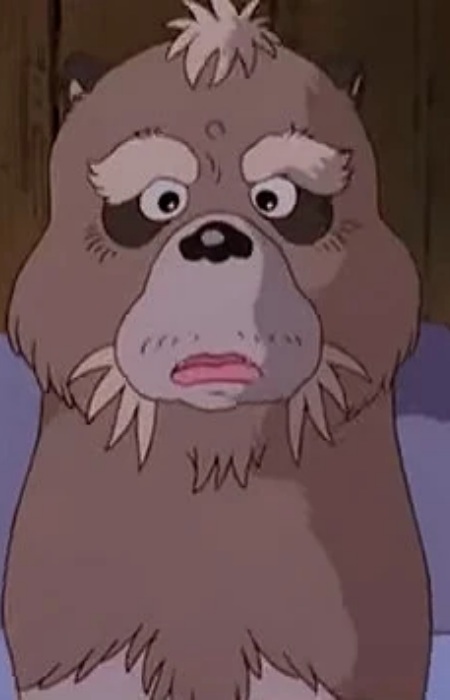
With the increasing need for Tokyo to expand as one of Japan's major cities, inevitable sacrifices must be made so that changes can take place. One of these sacrifices is that the room for nature and wildlife to flourish will decrease significantly over time. As this decline continues, many animal communities experience the brunt of urbanization. One such community known as the "Tanuki," a type of magical shape-shifting mammal, is caught up in a struggle to defend their beloved forest from being absorbed by the looming threat of an expanding Tokyo. As more and more Tanuki find themselves with nowhere to hide and territorial fights become increasingly regular amongst the different factions of the community, the elder Tanuki Oroku decides that something must be done. For the sake of their home as well as the safety of their future generations, the Tanuki unite as one with the hope that together they may be able to repel mankind's construction projects and scare them away from the forests using their shapeshifting abilities. But as they begin their first attempts at sabotage, the Tanuki soon realize the operation will be no easy task. Will they reclaim their forest as a united community, or will they be torn apart by a war against humanity, blinded by anger and pain after witnessing nature's destruction? [Written by MAL Rewrite]
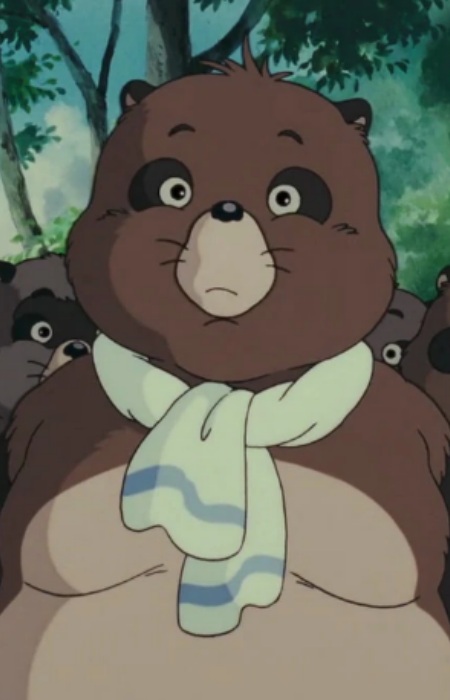
Главный
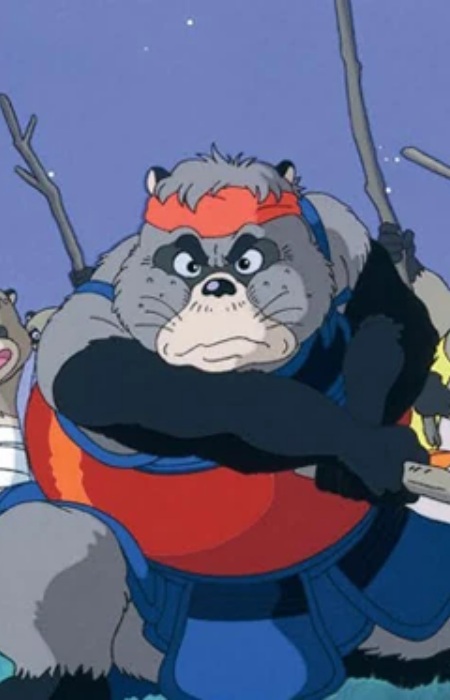
Главный
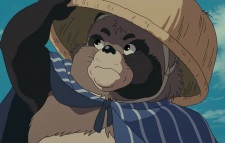
Второстепенный
Второстепенный
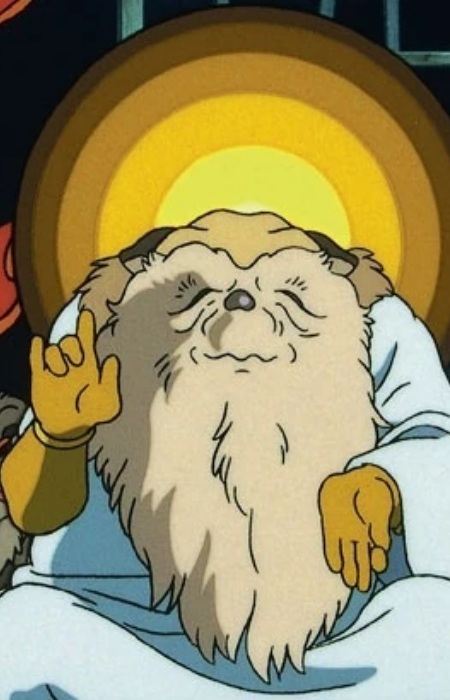
Второстепенный
Второстепенный
Второстепенный
Второстепенный
Второстепенный
Второстепенный
Origami_Cyclone
June 9, 2010
Pom Poko is one of my favorite anime movies, although that's not to say it's a perfect movie. The documentary-style opening , complete with uninspired narration, will lull most people into a false sense of security before the second half. If you can stay awake for the second half, prepare to be blown away. The Tanuki's transformation prowess here makes for some of the of the most imaginative and unrestrained animation I've ever seen. A careful eye will notice Kiki, Totoro, Porco Rosso, and Galaxy Express 999 during the parade sequence. The tanuki themselves fluidly turn without restraint into hyperrealistic, humanistic, and charicature forms.(the third being a homage to a classic manga-ka) The characters for the most part aren't very notable, more important is the interactions in the community. Pom Poko is easily the most misunderstood movie put out by Studio Ghibli. While there is some environmentalist message there, I feel this movie is more about adapting. In fact, while the main characters are raccoons, they represent the Japanese society, and how it has to cope with tradition being overtaken by technology. The older raccoons wear traditional kimonos and plan to wipe out the humans developing on their land. The grand masters apparently inspired Japanese deities-(the oldest master being 999 years old.) Eventually the tanuki learn to hide among the humans (modernize) but, not before one last battle. Most people view the battle as humorous, and it is indeed the most commented part of the movie (because of what, exactly the tanukis transform.) But I see it as an act of desperation, putting their very manhood on the line for one last hopeless push. The aftermath of the battle is all the warriors' dead bodies being dumped in a huge pile, more reminiscent of Auschwitz than a Disney movie. Because of the overwhelming circumstances the main characters must fight against, I found this movie to be sadder than Grave of the Fireflies, Takahata's much more famous work. This isn't Fern Gully or Avatar however, the tanuki are full of flaws. When they steal a TV to learn more about humans, they become couch potatoes instead. In another scene, they feast upon stolen McDonalds hamburgers. This is a very Japanese movie, it is filled with references to Japanese culture, mythology, yokai, folklore, and culture. This can make it dense and unappealing to some. They say that a truly good film is universal, but after seeing this film I disagree. Truly a great movie, one of the best. However, it might take a little patience on the viewer's part to fully enjoy. One of the best- but you might want to watch it in two parts.
With the increasing need for Tokyo to expand as one of Japan's major cities, inevitable sacrifices must be made so that changes can take place. One of these sacrifices is that the room for nature and wildlife to flourish will decrease significantly over time. As this decline continues, many animal communities experience the brunt of urbanization. One such community known as the "Tanuki," a type of magical shape-shifting mammal, is caught up in a struggle to defend their beloved forest from being absorbed by the looming threat of an expanding Tokyo. As more and more Tanuki find themselves with nowhere to hide and territorial fights become increasingly regular amongst the different factions of the community, the elder Tanuki Oroku decides that something must be done. For the sake of their home as well as the safety of their future generations, the Tanuki unite as one with the hope that together they may be able to repel mankind's construction projects and scare them away from the forests using their shapeshifting abilities. But as they begin their first attempts at sabotage, the Tanuki soon realize the operation will be no easy task. Will they reclaim their forest as a united community, or will they be torn apart by a war against humanity, blinded by anger and pain after witnessing nature's destruction? [Written by MAL Rewrite]
Optigisa
July 27, 2019
Stories about anthropomorphic animals behaving like human beings have always been a form of storytelling that different types of authors, narrators and storytellers used to employ back in the old days to convey a message to their audience. This was done by using the animals as some sort of metaphor to represent human society and the flaws that show up within it’s systems. Perhaps the most famous example would be George Orwell's magnificent social commentary on Communism that is the timeless Animal Farm. From there, this form of storytelling would go on to get adopted by many other storytellers that came after the man. Fortunatelyenough, one of the storytellers to pick up on Orwell’s unique form of narration was none other than the late and great Isao Takahata, a man I like to nickname as “The great innovator of Ghibli”. Isao Takahata is a name that needs no introduction whatsoever. The man was studio Ghibli’s greatest asset, and he was the one responsible for some of the greatest movies and TV series to come out of both Ghibli’s discography and the Anime world in general. Though Takahata has had many celebrated works throughout the course of his life, he’s also had works that have somehow managed to slip under the radar when it came to audiences and viewers everywhere. Beneath the eminent and prominent works that were Akage no Anne, Grave of the Fireflies and Omoide Poroporo, there was also a work that was just as thematically rich as those three, yet never got the recognition it deserved. That work is of course none other than the brilliant 1994 Anime movie, Pom Poko. What is Pom Poko exactly? Pom Poko would be the result of Takahata replacing his cast from his previous works with anthropomorphic animals - as in the characters have all the charm and humanity that the other Takahata characters possess, the only difference here being the fact that they are not human. Just like Takahata’s other movies, this movie was ahead of it’s time in the way it handled it’s narrative and used it to convey it’s central theme to it’s audience -- which was environmentalism -- unlike any other Ghibli movie that came before and after it. While Princess Mononoke was a great experience both in terms of visuals and direction, it didn’t quite hit the mark with it’s environmentalism theme, and it delivered the theme quite poorly might I add. It was an excellent film both narratively and visually, but Miyazaki became overindulged with those aspects of his work that he forgot to deliver the message that he preached about in a quality fashion. Unlike Princess Mononoke however, Pom Poko never concerned itself with a grand story nor did it explore the various political factions or the many landscapes and mythical creatures within it’s narrative. Pom Poko focused narrowly on a small, select group of raccoon dogs called the Tanuki species, where these Tanuki would shapeshift endlessly to take the form of humans and use those shapeshifting abilities to stop housing construction on their homeland. This was of course brilliant in reinforcing Takahata’s message regarding environmentalism. By focusing solely on his central theme and giving it more importance than other aspects of the work, he managed to deliver that theme quite perfectly in the end. The comedy is pretty spot-on as well. Almost every shapeshifting scene was fun and hit the mark in terms of making me laugh, and never did a scene go to waste. The comedic timing is almost perfect here, from the lady Tanuki shapeshifting into a malicious fox to instruct the young, juvenile Tanuki to use that specific transformation to scare off the pesky humans when their identity is discovered, to the elder Tanuki stretching his testicles to form a mattress so that the other Tanuki can sit on them. They were all lighthearted gags that never ceased to amaze me. Though the comedy managed to hit the nail on the head at most times, the testicles gag did become old and stale halfway through the movie, and it lost it’s charm due to the overuse of the gag, which is a shame since it was pretty hysterical when it hadn’t become an overused trope. It is pretty ironic though that the funniest thing about this movie is not the various creative transformations that the Tanuki made use of, rather the fact that Disney renamed the term “testicles” to "pouches". It is a pretty bizarre and awkward stance, and it gets even funnier the more one thinks about it. It was not an unnecessary change though, since most Ghibli movies are directed and are made for children at the end of the day, and western audiences are cultured differently from Japanese audiences, so it makes sense. The animation here is pretty consistent just like most other Ghibli movies. It does the job and it does it well enough to assert itself among it’s contemporaries. It has many well animated scenes, but my favorite one has to be the parade sequence the Tanuki perform near the middle of the movie’s run, where even by Ghibli’s standards it looks quite excellent and stands out from the rest of the scenes. Although the animation was pretty consistent for the most part, my biggest gripe with this movie was the absence of any originality or creativity when it came to the character designs. It looked like Takahata never placed any thought into making his characters as uniquely looking as possible, rather, it looked like he churned out the same character design over and over again until he got the main and supporting casts ready for use. Every character here looks like the typically animated raccoon that you would see everywhere on animated television, and all the characters look like they were copied and pasted off of one another, which makes matters even worse since the characters were well written in their own right. Now granted, this is a movie about raccoons and not humans, but it still isn’t a valid excuse for the vapid character designs. Many anthropomorphic animals are drawn in a very distinguishable and unique way in other media, so why should there be a problem here? In addition to the trite character designs, the soundtrack was pretty forgettable as well, which is a shame since most Ghibli movies are recognized by their main themes – Spirited Away had the hauntingly beautiful “The Name of Life”, Princess Mononoke had the haunting yet so ever-present “Legend of Ashitaka” and Kiki’s Delivery Service entranced it’s viewers with the beautiful orchestral melody that is “A Town With An Ocean View”. It seems here, with Pom Poko, not one track stands out from the rest. All of them are uncreative Japanese folk music tracks, they flow smoothly with one another and do well at being a coherent and cohesive soundtrack for the film, but fail to make an everlasting impression on the viewer. Not going to lie, the characters were pretty charming and were all full of wit and personality, and the creative dialogue between them was ever present. It just felt weird watching this movie and knowing that it was produced by Studio Ghibli, since there was no female protagonist to save the day in this one. Regardless, the most interesting aspect about this movie is the fact that it’s so focused in Japanese folklore, and it’s a pretty great introduction for anyone who would like to know more about Japanese mythology as a whole. This movie is a well-known representation of Tanukis in their fairy tales/mythology. For Japanese children, this is just a normal depiction of one of the many animals from their fairy tales. It is a good starting point for anyone who wants to learn more about them in their famous Japanese stories. Overall, it’s not that hard to see why Pom Poko is pretty obscure and niche compared to the other Ghibli titles. It does not have a standout heroine, it is underproduced in terms of audiovisuals compared to some of it’s contemporaries, and it focuses solely on it’s main theme - which is environmentalism - rather than focusing on developing a compelling narrative. However, I also think that this is what makes it the most unique work out of all of them. If you want to vicariously experience the theme of environmentalism, then no other movie does the theme justice more than Pom Poko. In it’s thematic exploration, it is rather excellent, and unlike Princess Mononoke, the message never felt forced whatsoever. Don’t expect this to be on the same level as other Ghibli movies in terms of anything else though, it delivers it’s central message quite perfectly, but that’s about it.
Morticon
December 31, 2008
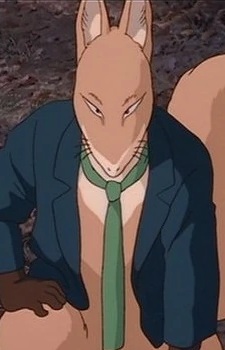
Another Studio Ghibli masterpiece, and produced by anime genius Hayao Miyazaki, Pom Poko brings something new to the table: Animals who, instead of fleeing from the deforestation that threatens them, choose to resort to a different method by turning the tables on the humans that shamelessly and thoughtlessly tear away at their homes. Based on the Japanese Tanuki folklore, many of the raccoons featured in Pom Poko have magical shape shifting powers, some a little more rusty than others. These creatures begin to notice their food and shelter becoming scarce after the invasion of their land by the crew of new housing construction, and mustcall on their elders, the masters of transformation, to teach them how to change their shapes. They hope to use these abilities in many different ways, but all for one sole purpose: to reclaim the land that is being stolen from them. Though in the film they are introduced as raccoons, the Tanuki folklore is centered around a very different breed, known as the raccoon dog. In either case, the creatures in this movie are far too plump to be easily identified, doubly so with the fact that in the movie, the raccoons do not possess the famous ringed-tail that raccoons are known for. Studio Ghibli's depictions of the Tanuki are nonetheless charming and adorable. Even the mean and stuffy raccoons are hard characters to hate. Also featured briefly in the film is another creature of folklore known at the Kitsune, a transforming fox, which in the film tries to convince the raccoons to stop their personal war with the humans and instead use their shape shifting abilities to change into humans and begin new lives. This decision is widely argued over in the film, partly because of the raccoons' inability to transform into convincing humans. I think a child would thoroughly enjoy this movie, however, here's where the warnings begin to come in. I had not been familiar with the Tanuki folklore before I watched this movie, so was surprised to discover that until about an hour through the movie, I had not noticed the raccoons' exposed genitalia. I later learn that this exposure is a prominent detail of the Tanuki in folklore, representing good luck financially. Though it may seem overly risque to the unknowing, their exposure is never, in the lore or the film, intended as sexual, and the film does not illustrate them sexually either. Rather, in the film they use what is referred to in the English dub as their "Pouches" to contribute to their shifting, such as parachutes which are seen later in the film. Other material in the film include the deaths of humans and several raccoons, and though there is occasionally blood, it is never graphic. Additionally, there is a short scene narrated by one of the raccoons talking about how, because of lack of food and sheltering, they must halt breeding. While the raccoon talks about the female raccoons making sure this rule is kept, we see male raccoons charging at female raccoons, some seemingly drunk, and the female raccoons using karate moves to fight back, which implies their attempts to cease reproduction. Some female raccoons also have exaggerated breast size with occasional cleavage. This movie I predict would otherwise be a delightful watch for children, even if they have to watch for 2 hours waiting for the conclusion. I extend yet another ovation for Studio Ghibli and Miyazaki.
JTurner
May 23, 2009
Fans who remember Isao Takahata best for his relentless tearjerker, "Grave of the Fireflies", could very well react with surprise and shock upon viewing "Pom Poko". This lavishly animated tale about raccoons battling for their homeland (which was the biggest hit of 1994 in Japan) isn't so much a heartwrenching tragedy as it is an interesting amalgam of humor, drama, and action--all delivered in a way that is daringly original for animation. At times, the viewer gets treated to scenes which recall the one-two-three emotional punch of "Grave of the Fireflies", but even though the tone of the movie is somber, a handful of lightheartedmoments elevate the overall production out of depression. As this is a Studio Ghibli film, production values are spectacular. Backgrounds are painted with a tasteful mixture of simplicity and art, and the raccoons are as cuddlesome as you would expect--especially when they shape-shift from "ordinary" animals to Saturday-morning-cartoon style critters in the style of shows such as "Care Bears". (If you're scratching your head while reading this, don't be alarmed--according to Japanese folklore, raccoons have the power to transform into anything--including human beings!) The actual animation is as colorful and imaginative as you might expect from a Ghibli movie--and there is one scene where we are treated to cameo appearances by Porco Rosso, Kiki, and Totoro. While "Pom Poko" has a story to tell and a meaningful message for one to think about, its character and plot aspects may come across as a bit off-putting to viewers expecting a typical animated feature. Indeed, while some raccoons identify themselves with distinguishable names and/or personalities (for example, Gonta is a burly, rough-and-ready raccoon who is always looking for a fight, while Oroku is the "wise woman" of the tribe), the story offers little in the way of character development. In fact, most of the action in the story is narrated (by Maurice LaMarche in English, Kokondei Shinchou in Japanese), which elevates the overall effect of the movie to that of a semi-documentary. For the most part, this approach works to a very interesting degree and is a refreshing change of pace. However, there were some scenes in the movie where I wished the narration could have been reduced a little bit, as it sometimes gets in the way of appreciating the beauty of the visuals onscreen. Aside from this, the biggest controversy about "Pom Poko" seems to be centered on several scenes where the raccoons can inflate and/or transform their testicles(!) for multiple purposes. One particular scene involves a raccoon flattening his testicles against a truck, causing its driver to crash. Such moments may be alarming to children, but it is important to remember that while we see the testicles at times, the movie is, after all, animated. Even still, while a Japanese audience may take such scenes naturally, squeamish viewers in America could react differently. In fact, as a solution to handling this kind of translation issue, the English language version (produced once again by Disney) refers to the testicles as "pouches". That's a somewhat awkward decision, but it sure beats digitally removing the testicles from the scenes they're in. "Pom Poko" was obviously a nightmare for English dub writers Cindy and Donald Hewitt to translate (especially since much of the movie is rooted in Japanese culture), but I really have to commend them for their efforts. There is some Americanizing here and there, but there was little, if any, that I could find missing in their script. In fact, I was most impressed at how they handled the songs; while at least two of them come across as a little contrived and/or corny, others flow so naturally that you never would have sworn that these were originally Japanese folksongs. Another interesting aspect of the dub is the voice acting. With the exception of Jonathan Taylor Thomas (star of TV's "Home Improvement"), the cast consists of veteran performers who are known for cartoon voice work; Tress MacNeille, John DiMaggio, Russi Taylor, Andre Stojka, and Clancy Brown, to name a few. Whether this was done to cut down on costs for big-name stars or for avoiding aural distraction is unclear, but when listening to the spirit and energy that the aforementioned voice artists give their characters, it really doesn't matter. "Pom Poko" may be an unusual entry from Isao Takahata, and its foreign aspects may not appeal to everyone, but if given a chance, the film offers a colorful display of imagination and pathos as well as an experience unlike many that one will find from ordinary cartoons.
literaturenerd
April 8, 2017
Overview: Studio Ghibli is generally synonymous with quality. Led by Hayao Miyazaki and his lifelong friend Isao Takahata, Ghibli has come closer to batting 1000 then any movie studio I can think of. However, if you delve into the more obscure Ghibli films you can find some that while still good...are a little less than perfection. This is definitely one of those. SPOILERS! Plot: The plot of this 1994, Takahata penned Ghibli film is that a community of magical tanuki (raccoon dogs) are being threatened by deforestation and must fight back against the loggers. Basically take the plot of 1992's Ferngully and add massive hairy balls. The tanuki aroundTokyo are being driven from their homes, having to fight for food, and being killed by hunters and cars. Soon the various clans unite and start trying to chase away the humans using their transformation magic. The tanuki actually manage to kill several humans and celebrate their victory with a party...in this children's film! However, the humans just keep coming back and clearly a more drastic plan is needed. The tanuki manage to gather ancient tanuki transformation masters from around Japan. The plan is to use a massive series of illusions so terrifying that the humans are driven away for good. However, the amount of magic this requires kills one of the masters and the tanuki retreat. The humans all immediately dismiss what they saw as a bad drug trip or dream. A theme park then claims responsibility and everyone just accepts it without ever questioning how they accomplished the illusion. None of the human characters in this film with the exception of 1 reporter EVER believe that magical tanuki exist. This is despite the fact that the tanuki don't exactly hide their powers. It is the same bullshit skepticism of the humans in DBZ or Seto Kaiba in Yugioh. TV Tropes calls it "Flat Earth Atheism", when a character refuses to believe in magic despite living in a world clearly filled with magic and personally see magic all the time. Next we introduced to the Kitsune fox tribe of shapeshifters. The Kitsune have learned to disguise themselves as humans and live among them. The kitsune that couldn't shapeshift were killed off, but the shapeshifting kitsune simply accept this as survival of the fittest. It is revealed that the theme park that claimed responsibility is actually run by the kitsune, but then the tanuki steal back their money and the kitsune vanish from the plot without ever really serving a purpose. It is at this point that different tanuki come up with different plans. One group of Tanuki pull a Lord of the Rings and sail into the afterlife. One group decides to fight the humans and we get easily the dumbest scene in the movie. Instead of using magic, the tanuki simply try clobber the humans with their massive scrotums. The humans don't enjoy being teabagged and start punching the tanuki in the nuts. The scene then fades to black and a narrator somberly explains that all the tanuki were killed...apparently by being punched repeatedly in the nuts. I think this scene was guest directed by Johnny Cage. The surviving tanuki that can shapeshift are forced to disguise themselves as humans and live like the kitsune, who of course are never seen or mentioned again after their brief introduction. The tanuki that can't shapeshift continue to try live their lives despite the deforestation continuing to get worse and the problem never being resolved. While Miyazaki's films tend to have an emotionally cathartic climax in which the characters learn a lesson, this film by Takahata just kind of...ends. We are however given a moment in which the main tanuki breaks the 4th wall and tells the audience to care more about the environment. Thanks Takahata! We never would have figured out the moral without Tanuki Deadpool. The end! Art: The art is excellent and has that Ghibli beauty. However, I'm not sure this film needed quite so many giant balls. Given this IS a film about tanuki so some balls were expected. What we REALLY didn't need was tanuki titties. I'm not just talking Lola bunny in Space Jam boobs, but fully displayed, large nippled, furry boobs aplenty. Thanks Takahata sensei! Music: The music is mostly traditional Japanese folk music and is among the highlights of the movie. Overall: This movie had some very cute moments, touchingly sad moments, and tried hard to teach the audience a lesson about environmentalism. However, like Takahata's more famous work Grave of the Fireflies, he drives his points home with all the subtlety and grace of a sledgehammer. He tries to forcefully milk tears from the audience and guilt them into supporting his message, respecting and listening to elders in Firefly and conserving the environment in this case. For all its faults, the film still does have its strong suits and I feel it wouldn't be fair to give it less than a 6/10. i would recommend watching, but only if you've already seen all the Miyazaki directed Ghibli films.
#3004
Популярность
#2086
Участники
120,328
В избранном
373
Эпизоды
1