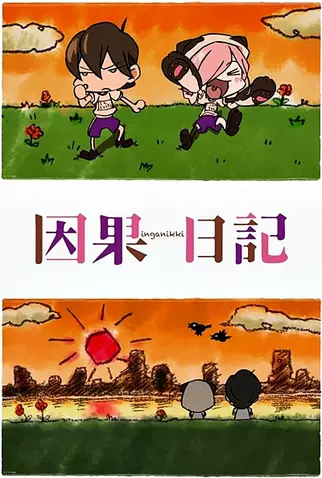

UN-GO アン ゴ
In a dystopian future, detective Shinjuurou Yuuki—known by some as the "Defeated Detective"—solves mysteries throughout Tokyo. Aided by his odd associate Inga, Shinjuurou's insight and ingenuity in cracking cases, particularly homicides, lead to numerous mysteries solved and culprits caught. However, his partner seems to have some other, more sinister intentions for the people they catch, and the truth of the assistant's identity and motivation is shrouded in secrecy. [Written by MAL Rewrite]
Главный
Главный
Второстепенный
Второстепенный
Второстепенный
Второстепенный
Второстепенный
Второстепенный
Второстепенный
Второстепенный
Randomman
January 28, 2012
This show is pretty great. UN-GO is a detective show, something I haven't seen a whole lot of recently (then again, I don't watch everything that comes out, so what do I know). The art and animation are pretty consistently good. The only art issue I would have with this show was the main character's design, but I've seen a lot worse (C control anyone?). This show does also use CGI for vehicles, but most of the time it's not noticeable. The place where this show really shines (shines brighter?) is the story. One of the things that really sticks out to me is how connected this showis. Very little that is introduced is without purpose. Miss a couple episodes and you'll likely end up confused. Not only that, but elements introduced ultimately become an important part of the conclusion. There's generally a sense that the series is going somewhere, and it doesn't disappoint in this regard. One of the things that appealed to me was it's cyberpunk tendencies. While a few of the show's core elements are supernatural, there's also a lot of really cool sci-fi concepts involved, and it all works together. I highly recommend checking this one out.
Uriel1988
December 24, 2011
Comforting lies or a bitter truth. Which is better? The above dichotomy is perhaps one of the most enduring through all of fiction. Many stories that tackle it end up siding with the truth, only to end up cushioning the blow through all sorts of contrivances; making the bitterness of the truth not as bad as initially thought. Enter UN-GO: an 11-episode anime series by Studio BONES which tackles this theme by pouring it in the format of a buddy-detective show, following cynical detective Shinjuurou Yuuki and his quirky assistant Inga as they tackle cases in a Japan that's recovering in the aftermath of a devastatingwar. The end result is something that thematically feels less like the typical mystery anime and more like a sci-fi spin on the British crime-drama Foyle's War. Let's get one thing clear: UN-GO isn't very good when taken as a pure detective story. Most of the cases involve genre staples such as blackmail or crimes of passion. Worse yet is that it seldom feels like the main characters are running an investigation. Whenever a crime occurs, the main duo briefly scans the scene and talks with (read: introduces) the people involved, this is followed by some brief speculating after which Shinjuurou will deduce the big picture, only to have Inga swoop in with a magical power that literally forces people to spill the beans. And seeing as the majority of the cases last only one episode, it all ends up feeling very rushed. By rights, UN-GO should be a complete disaster, yet it ends up worthwhile by being a show about detectives solving mysteries that isn't really about the mysteries. This is where the contrast between sweet lies and bitter truth comes into play. The story, as previously mentioned, takes place in a Japan that's licking its wounds in the aftermath of a war. The government has restricted people's freedoms and control the flow of information as much as possible. In-story avatar of these policies is Rinroku Kaishou, the chairman of the company that holds the monopoly on Tokyo's communication infrastructure. A charismatic, intelligent man who uses the system to his advantage. This in stark contrast to our hero Shinjuurou, a self-proclaimed seeker of truth whose insistence on uncovering shady practices earns him the hatred of officials and the people alike. The contrast between these two is the thematic driving point of UN-GO as well as one of its greatest strengths. What seems like a derivative tale of the well-respected villain vs a misunderstood hero becomes a n of how people will shape events in ways that best suits them. Terrorism, blind patriotism and greed are among the themes that come by throughout the episodes, and the show consistently surprises in how it ties them into its truth-vs-lies dichotomy. Interesting to note is that the show doesn't really pick a side between Shinjuurou and Rinroku. While the former's desire to uncover the truth is presented as an admirable quality, his complete lack of tact and almost suffocating cynicism are presented not as harmless quirks but as defense mechanisms born out of desperation. Rinroku's shady practices are in no way glossed over, but the narrative also makes it clear that he views himself as a lesser evil rather than a greater good. It's a shame then, that other characters don't fare as well. Recurring and one-shot characters alike usually fall into easily recognizable archetypes who play their roles as puppets of the plot competently. Standard detective fiction fare. A bigger shame is that the dynamic between Shinjuurou and Inga isn't fleshed out. It would've been interesting to see the more sinister undertones in their relationship elaborated upon, particularly the part where Inga feeds on truths as a substitute for souls. The dynamic as it is feels interesting if underdeveloped. Though it doesn't hurt the story proper in any significant manner. The visuals are what you'd expect of a competently produced TV-anime. The animation is nothing remarkable across the board, though key scenes are brilliantly animated. The music is nothing memorable in and of itself but always does an excellent job enhancing the mood of scenes. On the voice-acting side of things some praise is in order for Aki Toyosaki, who showcases surprising range in her role as the quirky yet mysterious Inga. Director Seiji Mizishima (Fullmetal Alchemist '03, Dai-Guard) once again proves himself to be highly capable, turning several aspects – many of which vary in quality and aren't always compatible - into a compelling whole. And it would be no exaggeration to say that UN-GO might not have turned out so well had someone else been at the helm. Ultimately, UN-GO is the best kind of bait-and-switch, providing the tale of a man seeking truth in a sea of deceit, under the guise of a detective story. Anyone intrigued by the premise and willing to be surprised would do well to give it a look.
Miharu-Kun
December 2, 2011
=updated after episode 11= If you were to ask me what I though about Un-Go after watching the first few episodes I probably would've said "boring, horrible character development, terrible pacing and lack of a plot. If you were to ask me now after seeing all the episodes I would say "brilliant, unique storytelling and interesting characters". Un-Go starts off from the generic 'future Japan' setting, using guess work you try to make sense of the plot and characters which is difficult and leaves you feeling like it's taking off from a prequel series. Though the backstory shines through little by little each episode and you canpiece it together (which fits into the detective mystery genre nicely). The main issue i had with the early episodes of Un-Go was pacing. It felt as if they were cramming in two-parters into one episode which left a long path of plot holes along the way. At the end of the episode, you'd be thinking "what just happened" "is that the ending?" "Why don't I just drop this crap" but thankfully this issue is resolved later on. I first thought the characters were really boring and bland, probably because the character development was nearly non-existent among the confusing plots and side characters in the first few episodes. Though you soon get attached to them, well most of them anyway. The art style is interesting and the character designs aren't too bad, though I really hated the design for 'that woman' (call her this to avoid spoilers). She looked like some out of proportion alien thing. I liked the OP and the ED wasn't that bad. The voice acting is average. Overall, Un-Go has it's flaws through features the 'detective/mystery' genre at it's best. It starts off as a terrible anime, filled with poor character development, plot holes and pacing issues though finishes off with a nicely polished interesting series which leaves you wanting more.
Aria34
June 11, 2012
My expectations for this show was more-or-less like a Japanese equivalent to a BBC Miss Marple or Sherlock Holmes special. And, in a way, it is, but it's so much more than a simple adaptation. While UN-GO is based upon the writing of Ango Sakaguchi (hence, the title) the mysteries are carried out in a very different setting than the original stories. However, it never feels strange or forced in it's new setting of post WWIII Tokyo. If you're expecting a supernatural horror anime, look elsewhere. The supernatural aspects of this show are kept to a bare minimum. In fact there are only two aspectsof this show which are supernatural, one being the nature of Inga, and the other is little more than a magic tool. Other than these two anomalies, Un-go has more in common with the Science Fiction genre. It has cool futuristic technology, hints of a dystopian future, and it even poses the question of how far can artificial intelligence evolve by itself and whether or not it is even right to treat them as machines at that point. What amazed me about UN-GO was just how tight the story was. Sure, it masquerades as a Perry Mason-esque mystery-of-the-week show, but when you look back you see that every episode was necessary to get from each story to the other. You learn the essentials of understanding how the world that Shinjuurou and Inga live in works and its history from each episode while still remaining entertaining. The relationship of our detective duo is straight-forward, especially if you've seen Majin Tantei, yet the nuances of their relationship are very subtle and they are great foils for each other. Shinjuurou is very serious, mature and he steadfastly holds onto his beliefs and his interpretation of justice, but he is also surprisingly compassionate and does show affection for Inga in spite of what he/she is. Inga on the other hand is childish in its boy form, but in its female form she is seductive and in some ways just as serious and mature as Shinjuurou. She shows a deep respect and admiration for him, but male and female Inga both don't mind messing with him. However both of Inga's forms are very savage and determined and they don't mind hurting Shinjuurou if he is getting in the way of a potential meal. I can't say much about the sound design other than it's great, just great. The music is cool and some tracks are catchy and the voice actors deliver really great performances, namely Inga's voice actress, Toyosaki Aki. I have to admit I didn't expect much from her when I heard she was in K-On, but she played a very dynamic Inga. She was able to cycle from innocently childish to frightening and creepy. She also accomplished the hardest thing for a voice actor; she was able to give emotional depth subtly through her voice. The animation is very smooth and rather colourful and stylish for a post-war setting, especially in the opening and ending sequences (which have awesome music by the way). My only complaint is that Shinjuurou's face in particular can look a little lazily drawn in places. I believe this is mainly due to one of the character designers', Pako's, distinctive style which is a little more suited to an otome game than it is an anime. UN-GO is a modest little series. It does not strive to be ground-breaking but in its own little way it challenges your viewpoints on subjects like self-sacrifice and the psychological effects of war and terrorism. This is one of the only shows I have ever seen which was able to show diversity in ideologies. But, as I said, it does not strive to be a masterpiece and thus I feel reluctant to rate it as one. Everything is very low-key and not a lot of risks were taken other than the major change in setting. But, the fact still remains that UN-GO is a great show that feels bigger than it is, and for that I cannot recommend it enough. But note that if you want to truly enjoy this show you must watch UN-GO episode:0 Inga-ron either before or immediately after watching the series. Every single question you could have about UN-GO at the end of the series is answered in Inga-ron. With UN-GO and Inga-ron together the series is this neat little package which has one of the most satisfying endings of any anime series.
mdz
December 22, 2011
Not your traditional mystery anime. [contains some generalized spoilers, suggestive humor and language] UN-GO is by no means a traditional “mystery anime”. If you view it only from that perspective, then UN-GO is relatively mediocre as a whole. What makes UN-GO a “good” anime is the hidden mystery behind all the concurrent “traditional” mysteries. Now, what exactly defines a “traditional mystery” and what sets UN-GO apart from being one? Well a traditional mystery is “best” mediocrely defined as going from the crime scene to interrogating the suspects, to finding the verdict by the end of the episode, this is best comparable to anime like Gosick. UN-GO onthe other hand incorporates a different element. It's the type of behind the scene mystery that's blatant after you learn about it, but rather difficult to discern when you're watching it initially; it's an enjoyable treat. But, it is arguable on whether or not it was actually done well. Unfortunately, UN-GO does suffers from mediocre characters. The entire cast is relatively linear, there's little to no character development. But, strangely enough, the characters aren't generic, they all surprisingly have something that sets them apart from any given cliché archetype. That could be positive or negative depending on how you view it, but you do have to inevitably assume their pasts (although episode zero should answer some questions). But, one character does stand out from the rest, possibly the worst character this season. It's the transvestite heroine addict that stays in the back until she needs her fix at the end of every case, whether he's needed or not. Now, what exactly does he do? Well, she's basically a cheat code. He possesses the ability to make her “victim” answer truthfully once to any of her questions (she does this by essentially sexually harassing his victim and giving them whiplash or something similar). Now, his ability wouldn't be so irritating if the show used his ability logically. Unfortunately, the main character decides to ask some of the most redundant questions using her, it often does aid the case, but there's probably a list of so many other better questions you could have asked (It's like asking do you own this knife rather than do you know who killed the dude in the corner). That being said, UN-GO would definitely be better if it was longer than eleven episodes. There's just too much content to cram into such a short frame of time. Watching this weekly often leads the viewer confused on the previous events. Many of the mysteries take up two episodes, it's a pain to recollect after a week. The maximum experience would probably be catalyzed by watching it after airs, in one or two sittings at the most. Objective Score: 6/10. You'll probably enjoy UN-GO more if you analyze it. On the surface, it's mediocre. The mysteries aren't that good, and the characters are mediocre. But what it does offer is an atmosphere that's relatively rare in anime. The setting of UN-GO and the behind the scenes occurring ultimately adds to the overall “mystery” of the anime. Subjective Score: 4/10: It's pretty bad if you watch it expecting for the obvious mystery. It's riddled with lapses of logic, and the storyline is sporadic. It wasn't really meant to be adapted in eleven episodes, it's way too short. But UN-GO does offer one of the best ED transitions since The Tatami Galaxy.
Ранг
#2934
Популярность
#1670
Участники
159,495
В избранном
632
Эпизоды
11