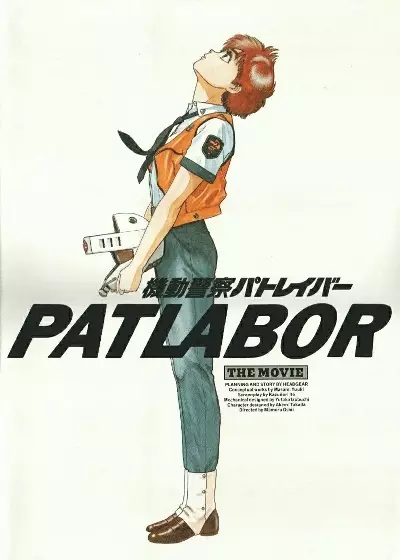

Patlabor: The Movie
機動警察パトレイバー the Movie
The Babylon Project is a massive renovation of Tokyo's neighborhoods, including the creation of artificial islands in the Bay. Utilizing "Labors," or robots created for the express purpose of doing work, architects and construction crews are able to more efficiently progress development of the overhaul. When a key figure in the Project's conception is found dead after committing suicide under mysterious circumstances, Captain Kiichi Gotou's Patlabor police unit is tasked with getting to the bottom of the bizarre situation. As several Labors begin to go haywire and a hacked AI program endangers the people of Tokyo, young pilot Noa Izumi and her Patlabor Alphonse work under Gotou's orders to save the city and the entire nation from a massive biblical conspiracy. [Written by MAL Rewrite]
Главный
Главный
Главный
Главный
Главный
Второстепенный
Второстепенный
Второстепенный
Второстепенный
Второстепенный
Второстепенный
Archaeon
December 9, 2009
When people think of mechas in anime, they automatically think of shows like Gundam, Macross, Code Geass, Neon Genesis Evangelion, and even Tengen Toppa Gurren Lagann. They think of flashy combat (sometimes with lots of missiles), lots of action, explosions, more fights, lots of gutsy shouting, etc, etc. Of all the shows on offer though, very few actually portray mechs as something..... utilitarian. Released in 1989, Patlabor: The Movie (the name is taken from the Patrol Labors used in the show), followed the story set by the original 7 episode OVA from 1988/9, and featured a completely original story written by Headgear (a group of5 writers and artists who work in anime and manga). Produced by Studio Deen, Production I.G. and Bandai, and directed by Headgear's own Oshii Mamoru, the movie received critical acclaim from a broader public spectrum than any other at the time, in particular because of it's "novel" use of all things mecha. The movie, set in Tokyo in 1999, begins with a man throwing himself off a giant steel structure in Tokyo Bay. The structure is called The Ark, a man made island where the Babylon project is coordinated, and the man who commits suicide is Hoba Eiichi, a programmer who worked on the project. Shortly after his death, Labors (the mechs in the show), around the city begin to malfunction and go out of control, and it's up to the members of the Section 2's Special Vehicles 2nd Division to sort things out. However, Captain Gotoh of the 2nd Division supects that everything is not as it seems. One the the truly great things about Patlabor: The Movie is that it actually has a very good story to back it up. Granted that this is in some measure due to there being an OVA already available before the film was released, but be that as it may, the fact remains that Patlabor is one of the most well scripted anime titles around - even now. That said, anyone who's familiar with the work of Oshii Mamoru, or of Headgear, will know that their pieces are generally extremely well written and directed. One of the gripes that people have with this movie is that they consider it too wordy and tedious. The plot may appear slow to some, but don't be fooled into thinking that this is a boring movie. The story progresses like a slow burning fuse, with numerous twists and turns throwing events in a new direction. The show begins with a mystery - why did Hoba Eiichi kill himself - but investigating this event only brings up more mysteries, more conundrums, and as the movie progresses the tension continues to rise ever so slowly and gently. One of the most impressive aspects of the plot is that the viewer may not even realise that they're inching further to the edge of their seat, such is the subtlety of the build up. In truth, this movie isn't meant for kids or people who expect mech shows to be all about guts and flashy combat. This, like Oshii Mamoru's later work, Ghost in the Shell, is a show aimed very much at a more mature, more rational audience (i.e. those able to breath and talk at the same time). The main reason people complain about this film is because they think it doesn't contain enough mech on mech combat, shouting or gutsy pilots, and while one can accept that the movie doesn't show much in the way of mech action, it was never meant to from the start. The mechas in the Patlabor franchise are far more useful and utilitarian than in almost any other show, with Labors being used in many aspects of society - law enforcement, construction, emergency services, heavy industry, military, etc, etc. It's a surprisingly normal, and very "novel" (in terms of anime), usage of mechas that isn't really reflected anywhere else, and more closely follows the doctrine of the "real robot" than just about any other mech show. Which neatly leads me on to design and animation. One of the key aspects of any mecha show is the design of the robots themselves. Many purists consider this element to be one of the prime factors in whether one likes the show or not, and while I can agree with that sentiment to a degree, for me it's not the be all and end all. It's nice to know then, that the design of the mechs in Patlabor: The Movie was left to another member of Headgear - Izubuchi Yutaka. Fans of RahXephon will recognise the name as both the creator and director of that series, and his credits also include work on Gundam, Jin-Roh (Kerberos Saga), Gasaraki, and several other shows. Izubuchi's designs in Patlabor are a far cry from almost every other mech show though, and reflect their utilitarian purposes in a way that no other show has managed. For example, construction Labors actually look like they belong on a construction site, and are coloured yellow like most heavy equipment used in that industry. Police Labors are sleeker, are coloured black and white, and have flashing lights (and sirens in some cases). Each mech in the movie is designed for a specific purpose, and it's because of this diversity of design that Patlabor is lauded as the epitome of "real world" robot design by many mecha fans - something which no other anime franchise has portrayed before or since. Unfortunately for some (not for me though), the mechs play second fiddle in Patlabor, and much of the action takes place with the characters themselves. It's nice therefore, to see that character designer Takada Akemi (another member of Headgear), was on the same page as Izubuchi when it came to realism. From Captain Goto Kiichi's world weary, droopy eyed face, to Izumi Noa's perky, bubbly, and happy go lucky expressions, the characters designs are as indiviual as they come, and fit each characters personalities almost perfectly. This realistic approach doesn't stop with the mecha or character design though. The scenery is detailed and descriptive, something which can't normally be said, and the reason for this is because the prodcution staff based much of the scenery on photos taken from around Tokyo - something which is a rarity in anime (although the game Shenmue used the same method years later). As for the animation itself, it is nothing short of impressive, even now. Given that the movie is now 20 years old, the lack of CG doesn't hold it back in any way. This movie is easily one of the most well animated pre-90s productions available, and even manages to hold it's own when compared to many modern day mech offerings. The production quality is so good in fact, that it even holds up in terms of how it sounds. As a card carrying fan of subtitles, there are very few shows that I will even consider watching with an English dub. Patlabor: The Movie is one of them. In all honesty, both the Japanese and original English dubs (not the re-issued version by Bandai), are equally excellent, especially as the English dub adopts an intuitive rather than a literal approach (something which made it a rarity in those days). The cast for either dub are talented actors and actresses who are able to provide a depth and feeling that, especially in the original english dub, is rare to see. The music used throughout the film is composed by Kawai Kenji, who also provided the music for the first two GitS movies, and ranges from grand and dramatic to languid, almost calm. The choreography between visuals and music is handled extremely well, a hallmark of Oshii's directing skills, and the overall presentation is truly splendid. In terms of effects, the movie is also well served in the range and usage of the various sounds and noises. It's nice to hear mechs that sound like mechs should, and the range of noises associated with the mechs is choreographed to fit it's particular type as well. Granted there's a limit on how much one can differentiate between two mechs in terms of how they sound, but at the very least the effort was made and the movie should be applauded for that. Or is anyone going to tell me that a JCB and a patrol car sound the same? I mentioned earlier that the mechs in Patlabor: The Movie play second fiddle to the characters, and if one decides to watch this movie then that fact should be kept very firmly in mind. Patlabor is a character driven story rather than a mecha showcase, and because of this the movie has more depth than can be found in most series. While one could argue that shows like Gundam, Macross, CG, etc, etc, are also character driven pieces, one has to remember that mechs play a central role in those stories. Here though, the tale follows a very human path that is less about combat and confrontation, and more about investigation, deduction, reasoning, and working things out. Patlabor: The Movie is essentially a detective drama that just happens to include mechs, and much of the interaction of the characters actually reinforces the belief that these robots are simply "tools of the trade" rather than anything wondrous or special. It's because of this realistic interaction between the characters as they go about their work that many consider Patlabor: The Movie a classic of the first order. The characters all have their individual gripes and foibles, much like you get in any workplace, and it's the sense of normality brought on by this that permeates the show, and makes it truly special. That said, because this is a movie there's only so much development that can occur, however there is some, especially with regards to Izumi Noa and Shinohara Asuma. What sets the movie apart though, is the strong characterisations that are present throughout, as this offsets any lack of real development rather nicely, and while it's advisable to watch the original OVA before watching the movie, in truth, it's not actually necessary. Most people will find that they watch the movie first, and will watch the rest of the franchise because they want to know more about the characters, their history, how the mechs developed, etc, etc. So, will you enjoy this? Well, if you're like me, and you like a bit of detective drama coupled with conceptualisation and philosophical debate, then this is the movie for you. If you like character driven stories with a slow build up of tension then this is for you. If you like your mech shows to have a bit more depth to them then this may be what you're looking for. If you're looking for a pre-90's show that's better than Akira, then this is it. If all you're after is flashy combat, powerful mechs, cool pilots, and overly convoluted plots, then this may not be your cup of tea (but it's still worth trying anyway). And apologies for the essay, but one can say a hell of a lot about something that's truly good.
Второстепенный
OtakuFreak
February 13, 2007
Today I bring you another Giant Mech seires, but it's not Gundam. Today I'm gonna introduce you to another popular Mech seires called Patlabor. I really don't know much about this series but's really solid stuff. Think of it as a cross over of Gundam and Ghost In The Shell. What really got me into this movie was the mystery, not the battle scenes. Okay, the story takes place in the present day 1999 (well this anime was made in the 80's), and in the middle of Tokyo Bay a new building is being built. The Mobile Police force has been assembled to prevent anyonefrom destroying it. While this is happening a whole bunch of other Patlabor mechs have been going on random rampages. As they try to figure out the mystery to they quickly find out it's the building that's making all the Patlabor's go beserk. But how? Well you'll have to see the movie to see what's going on. As my last qoute on this, it's an anime worth watching, even though it's kinda retro. To be an anime fan you have to like many of the old animes before you can start obsessing over the new ones. Patlabor the Movie is a must see.
Milk-plus__
December 14, 2008
Ah Mamoru Oshii, a great man who can mold his characters to resemble something akin to that friendly neighbor, or that 40 year old fascist cab driver who keeps asking you whether you have a gun license...if you're reading this I'll tell you again, no I don't! Anyway, with Oshii's help and some superb voice acting (well I thought it was very fitting) the great story of another robot revolt comes to life. Of course this one's slightly different, using a very subtle reference to animals(and probably robots) knowing something that we don't, or are at least able figure it out before we do. But themajor theme in Patlabor is clearly shown through the destructive force of the out of control mecha, and it questions our unbridled advancements in technology and science. In upgrading our physical society at such an exponential rate we run the risk of giving it the reigns, unless we place equal focus on cultural society, and allow people to catch up, we may just be forcing ourselves into absolution. As some of the older characters in this film complain over their outdated knowledge, so does much of the aging workforce of today still scream to be recognized. There are also some biblical references which are used in varying ways to aid the story, the most interesting of those would be that of the ark (as in Noah's Ark), of course Patlabor doesn't use the bible to the extent of Neon Genesis Evangelion. As I said before, Oshii is able to craft realistic and like-able characters, with my personal favorite being Kiichi Goto; the captian. I'd have to say the resemblance to Roy Mustang (FMA) is to close to be coincidental, but I'm not complaining. A cool, collected individual who never looses his head (well...not usually), Goto manipulates his crew of trigger happy pilots, eager cadets, and intuitive technicians to his ends. This seems to be a more efficient way of getting things done rather than constantly using his rank. The art is very well done for its time, but still doesn't hold up to modern work in terms of clarity. However it does have a rustic charm that I enjoy, and some of the urban landscapes are still impressive, high rise skyscrapers, construction sites and demolished lots all reinforcing the sense of unrestrained development. Also be prepared for a great 80's soundtrack, you know the standard that was in any great action movie, Lethal Weapon, Terminator...the never ending story. The point is you'll enjoy the funny and realistic characters as well as the at times comical animation, but at the same time you're able to dig into a solid story that doesn't just say advancement=good (unlike everyone else).
BruZZo
September 12, 2022
Patlabor: The Movie is the best thing that nobody has watched, and I imagine a lot of that comes from the fact that it’s an old anime movie that isn’t Akira or Ghost in the Shell and is tied to a pre-established mecha franchise. Even though it is canonical to the broader Patlabor series, I cannot stress enough that you do not need ANY prior knowledge of ANYTHING Patlabor before you watch this or its sequel film Patlabor 2, which is equally superb. While watching something like Char’s Counterattack mandates you have some knowledge of the prior Gundam meta, Patlabor: The Movie is a truestand-alone film that tells an airtight story without any reliance on the previous Patlabor show and OVA. As of the writing of this review, I haven’t even watched any other Patlabor media apart from this movie and its sequel, and I can tell you everything you need to know about every character because this film does such a wonderful job of establishing its major players and using great acting and writing to give you the info you need to keep up with the film’s plot. If all you’re looking for is a simple “yes” or “no” to whether you should give this film a watch, I feel my 10 rating is enough of an answer to that question. Please watch it, it’s so good. Patlabor revolves around the central plot conceit of the titular utilitarian mecha known as “labors” going haywire while on duty or even while unmanned, and the Tokyo Metropolitan Police Department’s 2nd Special Vehicles Section’s colorful cast of characters as they work to get to the bottom of the mystery. In a lot of my reviews, you’ll hear me talk about directing a lot because it’s incredibly important when it comes to visual clarity. Anyone with a good head on their shoulders can tell you that the director is the single most important individual when it comes to a film because overseeing all aspects of production and making sure that these raw materials are utilized well is the mark of good directing. Mamoru Oshii, fortunately, knows everything there is to know about great directing and is deified by the anime community because of the positively incomparable directorial flare and quality he possesses. Mamoru Oshii is a name that should ring a bell, an anime legend known best for Angel’s Egg, The Sky Crawlers, writing Jin-Roh: The Wolf Brigade, and one of the most influential works of Japanese cinema of all time, Ghost in the Shell. He’s got a massive reputation for being an immensely talented director and Patlabor really lets the man flex his muscles and exemplify some of the best visual cohesion that this medium has to offer. His work is what’s most brought up among cinephiles when discussing the best Japanese cinema out there, and being spoken of in the same breath as legends such as Ishiro Honda and Akira Kurosawa is as good a primer as ever to let you know that this man doesn’t just make good anime, but good films, respectable outside of the context of just Japanese animation. From the very beginning of the film, Patlabor: The Movie fires on all cylinders and exemplifies quintessential exceptional visual storytelling. A man pets a crow as he stands precariously over top an exposed metal beam, his cohorts in the background screaming at him to come back, but no audio except for the empty tinny drum breaking the silence. He falls with a smile on his face, and the sound of flowing wind and birds' wings increase in volume as they cut to the next scene: the JGSDF’s hunt for a haywire Labor. The color usage and time of day reflect the uncertainty of the enemy that the military faces, the ample amounts of time given to show the setting up of the military and their increasingly complex weaponry immediately conveying the intensity of the situation and also illustrating to the viewer just how far into the future we are, the music being foreboding but high tempo as the moonlit battle against the Labor unfolds, and at its resolution reveals that the Labor wasn’t even piloted the entire time. What just happened? How can the robot move without a pilot inside? What importance does that man at the beginning have with the rest of the story? CUE THE TITLE CARD, changing the music from ominous thrills to upbeat guitar to let the viewer know that you are going to get ALL the answers to the questions this intro posed. Textbook perfection right there guys, I don’t know what else to say. This film, from beginning to end, in all its down moments and emotional apexes, is a treat to take in. The characters are no less well-handled, with great dialogue writing and a fantastic emphasis on the processes they take to come to the conclusions they do. It’s easy with such plot-driven stories like these with so many lines about pulling up files, interviewing people, operating systems, and futuristic technical jargon for the script to feel vacuous, but Patlabor writes its characters all with very simple straightforward personalities that act as great shorthand for how the characters react to certain information: Noa is happier and more positive, prone to see the bright side of the situation and get a plan going, Ohta is brash and loud, prone to not give two shits about the intricacies of the situation and just wants to have something to shoot or break, Goto being deadpan but deathly serious is apt at playing to the strengths of his crew and putting them in positions where they’ll be most suited, and so on. Having simple and straightforward characters in a serious situation can be a dangerous line to tread since it’s easy to have them fall back into caricatures of themselves, which can leave their lighthearted nature to not feel right for a more complicated story, but it’s precisely because they all have such colorful personalities that it’s believable that they are the ones tasked with solving this mystery around the clock. Their unit is looked down upon for being a group of losers and weirdos, when their varying personalities and takes on the situation lead them to come to conclusions other units too busy with their heads stuck in the books won’t come to, ultimately leading them to solve the mystery against all odds. These simple characters also provide great springboards for the deeper development they get in the sequel, which will get a review soon too. As is the case with most anime films made in the 80’s, Patlabor: The Movie is ceaselessly gorgeous. I’m an absolute sucker for mechanical detail and the intricacies of design-work gone in to make the technology of the world seem as real as it can be, and there’s oodles of that stuff to be found in this film. Railings and joints showing how the limbs move on a mech, varying metal sheens conveying the age or rigidity of a certain alloy, fabric coverings over some joints to protect from dust, piercing blinding eye lights and larger floodlights for varying light conditions, etc. Wonderful rich colors, informative character designs, lived-in and excessively detailed environments, impeccable direction and composition courtesy of your main man Mamoru Oshii; you get the gist. If you’re a nerd for excessively realized technical details, this is your movie. The sound department on this film is another aspect that is obviously spectacular, to go with all the well-realized technical details of the mecha and the settings are brought to life by chunky, tactile, purposeful sound design reflective of giant metal behemoths tearing through the myriad backgrounds they find themselves in. Bleak interiors of mysterious untouched homes are fittingly silent and eerie, a quiet door creak being deafening in the emptiness, bustling crowd shots overflow with speaking, laughing and yelling. The soundtrack composed by anime legend Kenji Kawai knows when to keep the instrumentation sparse and minimal to convey a mystery and can conversely blast memorable melodies with high-energy guitars and horns to accent a scene’s intensity. The second film’s soundtrack is certainly better, but this one, again, is a gem that plays to the film’s strengths precisely as a soundtrack should. I’m just gushing at this point, I understand, but know that this is a film that just has got all the bases covered. There is so much to appreciate on the surface, and deeper appreciators have all sorts of themes and animation techniques to chew on throughout the entirety of the film’s runtime. It is such a stellar example of the advantages of animation when telling a story and is among the tightest written stories I can think of. Patlabor has certainly carved out its niche and had a sublime lifespan of TV series, OVA’s and films, but outside mecha circles Patlabor is generally unheard of, which is something I want to rectify. Patlabor: The Movie is an unsung masterpiece made during one of anime’s most famous periods of excessive quality, and is fittingly exceptional in every regard and represents some of the very best this medium has to offer. It’s an absolute gem, and no matter your artistic sensibilities I am 100% positive that you will find something to love.
FAKEANIMEGIRL
June 29, 2016
(Check out my profile for a link to my site containing more up-to-date reviews and bonus media!) A month after the conclusion of the Mobile Police Patlabor: Early Days OVA, the staff launched their coup de grace in the form of an hour and forty-minute movie. If you haven’t read my Early Days review then I recommend that you do, as this will reference it due to the fact it’s chronologically a sequel. This movie has the same members of Tokyo Mobile Police Force Section 2 combating their largest scale threat yet. A new operating system installed on Labor units across the country has been causingthe machines to go berserk for reasons unknown. The programmer behind the OS is unavailable for interrogation on account of suicide. Section 2 begins a seemingly hopeless investigation into the mystery behind programmer Eiichi Hoba and his cutting-edge operating system. If the crew can’t politically prove foul play, then all of Japan is at risk for a level of chaos that could sink their economy. Mobile Police Patlabor: The Movie is considerably more serious in tone than most of the Early Days OVA. It’s most comparable to episodes four and five, the epic two-parter that likewise got away from the more comedy-focused adventures of the series. It’s thankfully not a jarring shift, because although Section 2 finds themselves on a much bigger case, their core personalities haven’t changed. The focus is shifted to Asuma Shinohara this time around, who’s taken special interest in the case due to the impact the scandal could have on his father’s company. Most of the movie is an investigation procedural which maintains interest for how surprisingly elaborate the mysterious plot increasingly turns out to be. There’s a good amount of political maneuvering that’s relayed by commander Kiichi Gotou. Careful consideration is given for the implications of Section 2’s movements on bureaucracy that help the audience buy enough into the plausibility of the story when all of this complication could’ve simply been hand-waved by lazier writing. This movie feels like a natural continuation of the themes the OVA hinted at over its run. It started as an episodic comedy about an under-achieving police force, but in their exploits the audience uncovers what’s actually a dystopian future rife with political corruption, environmental destruction, and terrorism. The naïve members of Section 2 hold on to their optimism by being mostly unawares of how this degradation gradually slipped under the noses, similar to real generalized society, and Gotou is the perpetual link to a more realistic albeit depressing perspective. Another layer to Patlabor’s world is uncovered through the advancing of the Babylon Project. In the OVA this was introduced as a construction project to build a wall to deal with rising sea levels, and here it has broadened its scope into creating artificial islands in order to confront shrinking land mass. I won’t spoil the plot, but the antagonist is the most interesting yet. We get a feel for how a world like Patlabor’s actually impacts the individual rather than broad civilization. There’s an anti-industrialization sentiment at the movie’s core that seems to be a commentary on contemporary Japan’s industrialization movement cutting into long-held traditions of sentimentality and individuality. Mamoru Oshii’s routine perspective on the idea that human beings are becoming numbers and miniscule cogs ties this movie into the rest of his oeuvre. Kenji Kawai’s music is noticeably better here than in Early Days, seemingly making big strides towards the quality his reputation is known for. There’s much of the same synthesizer and electric guitar combination that’s definitive of 80s anime, but it all just sounds smoother than it ever did before and Kawai’s guitar riffs in particular are far more memorable and create appropriately powerful theme music. There’s more use of natural instruments this time around to suit the atmospheric ambiance of the investigation scenes, woodwinds in particular. A lot of the pulsing synthesizer work sounds similar to that of the original Terminator or a John Carpenter movie. The quality, variety, and synchronization of the music to the movie’s scenes has all greatly improved from Early Days. The production values are also suitably higher and certainly worthy of this larger production. The OVA was already impressive, so this is no small feat. There’s a scene in the middle somewhere where Asuma is looking up at the camera through a distorting fish-eye lens as a threatening message in red text flashes on his face repeatedly. I swear this same shot was used about a dozen times in Neon Genesis Evangelion. For the most part, the direction doesn’t hyperbolize reality too much in order to portray its story realistically. It’s still consummate, with care given to frame composition so that you aren’t staring at the same cels for too long. There are exceptions to this though, certain parts where the camera hangs far too long on a single frame that’s kept completely still. It can look pretty awkward when one character spends twenty seconds talking and revealing important information and five other faces on screen never change their facial expression in the middle. Just odd tidbits like that. Otherwise, this is a very worthy and well-edited movie. Patlabor: The Movie is well worth watching for fans, but it falls short of excellence. The themes are overly buried under the focus on the investigation, and they’re barren enough to the point they go past subtlety and simply undersell their weight and importance. The finale, which is otherwise extremely strong and the highlight of the movie, ends on a climax of plot resolution rather than addressing the themes the movie’s proposed. It’s too subtextual to be as profound as it could be, with the most relevant conversation taking place somewhere in the middle of the movie. With the themes pushed aside you have a high quality Patlabor plot that doesn’t become much greater than itself. I completely recommend watching the Early Days OVA first, as it’s not only first chronologically but it introduces the entire cast which doesn’t get as much focus during the movie. Patlabor is mainly enjoyable due to its likable cast of bums, and the implicit knowledge behind characters who aren’t featured as much this time around makes it much more possible to root for Section 2’s success as a whole. Furthermore, there’s an actual thematic progression from the themes of the OVA to the movie’s. Watching the movies first would be a mistake, but in the end this first movie delivers on an impressive quality worthy of the OVA. It can be argued, however, that it loses a bit of Patlabor’s character by getting away from the comedic malaise.
#1804
Популярность
#3342
Участники
55,709
В избранном
305
Эпизоды
1