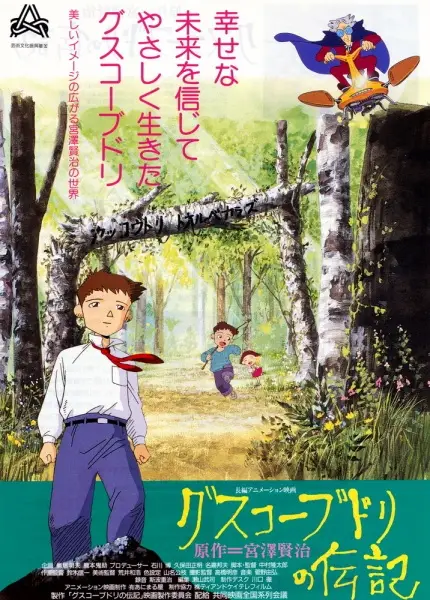
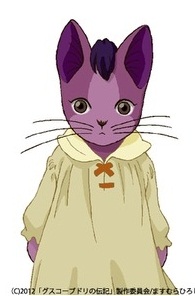
The Life of Budori Gusuko
グスコーブドリの伝記
The fairy tale follows a young man named Budori Gusuko in the Tohoku forests of northeastern Japan in the 1920s. After an onslaught of droughts and natural disasters, Budori is forced to leave his home and search for a better life elsewhere. Budori joins a group of scientists at the Ihatov Volcano Department, which deals with the same natural disasters that drove Budori from his home. (Source: ANN)
Главный
Главный
Avid_Reader
March 19, 2013
Kenji Miyazawa is known for writing children's books and it shows here. This is basically a movie for children, only a bit more challenging. It's mostly apparent in the main character, Budori. He would be an ideal role model for a child: caring for his family, studying diligently, even WANTING to study, working hard and persevering no matter what. Making a heroic decision in the end only tops it off. Except he isn't. He shows no attachment to literally anyone but his little sister. Not even his parents, let alone his employers and teachers. Earlier I wrote that he cares for his family - well, technically, hedoes; after all, his sister is part of his family. But that's really the only person he truly cares about. Not that he isn't interacting with everyone else; in fact, he is clearly distraught when both parents leave the house, but he doesn't even remember them afterwards. Now imagine the fate of those he only had brief encounters with. On one hand, this can be seen as a good thing, we really don't need yet another idealized main character. On the other hand, this is the biggest flaw of this movie. Since there's little interaction and no attachment to any character, most of them feel like tools for making Budori spew out some lines or make some actions and once they did their job, they are disposed of, so quickly that there isn't enough time for the viewer to care about them. This is not a good way to draw attention. Speaking of drawing attention, the overall story is not really good at it, either. It IS solid and rather well-written, but not really much is going on here and it feels almost pointless. Don't get me wrong, I didn't dislike the story, but I didn't really like it either. There is a boy who went through natural and personal disasters in his childhood days, managed to persevere, went to the big city, studied and saved many people from another disaster. And life goes on like it always did and always will. That's one part. Another part is the inner world of Budori, his development, his role in this world and his trying to come to terms with life and death. I personally feel this part is better done, because it actually makes use of the medium and relies heavily on symbolism, art and animation. And this is where the movie truly shines. One can literally see the amount of work that went into the art and it's really amazing. The first half of the movie is set in the countryside, so we get to see some really beautiful landscape panoramas. The second half is the city of Ihatov and while the art still remains beautiful it isn't nearly as amazing. Besides, there's quite some CGI in Ihatov, it's quite bad and does stand out because of that. Also, it feels like the movie tries really hard to be a Ghibli - but there's more to Ghibli than just the landscape art. Nevertheless, it's all really impressive. Is the mood happy and complacent? It shows in the art. Is there something new that just came to life and shines brightly? It shows in the art. Is something deteriorating over time? It shows in the art. It's even more impressive when the movie deals with Budori's inner world. Here everything becomes surreal and it's hard to tell whether the events should be taken literally, whether it's just a metaphor for something or whether it's simply embellishment. It's even harder to tell whether those scenes depict actual events or whether it's all in Budori's head. Those scenes were what I enjoyed most in this movie. To sum it up, while this movie isn't outstanding, it's really solid and does have some value. Do show it to your children but be prepared for their complaints when their attention starts wavering.
TehWhiteTiger
April 4, 2013
This movie wasn't exactly what I expected. In a nutshell, the movie is a slow paced slice of life film of a boy who after a tough childhood is forced to venture out into the world and find his place. A story that has been done many times before, sometimes done very well and some times not so much. This movie is for me a bit of both. The main character Budori, I found to be a bit lacking and bland. He shows little emotion and fails to stand out much at all. He is a hard worker and willingly accepts any work he is given without complaint.Although given his situation, it is understandable. But for a main character, even in this sort of story, is rather dull. Half of his dialogue pretty much boils down to him just saying 'yes, sir.'. The story itself is nice and is the sort of thing that has been seen many times before and will be seen again. However I felt it could have been executed a little better. I found the transitions betweens stages in his life a little lacking, as if he just accepted each part of his life, while forgetting his past. Especially when it comes to his family. My main problem with the story, is at least for me it is a bit confusing. But this may also be what people will enjoy the most. The film is very open and leaves a lot to your imagination to be interpreted how you will. If you enjoy movies that leave open questions of what something is or what happened, whether something is literal or a metaphor, you will probably enjoy this. However if you are more like me, who likes solid answers and everything to be summed up perfectly in a nice bow (although I usually miss the point anyway ;O) , you may not find this type of story telling quite to your liking. But that isn't to say you won't enjoy it. However I think by fat the strongest part of the story is the animation and the soundtrack. It is beautiful throughout and I would almost say to watch it just for the animation. So overall a nice, beautifully animated, enjoyable, some what slow, but not boring movie, which generally makes you really think about what is happening in rather than just telling a detailed story. Not outstanding, but certainly worth a watch.
Cabadath
March 13, 2013
Guskou Budori was not the kind of movie I expected. I thought I was going to watch "Arashi No Yoru Ni meets epic fantasy battles with cats", spiced with a decent adventure anime plot. What I got was a slow-paced, deep, poetic and philosophical slice of life that really got me thinking about life. The visuals and the soundtrack are awesome, and I enjoyed the symbolic nature of the movie (though I feel like the movie derails a bit in the surrealistic sequences, even though I liked them). The characters and the dialogue felt a bit soulless now and then. Especially the tight-lipped Budori felt likehis sole purpose was to act as the eyes of the audience, so that the actual plot could unveil around him. Still, as I watched the credits roll, I got more and more curious about the original novel, and I feel like this movie left out quite a bit of it. It's definitely worth watching, just don't expect to see a traditional fast-paced adventure story.
Perevodildo
November 28, 2022
The art style and designs are obvious hommage to night on the galactic railroad, or, rather "Because it worked once for Miyazawa, let's not reinvent the wheel." The problem is, as always, they just copied the approach without ever getting into why it worked. I, personally, don't mind any design as long as it doesn't get in a good story's way, but in this particular case it's rather irritating and distracting. It's like they're saying in your face, "You can't enjoy a story intended for children as an adult, because we enforce childish designs over it for no good reason." The same can be saidabout those greeko-something runes used in Budori's world. There is no point in adopting those, it's just distracting. Though these runes might also turn out to be some hommage or justified by some hidden motives, I'm writing this from a neutral clueless viewer's pov. Corners are smoothened here, and any even slightly traumatizing experience is reduced to zilch. It's apparent from minute 15-on, there would be no upfront plot turns to the worse, no violence, no openly admitted tragedy — everything that makes drama a drama is censored. The music is disingenuous and generic, too. No more mind-blowing scores of the 1994 movie, only amogus OST here. The occasional 3D CGI is also ugly as always. Generally, this movie does everything Osamu Tezuka's studio always does. Everything I detest about Tezuka's studio. After the thief scene, the movie went completely bonkers, because, "We already have anthropomorphic cats as characters, might as well get away with some more made up psychedelic bullshit." The problem with the surrealistic nature of Miyazawa's stories is, when you read the psychedelic bullshit in the book, the details are omitted. It's left for your imagination to conjecture how it would look, why it would have happened, what are the motives and consequences. Thus, the events look more consecutive and reasonable, gaining a cement footing and a flexible filling. When a movie shows that, the events, peoples, things, actions all have a predefined shape, because that's what movies do — visualize. But now that you can see those events, not just read them, with so little left for your imagination to make this work, they look like straight up psychedelic bullshit and a movie creators' fault for being so lame. Well, you won't be completely wrong thinking this way. But that's kinda what the old movie suffered from a little, too. You can, in fact, make psychedelic bullshit look cool, like in mind games, or make it make sense, like gegege no kitaro, or at least pretend it makes sense, like evangelion (albeit this option is hardly anything good either), but here it's just cringe. After the arrival to Ihatovo, this movie is just an extremely awkward and uncanny chimera of every techno-magical story you've ever seen, not excelling in anything and without any idea what it intends to be, shallow and insubstantial. The 90s ver, though, made every effort to not resort to magic or even fiction. It knew exactly what it wants to be, perhaps even much more so than I can comprehend, was gleefully inspiring when intended, as well as utterly gloom and despairing at other times. While this is just soulless. Even now, having finished this movie, I can't say for toffee what was it about: Well... there was a catboy... He attended the school and uhh... liked poetry, I guess? Then they had zeppelins and monorail, I guess? So he kinda wanted to fight global freezing so he, uhh... Lit a volcano...? — This story has no purpose whatsoever, it feels like just some disparate short sketches compiled into one big animated blob. In all fairness, however, the old movie has also made a mistake of omitting the second silkworm factory chapter altogether. It was pretty fascinating in the book, and both adaptations messed it up.
#8962
Популярность
#7994
Участники
7,665
В избранном
13
Эпизоды
1