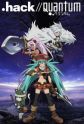
Maoyu
まおゆう魔王勇者
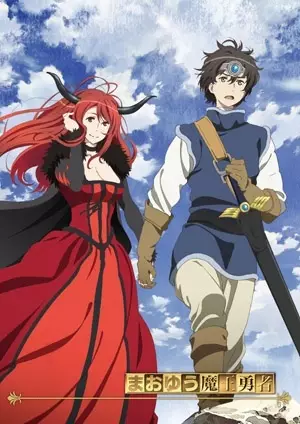
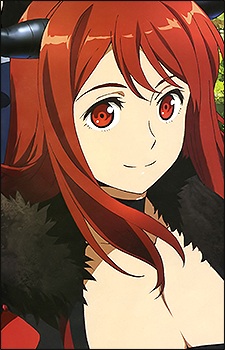
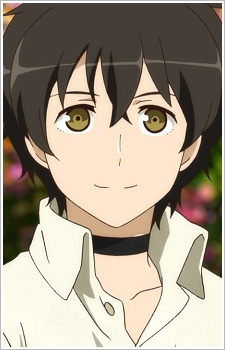
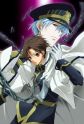
Fifteen years have passed since the war between humans and demons began. Dissatisfied with their slow advance into the Demon Realm, the Hero abandons his companions to quickly forge ahead towards the Demon Queen's castle. Upon his arrival at the royal abode, the Hero makes a startling discovery: not only is the Demon Queen a woman of unparalleled beauty, but she also seeks the Hero's help. Confused by this unexpected turn of events, the Hero refuses to ally himself with his enemy, claiming that the war the demons have waged is tearing the Southern Nations apart. However, the Demon Queen rebuts, arguing that the war has not only united humanity but has also brought them wealth and prosperity, providing evidence to support her claims. Furthermore, she explains that if the war were to end, the supplies sent by the Central Nations in aid to the Southern Nations would cease, leaving hundreds of thousands to starve. Fortunately, she offers the Hero a way to end the war while bringing hope not only to the Southern Nations, but also to the rest of the world, though she will need his assistance to make this a reality. Finally convinced, the Hero agrees to join his now former enemy in her quest. Vowing to stay together through sickness and health, they set off for the human world. [Written by MAL Rewrite]
Главный
Главный
Второстепенный
Второстепенный
Второстепенный
Второстепенный
Второстепенный
Второстепенный
Второстепенный
Второстепенный
Stellio
March 29, 2013
The problem with creating a historical anime is frequently similar to that of adapting a manga or video game: oftentimes, the author has to resort to filler or fan-service materials to clumsily meet the airing requirements for shows. However, an axiom that directors ought to familiarize themselves with is that quality is invariably better than quantity. Thankfully, this inference only applies to certain aspects of Maoyuu Maou Yuusha, a recent adaptation of the original light novels under the same name. Set in a time period of gruesome wars to political corruptions, Maoyuu depicts a fantasy world where humans and devils are fighting for the ultimate authority, whileexploring the infrastructures involved in wars. Despite it falling under the fantasy genre, Maoyuu brings many historical references into play--from the great innovations of the Discovery age (such as the compass, movable type prints, etc.) to the spread of crops like potato and corn into the agriculture industry. Moreover, it is reminiscent of a certain series that many of us could've never forgotten--Spice and Wolf. Better known for its formula of enchanting romance, Spice and Wolf consists of a very similar antique structure in the way that it handles its plot, drama, world-building, and specifically, the daily lives of merchants. While this may sound bland, Spice and Wolf manages to make it work with a recipe of individual arcs for concentrated purposes, and thus, the viewer can gain a fine viewing of diverse episodes with several delightful, piquant subjects at hand. If Spice and Wolf is a mix between curry and rice, then Maoyuu would surely be a mix between potatoes and candy bars; since, it is neither a smart combination nor a completely satisfying experience. Still, it's only in comparison that one is weaker than the other. The steady, episodic approach that Maoyuu employs very much stands out on its own. A scaffolding plot, after all, is better than none at all. The story of Maoyuu starts out with our protagonist Yuusha, a hero siding with the humans, not expecting the beautiful demon queen Maou, whose only wish was to negotiate with him, in the heart of the demons' castle. After their fated meeting, Yuusha then embarks on a journey at Maou's will, and each episode continues with mini-stories about Yuusha's encounters and findings for a seemingly nonexistent reason. Whereas, it is fairly obvious from the start that Yuusha has difficulties conveying his true intentions for Maou, and oftentimes these misunderstandings are used for comedic purposes as well as entertainment. Although repetitive, the several quirks that Maou and Yuusha begin to form do add onto the character interaction, and definitely made certain arcs more interesting. However, side characters do abruptly intervene in the capital of romance arcs, usually with very few good reasons for doing so, and thus, some developments can turn out stagnantly without progression. Most side characters also have very little to offer, ranging from a delusive maid to female knights like Onna Kishi. At times, female characters would surround Yuusha in herds, and it becomes questionable whether or not pandering to the audiences was the purpose. And, although some characters were satisfyingly fleshed out with conclusive stories, other individuals had trouble deciphering their prominent role in the series. Such abstruse matters also bring up the lack of characterization or any predisposition to determine the presence of a solid personality for specific characters, since most of the cast only experience trite developments. Maou, for example, is best described by her acquaintance as "useless meat". Although Maou herself denies this, and claims at all costs the significant deeds that she has achieved and will, the fact of the matter remains that her role embodies a few inconsistent hiccups. At times, she continuously aims to resolve world peace, while the scenes which repeatedly follow her scholarly deliberations are abruptly placed daydreams of Yuusha. Such applies to the grander scale of Maoyuu as it deconstructs historical figures and side characters to bring concerns about the time period being depicted--the medieval ages. Contrarily, the portrayal of the church's public servants during prehistoric times may have exaggerated some of the exploitations, but Maoyuu does extensively illustrate the corruption which overtook officials of feudal societies. Additionally, a charming aspect of Maoyuu resides with how the characters were named after fantasy classes, which effortlessly resonated a lovely core. However, due its enormous cast, Maoyuu couldn’t engender insightful eccentricities for certain characters as it did for others. Likewise, the character aesthetics in the series stuck with genuinely dull decorations as exemplified by Yuusha, whose character design emits the appeals of a generic, immutable male lead. Similarly, Maou has her own pairs of inflatable balloon issues, which many will see as being hackneyed and unoriginal. However, the art directing, layouts for many of the map animations and arrangement of urban images are, in comparison, much better. Correspondingly, majority of the background frameworks and presentations also fulfill their duty in making a location look rural, metropolitan, or even appropriately hideous. Music is undoubtedly one of Maoyuu's greatest assets. The original soundtrack entrances viewers with its vibrant nature, and likewise, the use of many instrumental pieces evokes an indelible atmosphere. With a spirited opening and ending theme, Maoyuu further enlivens its vigor. Correlation between the animation and music also paints an impressionable feeling for the series overall, and the seiyuus all befit their roles perfectly. On the contrary, good narration doesn’t necessarily equal quality dialogue. While the conversations in the series do present interesting observations about macroeconomics, some expositions on the networks of commerce can come off as brusque. Not only so, Maoyuu emphatically focuses on the construction of its own fantasy world, rather than the chronological order of its historical references, so some of the mentioned inventions furnish idealized timelines over what's factually correct. This, in turn, produces temporarily engrossing world-building, but it can also repeatedly bore or confuse the viewer with arbitrary elaborations on ultimately flimsy subjects. From the tone of my writing, it may sound like the majority of Maoyuu is about monotonous history or economics; however, during the latter parts of the series character relationships take center stage, and action scenes transpire more often. As most climaxes do, the story delivers a closing end towards previously unresolved issues, and desolating sides of things take form in both dialogues as well as battles. This, in some ways, may dismay some audiences since the pacing relatively changes, but as a closure, many aspects of the show become a lot more tasteful and digestible even in spite of the several interrelated topics displayed. Moderately diverse, Maoyuu is a series that really tries to bring something to the table for everyone, and in its mixture of historical references with fantasy themes, some of its themes are marred by oversimplified explanations. Although the stale, generic personalities some characters exhibit are very definite flaws, the majority of Maoyuu can still offer insights on the economic and strategic aspects of war, which shifts towards a manner infrequently attempted in its medium. It is most unfortunate, then, that this unique concept lacks the excitement its influences (Spice & Wolf) had obtained so gracefully. Perhaps if given a second season, the lackluster aspects of Maoyuu can do itself more justice through more concise yet lively handling of its themes, and its character relationships may become even more captivating. If nothing else, this series provides a fascinating outlook on the protocols and systems of commercial economics, but sadly, is a hero crippled by his towering boldness of attempting too many feats. Despite its unfortunate flaws, Maoyuu can still compensate for its faults by further constructing its dynamic universe, but only if a sequel will be permitted to fully execute the conceptual values.
Fifteen years have passed since the war between humans and demons began. Dissatisfied with their slow advance into the Demon Realm, the Hero abandons his companions to quickly forge ahead towards the Demon Queen's castle. Upon his arrival at the royal abode, the Hero makes a startling discovery: not only is the Demon Queen a woman of unparalleled beauty, but she also seeks the Hero's help. Confused by this unexpected turn of events, the Hero refuses to ally himself with his enemy, claiming that the war the demons have waged is tearing the Southern Nations apart. However, the Demon Queen rebuts, arguing that the war has not only united humanity but has also brought them wealth and prosperity, providing evidence to support her claims. Furthermore, she explains that if the war were to end, the supplies sent by the Central Nations in aid to the Southern Nations would cease, leaving hundreds of thousands to starve. Fortunately, she offers the Hero a way to end the war while bringing hope not only to the Southern Nations, but also to the rest of the world, though she will need his assistance to make this a reality. Finally convinced, the Hero agrees to join his now former enemy in her quest. Vowing to stay together through sickness and health, they set off for the human world. [Written by MAL Rewrite]
kekekeKaj
April 30, 2013
The success of "Spice and Wolf" probably came as a surprise to most. Who'd have thought a dialogue-heavy fantasy anime about economics on the surface but powered by the character chemistry underneath would sell, right? But sell it did, and some people must have extrapolated that there's a under-tapped market for such an anime, because the next thing you know, along comes "Maoyu Maou Yusha", a show so blatantly similar to "Spice and Wolf" (the fantasy settings, the economic lectures, moe heroine sporting ginger hair and unusual strength of character and intelligence, etc etc) that people immediately started labelling it "Spice and Wolf with Tits".If you're wondering where the "tits" part comes in, it's probably because some people also speculated that the "Spice and Wolf" formula could be improved upon by providing the heroine with a pair of giant knockers to shake around in front of the screen at every opportunity. But an improvement it ain't. And by sharing so many things with "Spice and Wolf" (including a big chunk of the staff), "Spice and Wolf with Tits" - or just SaWT for short - naturally invites comparisons with the material that inspired it. Alas, it's a comparison which ultimately does SaWT no favours because it falls so far short. But perhaps I'm being overly harsh on the show; it does deserve plaudits for putting some interesting twists into the age-old humans vs demons script. The show starts with humans and demons at war with each other, and the Hero - literally named "Hero" - storming the demon king's castle solo to try and end the war. The demon king (and guess what the demon king is called) surprisingly turned out to be an attractive girl with big bouncy breasts instead of a giant frothing monster with razor fangs. What also surprised Hero was her personality: she spoke a remarkable amount of sense, and, with a few well-chosen arguments, demolished the pre-conceptions the Hero had regarding humans, demons, and the nature of the war. Bewitched by Demon King's silver tongue and hypnotised by her jiggling assets, Hero agrees to co-operate with her mission to set the world to rights with wisdom rather than wars. SaWT started a little rough, but its concept got me interested enough to continue watching. Most of the first half helped maintain my interest, mostly with the way Demon King went about changing the world through her learning, introducing new technologies, new methods of doing things and new ways of thinking. And it's this, and not the interaction between the main leads that's the focus of SaWT. But that's not a bad thing, because while the nuanced interaction between the protagonists excels as one of the greatest strengths of "Spice and Wolf", that same aspect is one of greatest weaknesses of SaWT. I realise things are supposed to be a bit awkward between the ridiculously shy leads, but the insipid small-talk and overblown romance cliches is a combination cringe-worthy enough to embarrass a third-rate romance novelist. While showing some initial promise, the show soon started falling apart. SaWT has a major problem of being overly self-conscious of what it's trying to do, and thus very little of what it does feels natural. Speeches about the ways of the world is almost condescendingly delivered through long expositions that's aimed more at the viewer than the other characters. Then there are Demon King's inventions: she starts off introducing things like crop rotations methods, but soon began inventing one major technology after another, like some kind of Thomas Edison raised to the third power. What's more, her contributions span across ludicrously diverse fields, from agriculture to medical science to navigation, just to name a few; nearly every episode she conjures up something new. In one episode, someone other than her actually managed to invent something (namely, sparkling orange juice, aka Fanta), and, determined not to be outdone, Demon King invents not one but TWO things during that episode (and no, Coke isn't one of them). By the half way point of the series, I felt like I was watching a game like "Civilization" being played, with the Demon King way ahead of the other players in researching the tech tree comprising mankind's greatest ideas and inventions. If Demon King is guilty of over-performing in her role, Hero is guilty of the opposite: as one half of the central protagonist pair, he simply doesn't carry his weight. While Demon King busied herself with changing the world, Hero spends the first half just tagging along and doing very little beyond admiring her. Though later on he does goes off to distant lands and contribute to Demon King's plans there, we rarely see what he does because the story is still mostly focused on Demon King and her endless output of inventions. In fact, the imbalance issue extends to everyone else, too: the Demon King seems so intelligent that she makes the show kind of boring, and everyone else appear so dim that they can't do anything until Demon King bestows onto them her pearls of wisdom; you have to wonder how the human race managed to hold off extinction before the Demon King came along. SaWT also has pacing problems. I enjoyed the gentle strolling pace of world changing used for the first part of the series, but the global politics quickly escalated to the point where I struggled to follow. Everything began changing in all the nations, half of which the show failed to properly establish in the first place; I'd also started getting lost in all the economic babble, perhaps owing to my own meagre knowledge. The show simply accelerates away during the later parts and finishes in unseemly haste, leaving one giant political mess, full of dangling plot strands and badly explained developments, in its wake. But there I go again, coming down quite hard on the show. I do have a degree of respect for what SaWT tried to do, but the problem is that it simply did not do a good job. While it captured my interest early on, I struggled to get through the series as it progressed. It may not be a show devoid of intelligence, but it needed to be more intelligently written; it may not be a bad show, but it's far from being good. I guess it's just too much to expect a show that sought to improve upon something noted for its writing by throwing in a pair of big tits to amount to anything beyond A Good Try. And A Good Try is all SaWT managed to be. Personal rating: -0.5 (mediocre)
AvalonKnight
August 4, 2014
Fantasy isn't quite like it used to be nowadays, or at least it doesn't want to be. Tolkien-like stories of great heroes and their adventures in the world inspired by Medieval are considered old news; now fantasy likes to be dark, edgy and bitter, showing the "true rough nature" of the world. There are good examples of such "mature" fantasy, the Witcher, for example, much as I dislike its focus on angst over substance. Often, though, it just comes down to buckets of blood and a lot of sex scenes (yeah, so mature) with no depth to it. This anime's take on modern fantasy and overallMedieval is different and much more appealing, to me, at least. Oh, it doesn't hesitate to show how rough it can be but it chooses to introduce economics into its world. The premise is that demons are at war with humans, and finally a hero with three sidekicks gets close to stopping the war (of course he does, it's the plot of any party-based RPG ever) and heads off to kill the Satan. Who turns out to hate war herself and, in turn, tells him she actually wants to stop the war. He agrees to help her, and the rest of the show more or less focuses on her plans and their consequences. Most of these plans revolve around reforming agriculture, economics and so on. In the beginning it felt similar to Spice and Wolf: there are two main characters falling in love, the female is going to introduce some clever schemes, the atmosphere is equally warm, even the two leads are played by the same actors. However, Maou's ideas are all pretty simple, the intrigue comes not from the plans themselves but from the effect they have on people and, ultimately, on the country. The plot is coherent but seems to be episodic at times, partially because of the inevitable time jumps, as such reforms require time to actually take effect. This one is difficult to talk about, for it's really hard to point out one single element that makes the anime good; it's mostly the little touches. For example, I really enjoyed watching the Hero for many reasons, one of them being that he asks an interesting question: what is there for a hero to do after the war has concluded? He won, awesome, so what's next? This character seeks peace to begin with, and his interactions with Maou only serve to keep him on this path, while he actually can only function in times of war. The question of what war means to different people is an interesting one, and it's explored from different angles throughout the show. There is no clear answer, though, which might irritate people; me, personally, I hate when such questions get a clear answer, ambiguity is what makes the topic interesting to begin with. Many issues are addressed, some in a rather unusual light; for example, merchants tend to place profit before everything else - is this bad? Not necessarily, as this series suggests, one character was turned from an obvious and boring "heartless douche" type almost into someone to root for without any real change whatsoever. I have actually thought of a thing to praise here: the writing. The characters are good when they are given enough time to shine, I'd like to see more of the Mage with her split personality (for once, it's not a villain who has it), for example. Maou is interesting in that she's clearly wise and cunning but still childish and innocent, which overall makes her all the more appealing. Yuusha is pretty lighthearted and not that smart, though intelligent enough to understand his problems and limited usefulness; to his credit, he doesn't fall into angst, he always tries to help people. So, yeah, he's the Hero, no real surprise there. There obviously is a romance between these two (as usual with the characters voiced by these actors - Lelouch and Kallen, Lawrence and Horo), there is even a love triangle with the Knight lady, though this is the weakest part of the show. Don't get me wrong, the main couple's interactions are mostly nice but it leads to many unnecessary moments, like, say, discussions of boobs, which is always classy. It doesn't feature fanservice, though. The supporting cast consists of a variety of characters, some of which evolve throughout the series, others are interesting as they are. There are, of course, those who mostly serve as a throwaway joke or are ultimately pointless (the Old Man, the little servant girl, the Dragon Princess) but they almost always are there to complement someone else's personality, so it's not distracting. In the end, they do reflect the world they live in and present interesting possibilities for the writers to take advantage of. More than enough for me. The art and the score both serve to reinforce the aforementioned warm atmosphere and yeah, they work. It's not the sharp drawing style I usually enjoy but it's justified here. Everyone looks unique, particularly Maou, who is not drawn like your usual anime nice girl but instead opts for a more mild kind of beauty, which is refreshing in a female lead. The voice acting is awesome: practically all significant characters are voiced by someone whom I have heard and liked before (be it in Code Geass or Rozen Maiden), and they do a good job here too. Overall, I really enjoyed the show. Yeah, it doesn't really pay off in terms of the romance, and the story can feel somewhat unfinished, particularly with the ending being only semi-happy but I really like to see real world economics and serious issues like cultural diversity being brought into fantasy world. It makes for an intelligent plotline with believable outcomes for all actions and allows the creators to show how Medieval actually progressed. This is what I'm going to think of now when I think "Modern Fantasy". A great anime.
Stark700
March 29, 2013
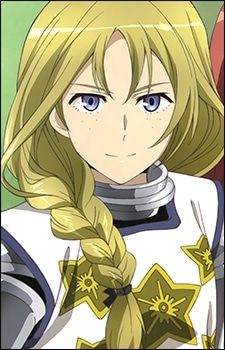
So begins the journey... In any fantasy world, some beings just don't get along. Take for example, demons and humans. In order for two races to co-exist, they have to accept each others' values. Yet that dream is an overwhelming task to achieve because let's all face it, some things just don't mix well. It's been fifteen years since the war waged by the humans and demons have begun. After an awkward meeting and the revelation that the Demon King is in fact a female, the duo forms an alliance after some reluctant arguing. Hence, let the tale of a human male and demon female begin! Mayou(Maoyu Maou Yusha, aka Archenemy and Hero) is an anime adapted series from a light novel that was originally “serialized” on 2ch. The series is written by Mamare Touno who is not well known but has recently made his debut. The LN has sold over 450,000 copies and here we are, the anime adaptation. As one of the first full length series to debut in 2013, it definitely needed to set the bar high. So without further ado, let's see if Maoyu lived up to the hype. Maoyu follows the story of a hero and queen of demons as they seemingly join forces to bring about a new world. They desire a world of peace, a world without conflict, and a world where values and ideas are accepted without violence. The series begins with a lot of promise as in the format of a preview as to what's to come. In fact, our two main characters (from the poster) takes up most of the tv time as they engage in humorous dialogues and discusses their ways of changing the world. It is actually quite fresh and entertaining as viewers can see that the demons and humans are not so different. For instance, the demons themselves has their own code of ethnics and politics. They have their own ideologies and ways of thinking. To top it off, they also don't have actual or maybe I should say..physical features in the way some people may originally see them as. To me, the series takes off with strange tropes and turns it into a rather refreshing series at first. I mean, we have an ordinary human and meets a not-so-ordinary demon king. Hero also gets a surprise from the fact that the Demon Queen is actually a female rather than what he originally expected. (a rather big breasted one if I may add...) The Demon Queen herself is shown to be not violent but rather trying to persuasive for her goals. It also sets up a state of prejudice at first between the races but as time goes on, it's shown that the duo can get along quite well. Even from the pilot episode, Hero seems convinced enough to join the Demon Queen despite her rather sophisticated dialogues. The dialogues themselves contains lengthy references to politics, economics, and a historical lesson rather than any violent backgrounds. In a entertaining way, it transforms the tale of struggle between humans and demons into a story of that almost seems to be educational at times. It's almost like watching the fantasy version of the Discovery Channel as the Demon Queen educates about trading and her ways of inventions. The series maintains as a small cast of characters. Obviously, we have the two main stars of the series, Maou and Yuusha. They often go by their titles, Demon Queen and Hero respectively. In fact, many of the supporting cast seems to follow this trend. We have Onna Kishi known as the Female Knight, Onna Mahoutsukai known as the Female Magician, etc. Their names matches their respective titles and defines the role they play in. But perhaps the most interesting relationship in the series is between Hero and the Demon Queen. This is because they are nearly nothing alike, even in terms of being the same race. Hero seems to be a guy of using action rather than words of persuasion. On the other hand, Demon Queen seems to play the role of a politician and uses her intelligence. Yet upon closer examination, they get along quite well and intimate at times. This brings a problem of their relationship being too rushed. As a matter of fact, there is strong hints of romance between the duo already after the initial episode. To add to this relationship is a strong dose of fan service. The term “useless meat” becomes a recurring joke for the Demon Queen as she takes on the role of an eye candy. With or without horns, she retains her stature as a female that seems to allure viewers. This shouldn't come too much as as surprise though as the production studio Arms handles the series. Arms is known for its rough and sketchy ways of presenting fan service such as in Elfen Lied, Ikkitousen, and Queen's Blade. Their stance of producing lascivious visuals has been a long standing trend. In this case, Maoyu isn't off their charts. As being labeled as an adventure genre, the series takes the fantasy theme well. There are the old medieval like architectures and maintains that feeling of being in a fantasy world. The way the characters are dressed reflects this theme of being in simple wear in the case of servants, modern in the case of the maids, and fancy in the case of high level authority figures. Hero's design sees him as a warrior and 'hero' as the title suggests him. On the other hand, there is Demon Queen who is dressed in an ornamental way that is elaborate and eye-catching. Unfortunately, some of her appearance is played as a joke like the “horns” on her hand and once again, the useless meat. Speaking of useless, I find the fan service of this series to be just that. Even with the light humor, romance, and sweet moments, I find the fan service part of the series to be in the way and preventing Maoyu to shine itself. It is distracting and seems manipulative in some of the sweet dialogues that moves away the balance. Other problems I've ran in to the series is the rather weak story based off the original premise. Some of the preceding episodes from the narrative prequel pilot almost seems like filler. It doesn't also help the fact that some of the jokes made throughout the series becomes a bit stale. Furthermore, Hero seems to attract other female characters of interest and creating some unfriendly rivalry for our Demon Queen. It falls under a track of insubstantial romance with a seemingly love triangle between her, Hero, and the Female Knight. Maoyu also seems to adapt many of the same themes as another popular title that debuted a few years back. Fans of Spice and Wolf may notice many similarities such as the adventure style storytelling, theme of economics, fantasy setting, and even the main female protagonist shares the same seiyuu. It can make an impression for viewers who once again desire a taste of economics and adventure rather than the typical “save the world with swords and magic”. It does have some of that though but the majority of the series focuses more on the politics, economics, and the interactions between the Hero/Demon Queen. In terms of artwork, the series did its job right. Despite some of the characters being serialized with the fan-service and presented in a gratuitous way, it maintains its background of the fantasy setting well. There is the elaborate landscapes, the majestic rivers, and plain rural backgrounds. The way the characters are dressed reflects off that old and classic feeling from the Dark Ages. It's the way that an adventure should be and maintains that theme well. At times though, it does look like the visual qualities of the show slows down. Yet, it maintain its fantasy posture well. For soundtrack, I found the series to be only mediocre. Toshiki Kameyama plays the role of the sound director and he seems to give that feeling of smoothness and melody of the medieval ages. However, it is hardly noticeable or distinguishing itself from other fantasy theme series. The OP and ED songs also presents a style of primitive artwork in the style of the old medieval ages. It is just too simple and not unique enough in my estimation. Ultimately, Maoyu is an adventure series that I have mixed feelings on. From one standpoint, it is a fun and entertaining series with our lovable duo. Their interactions and dialogues makes a first impression but that later becomes repetitive and stale. The way fan service is presented becomes a source of diversion rather than some comedic fun. It is comedic in some ways though but ultimately, it doesn't achieve its goal. However, there are instances where the series launches itself with its fresh way of adventure story. It is a story about a Hero, a Demon Queen, and the plan they hope to achieve in order to make the world a better place. I just hope they succeed and achieve glory for what they strive for.
mdz
April 7, 2013
It's a series that had potential, but ruined it by doing too much. [mild spoilers pertaining to storyline progression and general point-of-view] A third season of Spice and Wolf is perhaps the most desired adaptation among fans of the franchise. When announcement came through that a similar series, with similar staff members, was going to be released, fans were ecstatic. Unfortunately, it's not quite that simple to live up to the name of the predecessor, and it's even more difficult to satiate an entirely new crowd. Maoyū Maō Yūsha suffers from a variety of debilitating features that not only make it a shitty, half-assed 'successor', butan awfully trite,mundane standalone. Maoyū Maō Yūsha doesn't have the world's most amazing storyline. In fact, it's relatively archetypal -- the king of demons and the hero of humanity wish to team up to ultimately better the world. Sounds relatively creative right? It's not. But it could have been. We're given two main characters, Maou, and Yuusha [translated to Devil and Hero]. Their names are titular of their roles. During each episode, humanity attains a new invention that may better life [e.g. new farming techniques, agriculture]; and during each episode, a mild time skip is applied [typically a few months]. What does this do? It advances the plot. But does it do anything more than that? Probably not. Is it bad because it's simple? Not necessarily. Is it bad if they advance the plot over developing the characters/mood/every other aspect of the show? Probably. A certain series revolving around a travelling merchant and a wolf goddess revolved around the characters -- every episode moved at a snail's pace, and the characters were developed accordingly; in Maoyū Maō Yūsha, it isn't uncommon for several months to move in one episode. The characters aren't developed. There's a romance between Maou and Yuusha. But the romance between the two are magnetic. They're only together for the storyline. A magnet doesn't need a reason to attract the opposite charge, neither does Maou to Yuusha, and Yuusha to Maou. They're together, but there's no semblance or inclination that would insinuate anything outside of being together for the storyline. Love? What's that. 12 episodes, or several years, resulted in a half-assed display of affection at the end. No discourse implying anything significant, and no actions outside the cursory depicted a sort of love outside of obligation. The art and animation in Maoyū Maō Yūsha was fantastic? You mean the art and animation during Maoyū Maō Yūsha's first episode was fantastic. Arms was tasked with animating the series -- Arms did a really nice job during the former half of the series. The latter half, they kinda just gave up on maintaining consistent quality. Surprisingly, Arms, a studio, known for their integration of ecchi into everything, didn't put that much ecchi into Maoyū Maō Yūsha. That's a bright side. How about the soundtrack? The soundtrack's probably one of the best, redeeming features of the series. The track titled 'Beyond the Hill' by Takeshi Hama [composer of the original Devil May Cry soundtrack]would on its own, bump the score up by at least a point. The series contained a fantastic soundtrack, albeit, it wasn't exactly applied that well. The general soundtrack is perhaps one of the few things that Maoyū Maō Yūsha does better than its related series. It may not have been used as well [the soundtrack in the former was heavily ambient, but that ambience was integral in developing the mood], but it's certainly noteworthy [the main theme really is good]. So, we're given a series with generic characters that are seldom developed, the noble goal to save the world, time skips for plot, alongside a fantastic soundtrack, inconsistent animation, and a predictable, archetypal plot progression. Oh, and don't forget the romance. Everybody loves romance. So to sum it up, we're given a series that attempts to do too much within 12 episodes, that's understandable right? Well, it probably would be if it attempted to do something difficult. Every other development and concept explored in Maoyū Maō Yūsha isn't exactly novel, or avant-garde; it's not even a rendition of generic concepts. They're really just generic concepts without any sort of application. Economics? Spice and Wolf had more economics within a single episode than this did in 12. The notion that opposite sides often have a lot in common and that they probably shouldn't kill each other? That's clearly edgy and new. It's not as enjoyable as it could be to watch because the series tried to do too much. When you introduce a romance, actually develop it. When you attempt to mirror a similar series, at least compliment it. The series doesn't revolve around combat and the mechanics of the world? Then don't dedicate an entire episode to combat. There wasn't enough time to do what we wanted? Then don't do so much.
Ранг
#3474
Популярность
#478
Участники
524,218
В избранном
1,570
Эпизоды
12