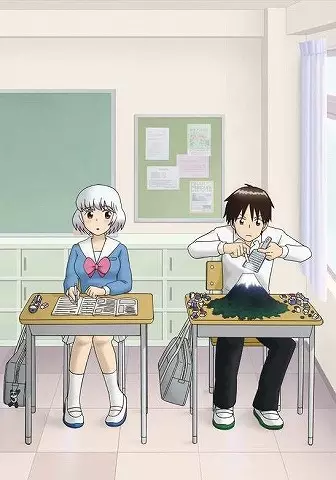
Tonari no Seki-kun: The Master of Killing Time
となりの関くん
All Rumi Yokoi wants to do is focus during school, but she is constantly distracted by Toshinari Seki, her neighboring classmate. Paying attention during class is the least of Seki's worries, as he obsesses over intricate setups created using an assortment of items, from an elaborate domino course on his desk to a treacherous war played out with shogi pieces. Yokoi desperately attempts to focus in class, only to be repeatedly sucked into his intriguing eccentricities; however, they always seem to end up with her getting in trouble with their teacher. Fortunately, lessons will never be dull with Seki's antics around! [Written by MAL Rewrite]
Главный
Главный
Второстепенный
Второстепенный
Второстепенный
Второстепенный
Второстепенный
Второстепенный
Второстепенный
Второстепенный
Stark700
May 25, 2014
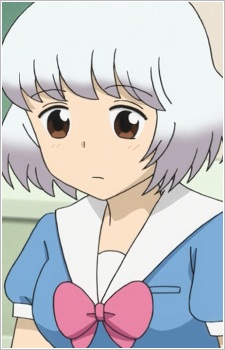
Creativity, a simple word that inspires so much innovative ideas from anyone, anywhere, anytime. What inspires creativity varies but for a young boy named Toshinari Seki, he takes it to astronomical levels that goes far beyond what you may be used to seeing at school. As a master of killing time, Seki lives up his reputation of such a title. For a 7-minute anime series, there’s so much attention Seki can attract towards its audience. When it comes to killing time, you would do something inventive, something creative, or anything that will prevent you from saying along the lines of ‘it’s so boring, there’s nothingto do’. For Seki, there’s a chance for that in his class every single day because he sits in the very back corner. As a kid of his age, Seki can be described as a simple yet curious character. He isn’t very interested in his studies by the way he behaves in class. Looking it from an intrinsic perspective, Seki is an average boy with nothing that stands out with his character or personality. Rather, he prefers to be alone by his activities. Of course, that’s perfectly normal because kids his age are growing up and build their characters. Seki is also more of the shy boy with his lack of dialogues. More often or not, he communicates using body language (gestures, signals, etc) that somehow makes its point. Rather than being intellectual, this series takes Seki and presents him as a bizarre yet likable character with his actions. Then, we have Rumi Yokoi, the not-so-fortunate girl sitting next to Seki. Similar to Seki, she is the typical average girl without the glorifying looks or an abnormal personality. Yet, she is similar in some ways to Seki as characterized by her curiosity. Despite trying to ignore Seki’s actions in class, she often finds herself unable to but instead entranced by his activities. It’s humorous in many ways because almost everything that Seki does tends to draw her attention. At the same time, Yokoi often gets into trouble by the teacher and mistakenly being labeled as a troublemaker. For Yokoi, it becomes a chore for her every class period to deal with Seki. On some instances, she seems to tolerate or even embrace Seki’s culture. Other times, she overestimates Seki’s intentions that results into a scolding by the adults. There’s a lot of anxiety each episode seeing Yokoi and her reactions towards how she perceives Seki in class. Furthermore, it’s surprisingly noticeable to see her character develop. This is evidenced as Yokoi seemingly grows stronger with every class period or episode. She is able to resist some her curiosity or even close to stopping Seki from goofing off in class. Unfortunately, she never seems to reach home base with her goals because time is simply not her side. The series adapts itself in an episodic format. Given its average 7-8 minute standard, viewers should not expect an engaging linear story saturated with complexity. Instead, do expect a slice of life story featuring Seki as he kills time in his boring class. What you might not expect is the activities he does in class when the teacher is not looking. Some of them might seem typical while others are not. Examples including bring live animals, performing experiments, and in general any activities that would earn you a trip to the principal’s office if caught. The humorous part is that Seki NEVER gets caught. Throughout the series, it is Yokoi that becomes the collateral damage because of Seki’s innovations. Not only that but no one believes a word she says. It aims at the purpose to appeal to the audience that the adults of this show are useless and self-insufficient. If every student could get away with Seki’s behavior, then nothing would ever be learned. But as an experimental show, Seki’s activities encourages creativity and even inspiration. It’s clear that the boy is intelligent because some of the games he engages in are fundamentally impossible, at least in realistic levels such as mixing chess and shogi on the same board. For Yokoi, she often formulates imaginations and delusions at her own discretions from the way Seki kills time. As a show of weird quirks, there are occasionally some characters that comes into the scenes to bring a little normalcy. I don’t classify them as supporting characters since most of them tend to enter and exit after the period/episode is over. Yet, there is one other character that is worth noting. Her name is Goto and like most girls her age is interested in relationships rather than her education. Make no mistake, her delusions can be as zany as Yokoi in class. Rather than being curious at Seki’s ingenious games, she is more interested in their “relationship”. This is in quotation marks because Seki and Yokoi are not dating. Yet, there are people that thinks they are dating for bizarre reasons. Further evidenced are some hints that Yokoi might see Seki as more than just a classmate. However, the show focuses more on its comedy and less so on a Romeo & Juliet story. Of all the silliness that the show brings in, it’s all presented as simplistic. It’s not realistic with some of Yokoi’s games that seems unconventional. Yet, they are practical and influences Yokoi’s school life at various levels. The story itself is rather too simple and may seems repetitive. Yokoi getting accused of being a troublemaker in class can also seem bizarre considering girls are often the ones that are more peaceful. Not only that but she doesn’t understand Seki’s purpose which is also a bit of an overstatement. We might never understand Seki’s purpose beyond the simple idea of ‘killing time’. The lack of character backgrounds such as their childhoods being explored also becomes a drawback. Finally, the humor of this show might not appeal to everyone. In essence, it’s a comedy show that inspires laughter but not everyone may get used to Seki’s quirky activities in class. Both artwork and soundtrack are consistent with this short series. In essence, they are simple and down to earth. The classroom backgrounds is straight point forward with nothing particular that stands out. It’s probably best to just call it ‘just there’ because Seki’s activities are what draws in the audience and his classmate. The character designs also seems normal except maybe some slightly physical aspects for Yokoi. In retrospect, we don’t see a girl with white hair often in class that goes unnoticed. On the other hand, the soundtrack is very noticeable for both its OP and ED songs with slightly edited changes throughout the show. Instrumentally, it has a melodious tone with comical backgrounds. We see both main characters in the songs as they demonstrate degrees of humor. The ED song features Seki playing an instrument to create the style that Tonari-Seki Kun accomplishes – innovational humor. Kana Hanazawa plays the role of Yokoi with her nervous yet curious voice mannerisms. It matches well since she is specialized in voicing girls of shy characters. On the other hand, Seki’s voice is hardly ever heard throughout the series. His body language does the talking. 7 minutes. That’s all it takes to draw in as much as attention for Seki towards an audience. There’s no need for a deep engaging story because shows like this should be presented with simplicity. While the activities that Seki performs can be complex, it’s easy to see what the show tries to accomplish. And that goal was achieved by bringing in humor in a different way that what you may be used to. No absurd fan service. No shock values. No crude humor. Rather, it’s a show that breaks down the barriers of a normal school life. Now, that’s a certain kind of fun.
Aeowina
July 6, 2014
WARNING: Avoid drinking anything while watching. This show is not liable for any snorting of said drink. Side effects may include stomach aches from giggle-fits and shortness of breath... Story: 8/10 There is a special charm that only short anime possess, such as Hetalia, Chi's Sweet Home and Miss Monochrome. Among these easy-to-watch shows is Tonari no Seki-kun, whose episodes are a mere 7 minutes in length. Each segment is episodic without much of an overlying plot, although there are recurring themes. A creative boy named Seki-kun brings in nick-nacks to class and messes around with them rather than pay attention. Yokoi-san, the girl who sitsnext to him, reluctantly gets drawn into his activities. Her inner monologue of observations explain his schemes and give significance to small changes. Sitting at the very back of the classroom, the other students and teachers take no notice of whatever dramatic occurrence is taking place; when they do, it usually takes form in some misunderstanding. Much to her chagrin, Seki-kun never gets caught, while Yokoi manages to get in trouble instead. The fact that the two take each situation so seriously only amps up the amusement. Art: 7/10 There is nothing very special about the animation, except for when it focuses on the games. The art does justice to Seki-kun's elaborate hobbies. The colors are light and happy, and the expressions of the characters take form in comedic ways. The only noteworthy character design is Yokoi, who sports white hair and a candy-colored girl's school uniform. The more detailed manga panels translate cleanly in the adaption. Overall, the simple style works wonders for the anime's simple premise. Sound: 8/10 The opening is sung by the voice actor of Yokoi, and it's basically her general reactions to Seki-kun's antics. The frantic stream of thought within each verse is sung in one breath, and the fast paced vocals are complimented by lighthearted music. I have never once thought of skipping it. The ending is also addictive, with Seki-kun drumming on his pencil cases and school supplies. Seki-kun never speaks, so you won't hear much of the seiyuu except for occasional grunts or laughter. Yokoi, on the other hand, is the prominent narrator. Kana Hanazawa does a wonderful job portraying Yokoi, but I did find her voice to be slightly annoying. It's a teeny-tiny mar to the overall execution. Character: 8/10 You really wonder why a genius like Seki-kun doesn't put his talents and energy into other skills rather than waste time. The audience quickly sympathizes with Yokoi's plight, but like her, are drawn into every game. As the series progresses, we see that Yokoi starts to become more and more involved with Seki-kun's various distractions. This however would be the extent of any character development. I fell in love with this adorable duo almost instantly and I'd like the anime to speak for itself. Supporting characters have a tiny role, but they are amusing additions to the plot nonetheless. Enjoyment: 9/10 This could potentially be the best comedy of the season, no joke. I'm really grateful to my little brother who introduced me to Tonari no Seki-kun. I'd definitely use some of the nifty ideas to pass time myself if I didn't get caught. Anyone who can pull off the antics should have the right to wear a T-shirt that says "Seki-kun like a boss." The style of humor is somewhat similar to that found in Azumanga Daioh or Lucky Star. I swear, it'll brighten up your entire day =D Overall: 8/10 Oh gosh, I've started rambling. Anyway - I totally recommend this (especially to younger demographics and people who haven't seen anime before) if your looking for something family-friendly. It's an automatic favorite. Thank you for reading this review and happy laughing.
NotDolphy
December 5, 2014
Each short episode of Tonari no Seki-kun is built on a similar foundation: Seki plays some comically elaborate game in the middle of class, and Yokoi, his more studious neighboring classmate, invariably gets sucked into what he's doing, to the point where she often becomes even more invested in it than him. That’s it. This seems like a fairly limited premise, but it provides a great framework with a surprising amount of comedic range for Seki to play in. The results are almost always a blast. The games Seki plays each episode range from staging complex, twist-laden wars with unconventional shogi play to bringing an actualbag full of cats into class. There are episodes where he’s seen building crazy Rube Goldberg machines right in the middle a lecture. He never really speaks outside of determined grunts and the like, but there’s a ton of expression put into the way he reacts to the various scenarios he concocts. There’s a sadistic edge to how he goes about his games and the way he crafts his fiction that makes him a great foil for Yokoi to play off of. Yokoi's reactions to these scenarios are diverse and keep her from becoming a stock overreaction character. More of a protagonist than Seki is, the episodes are generally filled with her internal narrations. She’s sometimes quite taken by Seki's more sensitive side, only to be crushed when he reverts to his usual, harsher self. Other times the plots of Seki's games become so grim that she finds herself becoming engaged in them, in an attempt to steer them towards happier directions. There’s a running gag involving a robot family that Seki often brings to class, for example, that he often puts in dangerous situations or will just mistreat in general. Yokoi gets really attached to Seki’s narrative for this family and will put herself at risk of being caught by the teacher just to help sway their fate in the direction she wants. Of course Seki doesn’t just take this lying down and it becomes a fun battle for the outcome of these toy robots. And this is all while she’s trying her best to study! It’s a lot of fun seeing the creative ways she gets whisked away from this each episode. They play off each other really well and make for a great comedic duo. Also Yokoi is like totes adorbs. Presentation works wonders in capturing the comedic idiosyncrasies of the scenarios. The dramatic score and aggrandizing theatrics elevate these silly games to the status of tense, mortal conflicts. Effortlessly pulling the audience into the characters' skewed sense of priority; the result is entertaining at every turn. Kana Hanazawa puts in a great performance as Yokoi, capturing the huge swings in emotion that Seki puts her through wonderfully. Fans of silly faces will find a lot to like here as well, as the show has a huge array of them that it uses really well to heighten the comedy. There are many places in the show where the creators went above and beyond, like giving the robot family their own theme song in the style of old mecha anime, or depicting shogi games as actual wars, acting out Seki’s stories. Even the OP and ED play out like skits from the show. The OP in particular is a clever meta piece about Seki actually animating Tonari no Seki-kun in class. A lot of subtle ingenuity went into making this simple premise a lot more than it seems. If there’s anything to complain about in this show, it’s that the show does have some rare instances where the punchlines can start to feel a bit samey. There are some recurring skits and although they still remain endearing, the edge of their punchlines are dulled on each successive rehash. It’s nothing too bad though and the short run time of the episodes makes these skits more of a fleeting occurrence before you’re back to something new again, but several of them did start to lose a bit of their luster for me by the end. They might even give the series a nice sense of continuity for some though, so your mileage may vary. Minor quibbles aside, this is an incredibly solid comedy. Seki and Yokoi have a great dynamic together and the show by and large does a superb job giving them varied situations to bring out the most in their personalities. Coupled with the grand presentation of it all, it’s easy to be whisked away into Seki’s antics just as Yokoi is. I doubt many will regret their time playing with Seki, especially without the risk of being caught by the teacher.
vigorousjammer
June 12, 2014
Tonari no Seki-Kun is a simple show with simple stories. That's one of the things I really like about it, because it's easy to digest. The short length works great, and no single episode feels like it's overstaying it's welcome. However, the whole thing also feels pretty formulaic, which eventually started to wear on me. Even only watching at a relatively average pace (at one episode every morning), I began to get bored of it about halfway through. Some episodes were pretty funny, but I can't recall many times the show actually made me laugh out loud. A few episodes also recycled ideas from earlier episodes,and just put a slight twist on them, which I thought seemed kind of lazy from a writing perspective. The art is pretty standard, and definitely common to what we normally see in the genre. It's well done, but it's nothing too impressive. I do think the character design is slightly better than what we typically see with this kind of art style, though. The voice acting is pretty standard as well, but it's well done for what it is. All of the actors represent their characters well, but again, nothing too remarkable here. I think where the show's audio really shines is with the opening and ending themes. They are super fun, catchy, and they fit perfectly with the setting of the show. The characters also go along with that sense of fun. The main characters Yokoi & Seki-kun are somewhat interesting. Seki-kun is a pretty standard looking character, visually, but they do enough to make him unique. They never have him say any words, just grunts and groans, however I like this because it lets his personality be shown entirely through his actions. Yokoi, on the other hand describes what Seki-Kun is doing, essentially narrating things for us. She has an excitable personality, and really pulls a lot of the fun of the show together. There are a few other supporting characters, which feel very generic, but fill a gap well enough, and flesh out the cast just a tiny bit. Overall, Tonari no Seki-Kun is a somewhat average, but enjoyable show. What it ends up being isn't anything special, but it also doesn't really try to be. This is both good and bad, as it's a good quick bit of fun, but over the course of watching it, I slowly began to lose interest. The writing is good, but perhaps a bit weak, however, the characters tend to make up for that somewhat, with their somewhat unique identities. I'd recommend it to anybody who enjoys the comedy genre and isn't expecting anything all that incredible... but just looking for a fun, simple show.
AmazingDaOne
May 29, 2014
Tonari no Seki-kun is an adaptation of a manga with the same name. I have been reading this for awhile, I have already caught up with the manga already. This anime is very creative and fun anime. This anime is a 7-min and 21 episodes anime, the OVA and special will be releasing soon. Story: 8 Tonari no Seki-kun is an anime revolves around Rumi Yokoi and her reaction and narration toward the person she sit next to Toshinari Seki or Seki-kun and his antics. His antics consists on something new every time, and it distracted Rumi from her note taking and sometimesshe got in trouble because of his antics, and Seki-kun never gets in trouble. He hasn't been caught because both of them sit in way back, Seki-kun sit by the back corner by the window, and Rumi sit next to him. IDK how he have been caught it called anime logic's. Art: 8 The art is not perfect Kyoto Animation. But from manga to anime, it near perfect the manga and anime have similar art to it and I give a hand to the producer for that. The art for Seki-Kun activities pretty good, expectually the art book one. Sound: 9 The main girl Rumi Yokoi voice actor sings the opening of the anime. She basically sing about her reaction toward Seki-kun antics. The opening is pretty good, and the voice actor for Rumi is good but Seki-kun didn't say anything...at...all, but he never say anything in the manga as well. The ending have a drum theme to it, impressive but it didn't get my attention unlike the opening. Character: 10 There are two main character of the anime, Rumi Yokoi and Toshinari Seki. I like both of the main character and there designed, I got no beef with the character. They are fun to watch and I have no complaint about the minor character as well. Enjoyment: 10 I enjoy this anime, I watch it every time when it came out to kill time because I have read the manga and know what going to happen next. But that don't take away the enjoyment I receive from this anime. Overall: 9 The anime is good time to watch, it's only 7-min long and 21 episode plus the OVA and Special is coming out soon and I can't wait for that.
Ранг
#2038
Популярность
#1087
Участники
255,101
В избранном
706
Эпизоды
21