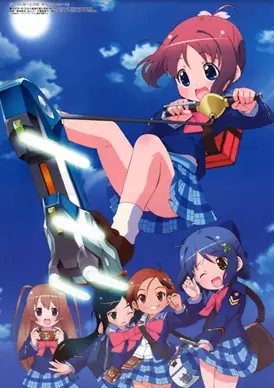
がくえんゆーとぴあ まなびストレート!
Manabi Straight! follows the lives of a group of young high school girls living in the year 2035 while they attend the all-girl Seioh Private High School. Since the birth rate has dropped dramatically, schools are being closed down due to the sheer lack of students available to teach. Morale in schools has dropped dramatically, and Seioh is no exception. The story begins when the main character, Manami Amamiya, transfers to Seioh. After some initial hijinks involving a futuristic scooter and a swim meet, followed by an inspirational school song performance, she is inducted as the student council president. The story that follows pertains to Manami working with Mika Inamori, the only other student council member, and three other classmates named Mutsuki Uehara, Mei Etoh, and Momoha Odori, in student council matters. After some remodeling of the student council room, Manami and her friends set forth to plan for the upcoming student festival. (Source: Wikipedia, edited)
Главный
Главный
Главный
Главный
Главный
Второстепенный
Второстепенный
Второстепенный
Второстепенный
Второстепенный
maybelletea
December 26, 2007
What a wonderful series. I am so glad I decided to watch this anime. I wouldn’t hesitate to say it’s one of my favorite, maybe one of the greatest anime I’ve ever seen. Don’t be fooled by its childish loli-looking exterior, what lies in this anime is the bittersweet and heartwarming message of moving forward. The story is set in the future, where schools’ populations continuously decrease, and is about girls brought together by something as simple as a student council. They develop such a strong bond throughout the series, I don’t think I’ve ever seen an anime where friends were this close. Mainlyit is about them preparing and then trying to revive the school fair, which turns out to be a long struggle. There is the lighthearted and funny moments (mostly brought on by Momo with her refreshingly odd antics) but there are also sad and dramatic times. Each episode will bring on different emotions, some sad, some happy. I love the animation. Each shot seems to be carefully done, and though some angles can be odd, others make the series a piece of art. The music is well done too, and the opening is so beautiful and becomes so clear as to what they've done once you finish the last episode. The ending theme is a little strange considering it is stop-animation, but perhaps this is one of the things that makes this series just a little different. What I was very impressed at, also, was that when the times of Manabi singing, the lip movements actually correspond with the words perfectly, instead of going up and down. This isn't true the whole way through the anime, but there were instances where I saw the brilliance shine forward into tiny details such as that. A strong controversy sets out over the "loli" factor. Yes, the girls are drawn looking cutesy and they look much younger than high schoolers, but if you get past that in which would attract viewers who would only watch this show for the cute girls, you see a deeper interior of a sweet, heartfelt anime that deserves to be watched. There are also other debates as to whether to consider this shoujo-ai. They do blush a bit with eachother and hold hands, and things could be inferred there, but nothing is taken too far. I believe the story tries to focus more on friendship, but obviously there are some undercurrent hints. However, I cannot give character as high of a score as I would like. The characters may be sweet and likeable, but really most aren't developed enough. While I realize it would take away the point of the show to feature their home lives, this results in a lack of character development. This could have been made up for by each character having an episode of their own besides Mei, whom in episode four you really get to see inside of her. Also, you would think the main character would be Manabi, but it is mostly shown through Mikan's perspective, probably the reason being Mikan is the person Manabi affects the most. So we see this change in Mikan... but do we really get to understand Manabi, and why she fervently defends the school she has been at a significantly short while? You do get to go into Mikan and Mutsuki’s relationship a bit, which is nice; however, the a couple scenes with them proved to be a bit confusing, because it gives the viewer no knowledge of what is happening beforehand, at the current time, or afterward. It’s sort of a key point to why they are good friends, too… perhaps I missed something. I believe their episode is episode 6. Don’t get me started on Momo. All we know about her through the entire series is that she has no attention span and she wealthy (which I’m not sure you really see until the OVA anyway). She may have been adorably odd and a treat to see on screen, but it’d have been nice to explore her personality a bit more. Yet despite these flaws, the characters are still enjoyable and each girl’s personality is different, but they still all become good friends. To sum it up: the animation is great and the art is adorable; the characters are cute and very loveable but some could be better developed; the opening and ending themes are amazing but the BGM is forgettable; and the story is sweet and poignant and the end suggests a positive outlook in life. The basic concept of the story is maturing and growing up, while still maintaining relationships. Though this may not be anyone’s cup of tea, I still recommend this highly and Gakuen Utopia Manabi Straight reminds one of my favorite anime.
KholdStare88
March 21, 2008
Gakuen Utopia Manabi Straight! This anime features wonderful creativity and enjoyment to the maximum, while not being bogged down with heavy clichés. I will not hesitate to say that it is probably my favorite slice-of-life series and probably one of the most touching series I have ever watched. 5 words review: Deep, touching, fun, cute, epic. Story: 10/10 The story is amazingly simplistic yet its plot is complex. In fact, this whole series is about the student council and the Seioh School Fair with absolutely no action or romance. There's not a lot of comedy, and it is basically a slice-of-life drama (weird, I know). Manabi Straight usesthe school fair to explore the true meaning of friendship, endeavours, and dreams as Manabi, Mika, Mei, Mutsuki, and Momo go through trials of hardship to find their courage and understand the bonds that they share. I love it for its ability to turn something so simple into a beautiful work of art. Art: 9/10 For some series I often notice weird character facial expressions, awkward animation sequences, or lazy screen shaking/panning/scrolling, but for this series the art is really excellent. Of course, it is nothing that makes you say "wow," but there's just no flaw. It is a solid series with good enough animation to capture the vast range of emotions the series portray. What I love best was the opening sequence that made so sense. Aside from being one of the most artistic and best animated opening sequence ever, it is very "cool," matching the energy of Manabi and other student council members. Sound: 9/10 Once again I would like to point out that the opening sequence was excellent, and it had an extremely catchy song to go along with it. Other than that, the background music was excellent and nothing seems out of place. It should be noted that Yui Horie voices Manabi, and she sings the Seioh school anthem, a pretty song, in many occasions throughout the series. Insert songs, especially good ones, are always a plus. Character: 8/10 As well as this series convey feelings and emotions, nothing is really known of the characters outside of school. Manabi Straight is strictly about school and rarely do the characters go outside of school, and even so, it would be for a school activity. Manabi and Mika's out of school life is pretty much most explored, but for Mutsuki, Mei, and Momo, no one really knows anything about them. However, their personality and and actions are quite unique and noticeable, which gives them character, unlike other shows with three girls that are just too similar. Oh, and did I mention? The characters are way too cute (this is a good thing), even though they're in high school. It adds an interesting element to the plot, as well as showing the difference of experience between high school students. For example Takako, Aikoh's student council president, is shown to be taller and about high school age, and she is usually more mature and organized. It should also be noted that a very widely known voice acting cast is used for Manabi Straight, including Yui Horie and Aya Hirano. The results are generally positive. Enjoyment: 10/10 This category is very important, because Manabi Straight is often a "hit of miss" anime for many people! This means that there's one group that finds it extremely good while there's another group that finds it pointless. Since this series really have no meaningful story, it could be understood why some would hate it. The meaningful part of Manabi Straight is the bond of friendship, and while people prefer action and romance to create drama, I personally find friendship a very unique yet powerful source for drama. I often forget how important the bond of friendship is, and this series did well to remind me of it. Overall: 9/10 I consider the series excellent, and even though it has lots of valuable messages, its best points were being enjoyable and "cool." I love how this series does comedy. It's definitely not overdone to take over the drama, but it is there enough to release tension. There are also some interesting additions, such as how the girls blush when they hold hands or are talked to, but I assume that this goes nowhere and that it's just there for fun. But overall, it is a series not to be missed, especially if you're taking a break for romance/drama or just trying to find something unique and interesting. I am personally impressed at how much a series like this could impress me. Don't miss it!
Splitter
October 28, 2008
I swore when I seriously started writing reviews that I would never give anything a perfect rating. No anime was flawless no matter how great I thought it was. However, Gakuen Utopia Manabi Straight is the closest thing I've found to perfect. Set in Japan in the near future, Manabi captures the outlook of its setting better than any other series that's tried to work out such a scenery. It is made clear with a national birth rate crisis reflecting the current steady drop in Japanese citizen births, as well as advanced but realistic technology such as streamlined buses, computers built into desks, and student organizersthat are essentially limited-function Blackberries. These subtle points serve to add an extra glow to the already wonderful story presented. Manabi's plot is so basic it may almost be seen as a flaw, but alas it cannot. So often do we get caught up in the grandeur anime has to offer that it becomes increasingly difficult to enjoy the simple story Manabi presents. But as is the theory regarding real life, Manabi takes great pleasure in the little things. Cleaning up what will be your office, making sure an assembly presentation is complete, recordng video interviews of your friends... all of these are either easy or mundane, yet for Manabi they are crucial plot elements and are thus treated with proper gravitas. Likewise, Manabi's story is not just an event-to-event episodic process like so many modern slice-of-life series are. Manabi is clearly a linear storyline. Episodes begin with character development, begin to introduce conflict simultaneously, flesh out the conflict once the characters are developed, conflict is properly resolved, and the story is even given time for a dynamic epilogue that brings the message of the series full-circle. This is proper storytelling, paced to perfection with each episode having its own moment of new resolution for a contained or continuous conflict. I can think of nothing to take out or add upon. Manabi is lead by five high-school girls, including the titular character. This is another point where Manabi stands out as well. Though each girl is given a requisite character archetype, their personalities were still given room to grow to the point that it no longer becomes acceptable to say "oh Mei's just a typical tsundere" and the like. Perspectives are also another plus as far as characterization goes, as the series starts leading us to believe it is from Manabi's perspective, yet it becomes clear as the series progresses that it is another girl through whose eyes we are watching the story unfold, and rightfully so as the epilogue demonstrates. Though character designs are skewed young, similar to Lucky Star, they are appealing and don't pander to moe extensively. Cute, but not sickeningly so, and within reason. More to the point, the fact that the characters were drawn in a "loli style" doesn't do anything to harm the series as a whole. Besides, any high-schooler can tell you that just because they were 16, that doesn't mean they acted like it. Manabi was animated by the spotty, hit-or-miss ufotable. All the stops were pulled out for Manabi though, from the gradient-style hair colors to the richly detailed web sites and chat room discussions. Animation flows smoothly throughout and frequently touches upon movie quality for its more poignant scenes. It's work that could hardly be improved upon and easily the studio's shining star for quality. One can only hope that ufotable animates another series of this art quality soon. Of course, ufotable included its penchant for a clay-mation ED sequence, but that is only to be expected, and the sequence is well choreographed despite its appearance. The accompaniement is provided by first-time composer Yasuhiro Misawa, and I pray that this is only a taste of what is to come. The soundtrack captures the urgency of Manabi's pace with appropriate music throughout, ranging from slow and serene, to frentic and uplifting. No track is quite the same and quite a few well probably memorable for every viewer; the most memorable arguably being the *CLAP CLAP CLAP CLAP* that decorates every next episode preview and other scenes. The OP and ED, originally songs by the late, etheral Ritsuko Okazaki are now sung with a headier sound by famous seiyuu Megumi Hayashibara. Both are quite good. The vocal performances however are all wonderful. Voiced by a blend of veterans and rookies to the field, each gives their all to their respective performance, capturing all the individual nuances of every single sentence. It's quite possibly the best ensemble cast for a slice-of-life anime, and arguably one of the best ensemble casts of any anime. At this point I think it's rhetorical to ask if I enjoyed it. This series took me to every possible emotional high and, despite its short run, satisfied me to the upmost. Everything about this series has left me with nothing but good impressions. Though personal biases will easily detract some from watching this, those with an open mind regarding the style should come running. Anime does not get much better than this. Overall, I proudly give Gakuen Utopia Manabi Straight a 10 out of 10.
Chag
July 27, 2008
Gakuen Utopia Manabi Straight! is a classic example of looks over substance. While not totally devoid of any redeemable qualities, it's hard to recommend Manabi Straight to anyone, as it is simply outclassed by too many other choices. The story revolves around the Seioh high school student council and its attempt at organizing the school fair. Underneath that lies a story of friendship between the five girls who takes part in student council activities. However, neither of these stories succeeds in gathering much interest for one important reason: the characters. Simply put, after the initial impressions, the characters of Manabi Straight get stale very quickly. You haveManabi, the hyperactive student council president; Mikan, the mousy and insecure treasurer; Mei, your typical tsundere in an all-girl setting; Mutsuki, the cheerful tomboy, and Momo, the side character with the attention span of a goldfish. There's not much to the characters beyond that, and if you have watched any significant amount of anime, none of the characters would strike you as original; but more importantly, the key flaw is in the lack of meaningful character development. Viewers are never given a glance behind Manabi's over-excitable disposition, hence they never come to understand her zealous passion for the school. Mikan's growth from her shy self is done in the ancient formula of "confidence through friendship", the kind of stuff you would expect from series aimed at younger children, such as Digimon. The only meaningful character development happens with Mei, but most of that takes place in one episode during the first half of the series, leaving the rest of Manabi Straight rather dull. The underlying friendship story concerning the student council as well as the rest of the school is just not very compelling, partly because of the caricature-like main characters, as well as the cliche developments that you would be able to see coming from a mile away. Because of this, it's very hard to actually care for the personal struggles of the characters or the school fair, which accounts for much of the overly simplistic plot. On the bright side, the art style of Manabi Straight definitely scores it some much-needed points. The colors are very pleasantly vibrant, both in the backgrounds and on the characters, producing an unique sheen. The characters are drawn in a slightly chubby style that is probably cuter than their actual personalities will ever hope to be, though trying to pass them off as high school students is a very long shot. Beyond that, the animation in the movements and mannerisms of the characters are above average, though the detail is never too high when dealing with the simplistic (but pleasant) character designs. In the terms of sound, the seiyuu of Manabi Straight did a fine job, though Mikan's mousy voice may get on some viewers' nerves at by the end of the series. The musical score consists of nothing too memorable, but nothing offending either. The opening, ending, and insert songs are also commendable, but once again fail to leave much impression. In the end, beyond the refreshing art style, Manabi Straight fails to impress. With a story more suited to younger audiences, yet a concept that appeals to older viewers, it suffers from a sort of identity crisis. The comedy is sparse, the drama is weak, the plot is cliche, the characters are generic -- reflecting upon these facts, Gakuen Utopia Manabi Straight! probably turned out better than the sum of its parts. Of course, that's not saying much, as Manabi Straight remains merely a mediocre experience.
Evangelynn
August 6, 2020
Gakuen Utopia Manabi Straight, or just Manabi Straight, is a school life anime that has been mostly forgotten by time. The term “underrated” is a somewhat contentious way to describe a show, (because who is to actually decide if a show receives enough attention/phrase?) and risks sounding pretentious or overly-emphasizing a show’s quality. However, in my eyes, Manabi Straight is a truly underrated show. With less than 27,000 members registered on MAL and only a mere 100 favorites, I feel that its lack of lasting attention from most anime fans is disappointing. It bears some obvious narrative similarities to the likes of Lucky Star, K-onand Azumanga Daioh, yet unlike those shows, has not been beloved by time in the slightest. There are certainly reasons for this, and I do think Manabi Straight is more niche of a story and has far less widespread appeal than the former three. Still, Manabi has a lot going for it, and is certainly worth a watch for those that enjoy the aforementioned anime. Manabi Straight is, to put it bluntly, a show about a bunch of cute girls in high school. However, Manabi handles a setting and attitude that I have never seen in another anime. Unlike most school life shows from this era, there is no initial school pride or excitement from the characters to enjoy their academic duty. Manabi takes place in 2035, where Japan remains mostly unchanged, besides the increased work force for its citizens from an earlier age. High school is made optional, and job opportunities and trade schools are opened up to teenagers very early on. Realistically, most teens in this world choose to begin their careers sooner, deciding on a solid paying work schedule over four more years of mandatory education. Due to this adjustment, high schools are a dying breed, and are constantly merged into one another because of the lack of both teachers and students attending. The kids at these high schools are mostly independent, studious, and appear to be even bored, focusing on their schoolwork first and having little interest in the excitement of high school activities. This concept feels unique right off the bat because it allows for some obvious questions. What will the characters get up to in the show if they are not even interested in going to school? What are the different perspectives and attitudes towards this system? Enter the main character Mikan, an adorable and easily flustered high schooler senior who was roped into running her high school’s student council. Mikan is without a doubt, Manabi Straight’s protagonist, as she has the most meaningful interactions with each character and the strongest development throughout the story. The titular Manabi herself plays the Kamina to Mikan’s Simon, constantly motivating and humbling her friend in hopes of seeing the leadership and strength that Manabi recognizes is there. Mikan begins the show by sloppily presenting a slideshow on the student council’s importance and attempts, halfheartedly, to encourage her classmates into joining her. She is paid no attention by anyone, not even the teachers, and loses her motivation quickly on this cause. Manabi then steps up to the stage, excitedly announces her want to help Mikan, and then SINGS the school’s anthem for a few minutes. This entrances the crowd briefly, as they sit both confused and curious about who this Manabi girl even is. Thus starts the story of Manabi Straight, as these two unlikely girls are now joined together in hopes of bringing back school spirit and fun to this futuristic, less school-dependent society. Manabi Straight’s first three episodes ultimately serve to introduce the main plot and characters, managing to be both a strong start to the central narrative and a lot of fun on their own. The ultimate destiny that Manabi wants to accomplish is a School Festival. In Manabi’s eyes, that will be her last hoorah for the senior class and a way to motivate interest in the dying out high school setting. Manabi and Mikan indocturate other members to help with their school festival, members who join somewhat half-heartedly initially but do progress and begin to share Manabi’s spirit. Although the main five girls are fairly simple and serve mostly as means to help the story progress, they are still a lot of fun and really entertaining to watch. Manabi is a spirited leader and the heartbeat of the show. Mikan is a somewhat timid and grounded girl who agrees with Manabi’s ambition, though is less blatant with showing it. Mei is tightly-wound and focused, Mutsuki is bold and well-respected by the school, and Momo serves mostly as comic relief/to even be the eyes of the audience. Although these characters do fit obvious archetypes, and are not the most nuisanced outside the plot/their roles within the show, I still found myself endeared to them greatly, and wished I could have seen more of them. The little moments of them sharing excitement together, working on planning for the festival and even just spending time relaxing are always comforting. Each episode of Manabi simply portrays a portion of planning for the school festival. Small arcs occur, typically involving setup for the big day (like indoctoraing clubs, signing petitions, getting motivated, etc.) Although I think Manabi Straight is mostly consistently good throughout, there are a few moments in the mid section that felt slightly forced and cheesy. The biggest for me being Manabi’s brother dating Aikoh’s principal, which felt only present in the story to create added internal conflict for Manabi. Aikoh’s principal’s role and personality felt kind of forced in general, since most of the other teachers and adults within this story were endeared by Manabi and her excitement for the festival. Still, these qualms are few and far between. Big moments happen in almost every episode, from friendship developments between the characters to the ever-emotional scene in episode 10 in which Manabi is able to bring her entire school together. Episode five definitely deserves a mention for being my personal favorite in the entire series. This episode focuses only on two characters and their hesitant friendship due to past circumstances. As the episode progresses, the two characters learn more about one another and complete different tasks without reliance on outside forces helping to break the tension between them. I am a big fan of montage scenes that are able to show off progression in a brisk yet emotional way, and this episode definitely does not fall flat in that regard. The ending of Manabi is also truly special. The characters graduate in the last episode, a common destiny for shows about girls in high school. However, Manabi takes its story a step further by showing the characters after high school, and showing each of their decisions they made for their futures. This definitely adds further weight to Manabi’s story, and really makes the entire show completely justified for just how well it wraps itself up. If I had to describe Manabi Straight’s story in one word, I would choose “cinematic”. Each episode of Manabi flows into the next as if it were a film. Little time is wasted for less important moments that would be service to the audience, as the show feels tight and most scenes feel somewhat necessary. Of course, Manabi Straight is still a show about cute high school girls. There are moments of silliness, weird interactions or just a second to look at the character in a cute pose. Still, it really feels like Manabi Straight is emphasizing the importance of its message and using its characters’ development as tools strictly for that mission. Shows like Lucky Star and K-on have more character interactions and variety in topic, which gives both of them the advantage of making one more invested in the characters by the end. However, neither of those shows have the consistent central story of Manabi. Where Manabi lacks the wide variety of discussion and added personality to its characters, it decides to prioritize the linear message of how important this goal for the characters is. I feel that this benefits the show greatly, considering it is only 12 episodes and it was a treat to see a well-done story about high school girls instead of taking up that time for random bullshit and typical tropes. Comedy wise, Manabi Straight is pretty strong. There were several instances when I laughed out loud at scenes and jokes, usually due to the unique timing. Manabi’s style could be described as a mixture of both slapstick and dry humor, often involving weird actions from the characters or a few seconds to let something bizarre that was spoken sink in. An example of this is in the first episode, when Manabi herself is late to school. She frantically asks a girl (later introduced as Momo) walking by for directions, and is pointed a few feet away from the steps going up the hill to school. Manabi completely ignores the steps and flies her scooter straight into the trees next to it, constantly whipping through trees to get to the school on the other side. And at times, the absurdity of a moment is the joke. Halfway through the show there is an entire scene of the characters losing their minds due to being overworked/experiencing sleep loss. Mikan begins to wreck their club room out of desperation to reorganize it (a common symptom of overstress) while Mei, Mitsuki, and Manabi taunt each other out of frustration and take turns smacking one another in the face. The ridiculousness of scenes such as this one provide further realism and character interactions, allowing for the potential happening of the Student Festival to be all the more important to the audience as it is for Manabi’s characters. Manabi Straight’s animation and art design can be described as ambitious and high-spirited. UFOtable may be known as the “Type Moon” studio nowadays, handling both the Fate and Kara no Kyoukai franchises, and pairing those stories with highly stylized and bright digital animation. However, a decade or so ago UFOtable had a very different aesthetic, which came across in both their graphics and stories. Their shows featured colorful and poppy animation and cute rounded character designs (you can see this in other 2000’s UFOtable productions like Ninja Nonsense and Dokkoida) and Manabi definitely continued this trend. Everything about Manabi’s setting is alive and bright, from the whimsical looking school to the detailed club room. Each girl’s room and house is shown throughout the show, and each of these settings is filled with so much variety and specific detail that they all have strong distinctions. And by the end of the show, the viewer will have somewhat of a spatial idea of the school, considering the show’s tendency to show off different angles and areas that the characters have wandered. This may seem like a pedantic compliment, but it is one I truly was very excited by. It is not often I can say an anime has made me feel aware of its central location’s proportions and that they have stuck in my mind, since that seems like an afterthought for a lot of shows, especially high school comedy ones. While I can not defend Manabi Straight as having the best animation ever, or even being a contender for that contest, I can strongly state that it has some of the most unique and interesting animations cuts I have seen. There are many little moments throughout that stick out and add an increased flavor to the show’s direction. Manabi growing wings as she motivates her club and flies around as her ideas are portrayed around her. Mei sitting in her lit-blue bedroom sadly while only her video game’s reflection is shown bounced off of her wall, which feels very Hideaki Anno inspired. And episode four must be praised for having the most interestingly animated scene in the entire show. A flashback showing an entire classroom of students with blindly neon inverted colors, emphasized in that fashion to show Mei’s despair and unease. Manabi Straight just feels unique with the way the characters move and interact within its universe. It often shows very blatant animated symbolism, which of course adds intrigue and enhanced attention due to straying away from stagnant direction. Of course, I can not discuss the artwork of Manabi Straight without mentioning the character designs. Manabi’s Straight’s characters are all drawn as cute and goofy looking lolis topped with bright hair, which I am fully aware will immediately turn off an entire crowd of viewers. However, it should be mentioned that everyone in Manabi’s story looks that way, even the adult men have rounded proportions and somewhat cutesy faces. Personally, the weirdly juvenile and innocent designs did not detract any of the show’s likability, and instead contributed to its unique narrative (which is of course, a coming of age story). The characters in Manabi also often make silly faces or have funny mannerisms (Manabi’s iconic raised fist is a big stand out) and I was admittedly endeared by just how cute they could be at times. Manabi Straight also has an extremely memorable and outright delightful soundtrack that suits it well. Each background song has so much personality and care put into it, often complimenting its given scene with grace. Fully orchestrated string pieces are played with the more melancholic and poignant scenes, and the upbeat moments are paired with upbeat clapping and what sounds like a really fun jam session. Manabi Straight also has one of my top five favorite openings ever, which might be surprising to some, but I can not deny how much of a fun earworm it is. Sung by the ever-wonderful Megumi Hayashibara, who has not only talent in voice acting but singing, “A Happy Life” is a motivating ballad with sweetly sung lyrics and exciting buildup in the background instruments. The characters are shown running around their school and appear almost as if they are being videotaped, shown in interesting angles. This video may appear nonsensical for a first time viewer, but has incredible payoff in the context of the ending. So do I recommend Manabi Straight? Obviously, I just gushed about it for a dozen paragraphs. If you are a fan of Cute Girls Doing Cute Things shows, you owe it to yourself to watch this one for its uniquely structured story and likable characters. If you are into original anime in general, or just want to see a tightly done yet fun narrative, it is also recommendable. Manabi Straight was an especially touching show to rewatch during these intense times, as it provides an entertaining tale that mostly revolves around the importance of taking advantage of the excitement of teenage years, no matter the circumstances.
Ранг
#3211
Популярность
#4382
Участники
33,736
В избранном
142
Эпизоды
12